
 100% FREE ACCESS
12th Standard Syllabus & Materials
12th Standard
TN 12th Computer Applications மின்னணு தரவு பரிமாற்றம் Sample Question Papers Study Material - QB365 Set A
NEW12th Standard
TN 12th Computer Applications மின் - வணிக பாதுகாப்பு அமைப்புகள் Sample Question Papers Study Material - QB365 Set A
NEW12th Standard
TN 12th Computer Applications மின்னணு செலுத்தல் முறைகள் Sample Question Papers Study Material - QB365 Set A
NEW12th Standard
TN 12th Computer Applications மின் - வணிகம் Sample Question Papers Study Material - QB365 Set A
NEW12th Standard
TN 12th Computer Applications திறந்த மூல கருத்துருக்கள் Sample Question Papers Study Material - QB365 Set A
NEW12th Standard
TN 12th Computer Applications வலையமைப்பு வடமிடல் Sample Question Papers Study Material - QB365 Set A

Published on: 17/01/2020
Download Tamil Nadu 12th Standard Business Maths and Statistics question papers, model tests, one-mark questions, important questions, and public exam papers in PDF format. Free study materials and answer keys for TN State Board students.
Questions + Answers key
Take MCQ Business Maths and Statistics Test
1.
Measurements of the weights of a random sample of 200 ball bearings made by certain machine during one week showed a mean of 0.824 newtons and a S.D. of 0.042 newton's. Find
a) 95% and
b) 99% confidence limits for the mean weight of all the ball bearings.
2.
Marks in an aptitude test given to 800 students of a school was found to be normally distributed 10% of the students scored below 40 marks and 10% of the students scored above 90 marks. Find the number of students scored between 40 and 90?
3.
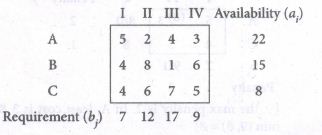
Obtain an initial basic feasible solution to the following transportation problem using Vogels' approximation method.
4.
The probability function of a random variable X is given by
\(p(x)=\left\{\begin{array}{l} \frac{1}{4}, \text { for } x=-2 \\ \frac{1}{4}, \text { for } x=0 \\ \frac{1}{2}, \text { for } x=10 \\ 0, \text { elsewhere } \end{array}\right.\)
Evaluate the following probabilities.
P(X<0)
5.
Evaluate \(\int { \frac { \left( { x }^{ 2 }+1 \right) dx }{ { \left( x-1 \right) }^{ 2 }\left( x+3 \right) } } \)
6.
Suppose that the quantity needed Qd = 42 -4p-4\(\frac { dp }{ dt } +\frac { { d }^{ 2 }p }{ { dt }^{ 2 } } \) and quantity supplied Qs = -6 + 8p where p is the price. Find the s equilibrium price for market clearance.
7.
The following data gives the melting point of a alloy of lead and zinc where ‘t’ is the temperature in degree c and P is the percentage of lead in the alloy
| P | 40 | 50 | 60 | 70 | 80 | 90 |
| T | 180 | 204 | 226 | 250 | 276 | 304 |
Find the melting point of the alloy containing 84 percent lead.
8.
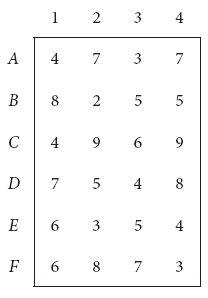
Assign four trucks 1, 2, 3 and 4 to vacant spaces A, B, C, D, E and F so that distance travelled is minimized. The matrix below shows the distance.
9.
Calculate the Laspeyre’s, Paasche’s and Fisher’s price index number for the following data. Interpret on the data.
| Commodities | Base Year | Current Year | ||
| Price | Quantity | Price | Quantity | |
| A | 170 | 562 | 72 | 632 |
| B | 192 | 535 | 70 | 756 |
| C | 195 | 639 | 95 | 926 |
| D | 187 | 128 | 92 | 255 |
| E | 185 | 542 | 92 | 632 |
| F | 150 | 217 | 180 | 314 |
| 7 | 12.6 | 12.7 | 12.5 | 12.8 |
| 8 | 12.4 | 12.3 | 12.6 | 12.5 |
| 9 | 12.6 | 12.5 | 12.3 | 12.6 |
| 10 | 12.1 | 12.7 | 12.5 | 12.8 |
10.
A manufacturer of ball pens claims that a certain pen he manufactures has a mean writing life of 400 pages with a standard deviation of 20 pages. A purchasing agent selects a sample of 100 pens and puts them for test. The mean writing life for the sample was 390 pages. Should the purchasing agent reject the manufactures claim at 1% level?
11.
In a particular university 40% of the students are having news paper reading habit. Nine university students are selected to find their views on reading habit. Find the probability that
(i) none of those selected have news paper reading habit
(ii) all those selected have news paper reading habit
(iii) atleast two third have news paper reading habit.
12.
If the marginal cost (MC) of a production of the company is directly proportional to the number of units (x) produced, then find the total cost function, when the fixed cost is Rs. 5,000 and the cost of producing 50 units is Rs. 5,625.
13.
The price of a machine is Rs. 5,00,000 with an estimated life of 12 years. The estimated salvage value is Rs. 30,000. The machine can be rented at Rs. 72,000 per year. The present value of the rental payment is calculated at 9% interest rate. Find out whether it is advisable to rent the machine.(e−1.08 = 0.3396).
14.
The price of 3 Business Mathematics books, 2 Accountancy books and one Commerce book is Rs. 840. The price of 2 Business Mathematics books, one Accountancy book and one Commerce book is Rs. 570. The price of one Business Mathematics book, one Accountancy book and 2 Commerce books is Rs. 630. Find the cost of each book by using Cramer’s rule.
15.
A company market car tyres. Their lives are normally distributed with a mean of 50,000 kms and standard derivation of 2000 kms. A test sample of 64 tyres has a mean life of 51250 km. Can you conclude that the sample mean differs significantly from the population mean? (Test at 5% level).
16.
The probability distribution of a discrete random variable. X is given by
| X | -2 | 2 | 5 |
| P(X=x) | \(\frac{1}{4}\) | \(\frac{1}{4}\) | \(\frac{1}{2}\) |
then find 4E(X2)- Var (2X)
17.
For the given pay-off matrix, choose the best alternative for the given states of nature under
(i) Maximin (ii) Minimax princple
| Alternative | States of Nature | ||
| Good | Fair | Bad | |
| A | 100 | 60 | +50 |
| B | 80 | 50 | +10 |
| C | 40 | 20 | +5 |
18.
Evaluate \(\int { \frac { { sec }^{ 2 }x }{ 3+tanx } } dx\)
19.
Form the differential equation for y = (A + Bx)e3x where A and B are constants.
20.
Given y3 = 2, y4 = −6, y5 = 8, y6 = 9 and y7 = 17 Calculate Δ4y3
21.
Calculate the cost of living index by aggregate expenditure method:
| Commodity | Weights 2010 |
Price (Rs.) | |
| 2010 | 2015 | ||
| P | 80 | 22 | 25 |
| Q | 30 | 30 | 45 |
| R | 25 | 42 | 50 |
| S | 40 | 25 | 35 |
| T | 50 | 36 | 52 |
22.
Evaluate \(\int _{ 0 }^{ \frac { \pi }{ 2 } }\) x sin x dx
23.
If the chance of running a bus service according to schedule is 0.8, calculate the probability on a day schedule with 10 services :
(i) exactly one is late
(ii) atleast one is late
24.
Consider the matrix of transition probabilities of a product available in the market in two brands A and B.
\(_{ B }^{ A }\left( \begin{matrix} \overset { A }{ 0.9 } & \overset { B }{ 0.1 } \\ 0.3 & 0.7 \end{matrix} \right) \)
Determine the market share of each brand in equilibrium position.
25.
Chance variation does not affect _____ of the product
price
value
quantity
quality
26.
Out of 1000 T.V viewers, 320 watched a particular programme. Then the standard error is __________
-0.147
0.147
0.0147
-0.0147
27.
If Z is a standard normal variate, then p(0
0.5
1
0.25
0.75
28.
If \(f(x)=\left\{\begin{array}{cc} \frac{A}{x}, & 1<x<e^{3} \\ 0, & \text { otherwise } \end{array}\right.\) is a p.d.f. of a continuous random variable. X then P(X≥e)
\(\frac{2}{3}\)
\(\frac{3}{2}\)
\(\frac{1}{6}\)
\(\frac{1}{8}\)
29.
In least cost method if the minimum cost is not unique then the choice can be made as ___________
arbitrarily
unique
difference
summation
30.
The I.F. of \(\frac { dy }{ dx } \)- y tan x = cos x is _____
sec x
cos x
etanx
cot x
31.
If ∫ x sin x dx = - x cos x + α then α = __________ +c
sin x
cos x
C
none of these
32.
If \(\left| \begin{matrix} 2x & 5 \\ 8 & x \end{matrix} \right| =\left| \begin{matrix} 6 & -2 \\ 7 & 3 \end{matrix} \right| \) then x =
3
± 3
± 6
6
33.
The knowledge of ______ is essential for the study of Numerical Analysis
Differences
finite differences
interpolation
extrapolation
34.
The area of the region bounded by the curve y2 = 2y - x and the y-axis _____ sq. units
\(\frac{4}{3}\)
\(\frac{2}{3}\)
4
\(\frac{16}{3}\)
35.
Δf(x) = _______.
f(x+ h)
f(x) − f(x+h)
f(x + h) − f(x)
f (x) − f(x−h)
36.
The Penalty in VAM represents difference between the first ________.
Two largest costs
Largest and Smallest costs
Smallest two costs
None of these
37.
The differential equation formed by eliminating a and b from \(y=a e^{x}+b e^{-x}\) is ______.
\(\frac{d^{2} y}{d x^{2}}-y=0\)
\(\frac{d^{2} y}{d x^{2}}-\frac{d y}{d x}=0\)
\(\frac { { d }^{ 2 }y }{ { dx }^{ 2 } } =0\)
\(\frac { { d }^{ 2 }y }{ { dx }^{ 2 } } -x=0\)
38.
A typical control charts consists of ________.
CL, UCL
CL, LCL
CL, LCL, UCL
UCL, LCL
39.
An estimator is a sample statistic used to estimate a ______.
population parameter
biased estimate
sample size
census
40.
\(\int _{ 0 }^{ \infty }{ { x }^{ 4 }{ e }^{ -x } } \)dx is _______.
12
4
4!
64
41.
The average percentage of failure in a certain examination is 40. The probability that out of a group of 6 candidates atleast 4 passed in the examination are ________.
0.5443
0.4543
0.5543
0.4573
42.
\(\int _{ -\infty }^{ \infty }{ f(x)dx } \) is always equal to ________.
zero
one
E(X)
f(x)+1
43.
The demand and supply function of a commodity are P(x) = (x − 5)2 and S(x)= x2 + x + 3 then the equilibrium quantity x0 is ________.
5
2
3
19
44.
If the rank of the matrix \(\left( \begin{matrix} \lambda & -1 & 0 \\ 0 & \lambda & -1 \\ -1 & 0 & \lambda \end{matrix} \right) \) is 2. Then \(\lambda \) is ________.
1
2
3
only real number
45.
Calculate the cost of living index by aggregate expenditure method
| Commodity | Quantity | Price(Rs.) | |
| 2000 | 2000 | 2003 | |
| A | 100 | 8 | 12 |
| B | 25 | 6 | 7.50 |
| C | 10 | 5 | 5.25 |
| D | 20 | 48 | 52 |
| E | 65 | 15 | 16.50 |
| F | 30 | 19 | 27.00 |
46.
The probability of the happening of an event X is 0.002 in an experiment. If an experiment is reported 1000 times, find the probability that the event X happens exactly twice? (e-2 = 0.1353)
47.
Find the missing term from the following data
| x | 1 | 2 | 3 | 4 |
| f(x) | 100 | - | 126 | 157 |
48.
The marginal cost at a production level of x units is given by C '(x) = 85 +\(\frac{375}{x^2}\). Find the cost of producing 10 in elemental units after 15 units have been produced?
49.
Two newspapers A and B are published in a city . Their market shares are 15% for A and 85% for B of those who bought A the previous year, 65% continue to buy it again while 35% switch over to B. Of those who bought B the previous year, 55% buy it again and 45% switch over to A. Find their market shares after one year
50.
What is the Assignment problem?
51.
Solve the following differential equations
\(\frac { { d }^{ 2 }y }{ d{ x }^{ 2 } } -4\frac { dy }{ dx } +4y=0\)
52.
What is type I error.
53.
Suppose, the life in hours of a radio tube has the following p.d.f
\(f(x)=\left\{\begin{array}{l} \frac{100}{x^{2}}, \text { when } x \geq 100 \\ 0, \text { when } x<100 \end{array}\right.\)
Find the distribution function.
54.
Integrate the following with respect to x.
(3 + x)(2 − 5x)
1.
Given sample size n = 200
Sample mean \(\bar { x } \) = 0.824
Sample S.D. s = 0.042
Standard error = \(\frac { s }{ \sqrt { n } } =\frac { 0.042 }{ \sqrt { 200 } } \)
= \(\frac { 0.042 }{ 14.14 } \) = 0.00270
(a) As the level of significance is α = 0.05, \(Z_{ \frac { \alpha }{ 2 } }\) = 1.96
∴ 95% confidence limits for μ are given by \(\bar { x } -Z_{ \frac { \alpha }{ 2 } }(S.E)\le \mu \le \bar { x } +Z_{ \frac { \alpha }{ 2 } }(S.E)\)
⇒ 0.824 - (1.96) (0.00270) ≤ μ ≤ 0.824 + (1.96) (0.00270)
⇒ 0.824 - 0.00582 ≤ μ ≤ 0.824 + 0.00582
⇒ 0.818 ≤ μ ≤ 0.832
Hence, the 95% confidence limits for μ is (0.818,0.832)
(b) As the level of significance is α =0.001, \(Z_{ \frac { \alpha }{ 2 } }\) = 2.58
∴ 99% confidence limits for μ are given by \(\bar { x } -Z_{ \frac { \alpha }{ 2 } }(S.E)\le \mu \le \bar { x } +Z_{ \frac { \alpha }{ 2 } }(S.E)\)
⇒ 0.824 - (2.58) (0.00270) ≤ μ ≤ 0.824 + (2.58) (0.00270)
⇒ 0.824 - 0.00582 ≤ μ ≤ 0.824 + 0.005825
⇒ 0.816 ≤ μ ≤ 0.832
Hence, the 99% confidence limits for μ is (0.816, 0.832)
2.
Let X denote the height of the student
Given P (X < 40) = 10% = \(\frac { 10 }{ 100 } \) =0.1
P(X> 90) = 10% = \(\frac { 10 }{ 100 } \) =0.1
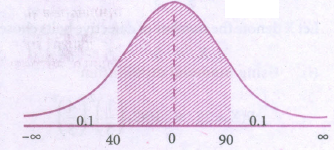
∴ P(40 < X < 90) = P(-∞ < X < ∞) - [P(X < 40) + P(X < 90)]
= 1 - (0.1 + 0.1)
= 1 - 0.2 = 0.8
∴ out of 800 students, number of students scored between 40 and 90 = 800 x 0.8
= 640 students.
3.
Here Σai = 22 + 15 + 8 = 45
Σbj = 7 + 12 + 17 + 9 = 45
Σai = Σbj
∴ The given problem is balanced transportation problem.
Hence, there exists a feasible solution to the given problem.
I-allocation:
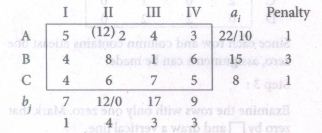
[∵ the max penalty is 4. In II, least cost is 2 & min (12,22) = 12]
II-allocation:
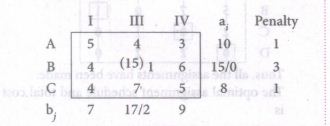
[∵ the max penalty is 3. In B, least cost is 1 & min (17,15) = 15]
III-allocation:
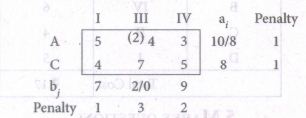
[∵ the max penalty is 3. In III, least cost is 4 & min (2, 10) = 2]
IV-allocation:
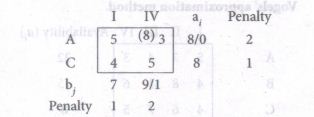
[∵ the max penalty is 2. In A, least cost is 3 & min (9, 8) = 8]
V-allocation:
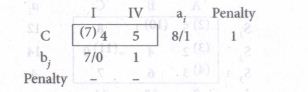
[∵ the max penalty is 1. In C, least cost is 4 & min (7, 8) = 7]
VI-allocation:
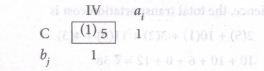
[∵ min (1,1) = 1]
Thus, the allocations are
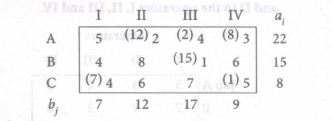
∴ The transportation schedule is
A → II, A → III, A → IV, B → III, C → I and C → IV
Hence, the total transportation cost is
= 12(2) + 2(4) + 8(3) + 15(1) + 7(4) + 1(5)
= 24 + 8 + 24 + 15 + 28 + 5 = Rs.104
4.
Given probability function is
\(p(x)=\left\{\begin{array}{l} \frac{1}{4}, \text { for } x=-2 \\ \frac{1}{4}, \text { for } x=0 \\ \frac{1}{2}, \text { for } x=10 \\ 0, \text { elsewhere } \end{array}\right.\)
| X=x | -2 | 0 | 10 |
| P(X=x) | \(\frac{1}{4}\) | \(\frac{1}{4}\) | \(\frac{1}{2}\) |
P(X<0)=P(X=-2)
= 1/4
5.
Let I = \(\int { \frac { \left( { x }^{ 2 }+1 \right) dx }{ { \left( x-1 \right) }^{ 2 }\left( x+3 \right) } } \)
Consider
\(\frac { { x }^{ 2 }+1 }{ { \left( x-1 \right) }^{ 2 }\left( x+3 \right) } =\frac { A }{ x-1 } +\frac { B }{ { \left( x-1 \right) }^{ 2 } } +\frac { C }{ x+3 } \quad ----(1)\)
\(\frac { { x }^{ 2 }+1 }{ { \left( x-1 \right) }^{ 2 }\left( x+3 \right) } =\quad \frac { A(x-1)(x+3)+B(x+3)+C{ (x-1) }^{ 2 } }{ { (x-1) }^{ 2 }(x+3) } \)
⇒ x2 + 1 = A (x - 1)(x+3) + B (x + 3) + C (x-1)2
When X = 1
1 + 1 = B (1 + 3) ⇒ 2 = b (4)
⇒ \(B=\frac { 2 }{ 4 } \Rightarrow B=\frac { 1 }{ 2 } \)
When x = -3
(-3)2 + 1 = C (-4)2 ⇒ 10 = 16C
⇒ \(C=\frac { 10 }{ 16 } \)
\(C=\frac { 5 }{ 8 } \)
When x = 0,
1 = -3A +3B + 3C
\(1=-3A+3\left( \frac { 1 }{ 2 } \right) +\frac { 5 }{ 8 } \)
\(3A=-1\frac { 3 }{ 2 } +\frac { 5 }{ 8 } =\frac { -8+12+5 }{ 8 } \)
= \(\frac { 9 }{ 8 } \)
\(A=\frac { 9 }{ 8 } \)
From (1), \(\frac { \left( { x }^{ 2 }+1 \right) dx }{ { \left( x-1 \right) }^{ 2 }\left( x+3 \right) } =\frac { \frac { 3 }{ 8 } }{ x-1 } +\frac { \frac { 1 }{ 2 } }{ { (x-1) }^{ 2 } } +\frac { \frac { 5 }{ 8 } }{ x+3 } \)
\(I=\frac { \left( { x }^{ 2 }+1 \right) dx }{ { \left( x-1 \right) }^{ 2 }\left( x+3 \right) } \)
= \(\frac { 3 }{ 8 } \int { \frac { dx }{ x-1 } + } \frac { 1 }{ 2 } \int { \frac { dx }{ { (x-1) }^{ 2 } } } +\frac { 5 }{ 8 } \int { \frac { dx }{ x+3 } } \)
= \(\frac { 3 }{ 8 } log\left| x-1 \right| +\frac { 1 }{ 2 } \int { { (x-1) }^{ -2 } } dx+\frac { 5 }{ 8 } log\left| x+3 \right| +c\)
= \(\frac { 3 }{ 8 } log\left| x-1 \right| +\frac { 1 }{ 2 } \frac { { (x-1) }^{ -1 } }{ -1 } +\frac { 5 }{ 8 } log\left| x+3 \right| +c\)
= \(\frac { 3 }{ 8 } log\left| x-1 \right| -\frac { 1 }{ 2(x-1) } +\frac { 5 }{ 8 } log\left| x+3 \right| +c\)
6.
For market clearance, Qd = Qs
\(\Rightarrow 42-4p-4\frac { dp }{ dt } +\frac { { d }^{ 2 }p }{ { dt }^{ 2 } } =-6+8p\)
\(\Rightarrow 48-12p-4\frac { dp }{ dt } +\frac { { d }^{ 2 }p }{ { dt }^{ 2 } } =0\)
\(\Rightarrow \frac { { d }^{ 2 }p }{ { dt }^{ 2 } } =4\frac { dp }{ dt } -12p=-48\)
The auxiliary equation is m2 - 4m - 12 = 0
⇒ (m - 6) (m + 2) = 0
⇒ m = -2, 6
The roots are real and different
∴ C.F. is Ae-2t + Be6t
P.I. = \(\frac { 48 }{ (D-6)(D+2) } { e }^{ 0t }=\frac { -48 }{ (0-6)(0+2) } \)
= \(\frac { -48 }{ -12 } \)
∴ The general solution is
P = C.F. + P.I.
⇒ P = Ae-2t + Be6t + 4
7.
Let the percentage of lead be x and temperature be y.
Given
| P | 40 | 50 | 60 | 70 | 80 | 90 |
| T | 180 | 204 | 226 | 250 | 276 | 304 |
Find y when x = 84
Since the temperature required is at the end of the table we apply Newton's backward interpolation formula.
∴ xn + nh = 84 ⇒ 90 + n(10) = 84
⇒ 10n = 84 - 90 = -6
[∵ h = 10 & xn = 90]
⇒ n = \(\frac{-6}{10}\) = -0.6
The difference table is
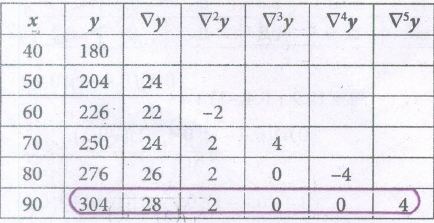
∴ The Newton's backward interpolation formula is
y(y=xn+nh) = \(\frac { n }{ 1! } \Delta { y }_{ n }+\frac { n(n+1) }{ 2! } { \triangledown }^{ 2 }{ y }_{ n }+\frac { n(n+1)(n+2) }{ 3! } { \triangledown }^{ 3 }{ y }_{ n }+\frac { n(n+1)(n+2)(n+3) }{ 4! } { \triangledown }^{ 4 }{ y }_{ n }+\frac { n(n+1)(n+2)(n+3)(n+4) }{ 5! } { \triangledown }^{ 5 }{ y }_{ n }\)
∴ y(84) = 304 + (-0.6) (28) + \(\frac { (-0.6)(-0.6+1) }{ 2 } (2)+0+0+\frac { (-0.6)(-0.6+1)(-0.6+3)(-0.6+4) }{ 5! } (4)\) [∵ ∇3 & ∇4 are zero]
⇒ y(84) = 304 - 16.8+ (-0.6) (0.4) + \(\frac { (-0.6)(0.4)(1.4)(2.4)(3.4) }{ 120 } (4)\)
⇒ y(84) = 304 -16.8 - 0.24 - 0.09139
⇒ y(84) = 286.86
Hence, the melting point of the alloy containing 84 percent lead is 286.86°C.
8.
Since the number of columns is less than the number of rows, given assignment problem is unbalanced one.
To balance it, introduce dummy columns with all the entries zero.
∴ The revised assignment problem is
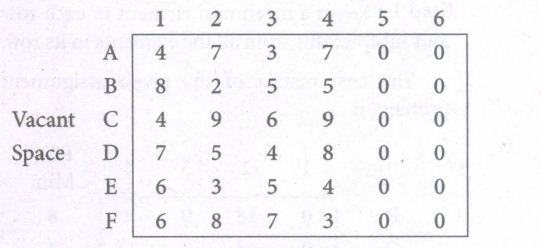
Step 1 : Select the smallest element in each row and subtract this from all the elements in its row.
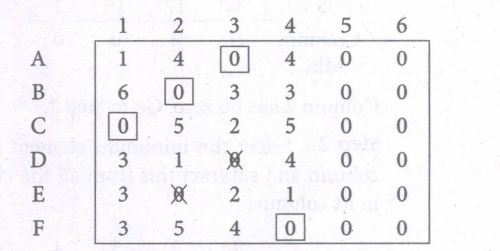
Since each row and column has atleast one zero, assignments can be made.
Step 2 : Examine the rows with atleast one row.
Row A & B have exactly one row. Mark them by and mark X by other zeros in its column.
Row C & F also has only one zero.
Here only 4 vacant space can be assigned to 4 trucks.
∴ The optimal assignments schedule and total cost is
| Vacant space | Truck | Cost |
|---|---|---|
| A | 3 | 3 |
| B | 2 | 2 |
| C | 1 | 4 |
| F | 4 | 3 |
| Total Cost | Rs. 12 | |
∴ The optimal assignment (minimum) cost = Rs. 12
9.
| Commodities | Base year | Current year | ||
| p0 | q0 | p1 | q1 | |
| A | 170 | 562 | 72 | 632 |
| B | 192 | 535 | 70 | 756 |
| C | 195 | 639 | 95 | 926 |
| D | 187 | 128 | 92 | 255 |
| E | 185 | 542 | 92 | 632 |
| F | 150 | 217 | 180 | 314 |
| 7 | 12.6 | 12.7 | 12.5 | 12.8 |
| 8 | 12.4 | 12.3 | 12.6 | 12.5 |
| 9 | 12.6 | 12.5 | 12.3 | 12.6 |
| 10 | 12.1 | 12.7 | 12.5 | 12.8 |
| p0q0 | p1q1 | p0q1 | p1q0 |
| 95540 | 45504 | 107440 | 40464 |
| 102750 | 52920 | 145152 | 37450 |
| 124605 | 87970 | 180570 | 60705 |
| 100270 | 58144 | 116920 | 49864 |
| 32550 | 56520 | 47100 | 39060 |
| 160.02 | 160 | 161.28 | 158.75 |
| 152.52 | 157.5 | 155 | 154.98 |
| 157.5 | 154.98 | 158.76 | 153.75 |
| 153.67 | 160 | 154.88 | 158.75 |
| 480244.7 | 325150.48 | 645496.92 | 239945.23 |
Laspeyre's pnce index number
\(P^{L}_{01}\) = \(\frac {\sum p_{1}q_{0}}{\sum p_{0}q_{0}} \times 100\)
= \(\frac {239945.23}{480244.71} \times 100 \)
Paasches index number
\(P^{p}_{01}\) = \(\frac {\sum p_{1}q_{0}}{\sum p_{0}q_{0}} \times 100\)
= \(\frac {325150.48}{645496.92} \times 100 \)
= 50.37
Fisher's index number
\(P^{F}_{01}\) = \(\sqrt{ \frac {\sum p_{0}q_{0}}{\sum p_{0}q_{0}} \times \frac{ {\sum p_{0}q_{0}} }{{\sum p_{0}q_{0}}}{}}\times 100\)
= \(\sqrt\frac {239945.23 \times 325150.48}{480244.71 \times 645496.92} \times 100\)
= \(\sqrt\frac {489.84 \times 570.22}{693 \times 803.43} \times 100\)
= 50.1
10.
Sample size n =100, Sample mean \(\bar x\) = 390 pages, Population mean \(\mu\) = 400 pages
Population SD \(\sigma\) = 20 pages
The sample is a large sample and so we apply Z -test
Null Hypothesis:
There is no significant difference between the sample mean and the population mean of writing life of pen he manufactures, i.e., H0 : \(\mu\) = 400
Alternative Hypothesis:
There is significant difference between the sample mean and the population mean of writing life of pen he manufactures, i.e., H1:\(\mu\neq\) 400 (two tailed test)
The level of significance \(\alpha\) = 1% = 0.01
Applying the test statistic
\(Z=\frac{\bar{x}-\mu}{\frac{\sigma}{\sqrt{n}}} \sim N(0,1) ; \)
\(Z=\frac{390-400}{\frac{20}{\sqrt{100}}}=\frac{-10}{2}=-5, \therefore|Z|=5\)
Thus the calculated value |Z| = 5 and the significant value or table value \({ Z }_{ \frac { \sigma }{ 2 } }=2.58\)
Comparing the calculated and table values, we found Z > \({ Z }_{ \frac { \sigma }{ 2 } }\) i.e., 5 > 2.58
Inference: Since the calculated value is greater than table value i.e., \(Z>{ Z }_{ \frac { \sigma }{ 2 } }\) at 1% level of significance, the null hypothesis is rejected and Therefore we concluded that \(\mu \neq400\) and the manufacturer’s claim is rejected at 1% level of significance.
11.
Let the probability of student having reading habit
p = 40% = \(\frac { 40 }{ 100 } \) = 0.4
⇒ q = 1-p = 1-0.4 = 0.6
n = 9
(i) P (none of those who have selected having reading habit)
= P(X = 0)
= 9C0(0.4)0 (0.6)9
= (1)(1)(0.6)9 [∵ nCx pxqn-x = p(x), n = 9, x = 0]
= (0.6)9 [ ∵ 9C0 = 1 ]
= 0.01008
(ii) P (all those who have selected have newspaper reading habit)
= P(X = 9)
= 9C9(0.4)9 (0.6)0 [∵ p(x) =nCx pxqn-x, n = 9, x = 9]
= (0.4)9 [ ∵ 9C9 = 1 ]
= 0.000261
(iii) Two thirds of 9 = \(\frac{2}{3}\) x 9 = 6
∴ P(atleast two third have newspaper reading habit)
= P (atleast 6 have newspaper reading habit)
= P(X≥6)
= P(X = 6)+P(X = 7)+P(X = 8)+P(X = 9)
= 9C6 (0.4)6 (0.6)3 + 9C7 (0.4)7 (0.6)2 + 9C8 (0.4)8 (0.6)1 + 9C9 (0.4)9 (0.6)0
= (0.4)6 [9C6 (0.6)3 + 9C7 (0.4) (0.6)2 + 9C8 (0.4)2 (0.6) + (0.4)3 ]
= (0.4)6 [9C3 (0.216) + 9C2 (0.144) + 9C1 (0.096)+0.64 [∵ nCr = nCn-r ]
= (0.4)6 \(\left[ \frac { 9\times 8\times 7 }{ 3\times 2\times 1 } (0.216)+\frac { 9\times 8 }{ 2\times 1 } (0.144)+9(0.096)+.064 \right] \)
= (0.4)6 [18.144 + 5.184 + 0.864 + 0.064]
= (0.4)6 [24.256] = (0.0041) (24.256)
∴ P(X≥6) = 0.0994
12.
Given MC = \(\frac{dC}{dx}\alpha x\)
\(\Rightarrow \frac { dC }{ dx } ={ k }_{ 1 }x\)
\(\Rightarrow dC={ k }_{ 1 }xdx\)
\(\Rightarrow \int { dC={ k }_{ 1 }\int { x } dx } \)
\(\Rightarrow C={ k }_{ 1 }\frac { { x }^{ 2 } }{ 2 } +{ k }_{ 2 }...(1)\)
Given fixed cost is Rs. 5000
∴ When x = 0, C = 5000
⇒ 5000 = k1(0) + k2 = 5000
∴ (1)becomes C=k1\(\frac{x^2}{2}+5000\) ...(2)
Also it is given that when x = 50, C = Rs. 5625
\(\therefore (2)5625={ k }_{ 1 }\frac { { x }^{ 2 } }{ 2 } +5000\)
\(\Rightarrow 5625-5000={ k }_{ 1 }\times \frac { { (50) }^{ 2 } }{ 2 } \)
\(\Rightarrow 625={ k }_{ 1 }\times \frac { (50)\times (50) }{ 2 } \)
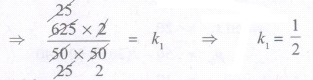
\(C=\frac { 1 }{ 2 } \left( \frac { { x }^{ 2 } }{ 2 } \right) +5000\)
⇒C = \(\frac{x^2}{4}\) + 5000
13.
The present value of payment for t year = \(\int _{ 0 }^{ t }{ { 72000e }^{ -0.09t } } dt\)
Present value of 12 years = \(\int _{ 0 }^{ t }{ { 72000e }^{ -0.09t } } dt\)
= 72000\({ \left[ \frac { { e }^{ -0.09t } }{ { -0.09 } } \right] }_{ 0 }^{ \\ 12 }\)
= \(\frac { 72000 }{ -0.09 } \left[ { e }^{ -0.09(12) }-{ e }^{ 0 } \right] \)
= \(-8,00,000[{ e }^{ -1.08 }-{ e }^{ 0 }]\)
= −8,00,000 [0.3396 −1]
= 5,28,320
Cost of the machine = 5,00,000 − 30,000
= 4,70,000
Hence it not advisable to rent the machine
It is better to buy the machine.
14.
Let ‘x’ be the cost of a Business Mathematics book
Let ‘y’ be the cost of a Accountancy book.
Let ‘z’ be the cost of a Commerce book.
\(\therefore \) 3x + 2y + z = 840
2x + y + z = 570
x + y + 2z = 630
Here \({ \triangle }=\left| \begin{matrix} 3 & 2 & 1 \\ 2 & 1 & 1 \\ 1 & 1 & 2 \end{matrix} \right| =-2\neq 0\)
\({ \triangle }_{ x }=\left| \begin{matrix} 840 & 2 & 1 \\ 570 & 1 & 1 \\ 630 & 1 & 2 \end{matrix}\begin{matrix} 1 \\ 1 \\ 2 \end{matrix} \right| =-240 \)
\({ \triangle }_{ y }=\left| \begin{matrix} 3 & 840 & 1 \\ 2 & 570 & 1 \\ 1 & 630 & 2 \end{matrix} \right| =-300 \)
\({ \triangle }_{ z }=\left| \begin{matrix} 3 & 2 & 840 \\ 2 & 1 & 570 \\ 1 & 1 & 630 \end{matrix} \right| =-360\)
\(\therefore \) By Cramer’s rule
\(x=\frac { { \triangle }x }{ { \triangle } } =\frac { -240 }{ -2 } =120 \)
\(y=\frac { { \triangle }y }{ { \triangle } } =\frac { 300 }{ -2 } =150 \)
\(z=\frac { { \triangle }z }{ { \triangle } } =\frac { 360 }{ -2 } =180\)
\(\therefore \) The cost of a Business Mathematics book is Rs. 120,
the cost of a Accountancy book is Rs. 150 and
the cost of a Commerce book is Rs. 180.
15.
Given sample size n = 64
Sample mean \(\bar { x } \) = 51250
Null hypotheses: H0: Population mean μ = 50000 Alternative hypotheses: H1 : μ≠ 50,000
The test statistic, z = \(\frac { \bar { x } -\mu }{ \frac { \sigma }{ \sqrt { n } } } =\frac { 51250-50000 }{ \frac { 2000 }{ \sqrt { 64 } } } \)=5
∴ z = 5
As the significance level is α = 0.05, \(Z_{ \frac { \alpha }{ 2 } }\) = 1.96
Here z > zα as 5 < 1.96
Inference: As z > zα, H0 is rejected. Hence, we can conclude that the sample mean differs significantly from the population mean.
16.
\(E(X)=\sum { xp(x)=-2(\frac { 1 }{ 4 } ) } +2(\frac { 1 }{ 4 } )+5(\frac { 1 }{ 2 } )\)
\(=\frac { -2 }{ 4 } +\frac { 2 }{ 4 } +\frac { 5 }{ 2 } =\frac { 5 }{ 2 } \)
∴ 4E(X2)-V(2X)=4E(X2)-4.V(X)
=4E(X2)-4[E(X2)-E(X)2]
=4E(X2)-4E(X2)+4[E(X)]2
\(=4{ \left( \frac { 5 }{ 2 } \right) }^{ 2 }[\because E(X)=\frac { 5 }{ 2 } ]\)
\(=4\left( \frac { 25 }{ 4 } \right) =25\)
17.
| Alternative | States of Nature | Minimum | Maximum | ||
| Good | Fair | Bad | |||
| A | 100 | 60 | +50 | +50 | 100 |
| B | 80 | 50 | +10 | 10 | 80 |
| C | 40 | 20 | +5 | 5 | 40 |
(i) Max (50, 10, 5) = 50
∴ A is the best alternative under maximin principle
(ii) Min (100, 80,40) = 40
∴ C is the best alternative under minimax principle
18.
Let \(I=\int { \frac { { sec }^{ 2 }x }{ 3+tanx } } dx\)
Put 3 + tan x = t
⇒ 0 + sec2x dx = dt
⇒ sec2 x dx = dt
\(\therefore I={ \int { \frac { dt }{ t } } }\)
= log |t| + c
= log |3 + tan x| + c
[∵ t = 3 + tan x]
19.
Given y = (A + Bx)e3x ....(1)
Differentiating w.r.t 'x' we get,
\(\frac { dy }{ dx } \)= (A+Bx)e3x(3)+e3x(B)
⇒ \(\frac { dy }{ dx } \) = 3y + Be3x [Using (1)]
⇒ Be3x = \(\frac { dy }{ dx } \)-3y
Differentiating again w.r.t 'x' we get,
\(\frac { d^{ 2 }y }{ { dx }^{ 2 } } =3\left( \frac { dy }{ dx } \right) \)+ Be3x(3)
⇒ \(\frac { d^{ 2 }y }{ { dx }^{ 2 } } =3\left( \frac { dy }{ dx } \right) +3\left[ \frac { dy }{ dx } -3y \right] \) [Using (2)]
⇒ \(\frac { d^{ 2 }y }{ { dx }^{ 2 } } =3\left( \frac { dy }{ dx } \right) +3\left( \frac { dy }{ dx } \right) \)-9y
⇒ \(\frac { d^{ 2 }y }{ { dx }^{ 2 } } =6\left( \frac { dy }{ dx } \right) \)-9y which is the required differential equation.
20.
Given y3 = 2, y4 = −6, y5 = 8, y6 = 9 and y7 = 17
Δ4y3 = (E−1)4y3
= (E4 − 4E3 + 6E2 − 4E+1)y3
= E4y3 − 4E3y3 + 6E2y3− 4Ey3 + y3
= y7 − 4y6 + 6y5 −4y4+ y3
= 17 – 4(9) + 6(8) –4(–6) + 2
= 17 – 36 + 48 + 24 + 2 = 55
21.
| Commodity | Weights 2010 (q0) |
Price (Rs.) | p1q0 | p0q0 | |
| 2010 (p0) | 2015 (p1) | ||||
| P | 80 | 22 | 25 | 2000 | 1760 |
| Q | 30 | 30 | 45 | 1350 | 900 |
| R | 25 | 42 | 50 | 1250 | 1050 |
| S | 40 | 25 | 35 | 1400 | 1000 |
| T | 50 | 36 | 52 | 2600 | 1800 |
| 8600 | 6510 | ||||
Using aggregate expenditure method,
Cost of living index number
C.L.I = \(\sqrt \frac {\sum p_{1}q_{0}}{{\sum p_{0}q_{0}}}\times100\)
= \(\sqrt \frac {8600}{6510}\times100\)
= 132.10
22.
\(\int _{ 0 }^{ \frac { \pi }{ 2 } }{ x \sin x } dx=\int _{ 0 }^{ \frac { \pi }{ 2 } }{ udv } \)
\(={ \left( uv \right) }_{ 0 }^{ \frac { \pi }{ 2 } }-\int _{ 0 }^{ \frac { \pi }{ 2 } }{ vdu } \)
\(={ \left[ -x \cos x \right] }_{ 0 }^{ \frac { \pi }{ 2 } }+\int _{ 0 }^{ \frac { \pi }{ 2 } }{ \cos x } dx\)
\(=0+{ \left[ \sin x \right] }_{ 0 }^{ \frac { \pi }{ 2 } }=1\)
| Take u = x Differentiate du = dx |
and dv = sin x dx |
23.
Probability of bus running late is denoted as p = 1-0.8 = 0.2
Probability of bus running according to the schedule is q = 0.8
Also given that n = 10
The binomial distribution is p(x) = 10Cx(0.2)x(0.8)10-x
(i) probability that exactly one is late P(x = 1) = 10C1pq9
= 10C1(0.2)(0.8)9
(ii) probability that at least one is late
= 1 – probability that none is late
= 1 – p(x = 0)
= 1– (0.8)10
24.
Transition probability matrix
T = \(_{ B }^{ A }\left( \begin{matrix} \overset { A }{ 0.9 } & \overset { B }{ 0.1 } \\ 0.3 & 0.7 \end{matrix} \right) \)
At equilibrium, (A B) T = (AB) where A + B = 1
(A B) \(\left( \begin{matrix} 0.9 & 0.1 \\ 0.3 & 0.7 \end{matrix} \right) \) = (A B)
0.9A + 0.3B = A
0.9A + 0.3(1−A) = A
0.9A−0.3A + 0.3 = A
0.6A + 0.3 = A
0.4A = 0.3
A = \(\frac { 0.3 }{ 0.4 } =\frac { 3 }{ 4 } \)
B = 1-\(\frac { 3 }{ 4 } =\frac { 1 }{ 4 } \)
Hence the market share of brand A is 75% and the market share of brand B is 25%
25.
(d)
quality
26.
(c)
0.0147
27.
(a)
0.5
28.
(a)
\(\frac{2}{3}\)
29.
(a)
arbitrarily
30.
(b)
cos x
31.
(a)
sin x
32.
(c)
± 6
33.
(b)
finite differences
34.
(a)
\(\frac{4}{3}\)
35.
(c)
f(x + h) − f(x)
36.
(c)
Smallest two costs
37.
(a)
\(\frac{d^{2} y}{d x^{2}}-y=0\)
38.
(c)
CL, LCL, UCL
39.
(a)
population parameter
40.
(c)
4!
41.
(a)
0.5443
42.
(b)
one
43.
(b)
2
44.
(a)
1
45.
| Commodity | Quantity | Price(Rs.) | p1q0 | p0q0 | |
| 2000(q0) | 2000 (p0) | 2003 (p1) | |||
| A | 100 | 8 | 12 | 1200 | 800 |
| B | 25 | 6 | 7.50 | 187.50 | 150 |
| C | 10 | 5 | 5.25 | 52.50 | 50 |
| D | 20 | 48 | 52 | 1040.00 | 960 |
| E | 65 | 15 | 16.50 | 1072.50 | 975 |
| F | 30 | 19 | 27.00 | 810 | 570 |
C.L.I = \(\frac{\Sigma p_1q_0}{\Sigma p_0q_0}\times100\)
C.L.I = \(\frac{4362.50}{3505}\times100\) = 124.46
46.
Let p be the probability of happening of an event.
Given p = 0.002 = \(\frac { 2 }{ 1000 } \)
Also n = 1000
∴ Mean = np = \(1000\times \frac { 2 }{ 1000 } \) = 2
Hence, X follows Poisson distribution with
P(x,λ) = \(\frac { e^{ -\lambda }.{ \lambda }^{ 0 } }{ x! } \)
∴ P( event happens exactly twice)
= P(X = 2)
= \(\frac { e^{ -\lambda }.{ \lambda }^{ 2 } }{ 2! } =\frac { e^{ -2 }.{ (2 }^{ 2 }) }{ 2 } \)
= e-2(2) = 2(0.1353) = 0.2706
∴ P(X = 2) = 0.2706
47.
Since three values of f(x) are given, we assume that the polynomial is of degree two.
⇒ Δ3(f(x0)) = 0
⇒ ∆3(yo) = 0
⇒ (E - 1)3 yo= 0
⇒ (E3 - 3E2 + 3E - 1) yo= 0
⇒ y3- 3y2+ 3y1 - yo= 0
⇒ 157 - 3 (126) + 3y1 - 100 = 0
⇒ y1 = 107
∴ The missing term is 107.
48.
Given C'(x) = 85 + \(\frac{375}{x^2}\).
We know C(x) ഽC'(x) + k
The cost of producing 10 incremental units after 15 units have been produced
\(C'(x)=85+\frac { 375 }{ { x }^{ 2 } } \)
\(C(x)=\int { C'(x) } dx\)
\(\int _{ 15 }^{ 25 }{ C'(x) } dx\)
\(\int _{ 15 }^{ 25 }{ \left( 85+\frac { 375 }{ { x }^{ 2 } } \right) } dx\)
\({ \left[ 85+\frac { 375 }{ { x } } \right] }_{ 15 }^{ 25 }\)
\(\left( 85(25)-\frac { 375 }{ 25 } \right) -\left( 85(15)-\frac { 375 }{ 15 } \right) \)
= (2125 - 15) - (1275 - 25)
= 2110 - 1250 = Rs. 860
49.
Transition probability matrix
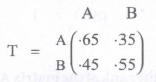
Given present market shares are 15% for A and 85% for B
\(\therefore\) Market shares after one year
= \(\left( \cdot 15\cdot 85 \right) \left( \begin{matrix} \cdot 65 & \cdot 35 \\ \cdot 45 & \cdot 55 \end{matrix} \right) \)
= ((-15)(-65)+(-85)(-45) ·15x·35+·85x·55)
= (-0975 + 0.3825 .0525 + 4675)
= (0 .48 0.52)
\(\therefore\) Market shares after one year for A is 48% and for B is 52%
50.
To assign the different jobs to the different machines (one job per machine) to minimize the overall cost is known as assignment problem.
51.
The auxiliary equation is m2 - 4m + 4 = 0
⇒ (m - 2)2 = 0
⇒ m 2,2
The roots are real and equal
∴ Complementary function CF is (Ax + B)e2x
∴ The general solution is y = (Ax + B)e2x
52.
The error of rejecting Ho when it is true is type I error.
53.
\(F(x)=\int _{ -\infty }^{ x }{ f(t)dt } \)
\(=\int _{ 100 }^{ x }{ \frac { 100 }{ { t }^{ 2 } } dt,\quad x\ge 100 } \)
\(={ \left[ \frac { 100 }{ -t } \right] }_{ 100 }^{ x },\quad x\ge 100\)
\(F(x)=\left[ 1-\frac { 100 }{ x } \right] ,\ge 100\)
54.
\(\int { \left( 3x+x \right) \left( 2-5x \right) } dx\)
\(=\int { \left( 6-15x+2x-{ 5x }^{ 2 } \right) } dx\)
\(=\int { \left( 6-13x-{ 5x }^{ 2 } \right) } dx\)
\(=6x-\frac { { 13x }^{ 2 } }{ 2 } -\frac { { 5x }^{ 3 } }{ 3 } +c\)

12th Standard Syllabus & Materials
12th Standard
TN 12th Computer Applications களப்பெயர் முறைமை (DNS) Sample Question Papers Study Material - QB365 Set A
NEW12th Standard
TN 12th Computer Applications வலையமைப்பு எடுத்துக்காட்டுகள் மற்றும் நெறிமுறைகள் Sample Question Papers Study Material - QB365 Set A
NEW12th Standard
TN 12th Computer Applications கணினி வலையமைப்பு ஓர் அறிமுகம் Sample Question Papers Study Material - QB365 Set A
NEW12th Standard
TN 12th Computer Applications PHP-உடன் MySQL-ஐ இணைத்தல் Sample Question Papers Study Material - QB365 Set A



Tamilnadu Stateboard 12th Standard Subjects

Maths

Chemistry

Physics

Biology

Computer Science
Business Maths and Statistics

Economics

Commerce

Accountancy

History

Computer Applications
Biology
Computer Technology
Computer Applications
Computer Science
Business Maths and Statistics
Commerce
Economics
Maths
Chemistry
Physics
Computer Technology
History
Accountancy

Tamil

English

French
Tamilnadu Stateboard Standards
