
 100% FREE ACCESS
12th Standard Syllabus & Materials
12th Standard
TN 12th Maths Applications of Matrices and Determinants Sample Question Papers Study Material - QB365 Set A
NEW12th Standard
TN 12th Computer Applications மின்னணு தரவு பரிமாற்றம் Sample Question Papers Study Material - QB365 Set A
NEW12th Standard
TN 12th Computer Applications மின் - வணிக பாதுகாப்பு அமைப்புகள் Sample Question Papers Study Material - QB365 Set A
NEW12th Standard
TN 12th Computer Applications மின்னணு செலுத்தல் முறைகள் Sample Question Papers Study Material - QB365 Set A
NEW12th Standard
TN 12th Computer Applications மின் - வணிகம் Sample Question Papers Study Material - QB365 Set A
NEW12th Standard
TN 12th Computer Applications திறந்த மூல கருத்துருக்கள் Sample Question Papers Study Material - QB365 Set A

Published on: 13/09/2019
Download Tamil Nadu 12th Standard Business Maths and Statistics question papers, model tests, one-mark questions, important questions, and public exam papers in PDF format. Free study materials and answer keys for TN State Board students.
Questions + Answers key
Take MCQ Business Maths and Statistics Test
1.
Solve: (x+y)2\(\frac { dy }{ dx } \) = 1
2.
Using graphic method, find the value of y when x=27.
| x | 10 | 15 | 20 | 25 | 30 |
| y | 35 | 32 | 29 | 26 | 23 |
3.
Show that the equations x- 3y + 4z = 3, 2x - 5y + 7z = 6, 3x - 8y + 11z = 1 are inconsistent
4.
5.
Solve the following:
\(\frac { dy }{ dx } +ycosx=sinx\ cosx\).
6.
Evaluate the following integrals:
\(\int _{ -1 }^{ 1 }{ { x }^{ 2 }{ e }^{ -2x } } dx\)
7.
If \(\int _{ a }^{ b }{ dx } =1\) and \(\int _{ a }^{ b }{ xdx } =1\), then find a and b
8.
The price of a machine is 6,40,000 if the rate of cost saving is represented by the function f(t) = 20,000 t. Find out the number of years required to recoup the cost of the function.
9.
Integrate the following with respect to x.
sin3 x
10.
The total cost of 11 pencils and 3 erasers is Rs. 64 and the total cost of 8 pencils and 3 erasers is Rs. 49. Find the cost of each pencil and each eraser by Cramer’s rule.
11.
Find the rank of the matrix \(\left( \begin{matrix} 5 & 3 & 0 \\ 1 & 2 & -4 \\ -2 & -4 & 8 \end{matrix} \right) \)
12.
Evaluate ഽ x3 sin (x4) dx
13.
Equipment maintenance and operating costs (are related to the overhaul interval x by the equation \({ x }^{ 2 }\frac { dc }{ dx } -10xc=-10\) with c = c0 and x = x0. Find c as a function of x.
14.
Using Lagrange's formula find the value of y when x = 4 from the following table.
| x | 0 | 3 | 5 | 6 | 8 |
| y | 276 | 460 | 414 | 343 | 110 |
15.
The sum of Rs. 2,000 is compounded continuously, the nominal rate of interest being 5% per annum. In how many years will the amount be double the original principal? (loge2 = 0.6931)
16.
For what values of the parameter λ, will the following equations fail to have unique solution: 3x − y+λz = 1, 2x + y + z = 2, x + 2y − λz = −1 by rank method.
17.
The particular integral of the differential equation \(\frac { d^{ 2 }y }{ { dx }^{ 2 } } -5\frac { dy }{ dx } \)+6y=e5x is _______
\(\frac { e^{ 5x } }{ 6 } \)
\(\frac { xe^{ 5x } }{ 21 } \)
6e5x
\(\frac { { e }^{ 5x } }{ 25 } \)
18.
The differential equation obtained by eliminating a and b from y = a e3x + b e-3x is _____________
\(\frac { { d }^{ 2 }y }{ dx^{ 2 } } \)+ay = 0
\(\frac { { d }^{ 2 }y }{ dx^{ 2 } } \)-9y = 0
\(\frac { { d }^{ 2 }y }{ dx^{ 2 } } -9\frac { dy }{ dx } \)
\(\frac { { d }^{ 2 }y }{ dx^{ 2 } } \)+9x = 0
19.
\(\int { \frac { { e }^{ x }+1 }{ { e }^{ x }+x } } \) dx = ______________ +c
log |ex +1|
log |ex +x|
log |ex -1|
log |ex -x|
20.
∫ sec2 (7-4x) dx = _____________ +c
\(-\frac { 1 }{ 4 } tan(7-4x)\)
\(\frac { 1 }{ 7 } tan(7-4x)\)
\(\frac { 1 }{ 4 } tan(7-4x)\)
\(\frac { 1 }{ 7 } tan(7-4x)\)
21.
If ∫ x sin x dx = - x cos x + α then α = __________ +c
sin x
cos x
C
none of these
22.
If A, B are two n x n non-singular matrices, then ___________
AB is non-singular
AB is singular
(AB)-1 = A-1 B-1
(AB)-1 does not exit
23.
For what value of k, the matrix \(A=\left( \begin{matrix} 2 & k \\ 3 & 5 \end{matrix} \right) \) has no inverse?
\(\frac { 3 }{ 10 } \)
\(\frac { 10 }{ 3 } \)
3
10
24.
If y is to be estimated for the value of x between two extreme points in a set of values, it is called ___________
Interpolation
extrapolation
Forward interpolation
backward interpolation
25.
E [f(x0)] is ______________
f(xo + h)
f(xo - h)
f(xo) + h
f(xo) - h
26.
The area of the region bounded by the curve y2 = 2y - x and the y-axis _____ sq. units
\(\frac{4}{3}\)
\(\frac{2}{3}\)
4
\(\frac{16}{3}\)
27.
If f (x)=x2 + 2x + 2 and the interval of differencing is unity then Δf (x) _______.
2x −3
2x +3
x + 3
x − 3
28.
For the given points (x0, y0) and (x1, y1) the Lagrange’s formula is _______.
\(y(x)=\frac{x-x_{1}}{x_{0}-x_{1}} y_{0}+\frac{x-x_{0}}{x_{1}-x_{0}} y_{1}\)
\(y(x)=\frac{x_{1}-x}{x_{0}-x_{1}} y_{0}+\frac{x-x_{0}}{x_{1}-x_{0}} y_{1}\)
\(y(x)=\frac{x-x_{1}}{x_{0}-x_{1}} y_{1}+\frac{x-x_{0}}{x_{1}-x_{0}} y_{0}\)
\(y(x)=\frac{x_{1}-x}{x_{0}-x_{1}} y_{1}+\frac{x-x_{0}}{x_{1}-x_{0}} y_{0}\)
29.
The variable separable form of \(\frac { dy }{ dx } =\frac { y(x-y) }{ x(x+y) } \) by taking y = vx and \(\frac { dy }{ dx } =v+x\frac { dv }{ dx } \) is ______.
\(\frac { 2{ v }^{ 2 } }{ 1+v } dv=\frac { dx }{ x } \)
\(\frac { 2{ v }^{ 2 } }{ 1+v } dv=-\frac { dx }{ x } \)
\(\frac { 2{ v }^{ 2 } }{ 1-v } dv=\frac { dx }{ x } \)
\(\frac { 1+v }{ 2{ v }^{ 2 } } dv=-\frac { dx }{ x } \)
30.
A homogeneous differential equation of the form \(\frac { dy }{ dx } \) = f\(\left( \frac { y }{ x } \right) \) can be solved by making substitution, ______.
y = v x
v = y x
x = v y
x = v
31.
The P.I of (3D2 + D − 14)y = 13e2x is ______.
\(\frac {x}{2}\)e2x
xe2x
\(\frac {x^2}{2}\)e2x
13xe2x
32.
\(\int _{ -1 }^{ 1 }{ { x }^{ 3 }{ e }^{ { x }^{ 4 } } } \) dx is _______.
1
2\(\int _{ -1 }^{ 1 }{ { x }^{ 3 }{ e }^{ { x }^{ 4 } } } \)dx
0
\({ e }^{ { x }^{ 4 } }\)
33.
If MR and MC denote the marginal revenue and marginal cost and MR − MC = 36x − 3x2 − 81 , then the maximum profit at x is equal to ________.
3
6
9
5
34.
The demand function for the marginal function MR = 100 − 9x2 is ________.
100 − 3x2
100x − 3x2
100x − 9x2
100 + 9x2
35.
If \(T=\begin{array}{l} A \\ B \end{array}\left(\begin{array}{ll} 0.7 & 0.3 \\ 0.6 & x \end{array}\right)\) is a transition probability matrix, then the value of x is ________.
0.2
0.3
0.4
0.7
36.
If A = (1 2 3), then the rank of AAT is ________.
0
2
3
1
37.
If \(\int _{ 0 }^{ a }{ { 3x }^{ 2 } } dx=8\) find the value of a
38.
Write down the order and degree of the following differential equations.
\(\sqrt { 1+\left( \frac { dy }{ dx } \right) ^{ 2 } } \)= 4x
39.
When h = 1, find Δ (x3).
40.
Solve 9y'' − 12y' + 4y = 0
41.
Evaluate ഽ\(\sqrt { { x }^{ 2 }-16 } \)dx
1.
Given (x+y)2\(\frac { dy }{ dx } \) = 1
put x+y = z
⇒ 1+\(\frac { dy }{ dx } =\frac { dz }{ dx } \)
\(\frac { dy }{ dx } =\frac { dz }{ dx } \)-1
∴ (1) becomes,
z2\(\left( \frac { dz }{ dx } -1 \right) \)= 1
⇒ z2\(\frac { dz }{ dx } \)-z2 = 1
⇒ z2\(\frac { dz }{ dx } \) = 1 + z2
Separating the variables we get,
\(\left( \frac { { z }^{ 2 } }{ 1+{ z }^{ 2 } } \right) \)dz = dx
Adding and Subtracting 1 in the numerator, we get
\(\left( \frac { 1+{ z }^{ 2 }-1 }{ 1+{ z }^{ 2 } } \right) \)dz = dx
⇒ \(\left( \frac { 1+{ z }^{ 2 } }{ 1+{ z }^{ 2 } } -\frac { 1 }{ 1+{ z }^{ 2 } } \right) \)dz = dx
⇒ \(\left( z-\frac { 1 }{ 1+{ z }^{ 2 } } \right) \)dz = dx
Integrating, \(\int { dz } -\int { \frac { dz }{ 1+{ z }^{ 2 } } } \)
[∵ \(\int { \frac { dz }{ 1+{ z }^{ 2 } } } \) = tan-1x+y]
⇒ (z-tan-1(2) = x+C
⇒ (x+y)-tan-1(x+y) = x + C
⇒ y-tan-1(x+y) = C
2.
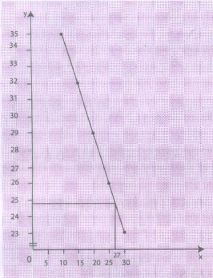
From the graph, it is clear that when x = 27, the value of y is 24.8
3.
Given non-homogeneous equations are
x- 3y + 4z = 3, 2x - 5y + 7z = 6, 3x - 8y + 11z = 1
| Augmented matrix [A, B] |
Elementary Transformation |
|---|---|
| \(\left( \begin{matrix} 1 & -3 & 4 \\ 2 & -5 & 7 \\ 3 & -8 & 11 \end{matrix}\begin{matrix} 3 \\ 6 \\ 1 \end{matrix} \right) \) | |
| \(\sim \left( \begin{matrix} 1 & -3 & 4 \\ 0 & 1 & -1 \\ 0 & 1 & -1 \end{matrix}\begin{matrix} 3 \\ 0 \\ -8 \end{matrix} \right) \) | \({ R }_{ 2 }\rightarrow { R }_{ 2 }-2{ R }_{ 1 }\) \({ R }_{ 3 }\rightarrow { R }_{ 3 }-{ 3R }_{ 1 }\) |
| \(\sim \left( \begin{matrix} 1 & -3 & 4 \\ 0 & 1 & -1 \\ 0 & 0 & -0 \end{matrix}\begin{matrix} 3 \\ 0 \\ -8 \end{matrix} \right) \) | \({ R }_{ 3 }\rightarrow { R }_{ 3 }-R_{ 2 }\) |
Clearly \(\rho (A)=2\) and \(\rho (A,B)=3\)
\(\rho (A,B)\neq \rho (A)\)
Hence, the given system is inconsistent and has no solution.
4.
5.
The given differential equation is of the follows
\(\frac { dy }{ dx } \)+ Py =Q where
P = cos x, Q = sinx cosx
∴ \(\int { P } dx=\int { cosx } dx\)
∴ Integrating factor (I.F) =\(e^{ \int { p.dx } }=e^{ sinx }\)
Hence, the solution is
\(ye^{ \int { p.dx } }=\int { Qe^{ \int { p.dx } } } dx+c\)
⇒ \(y.e^{ sinx }=\int { sinx } cosx.e^{ sinx }dx+c\)
put t = sin x ⇒ dt =cos x dx
⇒ \(ye^{ sinx }=\int { t{ e }^{ t } } dt\) ....(1)
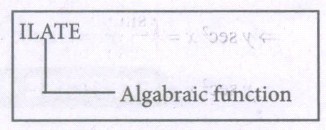
put u = t; dv = et dt
du = dt; v = et
Using integration by parts
\(\int { u } dv=uv-\int { v } du\)
⇒ \(\int { t } e^{ t }dt=te^{ t }-\int { e^{ t }dt } \) = tet-et....(2)
Substituting (2) in (1) we get,
yesinx = t et-et + c
⇒ y esinx = et(t-1)+c
⇒ y esinx = esinx (sin x-1)+c [∵ t = sinx]
6.
Let \(I=\int _{ -1 }^{ 1 }{ { x }^{ 2 } } e^{ -2x }dx\)
u = x2 dv = e-2x
u1 = 2x \(v=\cfrac { { e }^{ -2x } }{ -2 } =\cfrac { -e^{ -2x } }{ 2 } \)
u4 = 2 \({ v }_{ 1 }=+\cfrac { { e }^{ -2x } }{ 4 } \)
\({ v }_{ 2 }=-\cfrac { { e }^{ -2x } }{ 8 } \)
Using Bernoulli's formula
I = uv = u1v1 + u4v2
= \(\left[ { x }^{ 2 }\left( \cfrac { -e^{ -2x } }{ 2 } \right) -2x\left( \cfrac { { e }^{ -2x } }{ 4 } \right) +2\left( \cfrac { -e^{ -2x } }{ 8 } \right) \right] _{ -1 }^{ 1 }\)
= \(\left( { e }^{ -2x }\left[ \cfrac { -{ x }^{ 2 } }{ 2 } -\cfrac { x }{ 2 } -\cfrac { 1 }{ 4 } \right] \right) \)

\(\left( { e }^{ -2x }\left[ \cfrac { -{ x }^{ 2 } }{ 2 } -\cfrac { x }{ 2 } -\cfrac { 1 }{ 4 } \right] \right) \)
= \({ e }^{ -2 }\left( -\cfrac { 5 }{ 4 } \right) -{ e }^{ 2 }\left( -\cfrac { 1 }{ 4 } \right) \)
= \(\cfrac { -5 }{ 4 } { e }^{ -2 }+\cfrac { 1 }{ 4 } { e }^{ 2 }\)
= \(\cfrac { 1 }{ 4 } \left( { e }^{ 2 }-\cfrac { 5 }{ { e }^{ 2 } } \right) =\cfrac { 1 }{ 4 } \left( \cfrac { { e }^{ 4 }-5 }{ { e }^{ 2 } } \right) \)
7.
Given that \(\int _{ a }^{ b }{ dx } =1\)
\({ \left[ x \right] }_{ a }^{ b }\) = 1
b − a = 1 … (1)
Now, \(\int _{ a }^{ b }{ xdx } =1\)
\({ \left[ \frac { { x }^{ 2 } }{ a } \right] }_{ a }^{ b }\) = 1
b2 − a2 = 2
(b + a)(b − a) = 2
b + a = 2 … (2) [∵ b -a =1]
(1) + (2) ⇒ 2b = 3
ஃ \(b=\frac { 3 }{ 2 } \)
Now, \(\frac { 3 }{ 2 } \) - a = 1 [∵ from (1)]
ஃ a = \(\frac { 1 }{ 2 } \)
8.
Saving Cost S(t) = \(\int _{ 0 }^{ t }{ 20000t } \ dt\)
= 10000 t2
To recoup the total price,
10000 t2 = 640000
t2 = 64
t = 8
When t = 8 years, one can recoup the price.
9.
∫ sin3x dx
We know that sin 3x = 3sin x - 4 sin3x
⇒ 4 sin3x = 3sinx - sin 3x
⇒ sin3x = \(\frac { 1 }{ 4 } \left( 3\sin x-\sin3x \right) \)
sin3x = \(\frac { 1 }{ 4 } \left( 3 \sin x-\not 3\sin 3x \right) \)dx
\(=\frac { 3 }{ 4 } \int { \sin x\ dx-\frac { 1 }{ 4 } } \int { \sin 3x dx } \)
\(=\frac { 3 }{ 4 } \left( -\cos x \right) -\frac { 1 }{ 4 } \left( -\frac { \cos 3x }{ 3 } \right) +c \quad\left[ \because \int { \sin ax \ dx=\frac { -1 }{ a } \cos ax+c } \right] \)
\(=-\frac { 3 }{ 4 } \cos x+\left( \frac { \cos 3x }{ 12 } \right) +c\)
10.
Let ‘x’ be the cost of a pencil
Let ‘y’ be the cost of an eraser
\(\therefore \) By given data, we get the following equations
11x + 3y = 64
8x + 3y = 49
\(\triangle =\left| \begin{matrix} 11 & 3 \\ 8 & 3 \end{matrix} \right| =9\neq 0,\) It has unique solution.
\({ \triangle }_{ x }\left| \begin{matrix} 64 & 3 \\ 49 & 3 \end{matrix} \right| =45\)
\({ \triangle }_{ y }\left| \begin{matrix} 11 & 64 \\ 8 & 49 \end{matrix} \right| =27\)
\(\therefore \) By Cramer’s rule
\(x={ \frac { \triangle x }{ \triangle } =\frac { 45 }{ 9 } =5 }\)
\(y={ \frac { \triangle y }{ \triangle } =\frac { 27 }{ 9 } =3 }\)
\(\therefore \) The cost of a pencil is Rs. 5 and the cost of an eraser is Rs. 3.
11.
Let A= \(\left( \begin{matrix} 5 & 3 & 0 \\ 1 & 2 & -4 \\ -2 & -4 & 8 \end{matrix} \right) \)
Order of A is 3 \(\times\) 3.
∴\(\rho \)(A)\(\le \)3
Consider the third order minor \(\left| \begin{matrix} 5 & 3 & 0 \\ 1 & 2 & -4 \\ -2 & -4 & 8 \end{matrix} \right| =0\)
Since the third order minor vanishes, therefore \(\rho (A)\neq 3\)
Consider a second order minor \(\left| \begin{matrix} 5 & 3 \\ 1 & 2 \end{matrix} \right| =7\neq 0\)
There is a minor of order 2, which is not zero.
\(\therefore \rho (A)=2\)
12.
Let I = ഽ x3 sin (x4) dx
Put t = x4
⇒ dt = 4x3 dfx
\(\Rightarrow \frac { dt }{ 4 } ={ x }^{ 3 }dx\)
\(\therefore I=\int { sin } t.\frac { dt }{ 4 } =\frac { 1 }{ 4 } sint\quad dt\)
= \(-\frac { 1 }{ 4 } cos\quad t+c\)
= \(-\frac { 1 }{ 4 } cos\left( { x }^{ 4 } \right) +c\) \(\left[ \because t={ x }^{ 4 } \right] \)
13.
\({ x }^{ 2 }\frac { dc }{ dx } -10xc=-10\)
\(\div { x }^{ 2 },\frac { dc }{ dx } -\frac { 10c }{ x } =\frac { 10 }{ { x }^{ 2 } } \frac { dc }{ dx } +Pc=Q\)
This is a first order linear differential equation of the form \(\frac{dc}{dx}\) + Pc = Q where
\(P=\frac { 10 }{ x }\) and \(Q=-\frac { 10 }{ { x }^{ 2 } } \)
\(\int { pdx } =-\int { \frac { 10 }{ x } =10logx=log\left( \frac { 1 }{ { x }^{ 10 } } \right) } \)
∴ I.F. = \({ e }^{ \int { pdf } }{ = }^{ { e }^{ log{ 1/x }^{ 10 } } }=\frac { 1 }{ { x }^{ 10 } } \)
∴ General solution is
\({ Ce }^{ \int { px } }=\int { Q.{ e }^{ \int { pdf } }dx+k } \)
\(\Rightarrow c.\left( \frac { 1 }{ { x }^{ 10 } } \right) =\int { -\frac { 10 }{ { x }^{ 2 } } . } \frac { 1 }{ { x }^{ 10 } } dx+k\)
\(=-10\int { \frac { 1 }{ { x }^{ 12 } } } dx+k\)
\(\Rightarrow \frac { c }{ { x }^{ 10 } } =-10\int { { x }^{ -12 } } dx+k\)
\(\Rightarrow \frac { c }{ { x }^{ 10 } } =\frac { 10 }{ 11 } \left( \frac { 1 }{ { x }^{ 11 } } \right) +k\)
\(\Rightarrow \frac { { C }_{ 0 } }{ { x }_{ 0 } } =\frac { 10 }{ 11 } \left( \frac { 1 }{ { x }_{ 0 }^{ 11 } } \right) +k\)
When c = c0, x = x0
\(\Rightarrow k=\frac { c }{ { x }_{ 0 }^{ 10 } } -\frac { 10 }{ 11.{ x }_{ 0 }^{ 11 } } \)
∴ The solution is
\(\Rightarrow \frac { c }{ x^{ 10 } } =\frac { 10 }{ 11 } \left( \frac { 1 }{ { x }^{ 11 } } \right) +k\left( \frac { c }{ { x }_{ 0 }^{ 10 } } -\frac { 10 }{ 11{ x }_{ 0 }^{ 11 } } \right) \)
\(\Rightarrow \frac { c }{ x^{ 10 } } -\frac { c }{ { x }_{ 0 }^{ 10 } } =\frac { 10 }{ 11 } \left( \frac { 1 }{ { x }^{ 11 } } -\frac { 10 }{ { x }_{ 0 }^{ 11 } } \right) \).
14.
Given xo = 0, x1 = 3, x2 = 5, x3 = 6, x4 = 8
yo = 276, y1 = 460, y2 = 414, y3 = 343, y4 = 110
Lagrange's formula is
y = \(\frac { (x-{ x }_{ 1 })(x-{ x }_{ 2 })(x-{ x }_{ 3 })(x-{ x }_{ 4 }) }{ ({ x }_{ 0 }-{ x }_{ 1 })({ x }_{ 0 }-{ x }_{ 2 })({ x }_{ 0 }-{ x }_{ 3 })({ x }_{ 0 }-{ x }_{ 4 }) } { y }_{ 0 }+\frac { (x-{ x }_{ 0 })(x-{ x }_{ 2 })(x-{ x }_{ 3 })(x-{ x }_{ 4 }) }{ ({ x }_{ 1 }-{ x }_{ 0 })({ x }_{ 1 }-{ x }_{ 2 })({ x }_{ 1 }-{ x }_{ 3 })({ x }_{ 1 }-{ x }_{ 4 }) } { y }_{ 1 }+\frac { (x-{ x }_{ 0 })(x-{ x }_{ 1 })(x-{ x }_{ 3 })(x-{ x }_{ 4 }) }{ ({ x }_{ 2 }-{ x }_{ 0 })({ x }_{ 2 }-{ x }_{ 1 })({ x }_{ 2 }-{ x }_{ 3 })({ x }_{ 2 }-{ x }_{ 4 }) } { y }_{ 2 }+\frac { (x-{ x }_{ 0 })(x-{ x }_{ 1 })(x-{ x }_{ 3 })(x-{ x }_{ 4 }) }{ ({ x }_{ 3 }-{ x }_{ 0 })({ x }_{ 3 }-{ x }_{ 1 })({ x }_{ 3 }-{ x }_{ 2 })({ x }_{ 3 }-{ x }_{ 4 }) } { y }_{ 3 }+\frac { (x-{ x }_{ 0 })(x-{ x }_{ 2 })(x-{ x }_{ 3 })(x-{ x }_{ 4 }) }{ ({ x }_{ 4 }-{ x }_{ 0 })({ x }_{ 4 }-{ x }_{ 2 })({ x }_{ 4 }-{ x }_{ 3 })({ x }_{ 4 }-{ x }_{ 4 }) } { y }_{ 4 }\)
⇒ 276 \(\frac { (1)(-1)(-2)(-4) }{ (-3)(-5)(-6)(-8) } +460\frac { (4)(-1)(-2)(-4) }{ (3)(-2)(-3)(-5) } +414\frac { (4)(1)(-1)(-4) }{ (5)(2)(-1)(-3) } +343\frac { (4)(1)(-1)(-2) }{ (6)(3)(1)(-2) } +110\frac { (4)(1)(-1)(-2) }{ (8)(5)(3)(2) } \)
⇒ y = -3.066 + 163.555 + 441.6 - 152.44 + 3.666
⇒ y = 453.311.
15.
Let P be the principal at time ‘t’
\(\frac { dP }{ dt } =\frac { 5 }{ 100 } P=0.05P\)
⇒ ഽ\(\frac { dP }{ P } \) = ഽ0.05 dt + c
loge P = 0.05t + c
P = e0.05tec
P = c1e0.05t (1)
Given P = 2000 when t = 0
⇒ c1 = 2000
∴ (1) ⇒ P = 2000e0.05t
To find t , when P = 4000
(2) ⇒ 4000 = 2,000e0.05t
2 = e0.05t
0.05t = log2
t = \(\frac { 0.0931 }{ 0.05 } \) = 14 years (approximately)
16.
Given non-homogeneous equations are
\(3x-y+\lambda z=1\)
\(2x+y+z=2\)
\(x+2y-\lambda z=-1\)
The matrix equation corresponding to the given system is
| Augmented matrix [A,B] | Elementary Transformation |
|---|---|
| \(\left( \begin{matrix} 3 & -1 & \lambda \\ 2 & 1 & 1 \\ 1 & 2 & - \end{matrix}\begin{matrix} 1 \\ 2 \\ -1 \end{matrix} \right) \) | |
| \(\sim \left( \begin{matrix} 1 & 2 & -\lambda \\ 2 & 1 & 1 \\ 3 & -1 & \lambda \end{matrix}\begin{matrix} -1 \\ 2 \\ 1 \end{matrix} \right) \) | \({ R }_{ 1 }\leftrightarrow { R }_{ 3 }\) |
| \(\sim \left( \begin{matrix} 1 & 2 & -\lambda \\ 0 & -3 & 1+2\lambda \\ 3 & -1 & \lambda \end{matrix}\begin{matrix} -1 \\ 4 \\ 1 \end{matrix} \right) \) | \({ R }_{ 2 }\rightarrow { R }_{ 2 }-2{ R }_{ 1 }\) |
| \(\left( \begin{matrix} 1 & 2 & -\lambda \\ 0 & -3 & 1+2\lambda \\ 0 & -7 & 4\lambda \end{matrix}\begin{matrix} -1 \\ 4 \\ 4 \end{matrix} \right) \) | \({ R }_{ 3 }\rightarrow { R }_{ 3 }-3{ R }_{ 1 }\) |
| \(\sim \left( \begin{matrix} 1 & 2 & -\lambda \\ 0 & -1 & \frac { 1+2\lambda }{ 3 } \\ 0 & - & \frac { 4\lambda }{ 7 } \end{matrix}\begin{matrix} -1 \\ \frac { 4 }{ 3 } \\ \frac { 4 }{ 7 } \end{matrix} \right) \) | \({ R }_{ 2 }\rightarrow { R }_{ 2 }\div 3\) \({ R }_{ 3 }\rightarrow { R }_{ 3 }\div 7\) |
| \(\left( \begin{matrix} 1 & 2 & -\lambda \\ 0 & -1 & \frac { 1+2 }{ 3 } \\ 0 & 0 & \frac { -7-2\lambda }{ 21 } \end{matrix}\begin{matrix} -1 \\ \frac { 4 }{ 3 } \\ \frac { -16 }{ 21 } \end{matrix} \right) \) | \({ R }_{ 3 }\rightarrow { R }_{ 3 }-{ R }_{ 2 }\) |
Since
\(\cfrac { 4\lambda }{ 7 } -\cfrac { 1+2\lambda }{ 3 } \)
= \(\cfrac { 12\lambda -7-14\lambda }{ 21 } =\cfrac { -7-2\lambda }{ 21 } \)
and \(\cfrac { 4 }{ 7 } -\cfrac { 4 }{ 3 } =\cfrac { 12-28 }{ 21 } \)
= \(\cfrac { -16 }{ 21 } \)
\(\therefore\) Since the system is fail to have unique solution either it can have infinitely many solution or it may be inconsistent.
This can happen only when \(\cfrac { -7-2\lambda }{ 21 } =0\)
\(\Rightarrow -7-2\lambda =0\)
\(\Rightarrow -7=2\lambda \)
\(\Rightarrow \lambda =\cfrac { -7 }{ 2 } \)
17.
(a)
\(\frac { e^{ 5x } }{ 6 } \)
18.
(b)
\(\frac { { d }^{ 2 }y }{ dx^{ 2 } } \)-9y = 0
19.
(b)
log |ex +x|
20.
(a)
\(-\frac { 1 }{ 4 } tan(7-4x)\)
21.
(a)
sin x
22.
The non-homogeneous equation are
2x - y + z = 7, 3x + y - 5z = 13, x + y + z = 5
| Augmented matrix [A,B] |
Elementary Transformation |
|---|---|
| \(\left( \begin{matrix} 2 & -1 & 1 \\ 3 & 1 & -5 \\ 1 & 1 & 1 \end{matrix}\begin{matrix} 7 \\ 13 \\ 5 \end{matrix} \right) \) | |
| \(-\left( \begin{matrix} 1 & 1 & 1 \\ 3 & 1 & -5 \\ 2 & -1 & 1 \end{matrix}\begin{matrix} 5 \\ 13 \\ 7 \end{matrix} \right) \) | \({ R }_{ 1 }\leftrightarrow { R }_{ 3 }\) |
| \(\sim \left( \begin{matrix} 1 & 1 & 1 \\ 0 & -2 & -8 \\ 0 & -3 & -1 \end{matrix}\begin{matrix} 5 \\ -2 \\ -3 \end{matrix} \right) \) | \({ R }_{ 2 }\rightarrow { R }_{ 2 }-3{ R }_{ 1 }\) \({ R }_{ 3 }\rightarrow { R }_{ 3 }-2{ R }_{ 1 }\) |
| \(\sim \left( \begin{matrix} 1 & 1 & 1 \\ 0 & -2 & -8 \\ 0 & 0 & 11 \end{matrix}\begin{matrix} 5 \\ -2 \\ 0 \end{matrix} \right) \) | \({ R }_{ 3 }\rightarrow { R }_{ 3 }-\cfrac { 3 }{ 2 } { R }_{ 2 }\) |
Clearly \(\rho (A)=3\) and \(\rho (A,B)\) = 3 = Number of unknowns
\(\therefore\) The given system is consistent and has unique solution.
23.
(b)
\(\frac { 10 }{ 3 } \)
24.
(a)
Interpolation
25.
(a)
f(xo + h)
26.
(a)
\(\frac{4}{3}\)
27.
(b)
2x +3
28.
(a)
\(y(x)=\frac{x-x_{1}}{x_{0}-x_{1}} y_{0}+\frac{x-x_{0}}{x_{1}-x_{0}} y_{1}\)
29.
(d)
\(\frac { 1+v }{ 2{ v }^{ 2 } } dv=-\frac { dx }{ x } \)
30.
(a)
y = v x
31.
(b)
xe2x
32.
(c)
0
33.
(c)
9
34.
(a)
100 − 3x2
35.
(c)
0.4
36.
(d)
1
37.
Given \(\int _{ 0 }^{ a }{ { 3x }^{ 2 } } dx=8\)
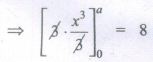
⇒ \({ \left[ { x }^{ 3 } \right] }_{ 0 }^{ a }=8\)
⇒ a3 - 0 = 8
⇒ a3 = 8
⇒ a3 = 23
⇒ a = 2
∴ a = 2
38.
Squaring both sides we get,
\(\left[ \sqrt { 1+\left( \frac { dy }{ dx } \right) ^{ 2 } } \right] ^{ 2 }\)= (4x)2 ⇒ 1+\(\left( \frac { dy }{ dx } \right) ^{ 2 }\)= 16x2
The highest derivative is of order 1and its power is 2
∴ order is 1 and degree is 2.
39.
We know Δ (f(x)) = f(x + h) -f(x)
Since h = 1, ∆ (f)) = f(x + 1) - f(x)
[∵ (x + 1)3 = x3 + 3x2 + 3x + 1]
⇒ Δ (x3) = (x + 1)3 - x3

⇒ Δ (x3) = 3x2 + 3x + 1
40.
Given (9D2−12D + 4)y = 0
The auxiliary equation is (3m - 2)2 = 0
(3m−2) (3m−2) = 0 ⇒ m = \(\frac 23,\frac 23\)
Roots are real and equal
The C.F. is (Ax + B)\({ e }^{ \frac { 2 }{ 3 } x }\)
The general solution is y = (Ax + B)\({ e }^{ \frac { 2 }{ 3 } x }\)
41.
ഽ\(\sqrt { { x }^{ 2 }-16 } \) dx = ഽ\(\sqrt { { x }^{ 2 }-{ 4 }^{ 2 } } \) dx
= \(\frac { x }{ 2 } \sqrt { { x }^{ 2 }-{ 4 }^{ 2 } } -\frac { { 4 }^{ 2 } }{ 2 } \log\left| x+\sqrt { { x }^{ 2 }-{ 4 }^{ 2 } } \right| +c\)
= \(\frac { x }{ 2 } \sqrt { { x }^{ 2 }-16 } -8 \log\left| x+\sqrt { { x }^{ 2 }-16 } \right| +c\)

12th Standard Syllabus & Materials
12th Standard
TN 12th Computer Applications வலையமைப்பு வடமிடல் Sample Question Papers Study Material - QB365 Set A
NEW12th Standard
TN 12th Computer Applications களப்பெயர் முறைமை (DNS) Sample Question Papers Study Material - QB365 Set A
NEW12th Standard
TN 12th Computer Applications வலையமைப்பு எடுத்துக்காட்டுகள் மற்றும் நெறிமுறைகள் Sample Question Papers Study Material - QB365 Set A
NEW12th Standard
TN 12th Computer Applications கணினி வலையமைப்பு ஓர் அறிமுகம் Sample Question Papers Study Material - QB365 Set A



Tamilnadu Stateboard 12th Standard Subjects

Maths

Chemistry

Physics

Biology

Computer Science
Business Maths and Statistics

Economics

Commerce

Accountancy

History

Computer Applications
Biology
Computer Technology
Computer Applications
Computer Science
Business Maths and Statistics
Commerce
Economics
Maths
Chemistry
Physics
Computer Technology
History
Accountancy

Tamil

English

French
Tamilnadu Stateboard Standards
