
 100% FREE ACCESS
12th Standard Syllabus & Materials
12th Standard
TN 12th Computer Applications மின்னணு தரவு பரிமாற்றம் Sample Question Papers Study Material - QB365 Set A
NEW12th Standard
TN 12th Computer Applications மின் - வணிக பாதுகாப்பு அமைப்புகள் Sample Question Papers Study Material - QB365 Set A
NEW12th Standard
TN 12th Computer Applications மின்னணு செலுத்தல் முறைகள் Sample Question Papers Study Material - QB365 Set A
NEW12th Standard
TN 12th Computer Applications மின் - வணிகம் Sample Question Papers Study Material - QB365 Set A
NEW12th Standard
TN 12th Computer Applications திறந்த மூல கருத்துருக்கள் Sample Question Papers Study Material - QB365 Set A
NEW12th Standard
TN 12th Computer Applications வலையமைப்பு வடமிடல் Sample Question Papers Study Material - QB365 Set A

Published on: 01/10/2019
Random Variable and Mathematical Expectation
Download Tamil Nadu 12th Standard Business Maths and Statistics question papers, model tests, one-mark questions, important questions, and public exam papers in PDF format. Free study materials and answer keys for TN State Board students.
Questions + Answers key
Take MCQ Business Maths and Statistics Test
1.
Suppose, the life in hours of a radio tube has the following p.d.f
\(f(x)=\left\{\begin{array}{l} \frac{100}{x^{2}}, \text { when } x \geq 100 \\ 0, \text { when } x<100 \end{array}\right.\)
Find the distribution function.
2.
The number of cars in a household is given below.
| No. of cars | 0 | 1 | 2 | 3 | 4 |
| No. of Household | 30 | 320 | 380 | 190 | 80 |
Estimate the probability mass function. Verify p(xi ) is a probability mass function.
3.
The amount of bread (in hundreds of pounds) x that a certain bakery is able to sell in a day is found to be a numerical valued random phenomenon, with a probability function specified by the probability density function f(x) is given by
\(f(x)=\left\{\begin{array}{l} Ax,for \ 0≤x10 \\ A(20−x),for \ 10 ≤x< 20 \\ 0,\quad \quad \quad otherwise \end{array}\right.\)
(a) Find the value of A.
(b) What is the probability that the number of pounds of bread that will be sold tomorrow is
(i) More than 10 pounds,
(ii) Less than 10 pounds, and
(iii) Between 5 and 15 pounds?
4.
A continuous random variable X has p.d.f
f(x) = 5x4, 0\(\le\)x\(\le\)1
Find a1 and a2 such that
i) P[X\(\le\)a1] = P[X>a1]
ii) P[X>a2] = 0.05
5.
Construct the distribution function for the discrete random variable X whose probability distribution is given below. Also draw a graph of p(x) and F(x).
| X = x | 1 | 2 | 3 | 4 | 5 | 6 | 7 |
| P(x) | 0.10 | 0.12 | 0.20 | 0.30 | 0.15 | 0.08 | 0.05 |
6.
A random variable X has the following probability function
| Values of X | 0 | 1 | 2 | 3 | 4 | 5 | 6 | 7 |
| p(x) | 0 | a | 2a | 2a | 3a | a2 | 2a2 | 7a2+a |
(i) Find a, Evaluate
(ii) P(X < 3),
(iii) P(X > 2) and
(iv) P(2 < X \(\leq\) 5).
7.
A continuous random variable X has the following p.d.f f(x) = ax, 0\(\le\)x\(\le\)1
Determine the constant a and also find P\(\\ \left[ X\le \frac { 1 }{ 2 } \right] \)
8.
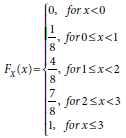
A coin is tossed thrice. Let X be the number of observed heads. Find the cumulative distribution function of X.
9.
Two unbiased dice are thrown simultaneously and sum of the upturned faces considered as random variable. Construct a probability mass function.

10.
\(\text { If } \ p(x) \ = \begin{cases}\frac{x}{20}, & x=0,1,2,3,4,5 \\ 0, & \text { otherwise }\end{cases}\)
Find
(i) P(X<3) and
(ii) P(2
1.
\(F(x)=\int _{ -\infty }^{ x }{ f(t)dt } \)
\(=\int _{ 100 }^{ x }{ \frac { 100 }{ { t }^{ 2 } } dt,\quad x\ge 100 } \)
\(={ \left[ \frac { 100 }{ -t } \right] }_{ 100 }^{ x },\quad x\ge 100\)
\(F(x)=\left[ 1-\frac { 100 }{ x } \right] ,\ge 100\)
2.
Let X be the number of cars
| X=xi | Number of Household | P(xi) |
| 0 | 30 | 0.03 |
| 1 | 320 | 0.32 |
| 2 | 380 | 0.38 |
| 3 | 190 | 0.19 |
| 4 | 80 | 0.08 |
| Total | 1000 | 1.00 |
i) P(xi)\(\ge\)0\(\forall \) i and
ii) \(\sum _{ i=1 }^{ \infty }{ P({ x }_{ i })=p(0)+p(1)+p(3)+p(4) } \)
= 0.03+0.32+0.38+0.19+0.08 = 1
Hence p(xi) is a probability mass function.
3.
(a) We know that
\(\int _{ -\infty }^{ \infty }{ f(x) } dx=1\)
\(\int _{ 0 }^{ 10 }{ Axdx } +\int _{ 10 }^{ 20 }{ A(20-x)dx=1 } \)
\(A\left\{ { \left[ \frac { { x }^{ 2 } }{ 2 } \right] }_{ 0 }^{ 10 }+{ \left[ 20x-\frac { { x }^{ 2 } }{ 2 } \right] }_{ 10 }^{ 20 } \right\} =1\)
A[(50-0)+(400-200)-(200-50)] = 1
\(A=\frac{1}{100}\)
(b) (i) The probability that the number of pounds of bread that will be sold tomorrow is more than 10 pounds is given by
\(P(10\le X\le 20)=\int _{ 10 }^{ 20 }{ \frac { 1 }{ 100 } (20-x) } dx\)
\(=\frac { 1 }{ 100 } { \left[ 20x-\frac { { x }^{ 2 } }{ 2 } \right] }_{ 10 }^{ 20 }\)
\(=\frac { 1 }{ 100 } [(400-200)-(200-50)]\)
= 0.5
(ii) The probability that the number of pounds of bread that will be sold tomorrow is less than 10 pounds, is given by
\(P(0\le X\le 20)=\int _{ 0 }^{ 10 }{ \frac { 1 }{ 100 } } xdx\)
\(=\frac { 1 }{ 100 } { \left[ \frac { { x }^{ 2 } }{ 2 } \right] }_{ 0 }^{ 10 }\)
\(=\frac { 1 }{ 100 } (50-0)\)
= 0.5
(ii) The probability that the number of pounds of bread that will be sold tomorrow is between 5 and 15 pounds is
\(P(5\le X \le15)=\int _{ 5 }^{ 10 }{ \frac { 1 }{ 100 } xdx } +\int _{ 10 }^{ 15 }{ \frac { 1 }{ 100 } (20-x)dx } \)
\(=\frac { 1 }{ 100 } { \left[ \frac { { x }^{ 2 } }{ 2 } \right] }_{ 5 }^{ 10 }+\frac { 1 }{ 100 } { \left[ 20x-\frac { { x }^{ 2 } }{ 2 } \right] }_{ 10 }^{ 15 }\)
= 0.75
4.
i) Since P[X\(\le\)a1] = P[X>a1]
\(P[X\le { a }_{ 1 }]=\frac { 1 }{ 2 } \)
\(i.e., \int _{ 0 }^{ { a }_{ 1 } }{ f(x)dx } =\frac { 1 }{ 2 } \)
\(i.e., \int _{ 0 }^{ { a }_{ 1 } }{ { 5x }^{ 4 } } dx=\frac { 1 }{ 2 } \)
\(5{ { \left[ \frac { { x }^{ 5 } }{ 5 } \right] } }_{ { 0 }_{ } }^{ a1 }=1/2\)
\({ a }_{ 1 }={ (0.5) }^{ \frac { 1 }{ 5 } }\)
ii) \(P[X>{ a }_{ 2 }]=0.05\)
\(\int _{ { a }_{ 2 } }^{ 1 }{ { f(x })dx=0.05 } \)
\(\int _{ { a }_{ 2 } }^{ 1 }{ { 5x }^{ 4 }dx=0.05 } \)
\(5{ { \left[ \frac { { x }^{ 5 } }{ 5 } \right] } }_{ { a }_{ 2 } }^{ 1 }=0.05\)
\({ a }_{ 2 }={ [0.95] }^{ \frac { 1 }{ 5 } }\)
5.
From the values of p(x) given in the probability distribution, we obtain
F(1) = P(x\(\le\)1) = P(1) = 0.10
F(2) = P(x\(\le\)2) = P(1) + P(2)
= 0.10+0.12 = 0.22
F(3) = P(x\(\le\)3) = P(1)+P(2)+P(3)
= F(2)+P(3)
= 0.22+0.20
= 0.42
F(4) = F(3)+P(4)
= 0.42+0.30
= 0.72
F(5) = F(4)+P(5)
= 0.72+0.15
= 0.87
F(6) = F(5)+P(6)
= 0.87+0.08
= 0.95
F(7) = F(6)+P(7)
= 0.95+0.05
= 1.00
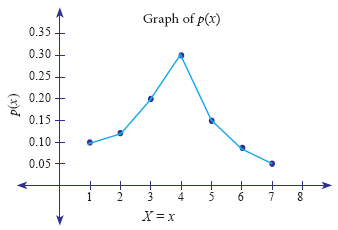
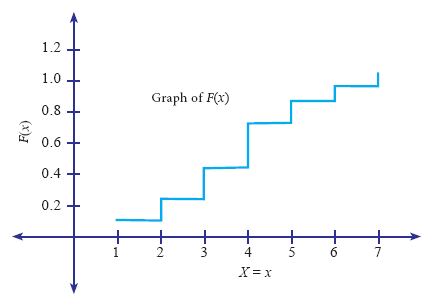
\(F(x) \text { is } F_{x}(x)= \begin{cases}0, & \text { if } x<1 \\ 0.10, & \text { if } x \leq 1 \\ 0.22, & \text { if } x \leq 2 \\ 0.42, & \text { if } x \leq 3 \\ 0.72, & \text { if } x \leq 4 \\ 0.87, & \text { if } x \leq 5 \\ 0.95, & \text { if } x \leq 6 \\ 1, & \text { if } x \leq 7\end{cases}\)
6.
\(\sum _{ i=1 }^{ \infty }{ p({ x }_{ i }) } =1\)
\(\therefore\) \(\sum _{ i=0 }^{ 7 }{ p({ x }_{ i }) } =1\)
0+a+2a+2a+3a+a2+2a2+7a2+a = 1
10a2+9a–1 = 0
(10a–1)(a+1) = 0
a = \(\frac{1}{10}\)and -1
Since p(x) cannot be negative, a = – 1 is not applicable. Hence, a = \(\frac{1}{10}\)
ii) P(X<3) = P(X = 0)+P(X=1)+P(X = 2)
= 0+a+2a
= 3a
\(\\ =\frac { 3 }{ 10 } \left( \because a=\frac { 1 }{ 10 } \right) \)
(iii) P(X>2) = 1-P(X\(\le\)2)
= 1-[P(X = 0)+P(X=1)+P(X=2)
= 1-\(\frac{3}{10}\)
= \(\frac{7}{10}\)
iv) P(2< x
= 2a+3a+a2
= 5a+a2
= \(\frac{5}{10}+\frac{1}{100}\)
\(=\frac{51}{100}\)
7.
We know that
\(\int _{ -\infty }^{ \infty }{ f(x)dx=1 } \)
\(\int _{ 0 }^{ -\infty }{ ax\quad dx } \Rightarrow a\int _{ 0 }^{ 1 }{ xdx=1 } \)
\(\Rightarrow a{ \left( \frac { { x }^{ 2 } }{ 2 } \right) }^{ 1 }=1\)
\(\Rightarrow \frac { a }{ 2 } (1-0)=1\)
\(\Rightarrow\)a = 2
\(P\left[ x\le \frac { 1 }{ 2 } \right] =\int _{ -\infty }^{ \frac { 1 }{ 2 } }{ f(x)dx } \)
\(=\int _{ 0 }^{ \frac { 1 }{ 2 } }{ axdx } \)
\(=\int _{ 0 }^{ \frac { 1 }{ 2 } }{ 2xdx } \)
\(=\frac { 1 }{ 4 } \)
8.
The sample space (S) = { (HHH), (HHT), (HTH), (HTT), (THH), (THT), (TTH), (TTT)}
X takes the values: 3, 2, 2, 1, 2, 1, 1, and 0
| Range of X(Rx) | 0 | 1 | 2 | 3 |
| Px(x) | \(\frac{1}{8}\) | \(\frac{3}{8}\) | \(\frac{3}{8}\) | \(\frac{1}{8}\) |
| Fx(x) | \(\frac{1}{8}\) | \(\frac{4}{8}\) | \(\frac{7}{8}\) | 1 |
Thus, we have
9.
Sample space \((s)=\left\{ \begin{matrix} (1,1) & (1,2) & (1,3) \\ (2,1) & (2,2) & (2,3) \\ \begin{matrix} (3,1) \\ (4,1) \\ \begin{matrix} (5,1) \\ (6,1) \end{matrix} \end{matrix} & \begin{matrix} (3,2) \\ (4,2) \\ \begin{matrix} (5,2) \\ (6,2) \end{matrix} \end{matrix} & \begin{matrix} (3,3) \\ (4,3) \\ \begin{matrix} (5,3) \\ (6,3) \end{matrix} \end{matrix} \end{matrix}\begin{matrix} (1,4) & (1,5) & (1,6) \\ (2,4) & (2,5) & (2,6) \\ \begin{matrix} (3,4) \\ (4,4) \\ \begin{matrix} (5,4) \\ (6,4) \end{matrix} \end{matrix} & \begin{matrix} (3,5) \\ (4,5) \\ \begin{matrix} (5,5) \\ (6,5) \end{matrix} \end{matrix} & \begin{matrix} (3,6) \\ (4,6) \\ \begin{matrix} (5,6) \\ (6,6) \end{matrix} \end{matrix} \end{matrix} \right\} \)
Total outcomes : n(S) = 36
10.
P(X<3) = P(X = 1)+P(X = 2)
\(=0+\frac{1}{20}+\frac{2}{20}\) = \(\frac{3}{20}\)
P(2
\(=\frac{3}{20}+\frac{4}{20}\) = \(\frac{7}{20}\)

12th Standard Syllabus & Materials
12th Standard
TN 12th Computer Applications களப்பெயர் முறைமை (DNS) Sample Question Papers Study Material - QB365 Set A
NEW12th Standard
TN 12th Computer Applications வலையமைப்பு எடுத்துக்காட்டுகள் மற்றும் நெறிமுறைகள் Sample Question Papers Study Material - QB365 Set A
NEW12th Standard
TN 12th Computer Applications கணினி வலையமைப்பு ஓர் அறிமுகம் Sample Question Papers Study Material - QB365 Set A
NEW12th Standard
TN 12th Computer Applications PHP-உடன் MySQL-ஐ இணைத்தல் Sample Question Papers Study Material - QB365 Set A



Tamilnadu Stateboard 12th Standard Subjects

Maths

Chemistry

Physics

Biology

Computer Science
Business Maths and Statistics

Economics

Commerce

Accountancy

History

Computer Applications
Biology
Computer Technology
Computer Applications
Computer Science
Business Maths and Statistics
Commerce
Economics
Maths
Chemistry
Physics
Computer Technology
History
Accountancy

Tamil

English

French
Tamilnadu Stateboard Standards
