
 100% FREE ACCESS
12th Standard Syllabus & Materials
12th Standard
TN 12th Computer Applications மின்னணு தரவு பரிமாற்றம் Sample Question Papers Study Material - QB365 Set A
NEW12th Standard
TN 12th Computer Applications மின் - வணிக பாதுகாப்பு அமைப்புகள் Sample Question Papers Study Material - QB365 Set A
NEW12th Standard
TN 12th Computer Applications மின்னணு செலுத்தல் முறைகள் Sample Question Papers Study Material - QB365 Set A
NEW12th Standard
TN 12th Computer Applications மின் - வணிகம் Sample Question Papers Study Material - QB365 Set A
NEW12th Standard
TN 12th Computer Applications திறந்த மூல கருத்துருக்கள் Sample Question Papers Study Material - QB365 Set A
NEW12th Standard
TN 12th Computer Applications வலையமைப்பு வடமிடல் Sample Question Papers Study Material - QB365 Set A

Published on: 19/09/2019
Random Variable and Mathematical Expectation
Download Tamil Nadu 12th Standard Business Maths and Statistics question papers, model tests, one-mark questions, important questions, and public exam papers in PDF format. Free study materials and answer keys for TN State Board students.
Questions + Answers key
Take MCQ Business Maths and Statistics Test
1.
The p.d.f. of X is defined as \(f(x)= \begin{cases}k & \text { for } 0< x \leq 4 \\ 0, & \text { otherwise }\end{cases}\)
2.
In a business venture a man can make a profit of Rs. 2,000 with a probability of 0.4 or have a loss of Rs. 1,000 with a probability of 0.6. What is his expected, variance and standard deviation of profit?
3.
State the properties of distribution function.
4.
The discrete random variable X has the following probability function \(P(X=x) = \begin{cases}kx & x =2, 4, 6 \\ k(x - 2), & x = 8 \\ 0, & \text { otherwise } \\ \end{cases}\) where k is a constant. Show that k = \(\frac{1}{18}\)
5.
State the definition of Mathematical expectation using continuous random variable.
6.
Define Mathematical expectation in terms of discrete random variable.
7.
In an investment, a man can make a profit of Rs. 5,000 with a probability of 0.62 or a loss of Rs. 8,000 with a probability of 0.38. Find the expected gain.
8.
Find the expected value for the random variable of an unbiased die
9.
Distinguish between discrete and continuous random variable.
10.
Describe what is meant by a random variable.
11.
What do you understand by continuous random variable?
12.
The discrete random variable X has the probability function
| X | 1 | 2 | 3 | 4 |
| P(X=x) | k | 2k | 3k | 4k |
Show that k = 0.1.
13.
The probability function of a random variable X is given by
\(p(x)=\left\{\begin{array}{l} \frac{1}{4}, \text { for } x=-2 \\ \frac{1}{4}, \text { for } x=0 \\ \frac{1}{2}, \text { for } x=10 \\ 0, \text { elsewhere } \end{array}\right.\)
Evaluate the following probabilities.
P(0\(\le\)X\(\le\)10)
14.
The probability function of a random variable X is given by
\(p(x)=\left\{\begin{array}{l} \frac{1}{4}, \text { for } x=-2 \\ \frac{1}{4}, \text { for } x=0 \\ \frac{1}{2}, \text { for } x=10 \\ 0, \text { elsewhere } \end{array}\right.\)
Evaluate the following probabilities.
P(X<0)
15.
A continuous random variable X has the following distribution function:
\(f(x)=\left\{\begin{array}{l} 0 , \text{if} \ x \leq1 \\ k(x-1)^4, \text{if} \ 1< x \leq 3 \\ 1, \text{if} \ x > 3 \end{array}\right.\)
Find (i) k and (ii) the probability density function.
1.
Given p.d.f. is
Since f(x) is a p.d.f.\(\int _{ -\infty }^{ \infty }{ f(x)dx=1 } \)
\(\Rightarrow \int _{ 0 }^{ 4 }{ kdx=1\Rightarrow k\int _{ 0 }^{ 4 }{ dx=1\Rightarrow k{ [x] }_{ 0 }^{ 4 }=1 } } \)
\(\Rightarrow k(4-0)=1\Rightarrow 4k=1\Rightarrow k=\frac { 1 }{ 4 } \)
Also P(2≤x≤4) =\(\int _{ 0 }^{ 4 }{ f(x)dx } \)
\(=2\int _{ 2 }^{ 4 }{ kdx=\int _{ 2 }^{ 4 }{ \frac { 1 }{ 4 } dx=\frac { 1 }{ 4 } \int _{ 2 }^{ 4 }{ dx } } } \)
\(=\frac { 1 }{ 4 } { [x] }_{ 2 }^{ 4 }=\frac { 1 }{ 4 } (4-2)=\frac { 2 }{ 4 } =\frac { 1 }{ 2 } \)
\(\\ \therefore P(2\le X\le 4)=\frac { 1 }{ 2 } \)
2.
Since the profit is Rs. 2000 and the loss is Rs. 1000
X can take values 2000 and -1000.
∴ The probability mass function is
| X = x | 2000 | -1000 |
| P(X = x) | 0.4 | 0.6 |
∴ Expected profit E(X) = Σxp(x)
= 2000(0.4)-1000(0.6)
= 800-600
E(X) = Rs. 200
E(X2) = Σx2p(x)
= 20002(0.4)-10002(0.6)
= 1600000+600000
= 2200000
∴ Var(X) = E(X2)-[E(X)]2
= 2200000-(200)2
= 2200000-40000
= 2160000.
Standard deviation = \(\sqrt{variance}=\sqrt{2160000}\)
= 1469.69.
3.
1) 0≤F(x)≤1, -∞
2) F(-∞) = 0 and F(∞) = 1
3) is a non-decreasing function, F(a) ≤F(b) for a
4) \(\underset { h\rightarrow 0 }{ lim } \) F(x+h) = F(x), since F(x) is continuous from the right
5) F'(x) = f(x)≥0
6) P(a≤x≤b) = F(b)-F(a)
4.
Given probability distribution function is
\(= \begin{cases}kx & x =2, 4, 6 \\ k(x - 2), & x = 8 \\ 0, & \text { otherwise } \\ \end{cases}\)
where k is a constant
| X = x | 2 | 4 | 6 | 8 |
| P(X=x) | 2k | 4k | 6k | k(8-2) = 6k |
Since the given function is a probability distribution function, each ρi>0Σ ρi=1
⇒ 2k+4k+6k+6k = 1
⇒ 18 k = 1
⇒ k = \(\frac{1}{18}\)
5.
If X is a continuous random variable and f(x) is the value of its probability density function at x, then the expected value of X is
\(E(X)=\int _{ -\infty }^{ \infty }{ x.(x)dx } \)
6.
Let X be a discrete random variable with probability mass function p(x), then its expected value is defined by
E(X) =\(\sum _{ x }^{ }{ x.p(x) } \)
7.
Given that in an investment profit is Rs. 5000 with probability of 0.62 or a loss of Rs.8000 with a probability of 0.38.
Hence, the probability mass function is
| X = x | 5000 | -8000 |
| P(X = x) | 0.61 | 0.38 |
∴ Expected gain E(X) = 5000(0.62) - 8000 (0.32)
= 3100-3040
= Rs. 60
Hence, the expected gain is = Rs. 60
8.
S = {1, 2, 3, 4, 5, 6}⇒ n(s) = 6
∴ X takes the values 1, 2, 3, 4, 5, 6
P(X = 1) = \(\frac{1}{6}\)
P(X = 2) = \(\frac{1}{6}\)
P(X = 3) = \(\frac{1}{6}\)
P(X = 4) = \(\frac{1}{6}\)
P(X = 5) = \(\frac{1}{6}\)
P(X = 6) = \(\frac{1}{6}\)
[Since in all the cases, only one favourable event and total no of events is 6]
∴ The probability mass function is
| X = x | 1 | 2 | 3 | 4 | 5 | 6 |
| P(X = x) | \(\frac{1}{6}\) | \(\frac{1}{6}\) | \(\frac{1}{6}\) | \(\frac{1}{6}\) | \(\frac{1}{6}\) | \(\frac{1}{6}\) |
∴ Expected value for the random value of an unbiased die
\(E(X)=\sum _{ i=1 }^{ 6 }{ xp(x) } \)
\(=1(\frac { 1 }{ 6 } )+2(\frac { 1 }{ 6 } )+3(\frac { 1 }{ 6 } )+4(\frac { 1 }{ 6 } )+5(\frac { 1 }{ 6 } )+6(\frac { 1 }{ 6 } )\)
\(=\frac { 1+2+3+4+5+6 }{ 6 } =\frac { 21 }{ 6 } =\frac { 7 }{ 2 } \)
\(\\ \therefore E(X)=3.5\)
9.
| Discrete random variable | Continuous random variable | |
| 1. | Finite number of possible values | Takes any value in the interval |
| 2. | p(xi) ≥ 0 ∀i, \(\sum _{ i=1 }^{ n }{ p({ x }_{ i })=1 } \) |
f(x) ≥ 0 ∀x and \(\\ \int _{ -\infty }^{ \infty }{ f(x)dx=1 } \) |
10.
When we perform any experiment, we expect an outcome. We associate a real numbers with each outcome of an experiment. In other words, we considering a function whose domain is the set of possible outcomes and whose range is subset of the set of real numbers such a function is called random variable.
11.
Continuous random variable :
A random variable X which can take on any value (integral as well as fraction) in the interval is called continuous random variable. For eg., height of students in a school.
12.
The given probability function is
| X | 1 | 2 | 3 | 4 |
| P(X = x) | k | 2k | 3k | 4k |
Since the given function is a probability function, each ρi>0 and Σρi = 1
⇒ k + 2k + 3k + 4k = 1
⇒10k = 1 ⇒ k = \(\frac{1}{10}\)
⇒ k = 0.1
13.
Given probability function is
\(p(x)=\left\{\begin{array}{l} \frac{1}{4}, \text { for } x=-2 \\ \frac{1}{4}, \text { for } x=0 \\ \frac{1}{2}, \text { for } x=10 \\ 0, \text { elsewhere } \end{array}\right.\)
| X=x | -2 | 0 | 10 |
| P(X=x) | \(\frac{1}{4}\) | \(\frac{1}{4}\) | \(\frac{1}{2}\) |
P(0≤X≤10)=P(X=0)+P(X=10)
\(\frac{1}{4}+\frac{1}{2}=\frac{3}{4}\)
14.
Given probability function is
\(p(x)=\left\{\begin{array}{l} \frac{1}{4}, \text { for } x=-2 \\ \frac{1}{4}, \text { for } x=0 \\ \frac{1}{2}, \text { for } x=10 \\ 0, \text { elsewhere } \end{array}\right.\)
| X=x | -2 | 0 | 10 |
| P(X=x) | \(\frac{1}{4}\) | \(\frac{1}{4}\) | \(\frac{1}{2}\) |
P(X<0)=P(X=-2)
= 1/4
15.
We have F(x) = f(x) ≥ 0, where F(x) is the distribution function and f(x) is the probability density function.
Here F(x) = 0 for x ≤ 1 f(x) = 0 for x ≤ 1
Again F(x) = 1 for x > 3
f(x) = d/dx (1) = 0 for x > 3
In 1 < x ≤ 3, F(x) = k(x – 1)4
f(x) = d/dx (k(x – 1)4) = 4k(x – 1)3
\(\therefore f(x)=4k{ (x-1) }^{ 3 }for\quad 1\le x\le 3\)
i) Since f(x) is a probability density function,
\(\int _{ 1 }^{ 3 }{ f(x)dx=1 } \)
\(\Rightarrow \int _{ 1 }^{ 3 }{ { 4k(x-1) }^{ 3 }dx=1 } \)
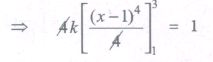
\(\Rightarrow k[{ (3-1) }^{ 4 }-{ (0) }^{ 4 }]=1\)
\(\Rightarrow k({ 2 }^{ 4 })=1\Rightarrow k(16)=1\)
\(\Rightarrow k=\frac { 1 }{ 16 } \)
ii) \(\therefore\)p.d.f
\(f(x)=\frac { 4\times 1 }{ 16 } { (x-1) }^{ 3 }for\quad 1\le x\le 3\)
\(f(x)=\frac { 1 }{ 4 } { (x-1) }^{ 3 }for\quad 1\le x\le 3\)

12th Standard Syllabus & Materials
12th Standard
TN 12th Computer Applications களப்பெயர் முறைமை (DNS) Sample Question Papers Study Material - QB365 Set A
NEW12th Standard
TN 12th Computer Applications வலையமைப்பு எடுத்துக்காட்டுகள் மற்றும் நெறிமுறைகள் Sample Question Papers Study Material - QB365 Set A
NEW12th Standard
TN 12th Computer Applications கணினி வலையமைப்பு ஓர் அறிமுகம் Sample Question Papers Study Material - QB365 Set A
NEW12th Standard
TN 12th Computer Applications PHP-உடன் MySQL-ஐ இணைத்தல் Sample Question Papers Study Material - QB365 Set A



Tamilnadu Stateboard 12th Standard Subjects

Maths

Chemistry

Physics

Biology

Computer Science
Business Maths and Statistics

Economics

Commerce

Accountancy

History

Computer Applications
Biology
Computer Technology
Computer Applications
Computer Science
Business Maths and Statistics
Commerce
Economics
Maths
Chemistry
Physics
Computer Technology
History
Accountancy

Tamil

English

French
Tamilnadu Stateboard Standards
