
 100% FREE ACCESS
12th Standard Syllabus & Materials
12th Standard
TN 12th Computer Applications மின்னணு தரவு பரிமாற்றம் Sample Question Papers Study Material - QB365 Set A
NEW12th Standard
TN 12th Computer Applications மின் - வணிக பாதுகாப்பு அமைப்புகள் Sample Question Papers Study Material - QB365 Set A
NEW12th Standard
TN 12th Computer Applications மின்னணு செலுத்தல் முறைகள் Sample Question Papers Study Material - QB365 Set A
NEW12th Standard
TN 12th Computer Applications மின் - வணிகம் Sample Question Papers Study Material - QB365 Set A
NEW12th Standard
TN 12th Computer Applications திறந்த மூல கருத்துருக்கள் Sample Question Papers Study Material - QB365 Set A
NEW12th Standard
TN 12th Computer Applications வலையமைப்பு வடமிடல் Sample Question Papers Study Material - QB365 Set A

Published on: 21/09/2019
Download Tamil Nadu 12th Standard Business Maths and Statistics question papers, model tests, one-mark questions, important questions, and public exam papers in PDF format. Free study materials and answer keys for TN State Board students.
Questions + Answers key
Take MCQ Business Maths and Statistics Test
1.
Evaluate
\(\int _{ 0 }^{ \infty }{ { e }^{ -2x }{ x }^{ 5 }dx } \)
2.
Find the order and degree of the following differential equations.
\({ \left( \frac { dy }{ dx } \right) }^{ 3 }+y=x-\frac { dx }{ dy } \)
3.
Define critical value.
4.
Find the rank of each of the following matrices.
\(\left( \begin{matrix} 5 & 6 \\ 7 & 8 \end{matrix} \right) \)
5.
Find the rank of the matrix \(\begin{pmatrix} 1 & 5 \\ 3 & 9 \end{pmatrix}\)
6.
From the following table obtain a polynomial of degree y in x
| x | 1 | 2 | 3 | 4 | 5 |
| y | 1 | -1 | 1 | -1 | 1 |
7.
The normal lines to a given curve at each point(x,y) on the curve pass through the point (1, 0). The curve passes through the point (1, 2). Formulate the differential equation representing the problem and hence find the equation of the curve.
8.
Evaluate the following using properties of definite integrals:
\(\int _{ 0 }^{ 1 }{ \log\left( \frac { 1 }{ x } -1 \right) dx } \)
9.
Solve by Cramer’s rule x + y + z = 4, 2x − y + 3z = 1, 3x + 2y − z = 1
10.
E f (x)= _______.
f(x− h)
f (x)
f(x+ h)
f(x+ 2h)
11.
The particular integral of the differential equation is \(\frac { { d }^{ 2 }y }{ d{ x }^{ 2 } } -8\frac { dy }{ dx } \) + 16y = 2e4x ______.
\(\frac { { x }^{ 2 }{ e }^{ 4x } }{ 2! } \)
\(\frac { { e }^{ 4x } }{ 2! } \)
x2e4x
xe4x
12.
\(\int _{ 0 }^{ \frac { \pi }{ 3 } }\)tanx dx is _______.
log 2
0
log\(\sqrt { 2 } \)
2 log 2
13.
ഽ\(\frac { { 2x }^{ 3 } }{ 4+{ x }^{ 4 } } \)dx is _______.
\(log\left| 4+{ x }^{ 4 } \right| +c\)
\(\frac { 1 }{ 2 } log\left| 4+{ x }^{ 4 } \right| +c\)
\(\frac { 1 }{4 } log\left| 4+{ x }^{ 4 } \right| +c\)
\(log\left| \frac { { 2x }^{ 3 } }{ { 4+x }^{ 4 } } \right| +c\)
14.
If the marginal revenue MR = 35 + 7x − 3x2, then the average revenue AR is ________.
35x + \(\frac { 7{ x }^{ 2 } }{ 2 } -{ x }^{ 3 }\)
35x + \(\frac { 7{ x }^{ 2 } }{ 2 } -{ x }^{ 2 }\)
35 +\(\frac { 7{ x }^{ 2 } }{ 2 } +{ x }^{ 2 }\)
35 + 7x + x2
15.
The system of linear equations x + y + z = 2, 2x + y − z = 3, 3x + 2y + k = 4 has unique solution, if k is not equal to _______.
4
0
-4
1
16.
The rank of m x n matrix whose elements are unity is ________.
0
1
m
n
17.
18.
Solve : (D2−4D−1)y = e−3x
19.
Assume the mean height of children to be 69.25 cm with a variance of 10.8 cm. How many children in a school of 1,200 would you expect to be over 74 cm tall?
20.
Evaluate ഽ\(\frac { dx }{ x^{ 2 }-3x+2 } \)
21.
Calculate the producer’s surplus at x = 5 for the supply function p = 7 + x.
22.
If f'(x) = x + b, f(1)= 5 and f(2) = 13, then find f(x)
23.
A set of values of the variable x1,x2,...xn satisfying all the equations simultaneously is called__________ of the system
24.
The system of linear equations x + y + Z = 2, 2x + Y - z = 3, 3x + 2y + kz = 4 has a unique solution if k is_______
25.
If A is a square matrix such that A2 = I, then A-1=_______
26.
If A is a square matrix of order n, then |Adj A|=______
27.
E (Δf(x))
28.
y = mx
29.
\(\Gamma (n)\quad \)
30.
R(x)
31.
R
1.
we know that
\(\int _{ 0 }^{ \infty }{ { e }^{ -2x }{ x }^{ 5 }dx } \) = \(\frac { n! }{ { a }^{ n+1 } } \)
\(∴\int _{ 0 }^{ \infty }{ { e }^{ -2x }{ x }^{ 5 } } dx=\frac { 5! }{ { 2 }^{ 5+1 } } =\frac { 5! }{ { 2 }^{ 6 } } \)
2.
\(\left( \frac { dy }{ dx } \right) ^{ 3 }+y=x-\frac { 1 }{ \left( \frac { dy }{ dx } \right) } \)
⇒ \(\left( \frac { dy }{ dx } \right) ^{ 3 }+y=\frac { x\left( \frac { dy }{ dx } \right) -1 }{ \left( \frac { dy }{ dx } \right) } \)
⇒ \(\left( \frac { dy }{ dx } \right) ^{ 4 }+y\left( \frac { dy }{ dx } \right) =x\left( \frac { dy }{ dx } \right) -1\)
The highest derivative is of first order and its power is 3.
∴ Order is 1 and degree is 4.
3.
The value of test statistic which separates the critical (or rejection) region and the acceptance region is called the critical value or significant value.
4.
Let \(A=\left( \begin{matrix} 5 & 6 \\ 7 & 8 \end{matrix} \right) \)
Order of A is 2 \(\times\) 2
\(\therefore \rho (A)\le 2\) [Since minimum of (2, 2) is 2]
Consider the second order minor
\(\left| \begin{matrix} 5 & 6 \\ 7 & 8 \end{matrix} \right| =40-42\)
= \(-2\neq 0\)
There is a minor of order 2, which is not zero
\(\therefore \rho (A)=2\)
5.
Let A =\(\begin{pmatrix} 1 & 5 \\ 3 & 9 \end{pmatrix}\)
Order of A is 2 \(\times\) 2
∴ \(\rho \) (A) \(\le \) 2
Consider the second order minor
\(\begin{vmatrix} 1 & 5 \\ 3 & 9 \end{vmatrix}=-6\neq 0\)
There is a minor of order 2, which is not zero.
∴ \(\rho \) (A) \(\le \) 2
6.
Given
The difference table is
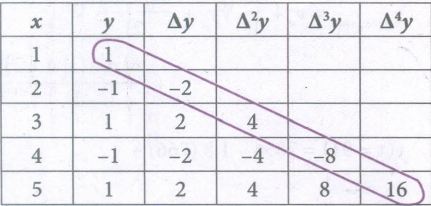
To findy when x = x ⇒ x0+ nh = x ⇒ 1 + n (1) = x ⇒ n = x-1
Newton's forward interpolation formula is
y(x=x) = \(\frac { n }{ 1! } { \triangle y }_{ 0 }+\frac { n(n+1) }{ 2! } { \triangle }^{ 2 }{ y }_{ 0 }+\frac { n(n+1)(n+2) }{ 3! } { \triangle }^{ 3 }{ y }_{ 0 }\)+ .....
y(x=x) = 1 + (x-1)(-2) + \(\frac { (x-1)(x-2) }{ 2 } (4)+\frac { (x-1)(x-2)(x-3) }{ 6 } (-8)+\frac { (x-1)(x-2)(x-3)(x-4) }{ 24 } (16)\)
⇒ y = 1 - 2x + 2(x2 - 3x + 2) - \(\frac{4}{3}\) (x - 1) (x - 2) (x - 3) + \(\frac{2}{3}\) (x - 1) (x - 2) (x - 3) (x -4)
⇒ y = 3 - 2x + 2x2 - 6x + 4 - \(\frac{4}{3}\) [(x2 - 3x + 2) (x- 3)] + \(\frac{2}{3}\) [(x2 - 3x + 2)(x2 - 7x + 12)]
⇒ y = 2x2 - 8x+ 7- \(\frac{4}{3}\) [x3- 3x2+ 2x- 3x2 + 9x- 6] + \(\frac{2}{3}\) [x4 - 3x3 + 2x2 - 7x3 + 21x2 - 14x + 12x2 - 36x + 24]
⇒ y = 2x2-8x+7- \(\frac{4}{3}\) x3 + 4x2 - \(\frac{8}{3}\) x + 4x2 - 12x + 8 + \(\frac { { 12x }^{ 4 } }{ 3 } -\frac { 20 }{ 3 } { x }^{ 3 }+\frac { 70 }{ 3 } { x }^{ 2 }-\frac { 100x }{ 3 } +\frac { 48 }{ 3 } \)
⇒ y = \(\frac{2}{3}\) x4 + x3 \(\left( \frac { -4 }{ 3 } \frac { -20 }{ 3 } \right) \) + x2\(\left( 2+4+4+\frac { 70 }{ 3 } \right) \) + x \(\left( -8-\frac { 8 }{ 3 } -12-\frac { 100 }{ 3 } \right) \) + 31
⇒ y = \(\frac{2}{3}\) x4 - 8x3 + \(\frac{100}{3}\) x2 - 56x + 31 which is the required polynomial.
7.
Slope of the normal at any point P(x, y) = -\(\frac { dx }{ dy } \)
Let Q be (1, 0)
Slope of the normal PQ is \(\frac { { y }_{ 2 }-{ y }_{ 1 } }{ { x }_{ 2 }-{ x }_{ 1 } } \)
i.e, \(\frac { y-0 }{ x-1 } =\frac { y }{ x-1 } \)
∴ \(\frac { dx }{ dy } =\frac { y }{ x-1 } \) ⇒ \(\frac { dx }{ dy } =\frac { y }{ 1-x } \), which is the differential equation
i.e., (1− x)dx = ydy
ഽ(1−x)dx = ഽydy + c
\(x-\frac { { x }^{ 2 } }{ 2 } =\frac { { y }^{ 2 } }{ 2 } +c\) ....(1)
Since it passes through (1,2)
1 - \(\frac { 1 }{ 2 } =\frac { 4 }{ 2 } +c\)
\(c=\frac { 1 }{ 2 } -2=\frac { 4 }{ 2 } +c\)
Put \(c = \frac { -3 }{ 2 } \) in (1)
\(x-\frac { { x }^{ 2 } }{ 2 } =\frac { { y }^{ 2 } }{ 2 } -\frac { 3 }{ 2 } \)
2x − x2 = y2 − 3
⇒ y2 = 2x−x2 + 3, which is the equation of the curve
8.
Let I = \(\int _{ 0 }^{ 1 }{ \log { \left( \frac { 1 }{ x } -1 \right) } } dx\)
\(I=\int _{ 0 }^{ 1 }{ \log { \left( \frac { 1-x }{ x } \right) } } dx\) ---(1)
By the property, \(\int _{ 0 }^{ a }{ f\left( x \right) dx=\int _{ 0 }^{ a }{ f\left( a-x \right) } } dx\)
\(I=\int _{ 0 }^{ 1 }{ \log { \left( \frac { 1-(1-x) }{ 1-x } \right) } } dx\)
\(I=\int _{ 0 }^{ 1 }{ \log { \left( \frac { 1-1+x }{ 1-x } \right) } } dx\)
\(=\int _{ 0 }^{ 1 }{ \log { \left( \frac { x }{ 1-x } \right) } } dx\) ---(2)
Adding (1) and (2) we get,
\(2I=\int _{ 0 }^{ 1 }{ \left[ \log { \left( \frac { 1-x }{ x } \right) } +\log { \left( \frac { x }{ 1-x } \right) } \right] } dx\)
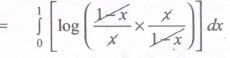
[∵ log m + log n= log mn]
\(=\int _{ 0 }^{ 1 }{ \log { 1 } } dx=0\) [∵ log 1 = 0]
2I = 0
⇒ I = 0
9.
Here \(\triangle =\left| \begin{matrix} 1 & 1 & 1 \\ 2 & -1 & 3 \\ 3 & 2 & -1 \end{matrix} \right| =13\neq 0\)
\(\therefore \) We can apply Cramer’s Rule and the system is consistent and it has unique solution.
\({ \triangle }_{ x }=\left| \begin{matrix} 1 & 1 & 1 \\ 2 & -1 & 3 \\ 3 & 2 & -1 \end{matrix} \right| =-13\)
\( { \triangle }_{ y }=\left| \begin{matrix} 1 & 4 & 1 \\ 2 & 1 & 3 \\ 3 & 1 & -1 \end{matrix} \right| =39\)
\( { \triangle }_{ z }=\left| \begin{matrix} 1 & 1 & 4 \\ 2 & -1 & 1 \\ 3 & 2 & 1 \end{matrix} \right| =26\)
\(\therefore \) By Cramer’s rule
\(x=\frac { { \triangle }x }{ { \triangle } } =\frac { -13 }{ 13 } =-1\)
\( y=\frac { { \triangle }y }{ { \triangle } } =\frac { 39 }{ 13 } =3\)
\( z=\frac { { \triangle }z }{ { \triangle } } =\frac { 26 }{ 13 } =2\)
\(\therefore \) The solution is (x, y, z) = (−1, 3, 2)
10.
(c)
f(x+ h)
11.
(c)
x2e4x
12.
(a)
log 2
13.
(b)
\(\frac { 1 }{ 2 } log\left| 4+{ x }^{ 4 } \right| +c\)
14.
(b)
35x + \(\frac { 7{ x }^{ 2 } }{ 2 } -{ x }^{ 2 }\)
15.
(b)
0
16.
(b)
1
17.
18.
(D2−4D−1)y = e−3x
The auxiliary equation is
m2−4m−1 = 0
(m−2)2−4−1 = 0
(m− 2)2 = 5
\(m-2=±\sqrt { 5 } \)
\(m=2±\sqrt5\)
C.F = Ae\((2+\sqrt5)x\) + Be\((2-\sqrt5)x\)
\(PI=\frac { 1 }{ \phi (D) } f(x)\)
= \(\frac { 1 }{ { D }^{ 2 }-4D-1 } { e }^{ -3x }\)
\(=\frac { 1 }{ { (-3) }^{ 2 }-4(-3)-1 } { e }^{ -3x }\) (Replace D by −3)
\(=\frac { 1 }{ 9+12-1 } { e }^{ -3x }\)
\(=\frac { e^{ -3x } }{ 20 } \)
Hence the general solution is y = C.F+P.I
⇒ y = Ae\((2+\sqrt5)x\) + Be\((2-\sqrt5)x\)+\(\frac { e^{ -3x } }{ 20 } \)
19.
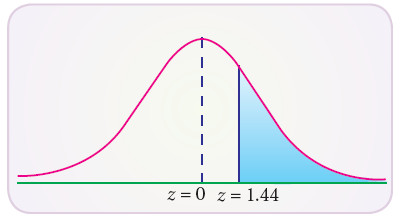
Let the distribution of heights be normally distributed with mean mean 68.22 and standard deviation = 3.286
\(Z=\frac { X-\mu }{ \sigma } =\frac { X-69.25 }{ 3.286 } \)
When X = 74
\(Z=\frac { X-\mu }{ \sigma } =\frac { 74-69.25 }{ 3.286 } =1.4455\)
Now P(Z > 74) = P(Z > 1.44)
= 0.5 – 0.4251
= 0.0749
Expected number of children to be over 74 cm out of 1200 children
= 1200 × 0.0749 ≈ 90 children
20.
ഽ\(\frac { dx }{ x^{ 2 }-3x+2 } \) = ഽ\(\frac { dx }{ { \left( x-\frac { 3 }{ 2 } \right) }^{ 2 }{ -\left( \frac { 1 }{ 2 } \right) }^{ 2 } } \)
= \(\frac { 1 }{ 2\left( \frac { 1 }{ 2 } \right) } \log\left| \frac { \left( x-\frac { 3 }{ 2 } \right) -\frac { 1 }{ 2 } }{ \left( x-\frac { 3 }{ 2 } \right) +\frac { 1 }{ 2 } } \right| +c\)
= \(\log\left| \frac { 2x-4 }{ 2x-2 } \right| +c\)
= \(\log\left| \frac { x-2 }{ x-1 } \right| +c\)
| By completing the squares |
| \(x^{ 2 }-3x+2={ \left( x-\frac { 3 }{ 2 } \right) }^{ 2 }{ -\left( \frac { 9 }{ 4 } \right) }+2\) \(={ \left( x-\frac { 3 }{ 2 } \right) }^{ 2 }-\frac { 1 }{ 4 } \) \(={ \left( x-\frac { 3 }{ 2 } \right) }^{ 2 }{ -\left( \frac { 1 }{ 2 } \right) }^{ 2 }\) |
21.
Given supply function p = 7 + x and x = 5
When x0 = 5, p0 = 7 + 5 = 12
∴ p0x0 = x12 = 60
Producer's Surplus
\(={ p }_{ 0 }{ x }_{ 0 }-\int _{ g }^{ x }{ (x)dx } \)
\(=60-\int _{ 0 }^{ 5 }{ (7+x)dx } \)
\(=60-{ \left[ 7x+\frac { { x }^{ 2 } }{ 2 } \right] }_{ 0 }^{ 5 }\)
\(=60-\left[ 7(5)+\frac { { 5 }^{ 2 } }{ 2 } \right] \)
\(=60-\left[ 35+\frac { 25 }{ 2 } \right] \)
= 60-(35+12.5)
= 60-47.5
P.S = 12.5 = \(\frac{25}{2}\) units.
22.
Given f'(x) = x + b, f(1) = 5 and f(2) = 13
f'(x) = x + b
\(\Rightarrow \int { f'(x)dx=\int { \left( x+b \right) dx } } \)
[ ∴ Integration is the reverse process of differentiation]
\(\Rightarrow f(0)=\frac { { x }^{ 2 } }{ 2 } +bx+c\)...(1)
Given f(1) = 5
\(\Rightarrow 5=\frac { { 1 }^{ 2 } }{ 2 } +b(1)+c\)
\(\Rightarrow 5=\frac { 1 }{ 2 } +b(1)+c\Rightarrow 5-\frac { 1 }{ 2 } =b+c\)
\(\Rightarrow \frac { 10-2 }{ 2 } =b+c\Rightarrow b+c=\frac { 9 }{ 2 } \)
\(\Rightarrow 2b+2c=9\)..(2)
\(Also\quad f(2)=13\Rightarrow 13=\frac { { 2 }^{ 2 } }{ 2 } +b(2)+c\)
⇒ 13 = 2 + 2b + c
⇒ 13-2 = 2b + c
⇒ 2b + c = 11 ---(3)
(2) - (3) ⟶ 2b + 2c = 9
-2b + -c = -11
c = -2
Substituting c = -2 in (3) we get
2b - 2 = 11⇒ 2b = 11+2 ⇒ 2b = 13
\(\Rightarrow b=\frac { 13 }{ 2 } \)
Substituting \(b=\frac { 13 }{ 2 } \), c = -2 in(1) we get,
\(f(x)=\frac { { x }^{ 2 } }{ 2 } +\frac { 13 }{ 2 } x-2\)
23.
()
Solution
24.
()
Not equal to 0
25.
()
A
26.
()
|A|n-1
27.
Δ . E. f(x)
28.
Family of lines
29.
(n - 1) \(\Gamma \)
(n - 1), n > 1
30.
ഽR'(x)dx + k
31.
Total revenue

12th Standard Syllabus & Materials
12th Standard
TN 12th Computer Applications களப்பெயர் முறைமை (DNS) Sample Question Papers Study Material - QB365 Set A
NEW12th Standard
TN 12th Computer Applications வலையமைப்பு எடுத்துக்காட்டுகள் மற்றும் நெறிமுறைகள் Sample Question Papers Study Material - QB365 Set A
NEW12th Standard
TN 12th Computer Applications கணினி வலையமைப்பு ஓர் அறிமுகம் Sample Question Papers Study Material - QB365 Set A
NEW12th Standard
TN 12th Computer Applications PHP-உடன் MySQL-ஐ இணைத்தல் Sample Question Papers Study Material - QB365 Set A



Tamilnadu Stateboard 12th Standard Subjects

Maths

Chemistry

Physics

Biology

Computer Science
Business Maths and Statistics

Economics

Commerce

Accountancy

History

Computer Applications
Biology
Computer Technology
Computer Applications
Computer Science
Business Maths and Statistics
Commerce
Economics
Maths
Chemistry
Physics
Computer Technology
History
Accountancy

Tamil

English

French
Tamilnadu Stateboard Standards
