
 100% FREE ACCESS
12th Standard Syllabus & Materials
12th Standard
TN 12th Computer Applications மின்னணு தரவு பரிமாற்றம் Sample Question Papers Study Material - QB365 Set A
NEW12th Standard
TN 12th Computer Applications மின் - வணிக பாதுகாப்பு அமைப்புகள் Sample Question Papers Study Material - QB365 Set A
NEW12th Standard
TN 12th Computer Applications மின்னணு செலுத்தல் முறைகள் Sample Question Papers Study Material - QB365 Set A
NEW12th Standard
TN 12th Computer Applications மின் - வணிகம் Sample Question Papers Study Material - QB365 Set A
NEW12th Standard
TN 12th Computer Applications திறந்த மூல கருத்துருக்கள் Sample Question Papers Study Material - QB365 Set A
NEW12th Standard
TN 12th Computer Applications வலையமைப்பு வடமிடல் Sample Question Papers Study Material - QB365 Set A

Published on: 29/10/2019
Download Tamil Nadu 12th Standard Business Maths and Statistics question papers, model tests, one-mark questions, important questions, and public exam papers in PDF format. Free study materials and answer keys for TN State Board students.
Questions + Answers key
Take MCQ Business Maths and Statistics Test
1.
Fit a trend line by the method of semi-averages for the given data.
| Year | 1990 | 1991 | 1992 | 1993 | 1994 | 1995 | 1996 | 1997 |
| Sales | 15 | 11 | 20 | 10 | 15 | 25 | 35 | 30 |
2.
Evaluate \(\int _{ \frac { \pi }{ 6 } }^{ \frac { \pi }{ 3 } }{ \sin x } \) dx
3.
Evaluate \(\int \sqrt{2 x+1} \ d x\)
4.
Find the rank of each of the following matrices.
\(\left( \begin{matrix} 5 & 6 \\ 7 & 8 \end{matrix} \right) \)
5.
Find the rank of the matrix \(\begin{pmatrix} -5 & -7 \\ 5 & 7 \end{pmatrix}\)
6.
7.
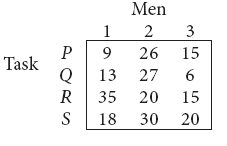
Solve the following assignment problem.
8.
Solve yx2dx + e − xdy = 0
9.
Solve: \(\frac { dy }{ dx } \) = y sin 2x
10.
Integrate the following with respect to x
\(\sqrt { { 1+x+x }^{ 2 } } \)
11.
A pair of dice is thrown 4 times. If getting a doublet is considered a success, find the probability of 2 successes.
12.
Find the area of the region bounded by the curve y2 = 27x3 and the lines x = 0, y = 1 and y = 2.
13.
The demand function of a commodity is y = 36 − x2. Find the consumer’s surplus for y0 = 11
14.
If the marginal cost function of x units of output is \(\frac { a }{ \sqrt { ax+b } } \) and if the cost of output is zero. Find the total cost as a function of x.
15.
If f'(x) = x + b, f(1)= 5 and f(2) = 13, then find f(x)
16.
Solve the equations 2x + 3y = 7, 3x + 5y = 9 by Cramer’s rule.
17.
E f (x)= _______.
f(x− h)
f (x)
f(x+ h)
f(x+ 2h)
18.
If c is a constant then Δc = _______.
c
Δ
Δ2
0
19.
A type of decision –making environment is _______.
certainty
uncertainty
risk
all of the above
20.
If number of sources is not equal to number of destinations, the assignment problem is called______.
balanced
unsymmetric
symmetric
unbalanced
21.
The Penalty in VAM represents difference between the first ________.
Two largest costs
Largest and Smallest costs
Smallest two costs
None of these
22.
The complementary function of (D2+ 4)y = e2x is ______.
(Ax +B)e2x
(Ax +B)e−2x
A cos 2x + B sin 2x
Ae−2x+ Be2x
23.
\(\overset {-}{X}\) chart is a ________.
attribute control chart
variable control chart
neither Attribute nor variable control chart
both Attribute and variable control chart
24.
Consumer price index are obtained by: ________.
Paasche’s formula
Fisher’s ideal formula
Marshall Edgeworth formula
Family budget method formula
25.
The value of ‘b’ in the trend line y = a + bx is ________.
Always positive
Always negative
Either positive or negative
Zero
26.
The standard error of sample mean is ______.
\(\frac { \sigma }{ \sqrt { 2n } } \)
\(\frac { \sigma }{ { n } } \)
\(\frac { \sigma }{ \sqrt { n } } \)
\(\frac { { \sigma }^{ 2 } }{ \sqrt { n } } \)
27.
An estimator is said to be ________ if it contains all the information in the data about the parameter it estimates.
efficient
sufficient
unbiased
consistent
28.
29.
The value of \(\int _{ -\frac{\pi}{2}}^{ \frac{\pi}{2}}\) cos x dx is _______.
0
2
1
4
30.
If P(Z > z) = 0.5832 what is the value of z (z has a standard normal distribution)?
-0.48
0.48
1.04
-0.21
31.
In a parametric distribution the mean is equal to variance is ________.
binomial
normal
poisson
all the above
32.
The probability density function p(x) cannot exceed ________.
zero
one
mean
infinity
33.
If c is a constant, then E(c) is ________.
0
1
c f (c)
c
34.
The marginal revenue and marginal cost functions of a company are MR = 30 − 6x and MC = −24 + 3x where x is the product, then the profit function is ________.
9x2 + 54x
9x2 − 54x
54x - \(\frac { { 9x }^{ 2 } }{ 2 } \)
54x - \(\frac { { 9x }^{ 2 } }{ 2 } \) + k
35.
Cramer’s rule is applicable only to get an unique solution when _______.
\({ \triangle }_{ z }\neq 0\)
\({ \triangle }_{ x }\neq 0\)
\({ \triangle } \neq 0\)
\({ \triangle }_{ y }\neq 0\)
36.
The rank of the unit matrix of order n is ________.
n −1
n
n +1
n2
37.
From the following table find the number of students who obtained marks less than 45.
| Marks | 30-40 | 40-50 | 50-60 | 60-70 | 70-80 |
| No. of Students | 31 | 42 | 51 | 35 | 31 |
38.
Solve the differential equation \(\frac { dy }{ dx } =\frac { x-y }{ x+y } \)
39.
40.
The mean weekly sales of soap bars in departmental stores were 146.3 bars per store. After an advertising campaign the mean weekly sales in 400 stores for a typical week increased to 153.7 and showed a standard deviation of 17.2. Was the advertising campaign successful at 95% confidence limit?
41.
One fifth percent of the the blades produced by a blade manufacturing factory turn out to be defective. The blades are supplied in packets of 10. Use Poisson distribution to calculate the approximate number of packets containing no defective, one defective and two defective blades respectively in a consignment of 1,00,000 packets (e–0.2 =.9802)
1.
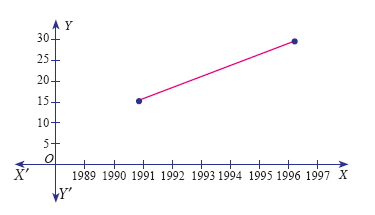
Since the number of years is even(eight), we can equally divide the given data it two equal parts and obtain the averages of first four years and last four years.
| Year | Production | Average |
| 1990 | 15 | \(\frac{15+11+20+10}{4}=14\) |
| 1991 | 11 | |
| 1992 | 20 | |
| 1993 | 10 | |
| 1994 | 15 | \(\frac{15+25+35+30}{4}=26.25\) |
| 1995 | 25 | |
| 1996 | 35 | |
| 1997 | 30 |
2.
\(\int _{ \frac { \pi }{ 6 } }^{ \frac { \pi }{ 3 } }{ \sin x } dx={ \left[ -\cos x \right] }_{ \frac { \pi }{ 6 } }^{ \frac { \pi }{ 3 } }\)
\(=-\left( \cos\frac { \pi }{ 3 } -\cos\frac { \pi }{ 6 } \right) \)
\(=\frac { 1 }{ 2 } (\sqrt { 3 } -1)\)
3.
\( \int \sqrt{2 x+1} \ d x=\int(2 x+1)^{\frac{1}{2}} d x\)
\(=\frac { { \left( 2x+1 \right) }^{ \frac { 3 }{ 2 } } }{ 3 } +c\)
4.
Let \(A=\left( \begin{matrix} 5 & 6 \\ 7 & 8 \end{matrix} \right) \)
Order of A is 2 \(\times\) 2
\(\therefore \rho (A)\le 2\) [Since minimum of (2, 2) is 2]
Consider the second order minor
\(\left| \begin{matrix} 5 & 6 \\ 7 & 8 \end{matrix} \right| =40-42\)
= \(-2\neq 0\)
There is a minor of order 2, which is not zero
\(\therefore \rho (A)=2\)
5.
Let A =\(\begin{pmatrix} -5 & -7 \\ 5 & 7 \end{pmatrix}\)
Order of A is 2 \(\times\) 2
∴\(\rho \)(A)\(\le \)2
Consider the second order minor \(\begin{vmatrix} -5 & -7 \\ 5 & 7 \end{vmatrix}\)=0
Since the second order minor vanishes,\(\rho (A)\neq 2\)
Consider a first order minor \(\left| -5 \right| \neq 0\)
There is a minor of order 1, which is not zero
\(\therefore \rho (A)=1\)
6.
7.
Since the number of columns is less than the number of rows, given assignment problem is unbalanced one. To balance it , introduce a dummy column with all the entries zero. The revised assignment problem is
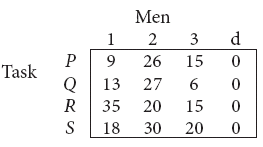
Here only 3 tasks can be assigned to 3 men.
Step 1: Its not necessary, since each row contains zero entry. Go to Step 2.
Step 2:
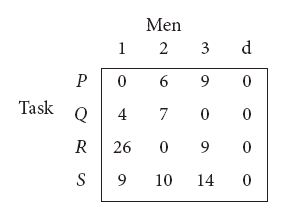
Step 3 (Assignment) :
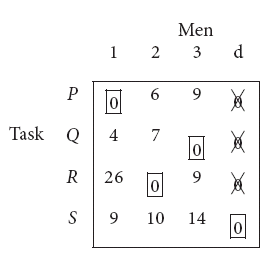
Since each row and each columncontains exactly one assignment,all the three men have been assigned a task. But task S is not assigned to any Man. The optimal assignment schedule and total cost is
| Task | Men | cost |
| P | 1 | 9 |
| Q | 3 | 6 |
| R | 2 | 20 |
| s | d | 0 |
| Total cost | 35 | |
The optimal assignment (minimum) cost = Rs. 35
8.
yx2 dx = -e-x dy
⇒ \(\frac { { x }^{ 2 } }{ { e }^{ -x } } dx=-\frac { dy }{ y } \)
⇒ x2 ex dx =\(-\frac { dy }{ y } \)
Integrating both sides,
\(\int { { x }^{ 2 }{ e }^{ x } } dx=-\int { \frac { dy }{ y } } \)
put u = x2
u'= 2x
u'' = 2
dv = ex dx
v = ex
v1 = ex
v2 = ex
Using Bernoulli's formula,
\(\int { u } dv\) = uv-u'v1 + u''v2
∴ \(\int { { x }^{ 2 }{ e }^{ x } } \)dx = x2ex-2xex+2ex
∴ From (1), x2ex-2xex + 2ex = -log y+C
⇒ ex(x2-2x+2)+log y = C
9.
Separating the variables, we get,
\(\frac { dy }{ x } \)= sin 2x dx
Integrating both sides we get,
\(\int { \frac { dy }{ y } } =\int { \sin 2x } \)
⇒ log y = \(\frac { -\cos 2x }{ 1 }\)+c
10.
\(\int { \sqrt { { x }^{ 2 }+x+1 } } dx\)
\(=\int { \sqrt { { x }^{ 2 }+x+\frac { 1 }{ 4 } -\frac { 1 }{ 4 } +1 } } dx\)
Adding and subtracting
\(\frac { 1 }{ 2 } { \left[ \text{co-effective of x} \right] }^{ 2 }\)
\(={ \left[ \frac { 1 }{ 2 } (-1) \right] }^{ 2 }=\frac { 1 }{ 4 } \)
\(=\int { \sqrt { { \left( x+\frac { 1 }{ 2 } \right) }^{ 2 }+\frac { 3 }{ 4 } } } dx\)
\(\int { \sqrt { { \left( x+\frac { 1 }{ 2 } \right) }^{ 2 }+{ \left( \frac { \sqrt { 3 } }{ 2 } \right) }^{ 2 } } } dx\)
\(\left[ \because \int { \sqrt { { x }^{ 2 }+{ a }^{ 2 } } dx=\frac { x }{ 2 } \sqrt { { x }^{ 2 }+{ a }^{ 2 } } } +\frac { { a }^{ 2 } }{ 2 } \log { \left| x+\sqrt { { x }^{ 2 }+{ a }^{ 2 } } \right| +c } \right] \)
\(=\frac { 1 }{ 2 } \left( x+\frac { 1 }{ 2 } \right) \sqrt { { x }^{ 2 }+x+1 } +\frac { 3 }{ 4(2) } \log { \left| \left( x+\frac { 1 }{ 2 } \right) +\sqrt { { x }^{ 2 }+x+1 } \right| } +c\)
\(=\frac { x+\frac { 1 }{ 2 } }{ 2 } \sqrt { { x }^{ 2 }+x+1 } +\frac { 3 }{ 8 } \log { \left| \left( x+\frac { 1 }{ 2 } \right) +\sqrt { { x }^{ 2 }+x+1 } \right| } +c\)
11.
In a throw of a pair of dice the doublets are (1, 1) (2, 2) (3, 3) (4, 4) (5, 5) (6, 6)
Probability of getting a doublet p = 6/36 = 1/6
⇒ q = 1 – p = 5/6 and also n = 4 is given
The probability of successes
\(=\left( \begin{matrix} 4 \\ x \end{matrix} \right) { (\frac { 1 }{ 6 } ) }^{ x }\left( \frac { 5 }{ 6 } \right) ^{ 4-x }\)
Therefore the probability of 2 successes are
\(P(X=2)\left( \begin{matrix} 4 \\ 2 \end{matrix} \right) { (\frac { 1 }{ 6 } ) }^{ 2 }\left( \frac { 5 }{ 6 } \right) ^{ 4-2 }\)
\(=6\times \frac { 1 }{ 36 } \times \frac { 25 }{ 36 } \)
\(=\frac { 25 }{ 216 } \)
12.
Given Curve is y2 = 27x3.
\({ x }^{ 3 }=\frac { { y }^{ 2 } }{ 27 } \)
\(x={ \left( \frac { { y }^{ 2 } }{ 27 } \right) }^{ \frac { 1 }{ 3 } }=\frac { { y }^{ \frac { 2 }{ 3 } } }{ 3 } \)
∴ Area \(=\frac { 1 }{ 3 } \int _{ 1 }^{ 2 }{ { y }^{ \frac { 2 }{ 3 } } } dy=\frac { 1 }{ 3 } { \left( \frac { { y }^{ \frac { 2 }{ 3 } +1 } }{ \frac { 2 }{ 3 } +1 } \right) }_{ 1 }^{ 2 }\)
\(={ \left( \frac { 1 }{ 3 } .\frac { { y }^{ \frac { 5 }{ 3 } } }{ \frac { 5 }{ 3 } } \right) }_{ 1 }^{ 2 }\)
\(=\frac { 1 }{ 3 } \times \frac { 3 }{ 5 } { \left( { y }^{ \frac { 5 }{ 3 } } \right) }_{ 1 }^{ 2 }=\frac { 1 }{ 5 } \left( { 2 }^{ \frac { 5 }{ 3 } }-{ 1 }^{ \frac { 5 }{ 3 } } \right) \)
\(=\frac { 1 }{ 5 } \left( { 2 }^{ \frac { 5 }{ 3 } }-1 \right) \)sq.units
13.
Given y = 36 − x2 and y0 = 11
11 = 36 – x2
x2 = 25
x = 5
CS = \(\int _{ 0 }^{ x }{ \text{(demand }\ \text{ function)dx–(Price×quantity demanded)}}\)
= \(\int _{ 0 }^{ 5 }{ (36-{ x }^{ 2 })dx-5\times 11 } \)
= \({ \left[ 36x-\frac { { x }^{ 3 } }{ 3 } \right] }_{ 0 }^{ 5 }-55\)
= \(\left[ 36(5)-\frac { { 5 }^{ 3 } }{ 3 } \right] -55\)
= \(180-\frac { 125 }{ 3 } -55=\frac { 250 }{ 3 } \)
Hence the consumer’s surplus is = \(\frac { 250 }{ 3 } \)
14.
Given marginal cost function = \(\frac { a }{ \sqrt { ax+b } } \)
\(\Rightarrow MC=\frac { a }{ \sqrt { ax+b } } \Rightarrow \frac { dC }{ dx } =\frac { a }{ \sqrt { ax+b } } \)
\(\Rightarrow dC=\frac { a }{ \sqrt { ax+b } } dx\)
\(\Rightarrow \int { dC } =a\int { \frac { dx }{ \sqrt { ax+b } } } \)
\(\Rightarrow C=a\int { { (ax+b) }^{ \frac { -1 }{ 2 } }dx } \)
\(\Rightarrow C=\not a \frac{(a x+b)^{\frac{-1}{2}+1}}{\left(-\frac{1}{2}+1\right) \not a}+k\)
\(\Rightarrow C=\frac { { (ax+b) }^{ \frac { 1 }{ 2 } } }{ 1 } +k\)
\(\Rightarrow C=2\sqrt { ax+b } +k\) ...(1)
Since the cost of output is zero.
C = 0, when x = 0
\(\therefore (1)\rightarrow 0=2\sqrt { 0+b } +k\)
\(\Rightarrow 0=2\sqrt { b } +k\)
\(\Rightarrow k=-2\sqrt { b } \)
∴(1)becomes
\(C=2\sqrt { ax+b } -2\sqrt { b } \)
15.
Given f'(x) = x + b, f(1) = 5 and f(2) = 13
f'(x) = x + b
\(\Rightarrow \int { f'(x)dx=\int { \left( x+b \right) dx } } \)
[ ∴ Integration is the reverse process of differentiation]
\(\Rightarrow f(0)=\frac { { x }^{ 2 } }{ 2 } +bx+c\)...(1)
Given f(1) = 5
\(\Rightarrow 5=\frac { { 1 }^{ 2 } }{ 2 } +b(1)+c\)
\(\Rightarrow 5=\frac { 1 }{ 2 } +b(1)+c\Rightarrow 5-\frac { 1 }{ 2 } =b+c\)
\(\Rightarrow \frac { 10-2 }{ 2 } =b+c\Rightarrow b+c=\frac { 9 }{ 2 } \)
\(\Rightarrow 2b+2c=9\)..(2)
\(Also\quad f(2)=13\Rightarrow 13=\frac { { 2 }^{ 2 } }{ 2 } +b(2)+c\)
⇒ 13 = 2 + 2b + c
⇒ 13-2 = 2b + c
⇒ 2b + c = 11 ---(3)
(2) - (3) ⟶ 2b + 2c = 9
-2b + -c = -11
c = -2
Substituting c = -2 in (3) we get
2b - 2 = 11⇒ 2b = 11+2 ⇒ 2b = 13
\(\Rightarrow b=\frac { 13 }{ 2 } \)
Substituting \(b=\frac { 13 }{ 2 } \), c = -2 in(1) we get,
\(f(x)=\frac { { x }^{ 2 } }{ 2 } +\frac { 13 }{ 2 } x-2\)
16.
The equations are
2x + 3y = 7
3x + 5y = 9
Here \(\triangle =\left| \begin{matrix} 2 & 3 \\ 3 & 5 \end{matrix} \right| =1\)
\(\neq 0\)
\(\therefore \) we can apply Cramer’s Rule
Now \({ \triangle }_{ x }=\left| \begin{matrix} 7 & 3 \\ 9 & 5 \end{matrix} \right| =8\) \({ \triangle }_{ y }=\left| \begin{matrix} 2 & 7 \\ 3 & 9 \end{matrix} \right| =-3\)
\(\therefore \) By Cramer’s rule
\(x=\frac { { \triangle }_{ X } }{ \triangle } =\frac { 8 }{ 1 } =8\) \(y=\frac { { \triangle }_{ y } }{ \triangle } =\frac { -3 }{ 1 } =-3\)
\(\therefore \) Solution is x = 8, y = −3
17.
(c)
f(x+ h)
18.
(d)
0
19.
(d)
all of the above
20.
(d)
unbalanced
21.
(c)
Smallest two costs
22.
(c)
A cos 2x + B sin 2x
23.
(b)
variable control chart
24.
(d)
Family budget method formula
25.
(c)
Either positive or negative
26.
(c)
\(\frac { \sigma }{ \sqrt { n } } \)
27.
(b)
sufficient
28.
(b)
29.
(b)
2
30.
(d)
-0.21
31.
(c)
poisson
32.
(b)
one
33.
(d)
c
34.
(d)
54x - \(\frac { { 9x }^{ 2 } }{ 2 } \) + k
35.
(c)
\({ \triangle } \neq 0\)
36.
(b)
n
37.
Let x be the marks and y be the number of students
By converting the given series into cumulative frequency distribution, the difference table is as follows.
| x | y | \(\Delta y\) | \(\Delta ^{ 2 }y\) | \(\Delta ^{ 2 }y\) | \(\Delta ^{ 4 }y\) |
| Less than 40 | 31 | ||||
| 42 | |||||
| 50 | 73 | 9 | |||
| 51 | –25 | ||||
| 60 | 124 | -16 | |||
| 35 | 12 | ||||
| 70 | 159 | -4 | |||
| 31 | |||||
| 80 | 190 |
\({ y }_{ \left( x={ x }_{ 0 }+nh \right) }={ y }_{ 0 }+\frac { n }{ n! } \Delta { y }_{ 0 }+\frac { n(n-1) }{ 2! } { \Delta }^{ 2 }{ y }_{ 0 }+\frac { n(n-)(n-2) }{ 3! } { \Delta }^{ 3 }{ y }_{ 0 }+...\)
To find y at x = 45
\(\therefore\) x0+nh = 45 , x0 = 40, h = 10 \(\Rightarrow n=\frac { 1 }{ 2 } \)
y(x = 45) = \(31+\frac { 1 }{ 2 } \times 42+\frac { \frac { 1 }{ 2 } \left( \frac { -1 }{ 2 } \right) }{ 2 } (9)+\cfrac { \frac { 1 }{ 2 } \left( \frac { -1 }{ 2 } \right) \left( \frac { -3 }{ 2 } \right) }{ 6 } \times \left( -25 \right) +\frac { \frac { 1 }{ 2 } \left( \frac { -1 }{ 2 } \right) \left( \frac { -3 }{ 2 } \right) \left( \frac { -5 }{ 2 } \right) }{ 24 } \times \left( -37 \right) \)
= \(31+21-\frac { 9 }{ 8 } -\frac { 25 }{ 16 } -\frac { 37\times 15 }{ 384 } \)
= 47.867 ≅ 48
38.
\(\frac { dy }{ dx } =\frac { x-y }{ x+y } \) ..... (1)
This is a homogeneous differential equation.
Now put y = vx and \(\frac { dy }{ dx } =v+x\frac { dv }{ dx } \)
∴ (1) ⇒ \(v+x\frac { dv }{ dx } =\frac { x-vx }{ x+vx } \)
\(=\frac { 1-v }{ 1+v } \)
\(x\frac { dv }{ dx } =\frac { 1-v }{ 1+v } -v\)
\(=\frac { 1-2v-{ v }^{ 2 } }{ 1+v } \)
\(\frac { 1+v }{ { v }^{ 2 }+2v-1 } dv=\frac { -dx }{ x } \)
Multiply 2 on both sides
\(\frac { 2+v }{ { v }^{ 2 }+2v-1 } dv=-2\frac { -dx }{ x } \)
On Integration
ഽ\(\frac { 2+v }{ { v }^{ 2 }+2v-1 } \)dv = -2ഽ\(\frac { -dx }{ x } \)
log(v2+2v − 1) = −2log x + log c
v2+2v − 1 = \(\frac { c }{ { x }^{ 2 } } \)
x2(v2+2v−1) = c
Now, Replace \(v=\frac { y }{ x } \)
\({ x }^{ 2 }\left[ \frac { { { y }^{ 2 } } }{ { x }^{ 2 } } +\frac { 2y }{ x } -1 \right] =c\)
y2 + 2xy − x2 = c is the solution
39.
40.
Sample size n = 400 stores
Sample mean \(\bar x\) = 153.7 bars
Sample SD s = 17.2 bars
Population mean m = 146.3 bars
Since population SD is unknown we can consider the sample SD s = \(\sigma\)
Null Hypothesis :
The advertising campaign is not successful i.e, H0: \(\mu\) = 146.3
(There is no significant difference between the mean weekly sales of soap bars in department stores before and after advertising campaign)
Alternative Hypothesis H1:
\(\mu\) >143.3 (Right tail test). The advertising campaign was successful
Level of significance \(\sigma\) = 0.05
Test statistic :
\(Z=\frac { \bar { x } -\mu }{ \frac { \sigma }{ \sqrt { n } } } \sim N(0,1)\)
\(Z=\frac { 153.7-146.3 }{ \frac { 17.2 }{ \sqrt { 400 } } } \)
\(=\frac { 7.4 }{ 0.86 } =8.605\)
\(\therefore\) Z = 8.605
Comparing the calculated value Z=8.605 and the significant value or table value \({ Z }_{ \alpha }=1.645.\) We get 8.605 > 1.645
Inference:
Since, the calculated value is much greater than table value i.e., Z > \({ Z }_{ \alpha }\), it is highly significant at 5% level of significance.
Hence we reject the null hypothesis H0 and conclude that the advertising campaign was definitely successful in promoting sales.
41.
P = 1/5/100 = 1/500 = 0.002 n = 10 λ = np = 0.02
\(p(x)=\frac { { e }^{ -\lambda }{ \lambda }^{ x } }{ x! } =\frac { { e }^{ -0.02 }{ (0.02) }^{ x } }{ x! } \)
(i) Number of packets containing no defective = N p(o) = 1,00,000 × e–0.02
= 98020
(ii) Number of packets containing one defective = N p(1) = 1,00,000 × 0.9802 × 0.02
= 1960
(iii) Number of packets containing 2 defectives = N p(2) = 20

12th Standard Syllabus & Materials
12th Standard
TN 12th Computer Applications களப்பெயர் முறைமை (DNS) Sample Question Papers Study Material - QB365 Set A
NEW12th Standard
TN 12th Computer Applications வலையமைப்பு எடுத்துக்காட்டுகள் மற்றும் நெறிமுறைகள் Sample Question Papers Study Material - QB365 Set A
NEW12th Standard
TN 12th Computer Applications கணினி வலையமைப்பு ஓர் அறிமுகம் Sample Question Papers Study Material - QB365 Set A
NEW12th Standard
TN 12th Computer Applications PHP-உடன் MySQL-ஐ இணைத்தல் Sample Question Papers Study Material - QB365 Set A



Tamilnadu Stateboard 12th Standard Subjects

Maths

Chemistry

Physics

Biology

Computer Science
Business Maths and Statistics

Economics

Commerce

Accountancy

History

Computer Applications
Biology
Computer Technology
Computer Applications
Computer Science
Business Maths and Statistics
Commerce
Economics
Maths
Chemistry
Physics
Computer Technology
History
Accountancy

Tamil

English

French
Tamilnadu Stateboard Standards
