
 100% FREE ACCESS
12th Standard Syllabus & Materials
12th Standard
TN 12th Maths Applications of Matrices and Determinants Sample Question Papers Study Material - QB365 Set A
NEW12th Standard
TN 12th Computer Applications மின்னணு தரவு பரிமாற்றம் Sample Question Papers Study Material - QB365 Set A
NEW12th Standard
TN 12th Computer Applications மின் - வணிக பாதுகாப்பு அமைப்புகள் Sample Question Papers Study Material - QB365 Set A
NEW12th Standard
TN 12th Computer Applications மின்னணு செலுத்தல் முறைகள் Sample Question Papers Study Material - QB365 Set A
NEW12th Standard
TN 12th Computer Applications மின் - வணிகம் Sample Question Papers Study Material - QB365 Set A
NEW12th Standard
TN 12th Computer Applications திறந்த மூல கருத்துருக்கள் Sample Question Papers Study Material - QB365 Set A

Published on: 20/10/2025
Download Tamil Nadu 12th Standard Chemistry question papers, model tests, one-mark questions, important questions, and public exam papers in PDF format. Free study materials and answer keys for TN State Board students.
Questions + Answers key
Take MCQ Chemistry Test
1.
The resistance of 0.15N solution of an electrolyte is 50 Ω. The specific conductance of the solution is 2.4 Sm-1. The resistance of 0.5 N solution of the same electrolyte measured using the same conductivity cell is 480 Ω. Find the equivalent conductivity of 0.5 N solution of the electrolyte.
2.
Write short notes on the following
ix. Gomberg reaction
3.
Write short notes on the following
vii. Coupling reaction
4.
Explain the function of H2 - O2 fuel cell.
5.
Why are lyophillic colloidal sols are more stable than lyophobic colloidal sol.
6.
Write a note on co –polymer
7.
What are anti fertility drugs? Give examples.
8.
9.
Based on VB theory explain why [Cr(NH3)6]3+ is paramagnetic, while [Ni(CN)4]2- is diamagnetic.
10.
Define: Drug.
11.
State Faraday's first law.
12.
What is the difference between a sol and a gel?
13.
Identify A aniline + benzaldehyde → A
14.
What are antibiotics?
15.
Why carbohydrates are generally optically active.
16.
Name the Vitamins whose deficiency cause i) rickets ii) scurvy
17.
What is hydrate isomerism? Give an example.
18.
[Ti(H2O)6]3+ is coloured, while [Sc(H2O)6]3+ is colourless- explain.
19.
Describe adsorption theory of catalysis
20.
Describe some feature of catalysis by Zeolites.
21.
How will you distinguish between primary secondary and tertiary alphatic amines.
22.
The conductivity of a 0.01M solution of a 1 :1 weak electrolyte at 298K is 1.5\(\times\)10-4 S cm−1.
i) molar conductivity of the solution
ii) degree of dissociation and the dissociation constant of the weak electrolyte
Given that
\(\lambda^{0}_{cation}=248.2 \ S\) cm2 mol-1
\(\lambda^{0}_{anlon}=51.8 \ S\) cm2 mol-1
23.
Write short notes on the following
i. Hofmann’s bromide reaction
ii. Ammonolysis
iii. Gabriel phthalimide synthesis
iv. Schotten – Baumann reaction
v. Carbylamine reaction
vi. Mustard oil reaction
vii. Coupling reaction
viii. Diazotisation
ix. Gomberg reaction
24.
What are narcotic and non – narcotic drugs. Give examples
25.
Explain the mechanism of cleansing action of soaps and detergents.
26.
Write a short note on peptide bond.
27.
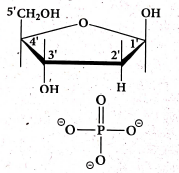
What type of linkages hold together monomers of DNA?
28.
Give the difference between double salts and coordination compounds.
29.
30.
Drugs that bind to the receptor site and inhibit its natural function are called _______.
antagonists
agonists
enzymes
molecular targets
31.
If one strand of the DNA has the sequence ‘ATGCTTGA’, then the sequence of complementary strand would be ______.
TACGAACT
TCCGAACT
TACGTACT
TACGRAGT
32.
Complete hydrolysis of cellulose gives ______.
L-Glucose
D-Fructose
D-Ribose
D-Glucose
33.
Vitamin B2 is also known as ______.
Riboflavin
Thiamine
Nicotinamide
Pyridoxine
34.
Which of the following amines does not undergo acetylation?
t – butylamine
ethylamine
diethylamine
triethylamine
35.
Nitrobenzene on reaction with Con HNO3 / H2SO4 at 80-100oC forms which one of the following products?
1,4 – dinitrobenzene
2,4,6 – tirnitrobenzene
1,2 – dinitrobenzene
1,3 – dinitrobenzene
36.
The product formed by the reaction an aldehyde with a primary amine ________.
carboxylic acid
aromatic acid
schiff ’s base
ketone
37.
The phenomenon observed when a beam of light is passed through a colloidal solution is_______.
Cataphoresis
Electrophoresis
Coagulation
Tyndall effect
38.
Fog is colloidal solution of _______.
solid in gas
gas in gas
liquid in gas
gas in liquid
39.
A current strength of 3.86 A was passed through molten Calcium oxide for 41 minutes and 40 seconds. The mass of Calcium in grams deposited at the cathode is_______. (atomic mass of Ca is 40g / mol and 1F = 96500C).
4
2
8
6
40.
How many faradays of electricity are required for the following reaction to occur MnO4-→ Mn2+
5F
3F
1F
7F
41.
42.
Which one of the following complexes is not expected to exhibit isomerism?
[Ni(NH3)4(H2O)2]2+
[Pt(NH3)2Cl2]
[Co(NH3)5SO4]Cl
[FeCl6]3-
43.
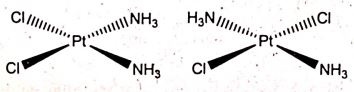
Which type of isomerism is exhibited by [Pt(NH3)2Cl2]?
Coordination isomerism
Linkage isomerism
Optical isomerism
Geometrical isomerism
1.
Given that
R1 = 50 Ω
R2 = 480 Ω
N1 = 0.15 N
N2 = 0.5 N
k1 = 2.4 Sm-1
k2 = ?
we know that
k = cell constant/R
\(\therefore \ \frac{k_2}{k_1} = \frac{R_1}{R_2}\)
\(k_2 = k_1 \times \frac{R_1}{R_2}\)
= 2.4 Sm-1 x 50 Ω/480 Ω
= 2.5 Sm-1
\(\Lambda =\frac { k({ Sm }^{ -1 })\times { 10 }^{ -3 }(\text { gram equivalent) }^{ -1 }{ m }^{ 3 } }{ N } \)
\(\Lambda =\frac { 0.25\times { 10 }^{ -3 }(\text { gram equivalent) }^{ -1 }{ m }^{ 3 } }{ 0.5 } \)
Λ = 5 × 10⁻⁴ Sm2 gram equivalent-1
2.
Gomberg reaction :
Benzene diazonium chloride reacts with benzene in the presence of sodium hydroxide to give biphenyl. This reaction in known as the Gomberg reaction

3.
Coupling reactions (or) p-hydroxyazobenzene, p-aminoazobenzene, 2-phenyl azo-4-methyl phenol:
Benzene diazonium chloride reacts with electron rich aromatic compounds like phenol, aniline to form brightly coloured azo compounds. Coupling generally occurs at the para position. If para position is occupied then coupling occurs at the ortho position. Coupling tendency is enhanced if an electron donating group is present at the para - position to -N2CI- group. This is an electrophilic substitution.
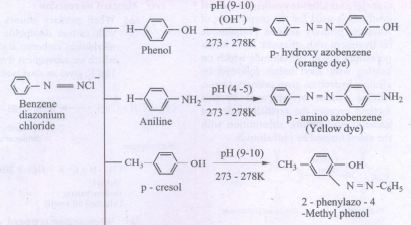
Aryl fluorides and iodides cannot be prepared by direct halogenation and the cyano group cannot be introduced by nucleophilic substitution of chlorine in chlorobenzene. For introducing such a halide group. cyano group -OH, NO2, etc.. benzenediazonium chloride is a very good intermediate Diazo compounds obtained from the coupling reactions of diazonium salts are coloured and are used as dyes.
4.
(i) In this case, hydrogen act as a fuel and oxygen as an oxidant and the electrolyte is aqueous KOH maintained at 200oC and 20-40 atm. Porous graphite electrode containing Ni and NiO serves as the inert electrodes.
(ii) Hydrogen and oxygen gases are bubbled through the anode and cathode, respectively.
Oxidation occurs at the anode:
\(2 \mathrm{H}_{2(\mathrm{~g})}+4 \mathrm{OH}_{(a q)}^{-} \rightarrow 4 \mathrm{H}_{2} \mathrm{O}_{(l)}+4 \mathrm{e}^{-}\)
Reduction occurs at the cathode:
\(\mathrm{O}_{2(\mathrm{~g})}+2 \mathrm{H}_{2} \mathrm{O}_{(t)}+4 \mathrm{e}^{-} \rightarrow 4 \mathrm{OH}_{(\mathrm{aq})}^{-}\)
(iii) The overall reaction is \(2 \mathrm{H}_{2(\mathrm{~g})}+\mathrm{O}_{2(\mathrm{~g})} \rightarrow 2 \mathrm{H}_{2} \mathrm{O}_{(1)}\)
(iv) The above reaction is the same as the hydrogen combustion reaction, however, they do not react directly ie., the oxidation and reduction reactions take place separately at the anode and cathode respectively like H2-O2 fuel cell. Other fuel cells like propane -O2 and methane O2 have also been developed.
5.
(i) In lyophillic colloids or sols definite attractive force or affinity exists between dispersion medium and dispersed phase. Examples: sols of protein and starch. They are more stable and will not get precipitated easily.
(ii) In a lyophobic colloids, no attractive force exists between the dispersed phase and dispersion medium. They are less stable and precipitated readily, but cannot be produced again by just adding the dispersion medium.
Examples: sols of gold, silver, platinum and copper.
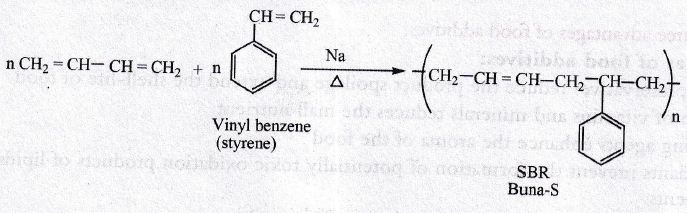
6.
(i) A polymer containing two or more different kinds of monomer units is called a copolymer.
(ii) For example, SBR rubber(Buna-S) contains styrene and butadiene monomer units.
(iii) Copolymers have properties quite different from the homopolymers.
(iv) Mixture of styrene and 1,3 butadiene to form a copolymer (Buna -S)
Preparation of Buna-S:
It is a co-polymer. It is obtained by the polymerisation of buta -1,3 - diene and styrene in the ratio 3: 1 in the presence of sodium.
7.
Anti fertility drugs are synthetic hormones that suppresses ovulation and fertilisation. They are used in birth control pills.
eg: Synthetic Oestrogen : Ethynylestradiol, Menstranol,
Synthetic Progestrone : Norethindrone, Norethynodrel etc.
8.
9.
\(\text {(a) }\left[\mathrm{Cr}\left(\mathrm{NH}_{3}\right)_{6}\right]^{3+}:{ }_{24} \mathrm{Cr} \Rightarrow{ }_{18}[\mathrm{Ar}] 4 \mathrm{~s}^{2} 3 \mathrm{~d}^{4} \)
\({ }_{21} \mathrm{Cr}^{3+} \Rightarrow{ }_{18}[\mathrm{Ar}] 3 \mathrm{~d}^{3}\)
.JPG)
(i) d2sp3 hybridisation (octahedral)
(ii) It has three unpaired electrons (n = 3)
(iii) So it is paramagnetic
(iv) Magnetic moment \(\left(\mu_{\mathrm{s}}\right)=\sqrt{\mathrm{n}(\mathrm{n}+2)} \mathrm{BM}\)
\(=\sqrt{3(3+2)}=\sqrt{15}=3.87 \mathrm{BM}\)
\((b) \ \left[\mathrm{Ni}(\mathrm{CN})_{4}\right]^{2-:}{ }_{28} \mathrm{Ni} \Rightarrow[\mathrm{Ar}] 4 \mathrm{~s}^{2} 3 \mathrm{~d}^{8} ;{ }_{26} \mathrm{Ni}^{2+} \Rightarrow{ }_{18}[\mathrm{Ar}] 3 \mathrm{~d}^{8}\)
.JPG)
(i) dsp2 hybridisation
(ii) Geometry - square planar
(iii) No unpaired electrons- It is Diamagnetic
(iv) Magnetic moment (μs) = 0.
10.
A drug is a substance that is used to modify or explore physiological systems or pathological states for the benefit of the recipient. (It is used for the purpose of diagnosis, prevention, cure/relief of a disease).
11.
Faraday's first law of electrolysis:
The amount of the substance that undergoes oxidation or reduction at each electrode during electrolysis is directly proportional to the amount of electricity that passes through the cell.
12.
| S.no | Sol | Gel |
| (a) | The liquid state of collidal solution | The solid (or) semi solid stage of a colloidal solution. |
| (b) | Very low viscosity | Very high viscosity |
| (c) | It does not have definite structure. | It possesses definite structure. |
13.
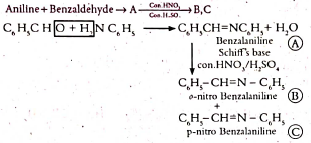
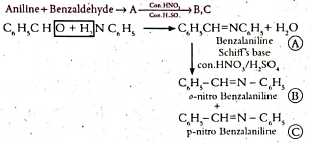

14.
(i) Many micro organisms (bacteria, fungi and moulds) produce certain chemicals which inhibit the growth or metabolism of some other micro organism. Such chemicals are called antibiotics.
(ii) Eg: Penicillin from the mould penicillium notatum
15.
(i) Almost all carbohydrates are optically active as they contain one or more chiral carbons.
(ii) The number of optical isomers depends upon the number of chiral carbons (ie) 2n isomers, where n = total number of chiral carbons.
(iii) Glucose has \(4{ }^{\star} \)C; ∴ It has 24 =16 isomers.
16.
i) Rickets - Vitamin - D (Cholecalciferol - (D3) Ergocalciferol - (D2)
ii) Scurvy (bleeding gums) - vitamin - C (Ascorbic acid)
17.
The best known examples of this type of isomerism occur for chromium chloride CrCI3.6H2O which may contain 4, 5, (or) 6 coordinated water molecules.
[Cr(H2O)4CI2]Cl.2H2O -Bright green
Tetraaquadichlorochromium(III)chloride dihydrate
[Cr(H2O)5CI]Cl2.H2O - grey-green
Pentaaquachlorochromium(III) chloride monohydrate
[Cr(H2O)6]CI3 Violet
Hexaaquachromium (III) chloride
18.
\({ }_{22} \mathrm{Ti}-{ }_{18}[\mathrm{Ar}] 4 \mathrm{s}^{2} 3 \mathrm{d}^{2} / {}_{21}\mathrm{Sc}-{ }_{18}[\mathrm{Ar}] 4 \mathrm{~s}^{2} 3 \mathrm{~d} \)
\({ }_{22} \mathrm{Ti}^{3+}-{ }_{18}[\mathrm{Ar}] 3 \mathrm{~d}^{1} /{ }_{18} \mathrm{Sc}^{3+}{ }_{18}[\mathrm{Ar}] 3 \mathrm{~d}^{0}\)
(i) In this complex the central metal ion is Ti3+, which has d1 configuration. This single electron occupies one of the t2g orbitals in the octahedral aqua ligand field. When white light falls on this complex the electron absorbs light and promotes itself to eg level. The spectral data show the absorption maximum is at 20000 cm-1 corresponding to the crystal field splitting energy \(\left(\Delta_{o}\right)\) 239.7 kJmol-1. The transmitted colour associated with this absorption is purple and hence the complex appears purple in colour.
(ii) Thus in \(\left[\mathrm{Ti}\left(\mathrm{H}_{2} \mathrm{O}\right)_{6}\right]^{3+} \mathrm{d}-\mathrm{d}\) transition takes place.
(iii) But in \(\left[\mathrm{Sc}\left(\mathrm{H}_{2} \mathrm{O}\right)_{6}\right]^{3+} \mathrm{Sc}^{3+}\) has the outer electronic configuration of 3d0 where d-d transition is not possible and it is colourless.
19.
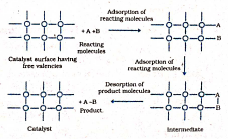
1. Langmuir explained the action of catalyst in heterogeneous catalysed reactions based on adsorption. The reactant molecules are adsorbed on the catalyst surfaces, so this can also be called as contact catalysis.
2. According to this theory, various steps involved in a heterogeneous catalyse reaction are given as follows:
(i) Reactant molecules diffuse from bulk to the catalyst surface.
(ii) The reactant molecules are adsorbed on the surface of the catalyst.
(iii) The adsorbed reactant molecules are activated and form activated complex which is decomposed to form the products.
(iv) The product molecules are desorbed.
(v) The product diffuse away from the surface of the catalyst.
20.
(i) Zeolites are microporous, crystalline, hydrated, alumino silicates, made of silicon and aluminium tetrahedra.
(ii) There are about 50 natural zeolites and 150 synthetic zeolites.
(iii) As silicon is tetravalent and aluminium is trivalent, the zeolite matrix carries extra negative charge.
(iv) To balance the negative charge, there are extra framework cations for example H+or Na+ons. Zeolites carrying protons are used as solid acids, catalysis and they are extensively used in the petrochemical industry for cracking heavy hydrocarbon fractions into gasoline, diesel, etc.,
(v) Zeolites carrying Na+ ions are used as basic catalysis.
(vi) One of the most important applications of zeolites is their shape selectivity.
(vii) In zeolites, the active sites namely protons are lying inside their pores. So, reactions occur only inside the pores of zeolites.
Reactant selectivity:
When bulkier molecules in a reactant mixture are prevented from reaching the active sites within the zeolite crystal, this selectivity is called reactant shape selectivity.
Transition state selectivity:
If the transition state of a reaction is large compared to the pore size of the zeolite, then no product will be formed.
Product selectivity:
It is encountered when certain product molecules one too big to diffuse out of the zeolite pores.
21.
| S.No | Reagents or Reaction | Primary amine RNH2 | Secondary amine R2NH | Tertiary amine R3N |
|---|---|---|---|---|
|
1. |
Carbylamine reaction or with CHCl3/KOH |
Carbylamine is formed (unpleasant smell) |
- | - |
| 2. | Mustard oil reaction or CS2/HgCl2 (Hoffmann's mustard oil test) |
Alkyl isothiocyanate is formed (Mustard oil odour) |
- | - |
| 3. | HNO2 (or) NaNO2 / HCl |
Alcohol is formed +H2 | Yellow oily nitrosoamine is formed, insoluble in water. (Liberman's Test) |
Forms nitrite in cold, soluble in water. |
| 4. | CH3COCl | N-acetyl derivative is formed | N,N- diacetyl derivative is formed |
- |
| 5. | Diethyl oxalate Hoffmann's method |
Solid oxamide is formed | Liquid oxamic ester is formed |
- |
| 6. | Benzene sulphonyl chloride in presence of excess. KOH (Hinsberg's reaction) |
N- alkyl benzene sulphonamide is formed (soluble) |
N, N - dialkyl benzene sulphonamide is formed (Insoluble). |
- |
| 7. | With RX | 1 mol → 2o amine 2 mol → 3o amine 3 mol → Quarternary salt |
1 mol → 3o amine 2 mol → Quarternary salt |
1 mol → Quarternary salt |
22.
i) Molar conductivity
Given : C = 0.01 M;
\(\kappa=1.5 \times 10^{-4} \mathrm{~S} \mathrm{~cm}^{-1} \)
\(=1.5 \times 10^{-2} \mathrm{~S} \mathrm{~m}^{-1} \)
\(\lambda_{\text {cation }}^{0}=248.2 \mathrm{~S} \mathrm{~cm}^{2} \mathrm{~mol}^{-1} \)
\(\lambda_{\text {anion }}^{0}=51.8 \mathrm{~S} \mathrm{~cm}^{2} \mathrm{~mol}^{-1} \)
\(\Lambda_{m}^{0}=\frac{\kappa \times 10^{-3}}{C} \mathrm{~S} \mathrm{~m}^{2} \mathrm{~mol}^{-1} \)
\(=\frac{1.5 \times 10^{-2} \times 10^{-3}}{0.01} \)
\(=1.5 \times 10^{-3} \mathrm{~S} \mathrm{~m}^{2} \mathrm{~mol}^{-1}\)
ii) \(\alpha=\frac{\Lambda_{m}}{\Lambda_{m}^{0}}\)
\(\Lambda_{\mathrm{m}}^{0}=\lambda_{\text {cation }}^{0}+\lambda_{\text {anion }}^{0} \)
\(=(248.2+51.8) \mathrm{S} \mathrm{cm}^{2} \mathrm{~mol}^{-1} \)
\(=300 \mathrm{~S} \mathrm{~cm}^{2} \mathrm{~mol}^{-1}\)
\(=300 \times 10^{-4} \mathrm{Sm}^{2} \mathrm{~mol}^{-1} \)
\(\alpha =\frac{1.5 \times 10^{-3}}{300 \times 10^{-4}}=0.05\)
iii) \(\mathrm{K}_{\mathrm{a}} =\frac{\alpha^{2} \mathrm{C}}{1-\alpha} \)
\(\mathrm{K}_{\mathrm{a}} =\frac{(0.05)^{2} \times(0.01)}{1-0.05}=2.6 \times 10^{-5} \)
(or)
\(\mathrm{K}_{\mathrm{a}} =\alpha^{2} \mathrm{C} \)
\(=(0.05)^{2} \times(0.01) \)
\(\mathrm{K}_{\mathrm{a}} =2.5 \times 10^{-5}\)
23.
Hoffmann's bromide reaction:
When Amides are treated with bromine in the presence of aqueous or ethanolic solution of KOH, primary amines with one carbon atom less than the parent amides are obtained.
\(\underset { \quad \quad \quad amide\\ R=Alkyl(or)Aryl }{ R-\overset { \underset { || }{ O } }{ C } -{ NH }_{ 2 } } \overset { { Br }_{ 2 }/KOH }{ \longrightarrow } \underset { Primary\quad amine }{ R-{ NH }_{ 2 }+{ K }_{ 2 }{ CO }_{ 3 } } +KBr+{ H }_{ 2 }O\)
(ii) Hoffmann's ammonolysis:
When Alkyl halides (or) benzylhalides are heated with alcoholic ammonia in a sealed tube, mixtures of 1°, 2° and 3° amines and quaternary ammonium salts are obtained.
\( { CH }_{ 3 }-Br\overset { \ddot { N } { H }_{ 3 } }{ \underset { \Delta }{ \longrightarrow } } \underset { { 1 }^{ 0 }-amine }{ { CH }_{ 3 }-\ddot { N } { H }_{ 2 } } \overset { { CH }_{ 3 }-Br }{ \longrightarrow } \underset { { 3 }^{ o }-amine }{ \left( { CH }_{ 3 } \right) _{ 2 }\ddot { N } H } \overset { { CH }_{ 3 }Br }{ \longrightarrow } \underset { 3^{ o }-amine }{ \left( { { CH }_{ 3 } } \right) _{ 3 }\ddot { N } } \overset { CH_{ 3 }Br }{ \longrightarrow } \underset { Quartenary \ ammonium\ bromide }{ \left( { CH }_{ 3 } \right) _{ 4 }\overset { + }{ N } { Br }^{ - } } \)
This is a nucleophilic substitution, the halide ion of alkyl halide is substituted by the -NH2 group. The product primary amine so formed can also has a tendency to act as a nucleophile and hence if excess alkyl halide is taken, further nucleophilic substitution takes place leading to the formation of quarternary ammonium salt. However, if the process is carried out with excess ammonia, primary amine is obtained as the major product. The order of reactivity of alkylhalides with amines
RI > RBr > RCl
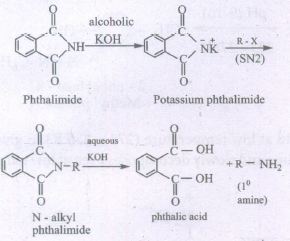
(iii) Gabriel phthalimide synthesis:
Gabriel synthesis is used for the preparation of Aliphatic primary amines. Phthalimide on treatment with ethanolic KOH forms potassium salt of phthalimide which on heating with alkyl halide followed by alkaline hydrolysis gives primary amine. Aniline cannot be prepared by this method because the arylhalides do not undergo nucleophilic substitution with the anion formed by phthalimide.
(iv) Schotten - Baumann reaction :
Aniline reacts with benzoylchloride (C6H5COCI) in the presence of NaOH to give N - phenyl benzamide. This reaction is known as Schotten - Baumann reaction. The acylation and benzoylation are nucleophilic substitutions.
\(\underset { Aniline }{ { C }_{ 6 }{ H }_{ 5 }-{ NH }_{ 2 } } +\underset { Benzoyl\quad chloride }{ { C }_{ 6 }{ H }_{ 5 }-\overset { \underset { || }{ O } }{ C } -Cl } \overset { Pyridine }{ \longrightarrow } \underset { N-phenyl\quad benzamide }{ { C }_{ 6 }{ H }_{ 5 }-NH-\overset { \underset { || }{ O } }{ C } -{ C }_{ 6 }{ H }_{ 5 } } +HCl\)
(v) Carbylamine reaction :
Aliphatic (or) aromatic primary amines react with: chloroform and alcoholic KOH to give isocyanides (carbylamines), which has an unpleasant smell. This reaction is known as carbylamines test. This test used to identify the primary amines.
\(\underset { Ethylamine }{ { C }_{ 2 }{ H }_{ 5 }-{ NH }_{ 2 } } +\underset { Chloroform }{ { CHCl }_{ 3 }+3KOH } \longrightarrow \underset { Ethylisocyanide }{ { C }_{ 2 }{ H }_{ 5 }-NC } +3KCl+3{ H }_{ 2 }O\)
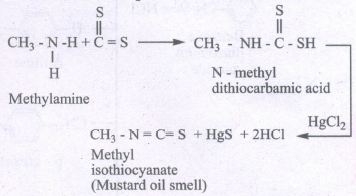
(vi) Mustard oil reaction:
(a) When primary amines are treated with carbon disulphide (CS2), N - alkyldithio carbonic acid is formed which on subsequent treatment with HgCI2, gives an alkyl isothiocyanate.
(b) When aniline is treated with carbon disulphide, or heated together, S-diphenylthio urea is formed, which on boiling with strong HCI, phenyl isothiocyanate (phenyl mustard oil), is formed.
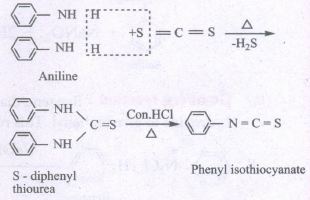
These reactions are known as Hofmann - Mustard oil reaction. This test is used to identify the primary amines.
(vii) Coupling reactions (or) p-hydroxyazobenzene, p-aminoazobenzene, 2-phenyl azo-4-methyl phenol:
Benzene diazonium chloride reacts with electron rich aromatic compounds like phenol, aniline to form brightly coloured azo compounds. Coupling generally occurs at the para position. If para position is occupied then coupling occurs at the ortho position. Coupling tendency is enhanced if an electron donating group is present at the para - position to -N2CI- group. This is an electrophilic substitution.
Aryl fluorides and iodides cannot be prepared by direct halogenation and the cyano group cannot be introduced by nucleophilic substitution of chlorine in chlorobenzene. For introducing such a halide group. cyano group -OH, NO2, etc.. benzenediazonium chloride is a very good intermediate Diazo compounds obtained from the coupling reactions of diazonium salts are coloured and are used as dyes.
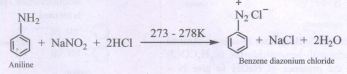
(viii) Diazotisation :
Aniline reacts with nitrous acid at low temperature (273 - 278 K) to give benzene. Diazonium chloride which is stable for a short time and slowly decomposes even at low temperatures.This reaction is known as diazotization
(ix) Gomberg reaction :
Benzene diazonium chloride reacts with benzene in the presence of sodium hydroxide to give biphenyl. This reaction in known as the Gomberg reaction
24.
Narcotic drugs: [Opioids]
(i) These are narcotic analgesics. These relieve pain and produce sleep. These drugs are addictive. In poisonous dose, these produces coma and ultimately death.
(ii) They are used for either short-term or long term relief of severe pains. They are mainly used for post operative pain, pain of terminal cancer.
(iii) Eg: Morphine, Codeine
Non-narcotic drugs:
(i) These are non- narcotic analgesics. These reduce the pain without causing impairment of consciousness.
(ii) They alleviate pain by reducing local inflammatory responses.
(iii) These are used for short-term pain relief and for modest pain like headache, muscle strain, bruising or arthritis.
(iv) These drugs have many other effects such as reducing fever (antipyretic) and preventing platelet coagulation (eg. aspirin).
(v) These reduce fever by causing the hypothalamus to over ride a prostaglandin - induced increase in temperature.
(vi) Eg. Aspirin, Paracetamol, Ibuprofen. There are two types in it.
a) Anti inflammatory: eg: Aspirin, Paracetamol
b) Non steroidal anti -inflammatory drugs: (NSAIDs) eg: Ibuprofen
25.
(i) To understand how a soap works as a cleansing agent, let us consider sodium palmitate an example of a soap. The cleansing action of soap is directly related to the structure of carboxylate ions (palmitate ion) present in soap. The structure of palmitate exhibit dual polarity. The hydrocarbon portion is non polar and the carboxyl portion is polar.

(ii) The nonpolar portion is hydrophobic while the polar end is hydrophilic. The hydrophobic hydro carbon portion is soluble in oils and greases, but not in water. The hydrophilic carboxylate group is soluble in water.
(iii) The dirt in the cloth is due to the presence of dust particles intact or grease which stick. When the soap is added to an oily or greasy part of the cloth, the hydrocarbon part of the soap dissolve in the grease, leaving the negatively charged carboxylate end exposed on the grease surface.
(iv) At the same time the negatively charged carboxylate groups are strongly attracted by water, thus leading to the formation of small droplets called micelles and grease is floated away from the solid object. When the water is rinsed away, the grease goes with it. As a result, the cloth gets free from dirt and the droplets are washed away with water. The micelles do not combine into large drops because their surfaces are all negatively charged and repel each other. The cleansing ability of a soap depends upon its tendency to act as a emulsifying agent between water and water insoluble greases.
.JPG)
The cleansing action of detergents are similar to cleansing action of soap. Eg: the structure of a cationic detergents is:
.JPG)
26.
(i) The amino acids are linked covalently by peptide bonds. The carboxyl group of the first amino acid react with the amino group of the second amino acid to give an amide linkage between these amino acids. This amide linkage is called peptide bond. The resulting compound is called a dipeptide. Addition an another amino acid to this dipeptide a second peptide bond results in tripeptide.
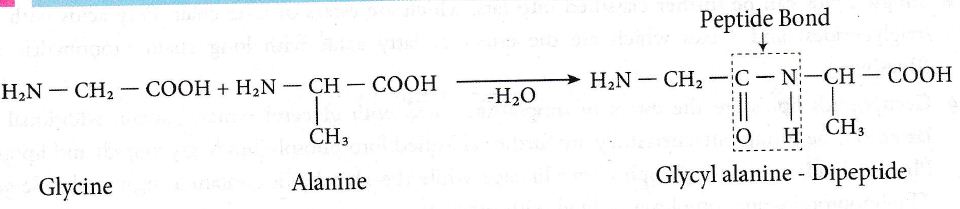
(ii) Thus we can generate tetra peptide, penta peptide etc... When you have more number of amino acids linked this way you get a polypeptide. If the number of amino acids are less it is called as a polypeptide, if it has large number of amino acids (and preferably has a function) then it is called a protein.
(iii) The amino end of the peptide is known as N - terminal or amino terminal while the carboxy end is called C-terminal or carboxy terminal. In general protein sequences are written from N-Terminal to C-Terminal.The atoms other than the side chains (R-groups) are called main chain or the back bone of the polypeptide.
27.
Watson & Crick proposed a 3-dimensional secondary structure of DNA. In this DNA molecule, Monomners of DNA are held together by Phosphodiester linkage. This linkages are occured in 5' & 3' carbon atoms of Pentose sugar.
28.
| S. No | Double salts | Co-ordination compound |
|---|---|---|
| 1. | They usually contain two simple salt in equimolar proportions | The simple salts from which they are formed may or may not be in equimolar proportion. |
| 2. | They exists only in the solid state. In aqueous solution they dissociate completely into ions. | They exist in the solid state as well as in aqueous solution. This is because even in solution, the complex ion does not dissociate into ions. |
| 3. | They are ionic compounds and do not contain any co-ordinate bond. | They may or may not be ion but the complex part always contain coordinate bonds |
| 4. | The properties of the double salts are same as those of its constituent compounds. | The properties of the coordination compounds are different for its constituent bonds. |
| 5. | In a double salt, the metal ion show their normal valency. | In a coordinate compound the metal ion satisfies its two types of valence called primary & secondary valenices. |
| 6. | A double salt loses its identity and dissociates into its constitute simple ions in solution. | The complex ion does not lose its identity and never dissociate to give simple ions. |
| Example: FeSO4 (NH4)2 SO4.6H2O | Example: K4[Fe(CN)6), K3[Fe(SCN)6) |
29.
(d)
30.
(a)
antagonists
31.
(a)
TACGAACT
32.
(d)
D-Glucose
33.
(a)
Riboflavin
34.
(d)
triethylamine
35.
(d)
1,3 – dinitrobenzene
36.
(c)
schiff ’s base
37.
Scattering of light
38.
dispersion medium-gas
dispersed phase-liquid
39.
mg = ZIt
\(= \frac{40 \times 3.86 \times 2500}{2 \times 96500} = 2g\)
(∵ t = 41 min 40 sec = 2500 seconds & \(Z = \frac{m}{n \times 96500} = \frac{40}{x \times 96500})\)
40.
7MnO4- + 5e- → Mn2+ + 4H2O
5 moles of electrons i.e., 5F charge is required.
41.
(c)
42.
Option (a) and (b) -geometrical isomerism is possible
Option (c) - ionization isomerism is possible
Option (d) - no possibility to show either constitutional isomerism or stereo isomerism
43.

12th Standard Syllabus & Materials
12th Standard
TN 12th Computer Applications வலையமைப்பு வடமிடல் Sample Question Papers Study Material - QB365 Set A
NEW12th Standard
TN 12th Computer Applications களப்பெயர் முறைமை (DNS) Sample Question Papers Study Material - QB365 Set A
NEW12th Standard
TN 12th Computer Applications வலையமைப்பு எடுத்துக்காட்டுகள் மற்றும் நெறிமுறைகள் Sample Question Papers Study Material - QB365 Set A
NEW12th Standard
TN 12th Computer Applications கணினி வலையமைப்பு ஓர் அறிமுகம் Sample Question Papers Study Material - QB365 Set A



Tamilnadu Stateboard 12th Standard Subjects

Maths
Chemistry

Physics

Biology

Computer Science

Business Maths and Statistics

Economics

Commerce

Accountancy

History

Computer Applications
Biology
Computer Technology
Computer Applications
Computer Science
Business Maths and Statistics
Commerce
Economics
Maths
Chemistry
Physics
Computer Technology
History
Accountancy

Tamil

English

French
Tamilnadu Stateboard Standards


