
 100% FREE ACCESS
12th Standard Syllabus & Materials
12th Standard
TN 12th Maths Applications of Matrices and Determinants Sample Question Papers Study Material - QB365 Set A
NEW12th Standard
TN 12th Computer Applications மின்னணு தரவு பரிமாற்றம் Sample Question Papers Study Material - QB365 Set A
NEW12th Standard
TN 12th Computer Applications மின் - வணிக பாதுகாப்பு அமைப்புகள் Sample Question Papers Study Material - QB365 Set A
NEW12th Standard
TN 12th Computer Applications மின்னணு செலுத்தல் முறைகள் Sample Question Papers Study Material - QB365 Set A
NEW12th Standard
TN 12th Computer Applications மின் - வணிகம் Sample Question Papers Study Material - QB365 Set A
NEW12th Standard
TN 12th Computer Applications திறந்த மூல கருத்துருக்கள் Sample Question Papers Study Material - QB365 Set A

Published on: 20/10/2025
Download Tamil Nadu 12th Standard Chemistry question papers, model tests, one-mark questions, important questions, and public exam papers in PDF format. Free study materials and answer keys for TN State Board students.
Questions + Answers key
Take MCQ Chemistry Test
1.
Choose the correct statement.
Square planar complexes are more stable than octahedral complexes
The spin only magnetic moment of [Cu(Cl)4]2- is BM and it has square planar structure.
Crystal field splitting energy \(\left( { \Delta }_{ 0 } \right) \) [FeF6]4- is higher than the \((\Delta _{ 0 })\) of [Fe(CN)6]4-
crystal field stabilization energy of [V(H2O)6]2+ is higher than the crystal field stabilization of [Ti(H2O)6]2+
2.
Fac-mer isomerism is shown by _______.
[CO(en)3]3+
[Co(NH3)4(Cl)2]+
[Co(NH3)3(Cl)3]
[Co(NH3)5Cl]SO4
3.
Which of the following is paramagnetic in nature?
[Zn(NH3)4]2+
[Co(NH3)6]3+
[Ni(H2O)6]2+
[Ni(CN)4]2-
4.
Formula of tris(ethane-1, 2-diamine)iron(II)phosphate _______.
[Fe(CH3-CH(NH2)2)3](PO4)3
[Fe(H2N-CH2-CH2-NH2)3](PO4)
[Fe(H2N-CH2-CH2-NH2)3](PO4)2
[Fe(H2N-CH2-CH2-NH2)3]3(PO4)2
5.
A complex in which the oxidation number of the metal is zero is_______.
K4[Fe(CN)6]
[Fe(CN)3(NH3)3]
[Fe(CO)5]
both (b) and (c)
6.
Which one of the following complexes is not expected to exhibit isomerism?
[Ni(NH3)4(H2O)2]2+
[Pt(NH3)2Cl2]
[Co(NH3)5SO4]Cl
[FeCl6]3-
7.
Which kind of isomerism is possible for a complex [Co(NH3)4Br2]CI?
geometrical and ionization
geometrical and optical
optical and ionization
geometrical only
8.
Which one of the following pairs represents linkage isomers?
[Cu(NH3)4][PtCl4] and [Pt(NH3)4][CuCl4]
[Co(NH3)5(NO3)]SO4 and [Co(NH3)5(ONO)]
[Co(NH3)4(NCS)2]Cl and [Co(NH3)4(SCN)2]Cl
both (b) and (c)
9.
How many geometrical isomers are possible for [Pt(Py)(NH3)(Br)(Cl)]
3
4
0
15
10.
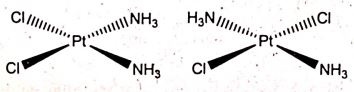
Which type of isomerism is exhibited by [Pt(NH3)2Cl2]?
Coordination isomerism
Linkage isomerism
Optical isomerism
Geometrical isomerism
11.
Which one of the following will give a pair of enantiomorphs?
[Cr(NH3)6][Co(CN)6]
[Co(en)2Cl2]Cl
[Pt(NH3)4][PtCl4]
[Co(NH3)4Cl2]NO2
12.
In which of the following coordination entities the magnitude of Δ0 will be maximum?
[Co(CN)6]3-
[Co(C2O4)3]3-
[Co(H2O)6]3+
[Co(NH3)6]3+
13.
Crystal field stabilization energy for high spin d5 octahedral complex is _______.
-0.6\({ \Delta }_{ 0 }\)
0
2(P-\({ \Delta }_{ 0 }\))
2(P+\({ \Delta }_{ 0 }\))
14.
A magnetic moment of 1.73BM will be shown by one among the following.
TiCl4
[CoCl6]4-
[Cu(NH3)4]2+
[Ni(CN)4]2-
15.
16.
As per IUPAC guidelines, the name of the complex [Co(en)2(ONO)Cl]Cl is _______.
chloro bis ethylenediamine nitrocobalt(III) chloride
chloridobis(ethane-1, 2-diamine)nitro K-O Cobaltate(III) chloride
chloridobis(ethane-1, 2-diammine)nitrito K-O Cobalt(II) chloride
chloridobis(ethane-1, 2-diamine)nitrito K-O Cobalt(III) chloride
17.
Oxidation state of Iron and the charge on the ligand NO in [Fe(H2O)5NO]SO4 are_______.
+2 and 0 respectively
+3 and 0 respectively
+3 and -1 respectively
+1 and +1 respectively
18.
A complex has a molecular formula MSO4Cl.6H2O. The aqueous solution of it gives white precipitate with Barium chloride solution and no precipitate is obtained when it is treated with silver nitrate solution. If the secondary valence of the metal is six, which one of the following correctly represents the complex?
[M(H2O)4Cl]SO4.2H2O
[M(H2O)6]SO4
[M(H2O)5Cl]SO4.H2O
[M(H2O)3Cl]SO4.3H2O
19.
An excess of silver nitrate is added to 100ml of a 0.01M solution of Pentaaquachlorochromium (III)chloride. The number of moles of AgCl precipitated would be _______.
0.02
0.002
0.01
0.2
20.
The sum of primary valence and secondary valence of the metal M in the complex [M(en)2(Ox)]Cl is________.
3
6
-3
9
21.
Which one of the following is not correct?
La(OH)3 is less basic than Lu(OH)3
In lanthanoid series ionic radius of Ln3+ ions decreases
La is actually an element of transition metal series rather than lanthanide series
Atomic radii of Zr and Hf are same because of lanthanide contract
22.
The actinoid elements which show the highest oxidation state of +7 are _______.
Np, Pu, Am
U, Fm, Th
U, Th, Md
Es, No, Lr
23.
The most common oxidation state of actinoids is _______.
+2
+3
+4
+6
24.
Which of the following oxidation states is most common among the lanthanoids?
+4
+2
+5
+3
25.
Which of the following lanthanoid ions is diamagnetic?
Eu2+
Yb2+
Ce2+
Sm2+
26.
Which one of the following statements related to lanthanons is incorrect?
Europium shows +2 oxidation state
The basicity decreases as the ionic radius decreases from Pr to Lu.
All the lanthanons are much more reactive than aluminium
Ce4+ solutions are widely used as oxidising agents in volumetric analysis.
27.
The number of moles of acidified KMnO4 required to oxidize 1 mole of ferrous oxalate(FeC2O4) is _______.
5
3
0.6
1.5
28.
29.
Permanganate ion changes to ________ in acidic medium.
MnO42−
Mn2+
Mn3+
MnO2
30.
Which of the following statements is not true?
on passing H2S, through acidified K2Cr2O7 solution, a milky colour is observed
Na2Cr2O7 is preferred over K2Cr2O7 in volumetric analysis
K2Cr2O7 solution in acidic medium is orange in colour
K2Cr2O7 solution becomes yellow on increasing the PH beyond 7
31.
32.
The correct order of increasing oxidizing power in the series _______.
VO2+ < Cr2O72- < MnO4-
Cr2O72- < VO2+ < MnO4-
Cr2O72- < MnO4- < VO2+
MnO4- < Cr2O72- < VO2+
33.
The catalytic behaviour of transition metals and their compounds is ascribed mainly due to _______.
their magnetic behaviour
their unfilled d orbitals
their ability to adopt variable oxidation states
their chemical reactivity
34.
The magnetic moment of Mn2+ ion is _______.
5.92BM
2.80BM
8.95BM
3.90BM
35.
Which one of the following ions has the same number of unpaired electrons as present in V3+?
Ti3+
Fe3+
Ni2+
Cr3+
36.
Among the transition metals of 3d series, the one that has highest negative \(\left( \frac { M^{ 2+ } }{ M } \right) \) standard electrode potential is _______.
Ti
Cu
Mn
Zn
37.
Which of the following d block element has half filled penultimate d sub shell as well as half filled valence sub shell?
Cr
Pd
Pt
none of these
38.
Sc (Z = 21) is a transition element but Zinc (z = 30) is not because _______.
both Sc3+ and Zn2+ ions are colourless and form white compounds
In case of Sc, 3d orbital are partially filled but in Zn these are completely filled
last electron as assumed to be added to 4s level in case of zinc
both Sc and Zn do not exhibit variable oxidation states
39.
The stability of +1 oxidation state increases in the sequence ________.
Al < Ga < In < Tl
Tl < In < Ga < Al
In < Tl < Ga < Al
Ga< In < Al < Tl
40.
The compound that is used in nuclear reactors as protective shields and control rods is _________.
Metal borides
metal oxides
Metal carbonates
metal carbide
41.
Duralumin is an alloy of ______.
Cu, Mn
Cu, Al, Mg
Al, Mn
Al, Cu, Mn, Mg
42.
| Column-I | Column-II | ||
| A | Borazole | 1 | B(OH)3 |
| B | Boric acid | 2 | B3N3H6 |
| C | Quartz | 3 | Na2[B4O5(OH)4]8H2O |
| D | Borax | 4 | SiO2 |
| A | B | C | D |
| 2 | 1 | 4 | 3 |
| A | B | C | D |
| 1 | 2 | 4 | 3 |
| A | B | C | D |
| 1 | 2 | 4 | 3 |
None of these
43.
Which of the following statements is not correct?
Beryl is a cyclic silicate
Mg2SiO4 is an orthosilicate
SiO44−is the basic structural unit of silicates
Feldspar is not aluminosilicate
44.
The geometry at which carbon atom in diamond are bonded to each other is _______.
Tetrahedral
hexagonal
Octahedral
none of these
45.
Which of the following is not sp2 hybridised?
Graphite
graphene
Fullerene
dry ice
46.
Which of these is not a monomer for a high molecular mass silicone polymer?
Me3SiCl
PhSiCl3
MeSiCl3
Me2SiCl2
47.
When copper is heated with conc HNO3 it produces ________.
Cu(NO3)2, NO and NO2
Cu(NO3)2 and N2O
Cu(NO3)2 and NO2
Cu(NO3)2 and NO
48.
Among the following the correct order of acidity is ________.
HClO2 < HClO < HClO3 < HClO4
HClO4 < HClO2 < HClO < HClO3
HClO3 < HClO4 < HClO2 < HClO
HClO < HClO2 < HClO3 < HClO4
49.
Which one of the following orders is correct for the bond dissociation enthalpy of halogen molecules?
Br2 > I2 > F2 > Cl2
F2 > Cl2 > Br2 > l2
I2 > Br2 > Cl2 > F2
Cl2 > Br2 > F2 > I2
50.
Which of the following is strongest acid among all?
HI
HF
HBr
HCl
51.
XeF6 on complete hydrolysis produces________.
XeOF4
XeO2F2
XeO3
XeO2
52.
Most easily liquefiable gas is _______.
Ar
Ne
He
Kr
53.
Which one of the following compounds is not formed?
XeOF4
XeO3
XeF2
NeF2
54.
The correct order of the thermal stability of hydrogen halide is_______.
HI > HBr > HCl > HF
HF > HCl > HBr > HI
HCl > HF > HBr > HI
HI > HCl > HF > HBr
55.
Among the following, which is the strongest oxidizing agent?
Cl2
F2
Br2
l2
56.
The molarity of given orthophosphoric acid solution is 2M. Its normality is _______.
6N
4N
2N
none of these
57.
The basicity of pyrophosphorous acid ( H4P2O5) is _______.
4
2
3
5
58.
P4O6 reacts with cold water to give _______.
H3PO3
H4P2O7
HPO3
H3PO4
59.
On hydrolysis, PCl3 gives________.
H3PO3
PH3
H3PO4
POCl3
60.
Solid (A) reacts with strong aqueous NaOH liberating a foul smelling gas(B) which spontaneously burn in air giving smoky rings. A and B are respectively_________.
P4(red) & PH3
P4(white) & PH3
S8 & H2S
P4(white) & H2S
61.
An element belongs to group 15 and 3rd period of the periodic table, its electronic configuration would be_______.
1s2 2s2 2p4
1s2 2s2 2p3
1s2 2s2 2p6 3s2 3p2
1s2 2s2 2p6 3s2 3p3
62.
Which is true regarding nitrogen?
least electronegative element
has low ionisation enthalpy than oxygen
d- orbitals available
ability to form pπ-pπ bonds with itself
63.
In which of the following, NH3 is not used?
Nessler's reagent
Reagent for the analysis of IV group basic radical
Reagent for the analysis of III group basic radical
Tollen's reagent
64.
The repeating unit in silicone is_______.
SiO2
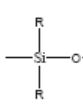
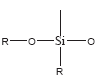
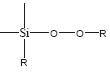
65.
The basic structural unit of silicates is _______.
\(\left( SiO_{ 3 } \right) ^{ 2- }\)
\(\left( SiO_{ 4 } \right) ^{ 2- }\)
\(\left( Sio \right) ^{ - }\)
\(\left( SiO_{ 4 } \right) ^{ 4- }\)
66.
Oxidation state of carbon in its hydrides _______.
+4
-4
+3
+2
67.
Carbon atoms in fullerene with formula C60 have _______hybridisation.
sp3 hybridised
sp hybridised
sp2 hybridised
partially sp2 and partially sp3 hybridised
68.
The element that does not show catenation among the following p-block elements is ________.
Carbon
silicon
Lead
germanium
69.
In diborane, the number of electrons that accounts for banana bonds is ________.
six
two
four
three
70.
Which of the following metals has the largest abundance in the earth’s crust?
Aluminium
Calcium
Magnesium
Sodium
71.
Which among the following is not a borane?
B2H6
B3H6
B4H10
none of these
72.
73.
An aqueous solution of borax is________.
neutral
acidic
basic
amphoteric
74.
Which of the following is not true with respect to Ellingham diagram?
Free energy changes follow a straight line. Deviation occurs when there is a phase change.
The graph for the formation of CO2 is a straight line almost parallel to free energy axis.
Negative slope of CO shows that it becomes more stable with increase in temperature.
Positive slope of metal oxides shows that their stabilities decrease with increase in temperature.
75.
Which of the following reduction is not thermodynamically feasible?
\({ Cr }_{ 2 }{ O }_{ 3 }+2Al\longrightarrow { Al }_{ 2 }{ O }_{ 3 }+2Cr\)
\(\mathrm{Al}_2 \mathrm{O}_3+2 \mathrm{Cr} \longrightarrow \mathrm{Cr}_2 \mathrm{O}_3+2 \mathrm{Al}\)
\(3Ti{ O }_{ 2 }+4Al\longrightarrow 2A{ l }_{ 2 }{ O }_{ 3 }+3Ti\)
none of these
76.
In the Ellingham diagram, for the formation of carbon monoxide________.
\(\left( \cfrac { \Delta { S }^{ 0 } }{ \Delta T } \right) \) is negative
\(\left( \cfrac { \Delta { G }^{ 0 } }{ \Delta T } \right) \) is positive
\(\left( \cfrac { \Delta { G }^{ 0 } }{ \Delta T } \right) \) is negative
initially \(\left( \cfrac { \Delta T }{ \Delta { G }^{ 0 } } \right) \) is positive, after 700oC,\(\left( \cfrac { \Delta { G }^{ 0 } }{ \Delta T } \right) \) is negative
77.
Which of the following plot gives Ellingham diagram
\(\Delta S \ \text{Vs} \ T\)
\(\Delta { G }^{ 0 }\ \text{Vs} \ T\)
\(\Delta { G }^{ 0 }\ \text{Vs} \ \frac { 1 }{ T } \)
\(\Delta { G }^{ 0 }\ \text{Vs} \ { T }^{ 2 }\)
78.
79.
The incorrect statement among the following is______.
Nickel is refined by Mond’s process
Titanium is refined by Van Arkel’s process
Zinc blende is concentrated by froth floatation
In the metallurgy of gold, the metal is leached with dilute sodium chloride solution
80.
Which of the following is used for concentrating ore in metallurgy?
Leaching
Roasting
Froth floatation
Both (a) and (c)
81.
The following set of reactions are used in refining Zirconium
\(Zr \text{(impure)}+2I_{ 2 }\overset { 523k }{ \longrightarrow } ZrI_{ 4 }\)
\({ ZrI }_{ 4 }\overset { 1800K }{ \longrightarrow } Zr \text{(pure)}+{ 2I }_{ 2 }\)This method is known as ______.
Liquation
Van Arkel process
Zone refining
Mond’s process
82.
Considering Ellingham diagram, which of the following metals can be used to reduce alumina?
Fe
Cu
Mg
Zn
83.
84.
Zinc is obtained from ZnO by________.
Carbon reduction
Reduction using silver
Electrochemical process
Acid leaching
85.
In the extraction of aluminium from alumina by electrolysis, cryolite is added to_______.
Lower the melting point of alumina
Remove impurities from alumina
Decrease the electrical conductivity
Increase the rate of reduction
86.
Which one of the following ores is best concentrated by froth – floatation method?
Magnetite
Haematite
Galena
Cassiterite
87.
Flux is a substance which is used to convert_______.
Mineral into silicate
Infusible impurities to soluble impurities
Soluble impurities to infusible impurities
All of these
88.
Electrochemical process is used to extract_______.
Iron
Lead
Sodium
silver
89.
Which one of the following is not feasible
Zn(s) + Cu2+(aq) \(\rightarrow\) Cu(s) + Zn2+(aq)
Cu(s)+ Zn2+(aq)\(\rightarrow\) Zn(s) + Cu2+(aq)
Cu(s) + 2Ag+(ag)\(\rightarrow\) 2Ag(s) + Cu2+(aq)
Fe(s) + Cu2+(aq) \(\rightarrow\) Cu(s)+ Fe2+(aq)
90.
Wolframite ore is separated from tinstone by the process of________.
Smelting
Calcination
Roasting
Electromagnetic separation
91.
Match items in column - I with the items of column – II and assign the correct code.
| Column-I | Column-II | ||
| A. | Cyanide process | (i) | Ultrapure Ge |
| B | Froth floatation process | (ii) | Dressing of ZnS |
| C | Electrolytic reduction | (iii) | Extraction of Al |
| D | Zone refining | (iv) | Extraction of Au |
| (v) | Purification of Ni | ||
| A | B | C | D |
| (i) | (ii) | (iii) | (iv) |
| A | B | C | D |
| (iii) | (iv) | (v) | (i) |
| A | B | C | D |
| (iv) | (ii) | (iii) | (i) |
| A | B | C | D |
| (ii) | (iii) | (i) | (v) |
92.
Which of the following statements, about the advantage of roasting of sulphide ore before reduction is not true?
\(\Delta { G }_{ f }^{ 0 }\) of sulphide is greater than those for CS2 and H2S
\(\Delta { G }_{ r }^{ 0 }\) is negative for roasting of sulphide ore to oxide
Roasting of the sulphide to its oxide is thermodynamically feasible
Carbon and hydrogen are suitable reducing agents for metal sulphides
93.
Which of the metal is extracted by Hall-Heroult process?
Al
Ni
Cu
Zn
94.
The metal oxide which cannot be reduced to metal by carbon is ________.
PbO
Al2O3
ZnO
FeO
95.
Which one of the following reaction represents calcinations?
\(2Zn+{ O }_{ 2 }\rightarrow 2ZnO\)
\(2ZnS+3O_{ 2 }\rightarrow 2ZnO+2SO_{ 2 }\)
\(MgCO_{ 3 }\rightarrow MgO+CO_{ 2 }\)
Both (a) and (c)
96.
Roasting of sulphide ore gives the gas (A).(A) is a colourless gas. Aqueous solution of (A) is acidic. The gas (A) is______.
CO2
SO3
SO2
H2S
97.
Bauxite has the composition ______.
Al2O3
Al2O3.nH2O
Fe2O3.2H2O
None of these
1.
(d)
crystal field stabilization energy of [V(H2O)6]2+ is higher than the crystal field stabilization of [Ti(H2O)6]2+
2.
(c)
[Co(NH3)3(Cl)3]
3.
a) Zn2+ (d10 ⇒ diamagnetic)
b) Co3+ (d6 Low spain ⇒ t2g6 e0g ; diamagnetic)
c) Ni2+ (d8 Low spain ⇒ t2g6 e2g ; paramagnetic)
d) [Ni(CN)4]2+ (dsp2 ; square planar, diamagnetic)
4.
[Fe(H2N-CH2-CH2-NH2)3]3(PO4)2
[Fe(en)3]2+(\(PO_{4}^{3-}\))
5.
a) Fe2+ b) Fe3+ c) Fe0
6.
Option (a) and (b) -geometrical isomerism is possible
Option (c) - ionization isomerism is possible
Option (d) - no possibility to show either constitutional isomerism or stereo isomerism
7.
For [MA4B2]4+ complexes - geometrical isomerism is possible
{[Co(NH3)4Br2]CI,[Co(NH3)4Br CI]Br} - ionisation isomers
8.
(a) coordination isomers
(b) no isomerism ( different molecular formula)
(c)⬅NCS; ⬅SCN coordinating atom differs : linkage isomers
9.
Three isomers. If we consider any one of the ligands as reference (say Py), the arrangement of other three ligands (NH3, Br- and Cl-) with respect to (Py) gives three geometrical isomers.
10.
11.
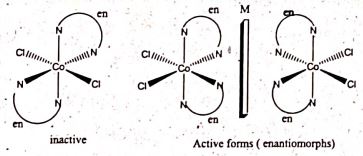
Complexes given in other options (a), (c) and (d) have symmetry elements and hence they are optically inactive.
12.
In all the complexes, the central metal ion is Co3+, among the given ligands CN- is the strongest ligand, which causes large crystal
field splitting i.e maximum Δ0
13.
The electronic configuration t2g3, e2g
[ 3 x (-0.4)+ 2(0.6)]Δ0
[-1.2 + 1.2] Δ0 = 0
14.
Ti4+ (d0 ⇒ 0BM)
Co2+ (d7 spain free ⇒ t2g5, e2g; n = 3; μ = 3.9BM)
Cu2+ (d9 Low spain ⇒ t2g6, e3g; n = 1; μ = 1.732BM)
Ni2+ (d8 Low spain ⇒ t2g6, e2g; n = 2; μ = 2.44 BM)
15.
(d)
16.
(d)
chloridobis(ethane-1, 2-diamine)nitrito K-O Cobalt(III) chloride
17.
[\( \overset{+}{Fe}\)(H2O)5\( \overset{+}{NO}\)]2+ SO2-4
+1 and +1 respectively
18.
Molecular formula: MSO4Cl.6H2O
Formation of white precipitate with Barium chloride indicates that SO2-4 ions are outside the coordination sphere, and no precipitate with AgNO3 solution indicates that the Cl- ions are inside the coordination sphere. Since the coordination number of M is 6.Cl- and 5 H2O are ligands, remaining 1 H2O molecular and SO2-4 are in the outer coordination sphere.
19.
The complex is [M(H2O)5Cl]Cl2
1000 ml of 1 M solution of the complex gives 2 moles of Cl- ions 1000 ml of 0.01 M solution of the complex will give
\(\frac{100 ml \times 0.01M \times 2Cl^-}{1000 ml \times 1M}\)
= 0.002 moles of Cl- ions
20.
In the complex [M(en)2(Ox)]Cl For the central metal ion M3+
The primary valence is = +3
The secondary valence = 6
sum of primary valence and secondary valence = 3 + 6 = 9
21.
(a)
La(OH)3 is less basic than Lu(OH)3
22.
(a)
Np, Pu, Am
23.
(b)
+3
24.
(d)
+3
25.
Yb2+ - 4f14 - no unpaired electrons - diamagnetic
26.
As we move from La to Lu, their metallic behaviour because almost similar to that of aluminium.
27.
+7 +2+3 2+ 3+ 4+
MnO4- + FeC2O4 ⟶ Mn2+ + Fe3+ + 2CO2
5e- acception 3e- release
5 moles of FeC2O4 \(\equiv\) 3 moles of KMnO4
1 mole of FeC2O4 \(\equiv\) (3/5) moles of KMnO4
1 mole of FeC2O4 \(\equiv\) 0.6 moles of KMnO4
28.
(c)
29.
MnO-4 + 8H+ + 5e- → Mn2+ + 4H2O
30.
(b)
Na2Cr2O7 is preferred over K2Cr2O7 in volumetric analysis
31.
(b)
32.
+5 +6 +7
VO2+ < Cr2O72- < MnO4-
Greater the oxidation state, higher is the oxidising power.
33.
(c)
their ability to adopt variable oxidation states
34.
Mn2+ ⇒ 3d5 contains 5 unpaired electrons
n = 5,
\( \sqrt{n(n+ 2)} \) BM
\(= \sqrt{5(5+ 2)} = \sqrt{35} = 5.92 BM\)
35.
(c)
Ni2+
36.
(a)
Ti
37.
Cr ⇒ [Ar]3d54s1
38.
(b)
In case of Sc, 3d orbital are partially filled but in Zn these are completely filled
39.
(a)
Al < Ga < In < Tl
40.
(a)
Metal borides
41.
(d)
Al, Cu, Mn, Mg
42.
(a)
| A | B | C | D |
| 2 | 1 | 4 | 3 |
43.
(d)
Feldspar is not aluminosilicate
44.
(a)
Tetrahedral
45.
(d)
dry ice
46.
(a)
Me3SiCl
47.
(c)
Cu(NO3)2 and NO2
48.
(d)
HClO < HClO2 < HClO3 < HClO4
49.
(d)
Cl2 > Br2 > F2 > I2
50.
(a)
HI
51.
(c)
XeO3
52.
(d)
Kr
53.
(d)
NeF2
54.
(b)
HF > HCl > HBr > HI
55.
(b)
F2
56.
(a)
6N
57.
(b)
2
58.
(a)
H3PO3
59.
(a)
H3PO3
60.
(b)
P4(white) & PH3
61.
(d)
1s2 2s2 2p6 3s2 3p3
62.
(d)
ability to form pπ-pπ bonds with itself
63.
(a)
Nessler's reagent
64.
(b)
65.
(d)
\(\left( SiO_{ 4 } \right) ^{ 4- }\)
66.
(a)
+4
67.
(c)
sp2 hybridised
68.
(c)
Lead
69.
(c)
four
70.
(a)
Aluminium
71.
(b)
B3H6
72.
(d)
73.
(c)
basic
74.
(b)
The graph for the formation of CO2 is a straight line almost parallel to free energy axis.
75.
(b)
\(\mathrm{Al}_2 \mathrm{O}_3+2 \mathrm{Cr} \longrightarrow \mathrm{Cr}_2 \mathrm{O}_3+2 \mathrm{Al}\)
76.
(c)
\(\left( \cfrac { \Delta { G }^{ 0 } }{ \Delta T } \right) \) is negative
77.
(b)
\(\Delta { G }^{ 0 }\ \text{Vs} \ T\)
78.
(b)
79.
(d)
In the metallurgy of gold, the metal is leached with dilute sodium chloride solution
80.
(d)
Both (a) and (c)
81.
(b)
Van Arkel process
82.
(c)
Mg
83.
(c)
84.
(a)
Carbon reduction
85.
(a)
Lower the melting point of alumina
86.
(c)
Galena
87.
(b)
Infusible impurities to soluble impurities
88.
(c)
Sodium
89.
(b)
Cu(s)+ Zn2+(aq)\(\rightarrow\) Zn(s) + Cu2+(aq)
90.
(d)
Electromagnetic separation
91.
(c)
| A | B | C | D |
| (iv) | (ii) | (iii) | (i) |
92.
(d)
Carbon and hydrogen are suitable reducing agents for metal sulphides
93.
(a)
Al
94.
(b)
Al2O3
95.
(c)
\(MgCO_{ 3 }\rightarrow MgO+CO_{ 2 }\)
96.
(c)
SO2
97.
(b)
Al2O3.nH2O

12th Standard Syllabus & Materials
12th Standard
TN 12th Computer Applications வலையமைப்பு வடமிடல் Sample Question Papers Study Material - QB365 Set A
NEW12th Standard
TN 12th Computer Applications களப்பெயர் முறைமை (DNS) Sample Question Papers Study Material - QB365 Set A
NEW12th Standard
TN 12th Computer Applications வலையமைப்பு எடுத்துக்காட்டுகள் மற்றும் நெறிமுறைகள் Sample Question Papers Study Material - QB365 Set A
NEW12th Standard
TN 12th Computer Applications கணினி வலையமைப்பு ஓர் அறிமுகம் Sample Question Papers Study Material - QB365 Set A



Tamilnadu Stateboard 12th Standard Subjects

Maths
Chemistry

Physics

Biology

Computer Science

Business Maths and Statistics

Economics

Commerce

Accountancy

History

Computer Applications
Biology
Computer Technology
Computer Applications
Computer Science
Business Maths and Statistics
Commerce
Economics
Maths
Chemistry
Physics
Computer Technology
History
Accountancy

Tamil

English

French
Tamilnadu Stateboard Standards


