
 100% FREE ACCESS
12th Standard Syllabus & Materials
12th Standard
TN 12th Computer Applications மின்னணு தரவு பரிமாற்றம் Sample Question Papers Study Material - QB365 Set A
NEW12th Standard
TN 12th Computer Applications மின் - வணிக பாதுகாப்பு அமைப்புகள் Sample Question Papers Study Material - QB365 Set A
NEW12th Standard
TN 12th Computer Applications மின்னணு செலுத்தல் முறைகள் Sample Question Papers Study Material - QB365 Set A
NEW12th Standard
TN 12th Computer Applications மின் - வணிகம் Sample Question Papers Study Material - QB365 Set A
NEW12th Standard
TN 12th Computer Applications திறந்த மூல கருத்துருக்கள் Sample Question Papers Study Material - QB365 Set A
NEW12th Standard
TN 12th Computer Applications வலையமைப்பு வடமிடல் Sample Question Papers Study Material - QB365 Set A

Published on: 20/10/2025
Download Tamil Nadu 12th Standard Chemistry question papers, model tests, one-mark questions, important questions, and public exam papers in PDF format. Free study materials and answer keys for TN State Board students.
Questions + Answers key
Take MCQ Chemistry Test
1.
For the reaction \({ N }_{ 2 }{ O }_{ 5 }\left( g \right) \longrightarrow { 2NO }_{ 2 }\left( g \right) +\frac { 1 }{ 2 } { O }_{ 2 }\left( g \right) \) value of rate of disappearance of N2O5 is given as 6.5 x 10⁻² mol L-1s-1. The rate of formation of NO2 and O2 is given respectively as_____.
(3.25 x 10⁻² mol L-1s-1) and (1.3 x 10⁻² mol L-1s-1)
(1.3 x 10⁻² mol L-1s-1) and (3.25 x 10⁻² mol L-1s-1)
(1.3 x 10⁻¹ mol L-1s-1) and (3.25 x 10⁻² mol L-1s-1)
None of these
2.
What is the activation energy for a reaction if its rate doubles when the temperature is raised from 200K to 400K? (R = 8.314 JK-1 mol-1)
234.65 kJ mol-1
434.65 kJ mol-1
2.305 kJ mol-1
334.65 J mol-1
3.
In a reversible reaction, the enthalpy change and the activation energy in the forward direction are respectively −x kJ mol-1 and y kJ mol-1. Therefore, the energy of activation in the backward direction is _______.
(y-x) kJ mol-1
(x+y) J mol-1
(x-y) KJ mol-1
(x+y) x 103J mol-1
4.
For a reaction Rate = k[acetone]3/2 then unit of rate constant and rate of reaction respectively is _______.
(mol L-1 S-1),(mol1/2 L1/2 S-1)
(mol-1/2 L1/2 s-1),(mol L-1 s-1)
(mol1/2 L1/2 s-1),(mol L-1 s-1)
(mol L s-1),(mol1/2 L1/2 s)
5.
Potassium has a bcc structure with nearest neighbor distance 4.52 \(\overset{o}{A}\). Its atomic weight is 39. its density will be_______.
915 kg m-3
2142 kg m-3
452 kg m-3
390 kg m-3
6.
The fraction of total volume occupied by the atoms in a simple cubic is ________.
\(\left( \frac { \pi }{ 4\sqrt { 2 } } \right) \)
\(\left( \frac { \pi }{ 6 } \right) \)
\(\left( \frac { \pi }{ 4 } \right) \)
\(\left( \frac { \pi }{ 3\sqrt { 2 } } \right) \)
7.
A solid compound XY has NaCl structure if the radius of the cation is 100pm, the radius of the anion will be ________.
\(\left( \frac { 100 }{ 0.414 } \right) \)
\(\left( \frac { 0.732 }{ 100 } \right) \)
100 x 0.414
\(\left( \frac { 0.414 }{ 100 } \right) \)
8.
For a first order reaction A ⟶ product with initial concentration x mol L-1, has a half life period of 2.5 hours. For the same reaction with initial concentration \(\left( \frac { x }{ 2 } \right) \) mol L-1 the half life is
(2.5 x 2) hours
\(\left( \frac { 2.5 }{ 2 } \right) \) hours
2.5 hours
Without knowing the rate constant, t1/2 cannot be determined from the given data
9.
A zero order reaction X ⟶ Product, with an initial concentration 0.02M has a half life of 10 min. if one starts with concentration 0.04M, then the half life is
10 s
5 min
20 min
cannot be predicted using the given information
10.
The number of unit cells in 8 gm of an element X (atomic mass 40) which crystallizes in bcc pattern is (NA is the Avogadro number)________.
6.023 x 10²³
6.023 x 10²²
60.23 x 10²³
\(\left( \frac { 6.023\times { 10 }^{ 23 } }{ 8\times 40 } \right) \)
11.
The ratio of close packed atoms to tetrahedral hole in cubic packing is ________.
1:1
1:2
2:1
1:4
12.
An ionic compound Ax By crystallizes in fcc type crystal structure with B ions at the centre of each face and A ion occupying corners of the cube the correct formula of Ax, By is ________.
AB
AB3
A3B
A8B6
13.
Choose the correct statement.
Square planar complexes are more stable than octahedral complexes
The spin only magnetic moment of [Cu(Cl)4]2- is BM and it has square planar structure.
Crystal field splitting energy \(\left( { \Delta }_{ 0 } \right) \) [FeF6]4- is higher than the \((\Delta _{ 0 })\) of [Fe(CN)6]4-
crystal field stabilization energy of [V(H2O)6]2+ is higher than the crystal field stabilization of [Ti(H2O)6]2+
14.
Fac-mer isomerism is shown by _______.
[CO(en)3]3+
[Co(NH3)4(Cl)2]+
[Co(NH3)3(Cl)3]
[Co(NH3)5Cl]SO4
15.
Formula of tris(ethane-1, 2-diamine)iron(II)phosphate _______.
[Fe(CH3-CH(NH2)2)3](PO4)3
[Fe(H2N-CH2-CH2-NH2)3](PO4)
[Fe(H2N-CH2-CH2-NH2)3](PO4)2
[Fe(H2N-CH2-CH2-NH2)3]3(PO4)2
16.
Which one of the following pairs represents linkage isomers?
[Cu(NH3)4][PtCl4] and [Pt(NH3)4][CuCl4]
[Co(NH3)5(NO3)]SO4 and [Co(NH3)5(ONO)]
[Co(NH3)4(NCS)2]Cl and [Co(NH3)4(SCN)2]Cl
both (b) and (c)
17.
Which one of the following will give a pair of enantiomorphs?
[Cr(NH3)6][Co(CN)6]
[Co(en)2Cl2]Cl
[Pt(NH3)4][PtCl4]
[Co(NH3)4Cl2]NO2
18.
19.
An excess of silver nitrate is added to 100ml of a 0.01M solution of Pentaaquachlorochromium (III)chloride. The number of moles of AgCl precipitated would be _______.
0.02
0.002
0.01
0.2
20.
Which of the following lanthanoid ions is diamagnetic?
Eu2+
Yb2+
Ce2+
Sm2+
21.
Permanganate ion changes to ________ in acidic medium.
MnO42−
Mn2+
Mn3+
MnO2
22.
The correct order of increasing oxidizing power in the series _______.
VO2+ < Cr2O72- < MnO4-
Cr2O72- < VO2+ < MnO4-
Cr2O72- < MnO4- < VO2+
MnO4- < Cr2O72- < VO2+
23.
The catalytic behaviour of transition metals and their compounds is ascribed mainly due to _______.
their magnetic behaviour
their unfilled d orbitals
their ability to adopt variable oxidation states
their chemical reactivity
24.
Which one of the following ions has the same number of unpaired electrons as present in V3+?
Ti3+
Fe3+
Ni2+
Cr3+
25.
Among the transition metals of 3d series, the one that has highest negative \(\left( \frac { M^{ 2+ } }{ M } \right) \) standard electrode potential is _______.
Ti
Cu
Mn
Zn
26.
Sc (Z = 21) is a transition element but Zinc (z = 30) is not because _______.
both Sc3+ and Zn2+ ions are colourless and form white compounds
In case of Sc, 3d orbital are partially filled but in Zn these are completely filled
last electron as assumed to be added to 4s level in case of zinc
both Sc and Zn do not exhibit variable oxidation states
27.
When copper is heated with conc HNO3 it produces ________.
Cu(NO3)2, NO and NO2
Cu(NO3)2 and N2O
Cu(NO3)2 and NO2
Cu(NO3)2 and NO
28.
Which one of the following orders is correct for the bond dissociation enthalpy of halogen molecules?
Br2 > I2 > F2 > Cl2
F2 > Cl2 > Br2 > l2
I2 > Br2 > Cl2 > F2
Cl2 > Br2 > F2 > I2
29.
Which of the following is strongest acid among all?
HI
HF
HBr
HCl
30.
Most easily liquefiable gas is _______.
Ar
Ne
He
Kr
31.
The basicity of pyrophosphorous acid ( H4P2O5) is _______.
4
2
3
5
32.
On hydrolysis, PCl3 gives________.
H3PO3
PH3
H3PO4
POCl3
33.
An element belongs to group 15 and 3rd period of the periodic table, its electronic configuration would be_______.
1s2 2s2 2p4
1s2 2s2 2p3
1s2 2s2 2p6 3s2 3p2
1s2 2s2 2p6 3s2 3p3
34.
The basic structural unit of silicates is _______.
\(\left( SiO_{ 3 } \right) ^{ 2- }\)
\(\left( SiO_{ 4 } \right) ^{ 2- }\)
\(\left( Sio \right) ^{ - }\)
\(\left( SiO_{ 4 } \right) ^{ 4- }\)
35.
Carbon atoms in fullerene with formula C60 have _______hybridisation.
sp3 hybridised
sp hybridised
sp2 hybridised
partially sp2 and partially sp3 hybridised
36.
In diborane, the number of electrons that accounts for banana bonds is ________.
six
two
four
three
37.
Which of the following metals has the largest abundance in the earth’s crust?
Aluminium
Calcium
Magnesium
Sodium
38.
Which among the following is not a borane?
B2H6
B3H6
B4H10
none of these
39.
40.
Which of the following reduction is not thermodynamically feasible?
\({ Cr }_{ 2 }{ O }_{ 3 }+2Al\longrightarrow { Al }_{ 2 }{ O }_{ 3 }+2Cr\)
\(\mathrm{Al}_2 \mathrm{O}_3+2 \mathrm{Cr} \longrightarrow \mathrm{Cr}_2 \mathrm{O}_3+2 \mathrm{Al}\)
\(3Ti{ O }_{ 2 }+4Al\longrightarrow 2A{ l }_{ 2 }{ O }_{ 3 }+3Ti\)
none of these
41.
Which of the following plot gives Ellingham diagram
\(\Delta S \ \text{Vs} \ T\)
\(\Delta { G }^{ 0 }\ \text{Vs} \ T\)
\(\Delta { G }^{ 0 }\ \text{Vs} \ \frac { 1 }{ T } \)
\(\Delta { G }^{ 0 }\ \text{Vs} \ { T }^{ 2 }\)
42.
The incorrect statement among the following is______.
Nickel is refined by Mond’s process
Titanium is refined by Van Arkel’s process
Zinc blende is concentrated by froth floatation
In the metallurgy of gold, the metal is leached with dilute sodium chloride solution
43.
Considering Ellingham diagram, which of the following metals can be used to reduce alumina?
Fe
Cu
Mg
Zn
44.
45.
In the extraction of aluminium from alumina by electrolysis, cryolite is added to_______.
Lower the melting point of alumina
Remove impurities from alumina
Decrease the electrical conductivity
Increase the rate of reduction
46.
Which one of the following ores is best concentrated by froth – floatation method?
Magnetite
Haematite
Galena
Cassiterite
47.
Which one of the following is not feasible
Zn(s) + Cu2+(aq) \(\rightarrow\) Cu(s) + Zn2+(aq)
Cu(s)+ Zn2+(aq)\(\rightarrow\) Zn(s) + Cu2+(aq)
Cu(s) + 2Ag+(ag)\(\rightarrow\) 2Ag(s) + Cu2+(aq)
Fe(s) + Cu2+(aq) \(\rightarrow\) Cu(s)+ Fe2+(aq)
48.
Wolframite ore is separated from tinstone by the process of________.
Smelting
Calcination
Roasting
Electromagnetic separation
49.
Which of the following statements, about the advantage of roasting of sulphide ore before reduction is not true?
\(\Delta { G }_{ f }^{ 0 }\) of sulphide is greater than those for CS2 and H2S
\(\Delta { G }_{ r }^{ 0 }\) is negative for roasting of sulphide ore to oxide
Roasting of the sulphide to its oxide is thermodynamically feasible
Carbon and hydrogen are suitable reducing agents for metal sulphides
50.
Which of the metal is extracted by Hall-Heroult process?
Al
Ni
Cu
Zn
1.
Rate \(=\frac { d\left[ { N_2O_5 } \right] }{ dt } =\frac { 1 }{ 2 } =\frac { d\left[ { NO}_{ 2 } \right] }{ dt } =\frac { 2d\left[ { O }_{ 2 } \right] }{ dt } \)
Given that \(=\frac { d\left[ { N_2O_5 } \right] }{ dt } \) =6.5 x 10⁻² mol L-1 s-1
\(=\frac { d\left[ { NO}_{ 2 } \right] }{ dt }\) =2 x 6.5 x 10-2 = 1.3 x 10⁻¹ mol L-1 s-1
\(=\frac { d\left[ { O}_{ 2 } \right] }{ dt }\)\(=\frac{6.5 \times 10^{-2}}{2}\) = 3.25 x 10⁻² mol L-1s-1
2.
T1= 200 K ; k = k1
T2 =400 K ; k1 = k2 = 2k1
log\(\frac {{ k }_{ 2 } }{ { k }_{ 1 } } =\frac { { E }_{ a } }{ 2.303R } \left[ \frac { { T }_{ 2 }-{ T }_{ 1 } }{ { T }_{ 1 }{ T }_{ 2 } } \right] \)
log \( [\frac {{2 k }_{ 1 } }{ { k }_{ 1 } }]\)
\(= \left[ \frac { E_{a} }{ 2.303\times 8.314 JK^{-1} mol^{-1} } \right] \)
\(= \left[ \frac { 400 k - 200K }{200 k \times 400 k } \right] \)
\(E_{a} = \frac{ 0.3010 \times 2.303 \times 8.314 JK^{-1}mol^{-1} \times 200K \times 400 K}{200 K}\)
Ea = 2305 J mol-1
Ea = 2.305 kJ mol-1
3.
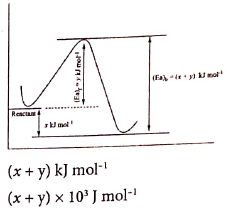
4.
Rate = k[A]n
Rate = \(\frac{-\mathrm{d}[\mathrm{A}]}{\mathrm{dt}}\)
unit of rate = \(\frac{mol L^{-1}}{s}\)=mol L-1/s-1
unit of rate constant
\(=\frac{ (mol{ L }^{ -1 }{ S }^{ -1 }) }{ ({ mol }{ L }^{ -1 })^n } \)
= mol1-nLn-1s-1
in the case
rate = k [Acetone]3/2
n = 3/2
= mol1-(3/2)L(3/2)-1s-1
(mol-(1/2) L(1/2) s-1).
5.
\(\rho=\frac{\mathrm{n} \times \mathrm{M}}{\mathrm{a}^{3} \mathrm{~N}_{\mathrm{A}}}\)
For bcc n =2, M = 39 nearest distance 2r = 4.52 A0
\(a =\frac{4r}{\sqrt {3}} = \frac { 2\times 4.52 \times 10^{-10} }{ \sqrt{3}} \)
\(\rho =\frac { {( 5.21\times 10^{-10})^{ 3 }} \times (6.023 \times 10^{-23}) }{ 2 \times 39} \)
ρ = 915 kgm-3
6.
(b)
\(\left( \frac { \pi }{ 6 } \right) \)
7.
For a fcc structure = rx+ / ry- = 0.414
Given that rx+ = 100 pm
ry = 100pm/0.414
8.
For a first order reaction
t1/2 = \(\frac { 0.693 }{ { k }}\)
t1/2 does not depend on the initial concentration and it remains constant (whatever may be the initial concentration)
t1/2 = 2.5 hrs
9.
for n ≠ 1 t1/2 = \(\frac{2^{n-1} -1}{(n- 1) k[A_{0}]^{-1}}\)
for n = 0; t1/2 = \(\frac{1}{2 k[A_{0}]^{-1}}\)
t1/2 = \(\frac{[A_{0}]}{2 k}\)
t1/2 α [A0] ...(1)
Given [A0] = 0.002 M; t1/2 = 10 min
[A0] = 0.04M; t1/2 = ?
Substitute in (1)
10 min α 0.02 M...(2)
t1/2 α 0.04M ....(3)
(3)(2)
⇒ t1/2 / 10 min
= 0.04 M/0.02 M
t1/2 = 2 x 10 min = 20 min
10.
In bcc unit cell,
2 atoms = 1 unit cell
Number of atoms in 8 g of element is, Number of moles = 8g / 40 g mol-1 = 0.2 mol
1 mole contains 6.023 x10²³ atoms
0.2 mole contains 0.2 x 6.023 x 1023 atoms
[1 unit cell / 2 atoms] x 0.2 x 6.023 x 1023
= 6.023 x 10²² unit cells.
11.
If number of close packed atoms = N, then
The number of Tetrahedral holes formed = 2N
The number of Octahedral holes formed = N
Therefore, N:2N = 1:2
12.
Number of A ions = Nc/8 = 8/8 = 1
Number of B ions = Nf/2 = 6/2 = 3
Simplest formula = AB3
13.
(d)
crystal field stabilization energy of [V(H2O)6]2+ is higher than the crystal field stabilization of [Ti(H2O)6]2+
14.
(c)
[Co(NH3)3(Cl)3]
15.
[Fe(H2N-CH2-CH2-NH2)3]3(PO4)2
[Fe(en)3]2+(\(PO_{4}^{3-}\))
16.
(a) coordination isomers
(b) no isomerism ( different molecular formula)
(c)⬅NCS; ⬅SCN coordinating atom differs : linkage isomers
17.
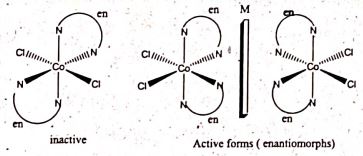
Complexes given in other options (a), (c) and (d) have symmetry elements and hence they are optically inactive.
18.
(d)
19.
The complex is [M(H2O)5Cl]Cl2
1000 ml of 1 M solution of the complex gives 2 moles of Cl- ions 1000 ml of 0.01 M solution of the complex will give
\(\frac{100 ml \times 0.01M \times 2Cl^-}{1000 ml \times 1M}\)
= 0.002 moles of Cl- ions
20.
Yb2+ - 4f14 - no unpaired electrons - diamagnetic
21.
MnO-4 + 8H+ + 5e- → Mn2+ + 4H2O
22.
+5 +6 +7
VO2+ < Cr2O72- < MnO4-
Greater the oxidation state, higher is the oxidising power.
23.
(c)
their ability to adopt variable oxidation states
24.
(c)
Ni2+
25.
(a)
Ti
26.
(b)
In case of Sc, 3d orbital are partially filled but in Zn these are completely filled
27.
(c)
Cu(NO3)2 and NO2
28.
(d)
Cl2 > Br2 > F2 > I2
29.
(a)
HI
30.
(d)
Kr
31.
(b)
2
32.
(a)
H3PO3
33.
(d)
1s2 2s2 2p6 3s2 3p3
34.
(d)
\(\left( SiO_{ 4 } \right) ^{ 4- }\)
35.
(c)
sp2 hybridised
36.
(c)
four
37.
(a)
Aluminium
38.
(b)
B3H6
39.
(d)
40.
(b)
\(\mathrm{Al}_2 \mathrm{O}_3+2 \mathrm{Cr} \longrightarrow \mathrm{Cr}_2 \mathrm{O}_3+2 \mathrm{Al}\)
41.
(b)
\(\Delta { G }^{ 0 }\ \text{Vs} \ T\)
42.
(d)
In the metallurgy of gold, the metal is leached with dilute sodium chloride solution
43.
(c)
Mg
44.
(c)
45.
(a)
Lower the melting point of alumina
46.
(c)
Galena
47.
(b)
Cu(s)+ Zn2+(aq)\(\rightarrow\) Zn(s) + Cu2+(aq)
48.
(d)
Electromagnetic separation
49.
(d)
Carbon and hydrogen are suitable reducing agents for metal sulphides
50.
(a)
Al

12th Standard Syllabus & Materials
12th Standard
TN 12th Computer Applications களப்பெயர் முறைமை (DNS) Sample Question Papers Study Material - QB365 Set A
NEW12th Standard
TN 12th Computer Applications வலையமைப்பு எடுத்துக்காட்டுகள் மற்றும் நெறிமுறைகள் Sample Question Papers Study Material - QB365 Set A
NEW12th Standard
TN 12th Computer Applications கணினி வலையமைப்பு ஓர் அறிமுகம் Sample Question Papers Study Material - QB365 Set A
NEW12th Standard
TN 12th Computer Applications PHP-உடன் MySQL-ஐ இணைத்தல் Sample Question Papers Study Material - QB365 Set A



Tamilnadu Stateboard 12th Standard Subjects

Maths
Chemistry

Physics

Biology

Computer Science

Business Maths and Statistics

Economics

Commerce

Accountancy

History

Computer Applications
Biology
Computer Technology
Computer Applications
Computer Science
Business Maths and Statistics
Commerce
Economics
Maths
Chemistry
Physics
Computer Technology
History
Accountancy

Tamil

English

French
Tamilnadu Stateboard Standards


