
 100% FREE ACCESS
12th Standard Syllabus & Materials
12th Standard
TN 12th Computer Applications மின்னணு தரவு பரிமாற்றம் Sample Question Papers Study Material - QB365 Set A
NEW12th Standard
TN 12th Computer Applications மின் - வணிக பாதுகாப்பு அமைப்புகள் Sample Question Papers Study Material - QB365 Set A
NEW12th Standard
TN 12th Computer Applications மின்னணு செலுத்தல் முறைகள் Sample Question Papers Study Material - QB365 Set A
NEW12th Standard
TN 12th Computer Applications மின் - வணிகம் Sample Question Papers Study Material - QB365 Set A
NEW12th Standard
TN 12th Computer Applications திறந்த மூல கருத்துருக்கள் Sample Question Papers Study Material - QB365 Set A
NEW12th Standard
TN 12th Computer Applications வலையமைப்பு வடமிடல் Sample Question Papers Study Material - QB365 Set A

Published on: 20/10/2025
Download Tamil Nadu 12th Standard Chemistry question papers, model tests, one-mark questions, important questions, and public exam papers in PDF format. Free study materials and answer keys for TN State Board students.
Questions + Answers key
Take MCQ Chemistry Test
1.
HO CH2 CH2 – OH on heating with periodic acid gives ______.
methanoic acid
Glyoxal
methanol
CO2
2.
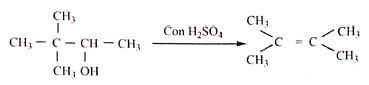
(CH3)3-C-CH(OH) CH3 \(\overset { con{ H }_{ 2 }{ SO }_{ 4 } }{ \longrightarrow } \)X (major product)
(CH3)3 CCH = CH2
(CH3)2C = C (CH3)2
CH2= C(CH3)CH2-CH2- CH3
CH2= C (CH3) - CH2- CH2- CH3
3.
Carbolic acid is _____.
Phenol
Picri cacid
benzoic acid
phenylacetic acid
4.
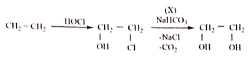
In the reaction sequence, Ethane \(\overset { HOCl }{ \longrightarrow } A\overset { x }{ \longrightarrow } \) ethan -1, 2 - diol. A and X respectively are ________.
Chloroethane and NaOH
ethanol and H2SO4
2 – chloroethan -1-ol and NaHCO3
ethanol and H2O
5.
An alcohol (x) gives blue colour in victormayer’s test and 3.7g of X when treated with metallic sodium liberates 560 mL of hydrogen at 273 K and 1 atm pressure what will be the possible structure of X?
CH3 CH (OH) CH2CH3
CH3 – CH (OH) – CH3
CH3 – C (OH) – (CH3)2
CH3- CH2 –CH (OH) – CH2 – CH3
6.
Which of the following is paramagnetic in nature?
[Zn(NH3)4]2+
[Co(NH3)6]3+
[Ni(H2O)6]2+
[Ni(CN)4]2-
7.
How many geometrical isomers are possible for [Pt(Py)(NH3)(Br)(Cl)]
3
4
0
15
8.
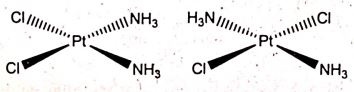
Which type of isomerism is exhibited by [Pt(NH3)2Cl2]?
Coordination isomerism
Linkage isomerism
Optical isomerism
Geometrical isomerism
9.
A magnetic moment of 1.73BM will be shown by one among the following.
TiCl4
[CoCl6]4-
[Cu(NH3)4]2+
[Ni(CN)4]2-
10.
A complex has a molecular formula MSO4Cl.6H2O. The aqueous solution of it gives white precipitate with Barium chloride solution and no precipitate is obtained when it is treated with silver nitrate solution. If the secondary valence of the metal is six, which one of the following correctly represents the complex?
[M(H2O)4Cl]SO4.2H2O
[M(H2O)6]SO4
[M(H2O)5Cl]SO4.H2O
[M(H2O)3Cl]SO4.3H2O
11.
12.
Permanganate ion changes to ________ in acidic medium.
MnO42−
Mn2+
Mn3+
MnO2
13.
Which of the following statements is not true?
on passing H2S, through acidified K2Cr2O7 solution, a milky colour is observed
Na2Cr2O7 is preferred over K2Cr2O7 in volumetric analysis
K2Cr2O7 solution in acidic medium is orange in colour
K2Cr2O7 solution becomes yellow on increasing the PH beyond 7
14.
The magnetic moment of Mn2+ ion is _______.
5.92BM
2.80BM
8.95BM
3.90BM
15.
Sc (Z = 21) is a transition element but Zinc (z = 30) is not because _______.
both Sc3+ and Zn2+ ions are colourless and form white compounds
In case of Sc, 3d orbital are partially filled but in Zn these are completely filled
last electron as assumed to be added to 4s level in case of zinc
both Sc and Zn do not exhibit variable oxidation states
16.
Which of the following set of reactants will give 1-methoxy-4-nitrobenzene.

17.
Suggest a suitable carbonyl compound for the preparation of pent-2-en-1-ol using LiAlH4.
18.
Why iron is more stable in +3 oxidation state than in +2 and the reverse is true for Manganese?
19.
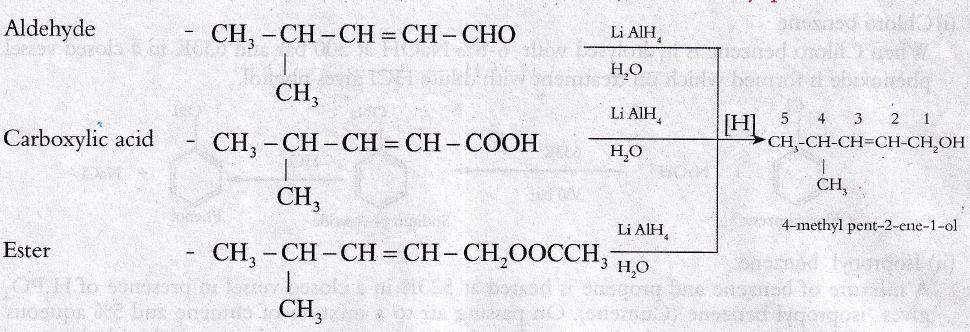
Write the structure of the aldehyde, carboxylic acid and ester that yield 4- methylpent -2-en-1-ol.
20.
Transition metals show high melting points. Why?
21.
Calculate the number of unpaired electrons in Ti3+ , Mn2+ and calculate the spin only magnetic moment.
22.
Complete the following.
a. 3MnO42- + 4H+ ⟶?
b. C6H5CH3 \(\overset { acidified }{ \underset { KMnO_{ 4 } }{ \longrightarrow } } \)?
c. MnO4- + Fe2+ ⟶?
d. KMnO4 \(\overset { \triangle }{ \underset { Red\ hot }{ \longrightarrow } } \) ?
e. Cr2O72- + 6I- + 14H+ ⟶?
f. Na2Cr2O7 + 2KCl ⟶?
23.
What is lanthanoid contraction and what are the effects of lanthanoid contraction?
24.
What is the coordination entity formed when excess of liquid ammonia is added to an aqueous solution of copper sulphate?
25.
What is linkage isomerism? Explain with an example.
26.
The mean pairing energy and octahedral field splitting energy of [Mn(CN6)3- are 28,800 cm-1 and 38500 cm-1 respectively. Whether this complex is stable in low spin or high spin?
27.
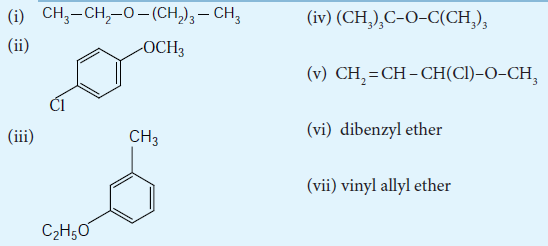
Give the IUPAC name for the following ethers and classify them as simple or mixed.
28.
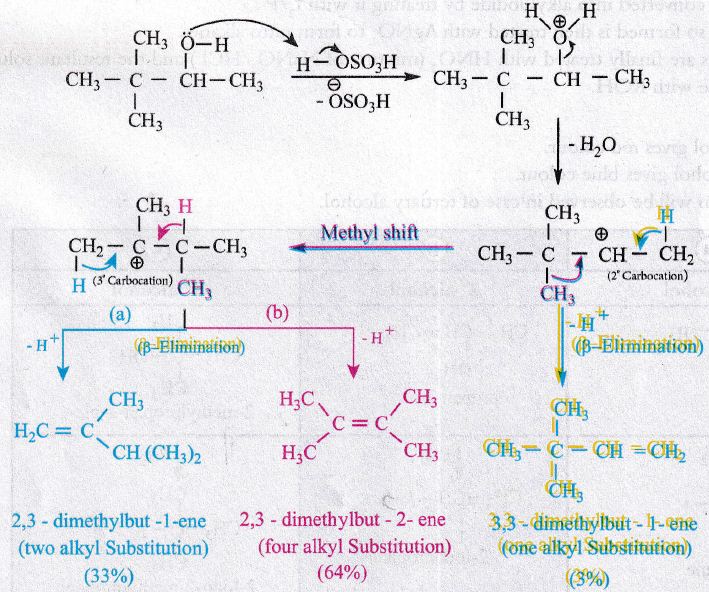
3,3 – dimethylbutan -2-ol on treatment with conc. H 2SO4 to give tetramethyl ethylene as a major product. Suggest a suitable mechanism.
29.
A solution of [Ni(H2O)6]2+ is green, whereas a solution of [Ni(CN)4]2- is colorless -Explain
30.
Give the difference between double salts and coordination compounds.
31.
Which metal in the 3d series exhibits +1 oxidation state most frequently and why?
32.
33.
Compare the ionization enthalpies of first series of the transition elements.
34.
Justify the position of lanthanoids and actinoids in the periodic table.
35.
What are transition metals? Give four examples.
1.
(c)
methanol
2.
(CH3)2C = C (CH3)2
3.
(a)
Phenol
4.
5.
CH3 CH (OH) CH2CH3
2R-OH+ 2Na ⟶ 2RONa + H2 ↑
2 moles of alcohol gives 1 mole of H2 which occupies 22.4 L at 273 K and 1 atm number of moles of alcohol
= 2 moles of R -OH/22.4L of H2 x 560 ml
= 0.05 moles
No of moles = mass/molar mass = m/M
= 3.7/0.05 = 74 g mol-1
General formula for (R-OH) Cn H2n + 1OH
n(12) + (2n + 1) (1) + 16 + 1 = 74
14n = 74 - 18
14n = 56
n = 56/14 = 4
The "2" alcohol which contains 4 carbon is CH3 - CH (OH) CH2 - CH3
6.
a) Zn2+ (d10 ⇒ diamagnetic)
b) Co3+ (d6 Low spain ⇒ t2g6 e0g ; diamagnetic)
c) Ni2+ (d8 Low spain ⇒ t2g6 e2g ; paramagnetic)
d) [Ni(CN)4]2+ (dsp2 ; square planar, diamagnetic)
7.
Three isomers. If we consider any one of the ligands as reference (say Py), the arrangement of other three ligands (NH3, Br- and Cl-) with respect to (Py) gives three geometrical isomers.
8.
9.
Ti4+ (d0 ⇒ 0BM)
Co2+ (d7 spain free ⇒ t2g5, e2g; n = 3; μ = 3.9BM)
Cu2+ (d9 Low spain ⇒ t2g6, e3g; n = 1; μ = 1.732BM)
Ni2+ (d8 Low spain ⇒ t2g6, e2g; n = 2; μ = 2.44 BM)
10.
Molecular formula: MSO4Cl.6H2O
Formation of white precipitate with Barium chloride indicates that SO2-4 ions are outside the coordination sphere, and no precipitate with AgNO3 solution indicates that the Cl- ions are inside the coordination sphere. Since the coordination number of M is 6.Cl- and 5 H2O are ligands, remaining 1 H2O molecular and SO2-4 are in the outer coordination sphere.
11.
(c)
12.
MnO-4 + 8H+ + 5e- → Mn2+ + 4H2O
13.
(b)
Na2Cr2O7 is preferred over K2Cr2O7 in volumetric analysis
14.
Mn2+ ⇒ 3d5 contains 5 unpaired electrons
n = 5,
\( \sqrt{n(n+ 2)} \) BM
\(= \sqrt{5(5+ 2)} = \sqrt{35} = 5.92 BM\)
15.
(b)
In case of Sc, 3d orbital are partially filled but in Zn these are completely filled
16.

17.

18.
1. Fe2+ the electronic configuration is 3d6.
2. Fe3+ the electronic configuration is 3d5.
3. So it has exactly half filled stable electronic configuration. Hence Fe3+ is more stable than Fe2+.
4. For manganese Mn2+. the electronic configuration is 3d5 and that of Mn3+ is 3d4. Here Mn2+ has exactly half-filled stable electronic configuration.
19.
20.
(i) Transition metals have number of unpaired electron. They are involved in metallic bonding. Hence they show high melting point.
(ii) As we move from left to right along the transition metal series melting point first increases reach a maximum value and then decreases as the d-electrons pair up and become less available for bonding.
21.
Electronic configuration of Ti = 3d24s2
Electronic configuration of Ti3+ =3d1
Hence number of unpaired electron = 1
Spin only magnetic moment \((\mu)=\sqrt{\mathrm{n}(\mathrm{n}+2)}\)
= \(\sqrt{1(1+2)} \)
= \(\sqrt{3}\)
=1.732 BM
Electronic configuration of \(\mathrm{Mn}=3 \mathrm{~d}^{5} 4 \mathrm{~s}^{2}\)
Electronic configuration of \(\mathrm{Mn}^{2+}=3 \mathrm{~d}^{5}\)
Hence number of unpaired electrons = 5
Spin only magnetic moment
\((\mu) =\sqrt{5(5+2)}\)
= 5.92 BM
22.
a. 3MnO42- + 4H+ ⟶ 2MnO4- + MnO2 + 2H2O
(Manganate ion) (Permanganate ion) Manganese dioxide
b. C6H5CH3 \(\overset { acidified }{ \underset { KMnO_{ 4 } }{ \longrightarrow } } \) C6H5COOH
Toluene Benzoic Acid
c. 2MnO4- + 10Fe2++16H+ \(\underrightarrow { { 8H }^{ + } } \) 2Mn2++ 10Fe3+ + 8H2O
d. 2KMnO4 \(\overset { \triangle }{ \underset { Red\ hot }{ \longrightarrow } } \) K2MnO4 + MnO2 + O2
(Potassium Permanganate) (Potassium Manganate)
e. Cr2O72- + 6I- + 14H+ \(\underrightarrow { { (O) }}\) 2Cr3+ + 3I2 + 7H2O
(Iodide ion) Iodine
f. Na2Cr2O7 + 2KCl ⟶ K2Cr2O7 + 2NaCl
(Sodium dichromate) (Potassium dichromate)
23.
Lanthanoid contraction:
As we move across 4f series, the atomic and ionic radii of lanthanoids show gradual decrease with increase in atomic number. This decrease in ionic size is called lanthanoid contraction.
Effects (consequence) of lanthanoid contraction:
1. Basicity difference:
As we move from Ce3+ to Lu3+, the basic character of Ln3+ ions decrease. Due to the decrease in the size of Ln3+ ions, the ionic character of Ln -OH bond decreases (covalent character increases) which results in the decrease in the basicity.
2. Similarities among lanthanoid:
In the complete f - series only 10 pm decrease in atomic radii and 20 pm decrease in ionic radii is observed because of this very small change in radii of lanthanoids, their chemical properties are quite similar.
3. The elements of the second and third transition series resemble each other more closely than the elements of the first and second transition series.
24.
(i) When excess of liquid ammonia is added to an aqueous solution of copper sulphate gives tetra ammine copper (II) sulphate is formed.
CUso4 + 4NH3 \(\rightarrow\) [Cu(NH3)4]SO4
(ii) The co-ordination entity is [Cu(NH3)4]2+
25.
(i) This is also called as salt isomerism.
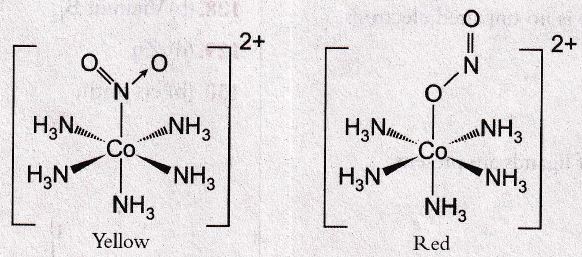
(ii) This type of isomers arises when an ambidentate ligand is bonded to the central metal atom/ion through either of its two different donor atoms. In the below mentioned examples, the nitrite ion is bound to the central metal ion Co3+ through a nitrogen atom in one complex and through oxygen atom in other complex.
\(\left[\mathrm{Co}\left(\mathrm{NH}_{3}\right)_{5}\left(\mathrm{NO}_{2}\right)\right]^{2+}\)
26.
[Mn(CN)6]3-
Mn - 3d3 4s2, Mn3+ - 3d4
Electronic configuration in isotropic field.

No of paired electrons (n'p) = 0
Therefore EIso = 0
High spin complex:
Ligand field: Electronic configuration: \(t_{2g}^{3}\) \(e_{g}^{1}\)

CFSE = {[3(-0.4) + 1(0.6)] \(\Delta\)o + 0 \(\times\) P} - 0
=(-1.2 + 0.6) \(\Delta\)o = -0.6 \(\times\) 38500
CFSE = -23,100 cm-1.
Low spin complex:
Ligand field: Electronic configuration: \(t_{2g}^{4}\) \(e_{g}^{0}\)

CFSE = {[4(-0.4) + 0(0.6)] \(\Delta\)0 + 1 \(\times\) P} - (0)
= (-1.6) \(\Delta\)0 + P
= - 0.6 \(\times\) 38,500 + 28,000
= -61,600 + 28,800
= -32,800 cm-1
High negative CFSE value indicates that low spin complex is favoured.
27.
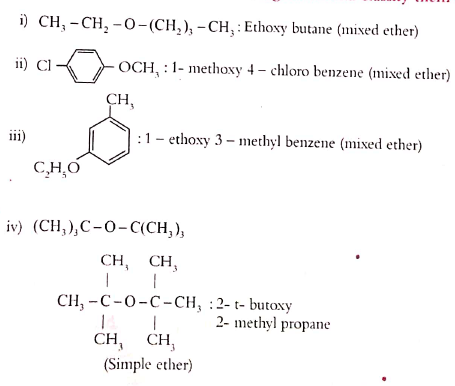
(v) CH2 = CH – CH(Cl)–O–CH3 : 3 - methoxy,3- choloro propene (mixed ether)
(vi) dibenzyl ether CH6CH5 -O-CH2-C6H5 : benzoxy toluene + Simple ether
(vii) vinyl allyl ether : ethoxy 2 - propene
CH2 = CH –O– CH2–CH–CH2(mixed ether)
28.
Mechanism:
This mechanism undergoes Saytzeff rule.
During intramolecular dehydration, if there is a possibility to form a carbon - carbon double bond at different locations, the preferred location is the one that gives the more (highly) substituted alkene i.e., the stable alkene.
29.
[Ni (H2O)6]2+
.JPG)
It has two unpaired electrons. So there is d-d transition. Hence it is green coloured.
[Ni(CN)4]2-
.JPG)
There is no unpaired electrons. So it is colourless, as there is no d-d transition.
30.
| S. No | Double salts | Co-ordination compound |
|---|---|---|
| 1. | They usually contain two simple salt in equimolar proportions | The simple salts from which they are formed may or may not be in equimolar proportion. |
| 2. | They exists only in the solid state. In aqueous solution they dissociate completely into ions. | They exist in the solid state as well as in aqueous solution. This is because even in solution, the complex ion does not dissociate into ions. |
| 3. | They are ionic compounds and do not contain any co-ordinate bond. | They may or may not be ion but the complex part always contain coordinate bonds |
| 4. | The properties of the double salts are same as those of its constituent compounds. | The properties of the coordination compounds are different for its constituent bonds. |
| 5. | In a double salt, the metal ion show their normal valency. | In a coordinate compound the metal ion satisfies its two types of valence called primary & secondary valenices. |
| 6. | A double salt loses its identity and dissociates into its constitute simple ions in solution. | The complex ion does not lose its identity and never dissociate to give simple ions. |
| Example: FeSO4 (NH4)2 SO4.6H2O | Example: K4[Fe(CN)6), K3[Fe(SCN)6) |
31.
Copper exhibits +1 oxidation state most frequently Cu (29) - electronic configuration 3d104s1 copper ready to lose outer most one electron to attain the stable full filled electronic configuration. Hence it exhibits +1 oxidisation state.
32.
33.
As we move from left to right in a transition metal series, the ionization enthalpy increases as expected. This is due to increase in the nuclear charge corresponding to the filling of d electrons. The increase in first ionisation enthalpy with increase in atomic number along a particular series is not regular. The added electron enters (n-1) d orbital and the inner electrons act as a shield and decrease the effect of nuclear charge on valence ns electrons. Therefore, it leads to variation in the ionization energy value.
34.
(i) The actual position of Lanthanides in the periodic table is at group number 3 and period number 6. However, in the sixth period after lanthanum, the electrons are preferentially filled in inner 4f sub shell and these fourteen elements following lanthanum show similar chemical properties.
(ii) Similarly the fourteen elements following actinium resemble in their physical and chemical properties. Hence they are placed separately bottom of the modern periodic table.
35.
IUPAC defines transition metal as an element whose atom has an incomplete d-sub shell or which can give rise to cations with an incomplete d-sub shell. They occupy the central position of the periodic table, between s and p-block elements.
Examples: Fe, Cu, Ag, Au

12th Standard Syllabus & Materials
12th Standard
TN 12th Computer Applications களப்பெயர் முறைமை (DNS) Sample Question Papers Study Material - QB365 Set A
NEW12th Standard
TN 12th Computer Applications வலையமைப்பு எடுத்துக்காட்டுகள் மற்றும் நெறிமுறைகள் Sample Question Papers Study Material - QB365 Set A
NEW12th Standard
TN 12th Computer Applications கணினி வலையமைப்பு ஓர் அறிமுகம் Sample Question Papers Study Material - QB365 Set A
NEW12th Standard
TN 12th Computer Applications PHP-உடன் MySQL-ஐ இணைத்தல் Sample Question Papers Study Material - QB365 Set A



Tamilnadu Stateboard 12th Standard Subjects

Maths
Chemistry

Physics

Biology

Computer Science

Business Maths and Statistics

Economics

Commerce

Accountancy

History

Computer Applications
Biology
Computer Technology
Computer Applications
Computer Science
Business Maths and Statistics
Commerce
Economics
Maths
Chemistry
Physics
Computer Technology
History
Accountancy

Tamil

English

French
Tamilnadu Stateboard Standards


