
 100% FREE ACCESS
12th Standard Syllabus & Materials
12th Standard
TN 12th Computer Applications மின்னணு தரவு பரிமாற்றம் Sample Question Papers Study Material - QB365 Set A
NEW12th Standard
TN 12th Computer Applications மின் - வணிக பாதுகாப்பு அமைப்புகள் Sample Question Papers Study Material - QB365 Set A
NEW12th Standard
TN 12th Computer Applications மின்னணு செலுத்தல் முறைகள் Sample Question Papers Study Material - QB365 Set A
NEW12th Standard
TN 12th Computer Applications மின் - வணிகம் Sample Question Papers Study Material - QB365 Set A
NEW12th Standard
TN 12th Computer Applications திறந்த மூல கருத்துருக்கள் Sample Question Papers Study Material - QB365 Set A
NEW12th Standard
TN 12th Computer Applications வலையமைப்பு வடமிடல் Sample Question Papers Study Material - QB365 Set A

Published on: 31/10/2019
Biomolecules
Download Tamil Nadu 12th Standard Chemistry question papers, model tests, one-mark questions, important questions, and public exam papers in PDF format. Free study materials and answer keys for TN State Board students.
Questions + Answers key
Take MCQ Chemistry Test
1.
Which of the following amino acids are achiral?
Alanine
Leucine
Proline
Glycine
2.
α -D (+) Glucose and β-D (+) glucose are ______.
Epimers
Anomers
Enantiomers
Conformational isomers
3.
Insulin, a hormone chemically is ______.
Fat
Steroid
Protein
Carbohydrates
4.
If one strand of the DNA has the sequence ‘ATGCTTGA’, then the sequence of complementary strand would be ______.
TACGAACT
TCCGAACT
TACGTACT
TACGRAGT
5.
Complete hydrolysis of cellulose gives ______.
L-Glucose
D-Fructose
D-Ribose
D-Glucose
6.
Which of the following vitamins is water soluble?
Vitamin E
Vitamin K
Vitamin A
Vitamin B
7.
The pyrimidine bases present in DNA are ______.
Cytosine and Adenine
Cytosine and Guanine
Cytosine and Thiamine
Cytosine and Uracil
8.
Vitamin B2 is also known as ______.
Riboflavin
Thiamine
Nicotinamide
Pyridoxine
9.
Which one of the following is not produced by body?
DNA
Enzymes
Hormones
Vitamins
10.
In aqueous solution of amino acids mostly exists in ______.
NH2-CH(R)-COOH
NH2-CH(R)-COO-
H3N+-CH(R)-COOH
H3N+-CH(R)-COO-
11.
In a protein, various amino acids linked together by ______.
Peptide bond
Dative bond
\(\alpha\) - Glycosidic bond
\(\beta\) - Glycosidic bond
12.
The central dogma of molecular genetics states that the genetic information flows from______.
Amino acids Protein DNA
DNA Carbohydrates Proteins
DNA RNA Proteins
DNA RNA Carbohydrates
13.
\(\text { Glucose } \stackrel{(\mathrm{HCN})}{\longrightarrow} \text { Product } \stackrel{(\text { hydrolysis })}{\longrightarrow} \text { Product } \stackrel{(\mathrm{HI}+\text { Heat })}{\longrightarrow} \mathrm{A}\) , the compound A is______.
Heptanoic acid
2-Iodohexane
Heptane
Heptanol
14.
Which one given below is a non-reducing sugar?
Glucose
Sucrose
maltose
Lactose
15.
Which one of the following rotates the plane polarized light towards left?
D(+) Glucose
L(+) Glucose
D(-) Fructose
D(+) Galactose
16.
Write a short note on peptide bond.
17.
Give the differences between primary and secondary structure of proteins.
18.
What type of linkages hold together monomers of DNA?
19.
Define enzymes
20.
What are harmones? Give examples
21.
How are vitamins classified?
22.
Give two difference between Hormones and vitamins.
23.
Write the Zwitter ion structure of alanine
24.
25.
26.
What are reducing and non – reducing sugars?
1.
(d)
Glycine
2.
(b)
Anomers
3.
(c)
Protein
4.
(a)
TACGAACT
5.
(d)
D-Glucose
6.
(d)
Vitamin B
7.
(c)
Cytosine and Thiamine
8.
(a)
Riboflavin
9.
(d)
Vitamins
10.
(d)
H3N+-CH(R)-COO-
11.
(a)
Peptide bond
12.
(c)
DNA RNA Proteins
13.
(a)
Heptanoic acid
14.
(b)
Sucrose
15.
(c)
D(-) Fructose
16.
(i) The amino acids are linked covalently by peptide bonds. The carboxyl group of the first amino acid react with the amino group of the second amino acid to give an amide linkage between these amino acids. This amide linkage is called peptide bond. The resulting compound is called a dipeptide. Addition an another amino acid to this dipeptide a second peptide bond results in tripeptide.
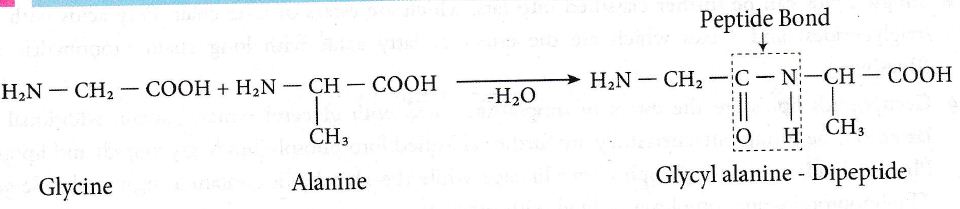
(ii) Thus we can generate tetra peptide, penta peptide etc... When you have more number of amino acids linked this way you get a polypeptide. If the number of amino acids are less it is called as a polypeptide, if it has large number of amino acids (and preferably has a function) then it is called a protein.
(iii) The amino end of the peptide is known as N - terminal or amino terminal while the carboxy end is called C-terminal or carboxy terminal. In general protein sequences are written from N-Terminal to C-Terminal.The atoms other than the side chains (R-groups) are called main chain or the back bone of the polypeptide.
17.
Primary structure of Proteins:
Proteins are polypeptide chains, made up of amino acids are connected through peptide bonds. The relative arrangement of the amino acids in the polypeptide chain is called the primary structure of the protein. Knowledge of this is essential as even small changes have potential to alter the overall structure and function of a protein.
\(\mathrm{H}_{2} \mathrm{~N}-\mathrm{Gly}-\mathrm{Met}-\mathrm{Phe}-\mathrm{Cys}-\mathrm{Arg}-\mathrm{Asp}-\mathrm{COOH}\)
α - Helix:
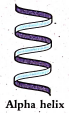
In the α-helix sub-structure, the amino acids are arranged in a right handed helical (spiral) structure and are stabilised by the hydrogen bond between the carbonyl oxygen of one amino acid (n residue) with amino hydrogen of the fifth residue (n + 4th residue). The side chains of the residues protrude outside of the helix. Each turn of an α-helix contains about 3.6 residues and is about 5.4 Å long. The amino acid proline produces a kink in the helical structure and often called as a helix breaker due to its rigid cyclic structure.
1. Linear sequence of aminoacids
2. Linear
3. Composed of peptide bonds formed between amino acids.
Secondary structure of Proteins:
The amino acids in the polypeptide chain forms highly regular shapes (sub-structures) through the hydrogen bond between the carbonyl oxygen (-C=O) and the neighbouring amine hydrogen (-NH) of the main chain. α-Helix and β-strands or sheets are two most common substructures formed by proteins.
β-Strand:
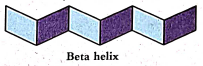
β-Strands are extended peptide chain rather than coiled. The hydrogen bonds occur between main chain carbonyl group one such strand and the amino group of the adjacent strand resulting in the formation of a sheet like structure. This arrangement is called β-sheets.
18.
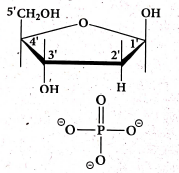
Watson & Crick proposed a 3-dimensional secondary structure of DNA. In this DNA molecule, Monomners of DNA are held together by Phosphodiester linkage. This linkages are occured in 5' & 3' carbon atoms of Pentose sugar.
19.
(i) Enzymes are naturally occurring simple or conjugated proteins which act as biological catalysts in living systems.
(ii) E.g. Carbonic anhydrase, Lactase, Sucrose
20.
(i) Hormone is an organic substance (e.g. a peptide or a steroid) that is secreted by one tissue. It limits the blood stream and induces a physiological response (e.g. growth and metabolism) in other tissues. It is an intercellular signalling molecule.
(ii) e.g. Testosterone, Thyroxine, Estrogen, Insulin, Oxytocin etc.
21.
Vitamins are classified into two groups based on their solubility in water or in fat.
(a) Fat soluble vitamins:
These vitamins absorbed best when taken with fatty food and are stored in fatty tissues and livers. These vitamins do not dissolve in water. Hence they are called fat soluble vitamins. Vitamin A, D, E & K are fatsoluble vitamins.
(b) Water soluble vitamins:
Vitamins B (B1, B2, B3, B5, B6, B7, B9 & B12) and C are readily soluble in water. On the contrary to fat soluble vitamins, these can't be stored. The excess vitamins present will be excreted through urine and are not stored in our body. Hence, these two vitamins should be supplied regularly to our body.
22.
| Hormone | Vitamin |
|---|---|
| Synthesized in animal bodies | Synthesised in plants |
| Produced in ductless (endocrine glands) | Have to be supplied in diet except (Vitamin D) |
| These are not stored in body but are continuously produced | These remain stored in the body to keep away diseases |
| Eg: Androgen, Estrogen, thyroxine etc. | Eg: Vitamin A (Retinol) Vitamin C (Ascorbic acid) |
23.
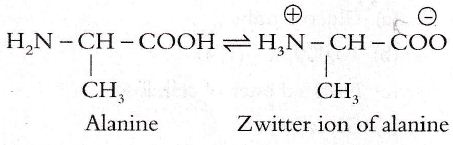
24.
25.
26.
i) Reducing sugars:
1. Sugars which reduce Tollen's reagent or Fehling's solution or Benedict's solution are called reducing sugars.
2. These contain either α - hydroxyl ketone or cyclical hemi acetal or hemi ketal or structures in equilibrium with open chain forms having a free- CHO or C=O group.
3. E.g. a) All monosaccharide's like D - glucose, D - fructose (aldoses and ketoses)
b) Sugars like Lactose and maltose except sucrose.
ii) Non - reducing sugars:
1. Sugars which do not reduce either Tollen's reagent, Fehling's solution or Benedict's solution are called non-reducing sugars.
2. They contain a stable acetal or ketal structures which cannot be opened into a free carbonyl group.
E.g. Sucrose, starch, cellulose, glycogen, dextrin etc.

12th Standard Syllabus & Materials
12th Standard
TN 12th Computer Applications களப்பெயர் முறைமை (DNS) Sample Question Papers Study Material - QB365 Set A
NEW12th Standard
TN 12th Computer Applications வலையமைப்பு எடுத்துக்காட்டுகள் மற்றும் நெறிமுறைகள் Sample Question Papers Study Material - QB365 Set A
NEW12th Standard
TN 12th Computer Applications கணினி வலையமைப்பு ஓர் அறிமுகம் Sample Question Papers Study Material - QB365 Set A
NEW12th Standard
TN 12th Computer Applications PHP-உடன் MySQL-ஐ இணைத்தல் Sample Question Papers Study Material - QB365 Set A



Tamilnadu Stateboard 12th Standard Subjects

Maths
Chemistry

Physics

Biology

Computer Science

Business Maths and Statistics

Economics

Commerce

Accountancy

History

Computer Applications
Biology
Computer Technology
Computer Applications
Computer Science
Business Maths and Statistics
Commerce
Economics
Maths
Chemistry
Physics
Computer Technology
History
Accountancy

Tamil

English

French
Tamilnadu Stateboard Standards
