
 100% FREE ACCESS
12th Standard Syllabus & Materials
12th Standard
TN 12th Computer Applications மின்னணு தரவு பரிமாற்றம் Sample Question Papers Study Material - QB365 Set A
NEW12th Standard
TN 12th Computer Applications மின் - வணிக பாதுகாப்பு அமைப்புகள் Sample Question Papers Study Material - QB365 Set A
NEW12th Standard
TN 12th Computer Applications மின்னணு செலுத்தல் முறைகள் Sample Question Papers Study Material - QB365 Set A
NEW12th Standard
TN 12th Computer Applications மின் - வணிகம் Sample Question Papers Study Material - QB365 Set A
NEW12th Standard
TN 12th Computer Applications திறந்த மூல கருத்துருக்கள் Sample Question Papers Study Material - QB365 Set A
NEW12th Standard
TN 12th Computer Applications வலையமைப்பு வடமிடல் Sample Question Papers Study Material - QB365 Set A

Published on: 07/01/2020
Chemical Kinetics
Download Tamil Nadu 12th Standard Chemistry question papers, model tests, one-mark questions, important questions, and public exam papers in PDF format. Free study materials and answer keys for TN State Board students.
Questions + Answers key
Take MCQ Chemistry Test
1.
The depletion of ozone involves the following steps:
Step 1: O2 +O \(\overset { { k }_{ 1 } }{ \underset { { k }_{ 2 } }{ \rightleftharpoons } } \) O3 (fast)
Step 2: O3 +O \(\overset { k }{ \longrightarrow } \) 2O2 (slow)
The predicted order of the reaction will be ______.
I
II
III
Zero
2.
For the reaction, 2N2O5 ⟶4 NO2+O2, select the correct statement.
Rate of formation of O2 is same as rate of formation of NO2
Rate of disappearance of N2O5 is two times the rate of formation of NO2.
Rate of formation of O2 is 0.5 times rate of disappearance of N2O5
Rate of formation of NO2 is equal to rate of disappearance of N2O5
3.
In a reversible reaction, the enthalpy change and the activation energy in the forward direction are respectively −x kJ mol-1 and y kJ mol-1. Therefore, the energy of activation in the backward direction is _______.
(y-x) kJ mol-1
(x+y) J mol-1
(x-y) KJ mol-1
(x+y) x 103J mol-1
4.
For a reaction Rate = k[acetone]3/2 then unit of rate constant and rate of reaction respectively is _______.
(mol L-1 S-1),(mol1/2 L1/2 S-1)
(mol-1/2 L1/2 s-1),(mol L-1 s-1)
(mol1/2 L1/2 s-1),(mol L-1 s-1)
(mol L s-1),(mol1/2 L1/2 s)
5.
For the reaction, 2NH3 ⟶ N2 + 3H2, if \(\frac { -d[NH_{ 3 }] }{ dt } \) = k1[NH3], \(\frac { d[N_{ 2 }] }{ dt } =k_{ 2 }[NH_{ 3 }],\frac { d[{ H }_{ 2 }] }{ dt } \)= k3[NH3] then the relation between k1, k2 and k3 is _________.
k1 = k2 = k3
k1 = 3k2 = 2k3
1.5k1 = 3k2 = k3
2k1 = k2 = 3k3
6.
A first order reaction takes 8 hours for 90% completion. Calculate the time required for 80% completion. (log 5 = 0.6989 ; log10 = 1)
7.
What is the effect of temperature on the rate constant of a reaction? How can this temperature effect on rate constant be represented quantitatively?
8.
A first order reaction is found to have a rate A constant k = 7.39 x 10⁻⁵ S-1. Find the half life of this reaction.
9.
Explain the effect of catalyst on reaction rate with an example.
10.
Describe the graphical representation of first order reaction.
11.
The rate of the reaction X + 2y→ product is 4 x 10⁻³ mol L-1S-1, if [X] = [Y] = 0.2M and rate constant at 400K is 2 x 10⁻²s-1, What is the overall order of the reaction.
12.
The reaction A + 2B ⟶ C obeys the rate equation. Rate = \(K{ \left[ A \right] }^{ \frac { 1 }{ 2 } }{ \left[ B \right] }^{ \frac { 3 }{ 2 } }\) What is the order of the reaction?
13.
The decomposition reaction of ammonia gas on platinum surface has a rate constant R = 2.5 x 10⁻⁴mol L-1. What is the order of the reaction.
14.
The activation energy of a reaction is 22.5 k Cal mol-1 and the value of rate constant at 40°C is 1.8 x 10⁻⁵s-1. Calculate the frequency factor, A.
15.
A zero order reaction is 20% complete in 20 minutes. Calculate the value of the rate constant. In what time will the reaction be 80% complete?
16.
For a reaction x + y + z\(\longrightarrow \) products the rate law is given by rate =k[x]3/2[y]1/2. What is the overall order of the reaction and what is the order of the reaction with respect to z.
17.
The decomposition of NH3 on platinum surface is zero reaction. What are the rate of production of N2 and H2 it K = 2.5 x 10⁻⁴mol L-1 S-1?
18.
A first order reaction laws on rate constant 1.15 x 10⁻³ S-1. How long will 5 g of this reactant take to reduce to 3g?
19.
Explain briefly the collision theory of bimolecular reactions.
1.
(a)
I
2.
(c)
Rate of formation of O2 is 0.5 times rate of disappearance of N2O5
3.
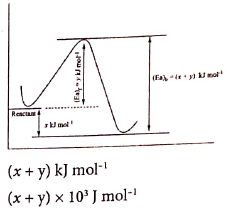
4.
Rate = k[A]n
Rate = \(\frac{-\mathrm{d}[\mathrm{A}]}{\mathrm{dt}}\)
unit of rate = \(\frac{mol L^{-1}}{s}\)=mol L-1/s-1
unit of rate constant
\(=\frac{ (mol{ L }^{ -1 }{ S }^{ -1 }) }{ ({ mol }{ L }^{ -1 })^n } \)
= mol1-nLn-1s-1
in the case
rate = k [Acetone]3/2
n = 3/2
= mol1-(3/2)L(3/2)-1s-1
(mol-(1/2) L(1/2) s-1).
5.
\(Rate=\frac { -1 }{ 2 } \frac { d[NH_3] }{ dt } \)
\(\frac { -d\left[ { N }_{ 2 } \right] }{ dt } =\frac { 1 }{ 3 } \frac { d\left[ { H}_{ 2 } \right] }{ dt } \)
\(=\frac { 1 }{ 2 } { k_1\left[ { NH}_{ 3 } \right] } = { k_2 \left[ { NH}_{ 3 } \right] }=\frac { 1 }{ 3 } { k_3\left[ { NH}_{ 3 } \right] } \)
[3/2] k1 = 3k2 = k3
1.5k1 = 3k2 = k3
6.
For a first order reaction
\(\\ \\ k=\frac { 2.303 }{ t } log\left( \frac { [{ A }_{ 0 }] }{ [A] } \right) \\ \) ..(1)
Let[A0] =100M
When
t = t90%; [A] = 10M (given that t90% = 8hours)
t = t80%; [A ] = 20M
\(k=\frac { 2.303 }{ { t }_{ 80\% } } \log\left( \frac { 100 }{ 20 } \right) \)
\({ t }_{ 80\% }=\frac { 2.303 }{ K } \log(5)\) ....(2)
Find the value of k using the given data
\(k=\frac { 2.303 }{ { t }_{ 90\% } } \log\left( \frac { 100 }{ 10 } \right) \)
\(k=\frac { 2.303 }{ 8 } \log10\)
\(k=\frac { 2.303 }{ 8 } ...(3)\)
Substitute the value of k in equation (2)
\({ t }_{ 80\% }\frac { 2.303 }{ 2.303/8hours } \log(5)\)
t80%= 8 hours x 0.6989
t80%= 5.59 hours
7.
(i) The rate constant is nearly doubled with a rise in temperature by 10oC for a chemical reaction.
(ii) The temperature effect on the rate constant can be represented quantitatively by Arrhenius equation.
\(k=A{ e }^{ \frac { -{ E }_{ a } }{ RT } }\)
8.
For first order reaction
\(k=\frac { 2.303 }{ t } \log { \frac { a }{ a-x } } \)
For t = t1/2, \(x=\frac { a }{ 2 } \)
\({ t }_{ \frac { 1 }{ 2 } }=\frac { 2.303 }{ k } \log { \frac { a }{ a-\frac { a }{ 2 } } } \)
\(\frac { 2.303 }{ k } \log2=\frac { 2.303\times 0.3010 }{ 7.39\times { 10 }^{ -5 } } \)
= 9.38 x 10³ s.
9.
(i) A catalyst is substance which alters the rate of a reaction without itself undergoing any permanent chemical change. They may participate in the reaction, but again regenerated and the end of the reaction. In the presence of a catalyst, the energy of activation is lowered and hence, greater number of molecules can cross the energy barrier and change over to products, thereby increasing the rate of the reaction.
(ii) The reaction between KMnO4 and H2SO4 and oxalic acid is catalysed by MnSO4 and increases the rate of oxidation of C2O42- by MnO4-.
10.
A Reaction whose rate depends on the reactant concentration raised to the first power is called a first order reaction. For a first order reaction,
A ⟶ product
Rate law can be expressed as
Rate = k[A]-1
\(\frac { -d\left[ A \right] }{ \left[ A \right] } =k dt\) ...(1)
Integrate the above equation between the limits of time t = 0 and time equal to t, while the concentration varies from the initial: concentration [Ao] to [A] at the later time.
\(\int _{ { [A }_{ 0 }] }^{ [A] }{ \frac { -d\left[ A \right] }{ \left[ A \right] } } =k\int _{ 0 }^{ t }{ dt } \)
\({ \left( -In\left[ A \right] \right) }_{ \left[ { A }_{ 0 } \right] }^{ \left[ A \right] }=k{ \left( t \right) }_{ 0 }^{ t }\)
\(-In\left[ A \right] -\left( In\left[ { A }_{ 0 } \right] \right) =k\left( t-0 \right) \)
\(-In\left[ A \right] -\left( In\left[ { A }_{ 0 } \right] \right) =kt\)
\(In\left( \frac { \left[ { A }_{ 0 } \right] }{ \left[ A \right] } \right) =kt\) ...(2)
This equation is in natural logarithm. To convert it into usual logarithm with base 10, we have to multiply the term by 2.303.
\(2.303\quad log\left( \frac { \left[ { A }_{ 0 } \right] }{ \left[ A \right] } \right) =kt\)
\(k=\frac { 2.303 }{ t } log\left( \frac { \left[ { A }_{ 0 } \right] }{ \left[ A \right] } \right) \) ...(3)
Equation (2) can be written in the form
y = mx+c as below
In [A0]-In[A] = kt
In[A] = In[A0]-kt
⇒ y = c + mx
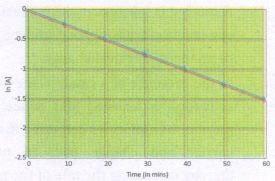
If we follow the reaction by measuring the concentration of the reactants at regular time interval 't' a plot of In[A] against 't' yields a straight line with a negative slope. From this, the rate constant is calculated.
11.
Rate = K[X]n[y]m
4 x 10⁻³ mol L-1s-1= 2 x 10⁻²s-1(0.2mol L-1)n(0.2mol L-1)m
\(\frac { 4\times { 10 }^{ -3 }mol\quad { L }^{ -1 }{ s }^{ -1 } }{ 2\times { 10 }^{ -2 }{ s }^{ -1 } } =\) (0.2)n+m(mol L-1)n+m
0.2(mol L-1) = (0.2)n+m(mol L-1)n+m
Comparing the powers on both sides
The overall order of the reaction n + m = 1
12.
Order of the reaction = \(\frac { 1 }{ 2 } +\frac { 3 }{ 2 } =\frac { 4 }{ 2 } =2\)
The reaction is second order.
13.
The order of the reaction is zero.
14.
\(\mathrm{k}=\mathrm{Ae}^{-\mathrm{E}_{\mathrm{a}} / \mathrm{RT}}\)
\(\log \mathrm{k}=\frac{-\mathrm{E}_{\mathrm{a}}}{2.303 \mathrm{RT}}+\log \mathrm{A} \text { (or) } \log \mathrm{A}=\log \mathrm{k}+\frac{\mathrm{E}_{\mathrm{a}}}{2.303 \mathrm{RT}}\)
\(\mathrm{k}=1.8 \times 10^{-5} \mathrm{~s}^{-1} ;\)
\(\mathrm{Ea}=22.5 \mathrm{k} \mathrm{Cal} \mathrm{mol}^{-1}=22500 \mathrm{Cal} \mathrm{mol}^{-1} \)
\(\log A=\log \left(1.8 \times 10^{-5}\right)+\frac{22500}{2.303 \times 1.987 \times 313} \)
\(=\log 1.8-5 \log {10}+15.71 \)
\(=0.2553-5+15.71 \)
\(\log A=10.9653 \)
\(A=\text { Antilog } 10.9653 \)
\(=9.232 \times 10^{10} \text { collisions } \mathrm{s}^{-1} \text {. }\)
15.
(i) Let A = 100M, [A0] - [A] = 20M,
For the zero order reaction
\(k=\left( \frac { \left[ { A }_{ 0 } \right] -\left[ A \right] }{ t } \right) \)
(i) 20% completion \(k=\left( \frac { 20M }{ 20min } \right) \) = 1 mol L-1 min-1
(ii) 80% completion
\(\mathrm{K}=1 \mathrm{~mol} \mathrm{~L}{ }^{-1} \mathrm{~s}^{-1} ;\left[\mathrm{A}_{0}\right]=100 \mathrm{M} ;\left[\mathrm{A}_{0}\right]-[\mathrm{A}]=80 \mathrm{M} ; \mathrm{t}=?\)
\(\therefore t=\left(\frac{\left[A_{O}\right]-[A]}{K}\right)=\frac{80}{1}=80 \mathrm{mins}\)
16.
Reaction rate = k[x]3/2[y]1/2
(i) Over all order of reaction = (3/2 + 1/2)=2
i.e., second order reaction.
(ii) Since the rate expression does not contain the concentration of z, the reaction is zero order with respect to z.
17.
The reaction is 2NH3(g) \(\overset { Pt }{ \longrightarrow } \) N2(g) + 3H2(g)
Here k = 2.5 x 10⁻⁴ mol L-1 s-1
The order of the reaction is zero i.e.,
Rate = k[Reactant]o
Rate = 2.5 x 10-4 x 1 = 2.5 x 10⁻⁴ mol L-1 s-1
\(\therefore \frac { d }{ dt } \left[ { H }_{ 2 } \right] =\frac { 1 }{ 3 } \frac { d }{ dt } \left[ { H }_{ 2 } \right] \)
The rate of formation of N2 = 2.5 x 10⁻⁴ mol L-1 s-1
\(\therefore 2.5\times { 10 }^{ -4 }=\frac { 1 }{ 3 } \frac { d }{ dt } \left[ { H }_{ 2 } \right] \)
\(\therefore \frac { d }{ dt } \left[ { H }_{ 2 } \right] \) = 7.5 x 10⁻⁴
Therefore, rate of formation of H2 = 7.5 x 10⁻⁴ mol L-1 s-1
18.
[R]0 = 5g, [R] = 3g
K = 1.15 x 10⁻³ s-1
As the reaction is of first order
K = \(\frac { 2.303 }{ t } \log { \frac { { \left[ R \right] }_{ 0 } }{ \left[ R \right] } } \)
\(t=\frac { 2.303 }{ 1.15\times { 10 }^{ -3 }{ s }^{ -1 } } \log { \frac { 5g }{ 3g } } \)
= 200 x 103 (log 1.667)s
= 20 x 103 x 0.22 19 s
= 443.8 s
= 444 s (approximately)
19.
(i) Collision theory is based on the kinetic theory of gases. According to this theory, a chemical reaction occurs as a result of collisions between the reacting molecules.
(ii) Let us understand this theory by considering the following reaction.
A2(g) + B2(g) ⟶ 2AB(g)
(iii) If we consider that, the reaction between A2 and B2 molecules proceeds through collisions between them, then the rate would be proportional to the number of collisions per second.
(iv) Rate ∝ number of molecules colliding per litre per second (collision rate).
(v) The number of collisions is directly proportional to the concentration of both A2 and B2.
Collison rate ∝ [A2][B2]
Collision rate = Z [A2][B2]
(vi) Where, Z is a constant
(vii) A fraction of effective collisions (f) is given by the following expression
\(f={ e }^{ \frac { { -E }_{ a } }{ RT } }\)
(xiv) This fraction of collisions is further reduced due to orientation factor i.e., even if the reactant collides with sufficient energy, they will not react unless the orientation of the reactant molecules is suitable for the formation of the transition state.
(viii) The diagram illustrates the importance of proper alignment of molecules which leads to reaction.
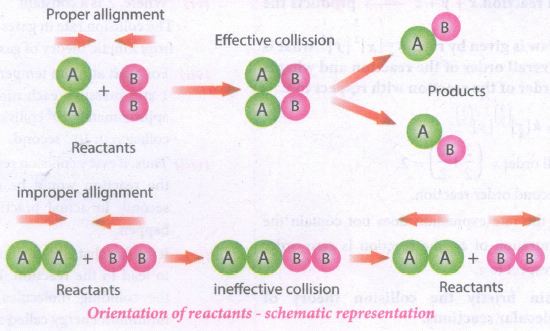
(ix) The fraction of effective collisions (f) having proper orientation is given by the steric factor p.
⇒ Rate = p x f x collision rate
\(\Rightarrow Rate=p\times { e }^{ \frac { -Ea }{ RT } }\times Z\left[ { A }_{ 2 } \right] \left[ { B }_{ 2 } \right] \quad ...(1)\)
As per the rate law,
Rate = \(k=\left[ { A }_{ 2 } \right] \left[ { B }_{ 2 } \right] \quad ...(2)\)
Where k is the rate constant
On comparing equation (1) and (2), the rate constant k is
\(k=pZ{ e }^{ \frac { -Ea }{ RT } }\)

12th Standard Syllabus & Materials
12th Standard
TN 12th Computer Applications களப்பெயர் முறைமை (DNS) Sample Question Papers Study Material - QB365 Set A
NEW12th Standard
TN 12th Computer Applications வலையமைப்பு எடுத்துக்காட்டுகள் மற்றும் நெறிமுறைகள் Sample Question Papers Study Material - QB365 Set A
NEW12th Standard
TN 12th Computer Applications கணினி வலையமைப்பு ஓர் அறிமுகம் Sample Question Papers Study Material - QB365 Set A
NEW12th Standard
TN 12th Computer Applications PHP-உடன் MySQL-ஐ இணைத்தல் Sample Question Papers Study Material - QB365 Set A



Tamilnadu Stateboard 12th Standard Subjects

Maths
Chemistry

Physics

Biology

Computer Science

Business Maths and Statistics

Economics

Commerce

Accountancy

History

Computer Applications
Biology
Computer Technology
Computer Applications
Computer Science
Business Maths and Statistics
Commerce
Economics
Maths
Chemistry
Physics
Computer Technology
History
Accountancy

Tamil

English

French
Tamilnadu Stateboard Standards
