
 100% FREE ACCESS
12th Standard Syllabus & Materials
12th Standard
TN 12th Computer Applications மின்னணு தரவு பரிமாற்றம் Sample Question Papers Study Material - QB365 Set A
NEW12th Standard
TN 12th Computer Applications மின் - வணிக பாதுகாப்பு அமைப்புகள் Sample Question Papers Study Material - QB365 Set A
NEW12th Standard
TN 12th Computer Applications மின்னணு செலுத்தல் முறைகள் Sample Question Papers Study Material - QB365 Set A
NEW12th Standard
TN 12th Computer Applications மின் - வணிகம் Sample Question Papers Study Material - QB365 Set A
NEW12th Standard
TN 12th Computer Applications திறந்த மூல கருத்துருக்கள் Sample Question Papers Study Material - QB365 Set A
NEW12th Standard
TN 12th Computer Applications வலையமைப்பு வடமிடல் Sample Question Papers Study Material - QB365 Set A

Published on: 03/01/2020
Chemical Kinetics
Download Tamil Nadu 12th Standard Chemistry question papers, model tests, one-mark questions, important questions, and public exam papers in PDF format. Free study materials and answer keys for TN State Board students.
Questions + Answers key
Take MCQ Chemistry Test
1.
Activation energy of a reactant is reduced by ________.
increased temperature
reduced temperature
increased pressure
reduced pressure
2.
The minimum energy that all colliding molecules must possess so as to make the collisions more effective and successful is_______.
activation energy
colliding energy
threshold energy
kinetic energy
3.
Rate law cannot be determined from balanced chemical equation if ______.
Reverse reactions is not involved
It is an elementary reaction
It is a sequence of elementary reactions
All of the reactants is in excess. Rate law can be determined from balanced chemical equation if it is an elementary reaction.
4.
The addition of a catalyst during a chemical reaction alters which of the following quantities?
Activation energy
Entropy
Internal energy
Enthalpy
5.
Which order reaction obeys the expression \({ t }_{ \frac { 1 }{ 2 } }\alpha \frac { 1 }{ \left[ A \right] } ?\)
First
Second
Third
Zero
6.
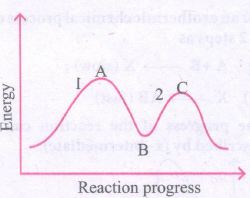
It is a 2 steps reaction, step 1 is slower than step 2
It is a 2 steps reaction, step 2 is slower than step 1.
Single step reaction where B is a activated complex
Single step reaction in which B is a reaction intermediate.
7.
A+B \(\longrightarrow \) C; ∆H = 60 kJ mol-1 Eaf = 150 kJ. What is the activation energy of the backward reaction?
210 kJ
105 kJ
90 kJ
145 kJ
8.
9.
Predict the rate law of the following reaction based on the data given below
2A+B⟶C+3D
| Reaction number | [A] (min) | [B] (min) | Initial rate (M s-1) |
| 1 | 0.1 | 0.1 | x |
| 2 | 0.2 | 0.1 | 2x |
| 3 | 0.1 | 0.2 | 4x |
| 4 | 0.2 | 0.2 | 8x |
rate = k[A]2 [B]
rate = k[A] [B]2
rate = k[A] [B]
rate = k[A]1/2 [B]3/2
10.
In a first order reaction x ⟶ y; if k is the rate constant and the initial concentration of the reactant x is 0.1M, then, the half life is_____.
\(\left( \frac { \log2 }{ k } \right) \)
\(\left( \frac { 0.693 }{ (0.1)k } \right) \)
\(\left( \frac { In2 }{ k } \right) \)
none of these
11.
For a reaction Rate = k[acetone]3/2 then unit of rate constant and rate of reaction respectively is _______.
(mol L-1 S-1),(mol1/2 L1/2 S-1)
(mol-1/2 L1/2 s-1),(mol L-1 s-1)
(mol1/2 L1/2 s-1),(mol L-1 s-1)
(mol L s-1),(mol1/2 L1/2 s)
12.
The decomposition of phosphine (PH3) on tungsten at low pressure is a first order reaction. It is because the _____.
rate is proportional to the surface coverage
rate is inversely proportional to the surface coverage
rate is independent of the surface coverage
rate of decomposition is slow
13.
From the rate expression for the following reactions, determine their order of reaction and the dimensions of the rate constants.
(i) 3NO(g) ⟶ N2O(g) Rate = K[NO]2
(ii) H2O2(aq) + 3I-(aq) +2H+ ⟶ 2H2O(l) +I3- Rate = K[H2O2][I-]
(iii) CH3CHO(g) ⟶ CH4(g) + CO(g) Rate = K[CH3 CHO]3/2
(iv) C2H5Cl(g) ⟶ C2H2(g) + HCl(g) Rate = K[C2H5Cl]2
14.
A reaction is of second order in A and first order in B.
(i) Write the differential rate equation.
(ii) How is the rate affected on increasing the concentration of A three times?
(iii) How is the rate affected when the concentration of both A and B is doubled?
15.
Benzene diazonium chloride in aqueous solution decomposes according to the equation \({ C }_{ 6 }{ H }_{ 5 }{ N }_{ 2 }Cl\longrightarrow { C }_{ 6 }{ H }_{ 5 }Cl+{ N }_{ 2 }\)Starting with an initial concentration of 10g L-1, the volume of N2 gas obtained at 50 °C at different intervals of time was found to be as under:
| t(min) | 6 | 12 | 18 | 24 | 30 | \(\infty \) |
| Vol of N2 (ml) | 19.3 | 32.6 | 41.3 | 46.5 | 50.4 | 58.3 |
Show that the above reaction follows the first order kinetics. What is the value of the rate constant?
16.
Describe the graphical representation of first order reaction.
17.
Define half life of a reaction. Show that for a first order reaction half life is independent of initial concentration.
18.
The initial rate of a first order reaction is 5.2 x 10⁻⁶ mol lit-1 S-1 at 298 K. When the initial concentration of reactant is 2.6 x 10⁻³ mol.lit-1, calculate the first order rate constant of the reaction at the same temperature.
19.
The time for half change in a first order decomposition of a substance A is 60 seconds. Calculate the rate constant. How much of A will be left after 180 seconds?
20.
Assertion: A catalyst is a substance which alters the rate of a reaction.
Reason: In the presence of catalyst the energy of activation is increased.
Codes:
a) Both assertion and reason are true and the reason is the correct explanation of the assertion.
b) Both assertion and reason are true but the reason is not the correct explanation of the assertion.
c) Assertion is true but reason is false.
d) Both assertion and reason are false.
21.
Assertion: Order and molecularity are same.
Reason: Order is determined experimentally and molecularity is the sum of the stoichiometric coefficient of rate determining elementary step.
Codes:
a) Both assertion and reason are true and the reason is the correct explanation of the assertion.
b) Both assertion and reason are true but the reason is not the correct explanation of the assertion.
c) Assertion is true but reason is false.
d) Both assertion and reason are false.
22.
Assertion: A positive catalyst increases the rate of reaction.
Reason: A positive catalyst alters reaction mechanism and decreases activation energy.
Codes:
a) Both assertion and reason are true and the reason is the correct explanation of the assertion.
b) Both assertion and reason are true but the reason is not the correct explanation of the assertion.
c) Assertion is true but reason is false.
d) Both assertion and reason are false.
23.
Two reactions A ⟶ B and C ⟶ D has the energy of activation 40 kJ and 60 kJ respectively. Which of the following statement is correct?
a) Comparison of rate cannot be determined
b) The reaction A ⟶ B proceeds at a faster rate compared to the reaction C ⟶ D
c) The reaction A ⟶ B proceeds at a slower rate compared to the reaction C ⟶ D.
d) Comparison of rate cannot be determined.
24.
Consider the following statements and identify the incorrect statement(s).
(i) Decomposition of H2O2 is an II order reaction
(ii) t1/u is independent of initial concentration of a reaction.
(iii) Fractional order reactions are observed depending on their rates.
(iv) Rate = k [A]p [B]q; p + q = order.
a) only (ii)
b) both (ii) and (iii)
c) only (i)
d) None of these
25.
If the rate of a reaction gets doubled as the temperature is increased from 27oC to 37oC. Find the activation energy of reaction?
26.
For a chemical reaction, Variation in the concentration In[A] Vs time in seconds is given as
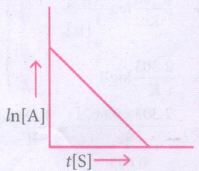
(i) What is the order of the reaction?
(ii) What is the unit of rate constant K?
(iii) Give the relationship between k and \({ t }_{ \frac { 1 }{ 2 } }\)
1.
(a)
increased temperature
2.
(c)
threshold energy
3.
(c)
It is a sequence of elementary reactions
4.
(a)
Activation energy
5.
(b)
Second
6.
(a)
It is a 2 steps reaction, step 1 is slower than step 2
7.
(c)
90 kJ
8.
(d)
9.
rate1 = k[0.1]n [0.1]m ....(1)
rate2 = k[0.2]n [0.1]m ....(2)
(2) (1)
\(=\frac{2x}{x} = \frac{k[0.2]^n [0.1]^m}{k[0.1]^n [0.1]^m}\)
\(= \frac{2x}{x} = 2^n\)
n = 1
rate3 = k[0.1]n [0.2]m ....(3)
rate4 = k[0.2]n [0.2]m ....(4)
\(=\frac{8x}{2x} = \frac{k[0.2]^n [0.2]^m}{k[0.2]^n [0.1]^m}\)
= 8/2 = 2m
m = 2
rate = k[A] [B]2
10.
\(k=\frac { 1 }{ t } ln \frac { \left[ { A }_{ 0 } \right] }{ \left[ A \right] } \)
[A0] = 0.1: [A] = 0.05
\(k= \left[ \frac { 1 }{ t _{1/2}} \right] ln\left[ \frac { { 0.1 } }{ 0.05 }\right] \)
\(k= \left[ \frac { 1 }{ t _{1/2}} \right] ln (2)\)
t1/2 = In(2)/K
11.
Rate = k[A]n
Rate = \(\frac{-\mathrm{d}[\mathrm{A}]}{\mathrm{dt}}\)
unit of rate = \(\frac{mol L^{-1}}{s}\)=mol L-1/s-1
unit of rate constant
\(=\frac{ (mol{ L }^{ -1 }{ S }^{ -1 }) }{ ({ mol }{ L }^{ -1 })^n } \)
= mol1-nLn-1s-1
in the case
rate = k [Acetone]3/2
n = 3/2
= mol1-(3/2)L(3/2)-1s-1
(mol-(1/2) L(1/2) s-1).
12.
Given:
At low pressure the reaction follows first order therefore,
Rate α [reactant]1
Rate α (surface area)
At high pressure due to the complete coverage of surface area, the reaction follows zero order.
Rate α [reactant]0
Therefore the rate is independent of surface area.
13.
(i) Given rate = K[NO]2
∴ Order of the reaction = 2
\(K=\frac { Rate }{ { \left[ NO \right] }^{ 2 } } \)
Dimension of = \(\frac { mol{ L }^{ -1 }{ S }^{ -1 } }{ { \left( mol{ L }^{ -1 } \right) }^{ 2 } } \)
\(=\frac { mol{ L }^{ -1 }{ S }^{ -1 } }{ { mol }^{ 2 }{ L }^{ -2 } } \)
= L mol-1 S-1
(ii) Given rate = K[H2O2][I-]
∴ order of reaction = 2
\(K=\frac { Rate }{ \left[ { H }_{ 2 }{ O }_{ 2 } \right] \left[ { I }^{ - } \right] } \)
Dimension of = \(\frac { mol{ L }^{ -1 }{ S }^{ -1 } }{ \left( mol{ L }^{ -1 } \right) \left( mol{ L }^{ -1 } \right) } \)
= L mol-1 S-1
(iii) Given rate = K[CH3CHO]3/2
∴ Order of the reaction = 3/2
\(K=\frac { Rate }{ { \left[ { CH }_{ 3 }CHO \right] }^{ \frac { 3 }{ 2 } } } \)
Dimension of = \(\frac { mol{ L }^{ -1 }{ S }^{ -1 } }{ { \left( mol{ L }^{ -1 } \right) }^{ \frac { 3 }{ 2 } } } \)
\(=\frac { mol{ L }^{ -1 }{ S }^{ -1 } }{ { mol }^{ \frac { 3 }{ 2 } }{ L }^{ -\frac { 3 }{ 2 } } } \)
\(={ L }^{ \frac { 1 }{ 2 } }{ mol }^{ -\frac { 1 }{ 2 } }{ S }^{ -1 }\)
Given rate = K[C2H5Cl]
∴ order of the reaction = 1
\(K=\frac { Rate }{ \left[ { C }_{ 2 }{ H }_{ 5 }CL \right] } \)
Dimension of \(=\frac { mol{ L }^{ -1 }{ S }^{ -1 } }{ { mol }{ L }^{ -1 } } \) = -1
14.
A reaction is second order in A and first order in B
(i) Differential rate equation,
Rate = \(\frac { -d\left[ R \right] }{ dt } =k{ \left[ A \right] }^{ 2 }\left[ B \right] \)
(ii) When the concentration of A is increased three times, (i.e) 3A, then
Rate = k[3A]2 [B]
= 9k [A]2[B] = 9 (initial rate)
This shows the rate will increase 9 times to the initial time.
(iii) When concentration of both A and B is doubled then,
Rate = k [2A]2 [2B] = 8k [A]2 [B] = 8 (initial rate)
This shows that rate will increase 8 times to the initial rate.
15.
For a first order reaction
\(k=\frac { 2.303 }{ t } \log\frac { \left[ { A }_{ 0 } \right] }{ \left[ A \right] } \)
\(k=\frac { 2.303 }{ t } \log\frac { { V }_{ \infty } }{ { V }_{ \infty }-{ V }_{ 1 } } \)
V∞= 58.3 ml.
| t(min) | Vt | V∞=Vt | \(k=\frac { 2.303 }{ t } \log\frac { { V }_{ \infty } }{ { V }_{ \infty }-{ V }_{ t } } \) |
| 6 | 19.3 | 58.3-19.3=39.0 | \(k=\frac { 2.303 }{ 6 } \log\left( \frac { 58.3 }{ 39 } \right) =0.0670\) min-1 |
| 12 | 32.6 | 58.3-32.6=25.7 | \(k=\frac { 2.303 }{ 12 } \log\left( \frac { 58.3 }{ 25.7 } \right) =0.06838\) min-1 |
| 18 | 41.3 | 58.3-41.3=17.0 | \(k=\frac { 2.303 }{ 18 } \log\left( \frac { 58.3 }{ 17 } \right) =0.06838\) min-1 |
| 24 | 46.5 | 58.3-46.5=11.8 | \(k=\frac { 2.303 }{ 24 } \log\left( \frac { 58.3 }{ 11.8 } \right) =0.0666\) min-1 |
| 30 | 50.4 | 58.3 - 50.4 = 7.9 | \(k=\frac{2.303}{30} \log \left(\frac{58.3}{7.9}\right)=0.067\) min-1 |
| Mean value of k = 0.0674 min-1 |
As the rate constants are constant through out it is a first order reaction.
16.
A Reaction whose rate depends on the reactant concentration raised to the first power is called a first order reaction. For a first order reaction,
A ⟶ product
Rate law can be expressed as
Rate = k[A]-1
\(\frac { -d\left[ A \right] }{ \left[ A \right] } =k dt\) ...(1)
Integrate the above equation between the limits of time t = 0 and time equal to t, while the concentration varies from the initial: concentration [Ao] to [A] at the later time.
\(\int _{ { [A }_{ 0 }] }^{ [A] }{ \frac { -d\left[ A \right] }{ \left[ A \right] } } =k\int _{ 0 }^{ t }{ dt } \)
\({ \left( -In\left[ A \right] \right) }_{ \left[ { A }_{ 0 } \right] }^{ \left[ A \right] }=k{ \left( t \right) }_{ 0 }^{ t }\)
\(-In\left[ A \right] -\left( In\left[ { A }_{ 0 } \right] \right) =k\left( t-0 \right) \)
\(-In\left[ A \right] -\left( In\left[ { A }_{ 0 } \right] \right) =kt\)
\(In\left( \frac { \left[ { A }_{ 0 } \right] }{ \left[ A \right] } \right) =kt\) ...(2)
This equation is in natural logarithm. To convert it into usual logarithm with base 10, we have to multiply the term by 2.303.
\(2.303\quad log\left( \frac { \left[ { A }_{ 0 } \right] }{ \left[ A \right] } \right) =kt\)
\(k=\frac { 2.303 }{ t } log\left( \frac { \left[ { A }_{ 0 } \right] }{ \left[ A \right] } \right) \) ...(3)
Equation (2) can be written in the form
y = mx+c as below
In [A0]-In[A] = kt
In[A] = In[A0]-kt
⇒ y = c + mx
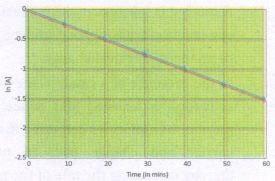
If we follow the reaction by measuring the concentration of the reactants at regular time interval 't' a plot of In[A] against 't' yields a straight line with a negative slope. From this, the rate constant is calculated.
17.
(i) The half life of a reaction is defined as the time required for the reactant concentration to reach one half its initial value.
\(k=\frac { 2.303 }{ t } log\frac { \left[ { A }_{ 0 } \right] }{ \left[ A \right] } \)
\(at\quad t={ t }_{ \frac { 1 }{ 2 } };\left[ A \right] =\frac { \left[ { A }_{ 0 } \right] }{ 2 } \)
\(k=\frac { 2.303 }{ t_{ 1/2 } } log\frac { \left[ { A }_{ 0 } \right] }{ \frac { \left[ { A }_{ 0 } \right] }{ 2 } } \)
\(k=\frac { 2.303 }{ { t }_{ 1/2 } } log2\)
\(k=\frac { 2.303\times 0.3010 }{ { t }_{ 1/2 } } =\frac { 0.6932 }{ { t }_{ 1/2 } } \)
\({ t }_{ 1/2 }=\frac { 0.6932 }{ k } \)
This equation has no concentration term So, the half life of a first order reaction is independent of initial concentration.
18.
Given data: Rate = 5.2 x 10⁻⁶ mol lit-1 sec-1
Initial concentration [A] = 2.6 x 10⁻³
Formula: Rate = k[A]1
Solution: Rate = 5.2 x 10⁻⁶ mol lit-1 sec-1 = k x 2.6 x 10⁻³ lit-1
= \(\frac { 5.26\times { 10 }^{ -6 }mol{ \ lit }^{ -1 }{ sec }^{ -1 } }{ 2.6\times { 10 }^{ -3 }mol \ { lit }^{ -1 } } \)= 2 x 10⁻³
∴ k = 2 x 10⁻³ s-1
19.
(i) Order of the reaction =1; \(\mathrm{t}_{1 / 2}=60 \mathrm{~s} ; \mathrm{k}=?\)
\(\mathrm{k}=\frac{0.6932}{\mathrm{t}_{\frac{1}{2}}} \)
\(=\frac{0.6932}{60} \)
\(k =1.155 \times 10^{-2} \mathrm{~s}^{-1}\)
(ii) \(\left[\mathrm{A}_{0}\right]=100 \% ; \mathrm{t}=180 \mathrm{~s} ;[\mathrm{A}]=? ; \mathrm{k}=1.155 \times 10^{-2} \mathrm{~s}^{-1}\)
For first order reaction
\(\mathrm{k}=\frac{2.303}{\mathrm{t}} \log \frac{\left[\mathrm{A}_{0}\right]}{[\mathrm{A}]} \)
\(1.155 \times 10^{-2} =\frac{2.303}{180} \log \left(\frac{100}{[A]}\right) \)
\(\frac{0.01155 \times 180}{2.303} =\log \left(\frac{100}{[A]}\right) \)
\(0.9027 =\log 100-\log [\mathrm{A}] \)
\(\log [\mathrm{A}] =\log 100-0.9027 \)
\(\log [A]=2-0.9027 \)
\(\log [A]=1.0972 \)
[A] = antilog of (1.0972)
[A] =12.51 %
20.
c) Assertion is true but reason is false.
21.
d) Both assertion and reason are false.
22.
a) Both assertion and reason are true and the reason is the correct explanation of the assertion.
23.
()
b) The reaction A ⟶ B proceeds at a faster rate compared to the reaction C ⟶ D
24.
c) only (i)
25.
In \(\frac { { k }_{ 2 } }{ { k }_{ 1 } } =\frac { { E }_{ a } }{ R } \left[ \frac { { T }_{ 2 }-{ T }_{ 1 } }{ { T }_{ 1 }{ T }_{ 2 } } \right] \)
In 2 = \(\frac { { E }_{ a } }{ R } \) \(\left[ \frac { 10 }{ 300\times 310 } \right] \)
Ea = 9300 R In 2
= 53.4 kJ mol-1
26.
(i) I Order reaction
(ii) S-1
(iii) \({ t }_{ \frac { 1 }{ 2 } }\) = 0.693/k

12th Standard Syllabus & Materials
12th Standard
TN 12th Computer Applications களப்பெயர் முறைமை (DNS) Sample Question Papers Study Material - QB365 Set A
NEW12th Standard
TN 12th Computer Applications வலையமைப்பு எடுத்துக்காட்டுகள் மற்றும் நெறிமுறைகள் Sample Question Papers Study Material - QB365 Set A
NEW12th Standard
TN 12th Computer Applications கணினி வலையமைப்பு ஓர் அறிமுகம் Sample Question Papers Study Material - QB365 Set A
NEW12th Standard
TN 12th Computer Applications PHP-உடன் MySQL-ஐ இணைத்தல் Sample Question Papers Study Material - QB365 Set A



Tamilnadu Stateboard 12th Standard Subjects

Maths
Chemistry

Physics

Biology

Computer Science

Business Maths and Statistics

Economics

Commerce

Accountancy

History

Computer Applications
Biology
Computer Technology
Computer Applications
Computer Science
Business Maths and Statistics
Commerce
Economics
Maths
Chemistry
Physics
Computer Technology
History
Accountancy

Tamil

English

French
Tamilnadu Stateboard Standards
