
 100% FREE ACCESS
12th Standard Syllabus & Materials
12th Standard
TN 12th Computer Applications மின்னணு தரவு பரிமாற்றம் Sample Question Papers Study Material - QB365 Set A
NEW12th Standard
TN 12th Computer Applications மின் - வணிக பாதுகாப்பு அமைப்புகள் Sample Question Papers Study Material - QB365 Set A
NEW12th Standard
TN 12th Computer Applications மின்னணு செலுத்தல் முறைகள் Sample Question Papers Study Material - QB365 Set A
NEW12th Standard
TN 12th Computer Applications மின் - வணிகம் Sample Question Papers Study Material - QB365 Set A
NEW12th Standard
TN 12th Computer Applications திறந்த மூல கருத்துருக்கள் Sample Question Papers Study Material - QB365 Set A
NEW12th Standard
TN 12th Computer Applications வலையமைப்பு வடமிடல் Sample Question Papers Study Material - QB365 Set A

Published on: 31/10/2019
Chemistry In Everyday Life
Download Tamil Nadu 12th Standard Chemistry question papers, model tests, one-mark questions, important questions, and public exam papers in PDF format. Free study materials and answer keys for TN State Board students.
Questions + Answers key
Take MCQ Chemistry Test
1.
Nylon is an example of _______.
polyamide
polythene
polyester
poly saccharide
2.
Natural rubber has _______.
alternate cis- and trans-configuration
random cis- and trans-configuration
all cis-configuration
all trans-configuration
3.
4.
Saccharin, an artificial sweetener is manufactured from ____________.
cellulose
toluene
cyclohexene
starch
5.
Which of the following is an analgesic?
Streptomycin
Chloromycetin
Asprin
Penicillin
6.
Which sweetening agent are used to prepare sweets for a diabetic patient?
7.
Write the structural formula of aspirin.
8.
What are antibiotics?
9.
Which chemical is responsible for the antiseptic properties of dettol.
10.
How is terylene prepared?
11.
Who do soaps not work in hard water?
12.
What are food preservatives?
13.
Write a note on synthetic detergents
14.
Differentiate thermoplastic and thermosetting.
15.
What are narcotic and non – narcotic drugs. Give examples
16.
What are drugs? How are they classified.
1.
(a)
polyamide
2.
(c)
all cis-configuration
3.
(a)
4.
(b)
toluene
5.
(c)
Asprin
6.
(i) Sucralose is used as sugar substituent like Sorbitol, Xylitol and Mannitol. All these have sweetness. They are metabolised without the influence of insulin.
(ii) Artificial sweetening agents like Aspartarne, Alitame and Saccharin are also used. These have negligible nutritional value.
Example : Saccharin,Aspartame, Sucralose, Alitame
7.
Aspirin is o-acetyl salicylic acid
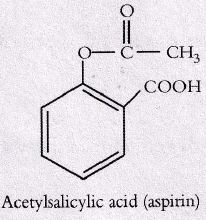
8.
(i) Many micro organisms (bacteria, fungi and moulds) produce certain chemicals which inhibit the growth or metabolism of some other micro organism. Such chemicals are called antibiotics.
(ii) Eg: Penicillin from the mould penicillium notatum
9.
Dettol is a mixture of chloroxylenol and terpineol which imparts antiseptic properties to it.
10.
(i) Monomers :Ethylene glycol and terepathalic acid (or) dimethyl terephthalate.
(ii) Catalyst : Zinc acetate and antimony trioxide.
(iii) Temperature : 500 K
(iv) Product : Terylene

(v) Uses : blending with cotton or wool fibres and as glass reinforcing materials in safety helmets
11.
Hard water contains salts of calcium and magnesium. When soaps are dissolved in hard water, these ions displace sodium and potassium from their salts and form insoluble calcium and magnesium salts of fatty acids. These insoluble salts separate as scum, Thus soaps do not work in hard water.
12.
(i) Preservatives are chemicals added to food which are capable of inhibiting, retarding or arresting the process of fermentation, acidification or other decomposition of food by the growth of micro organisms (or)
(ii) Chemical substances which are added to food that prevents the spoilage of food materials by destroying the food - spoiling micro-organisms are called food preservatives.
(iii) Eg: sodium benzoate, NaCl, Acetic acid Sodium metabisulphite, potassium meta bisulphite etc.
13.
Detergents:
a) Anionic detergents:
These are sodium salt of sulphonated long chain alcohols (or) hydrocarbons. The anionic part of the molecule is involved in the cleansing action.
Eg: sodium lawryl sulphate, sodium dodecyl benzene sulphonate.
Use: Household work & tooth paste.
b) Cationie detergents:
These are quarternary. ammonium salts of amines with acetates, chlorides (or) bromides as anions.
It is the cationic part of the molecule which is involved in cleansing action.
Eg: n-hexadecyl trimethyl ammonium chloride
c) Non-ionic detergents:
These donot contain any ion. These are esters of high molecular mass alcohols.
Eg: Pentaerythrityl stearate
Use dish washing detergents.
| Detergent Type | Example |
| Anionic detergent | Sodium Lauryl Sulphate (SLS).JPG) |
| Cationic detergent | N - hexadecyltrimethyl ammonium chloride.JPG) N,N,N - trimethylhexadecan - 1 - aminium chloride |
| Non - ionic detergent | Pentaerythrityl stearate.JPG) 3 - hydroxy -2,2 - bis (hydroxymethyl) propyl heptanoate |
14.
(i) Thermoplastic: They become soft on heating and hard on cooling. They can be remolded
E.g. polythene, PVC, polystrene
(ii) Thermo setting : Do not be come soft on heating set to an infusible mass upon heating.
E.g. bakelite, melamine, formaldehyde
15.
Narcotic drugs: [Opioids]
(i) These are narcotic analgesics. These relieve pain and produce sleep. These drugs are addictive. In poisonous dose, these produces coma and ultimately death.
(ii) They are used for either short-term or long term relief of severe pains. They are mainly used for post operative pain, pain of terminal cancer.
(iii) Eg: Morphine, Codeine
Non-narcotic drugs:
(i) These are non- narcotic analgesics. These reduce the pain without causing impairment of consciousness.
(ii) They alleviate pain by reducing local inflammatory responses.
(iii) These are used for short-term pain relief and for modest pain like headache, muscle strain, bruising or arthritis.
(iv) These drugs have many other effects such as reducing fever (antipyretic) and preventing platelet coagulation (eg. aspirin).
(v) These reduce fever by causing the hypothalamus to over ride a prostaglandin - induced increase in temperature.
(vi) Eg. Aspirin, Paracetamol, Ibuprofen. There are two types in it.
a) Anti inflammatory: eg: Aspirin, Paracetamol
b) Non steroidal anti -inflammatory drugs: (NSAIDs) eg: Ibuprofen
16.
A drug is a substance that is used to modify or explore physiological systems or pathological states for the benefit of the recipient. It is used for the purpose of diagnosis, prevention, cure/relief of a disease.
a) Classification of drugs:
Drugs are classified based on their properties such as chemical structure, pharmacological effect, target system, site of action etc.
b) Classification based on the chemical structure:
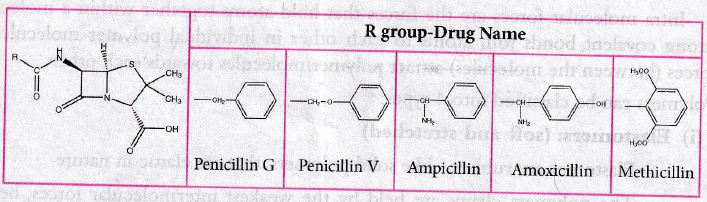
In this classification, drugs with a common chemical skeleton are classified into a single group. For example, ampicillin, amoxicillin, methicillin etc.. all have similar structure and are classified into a single group called penicillin. Similarly, we have other group of drugs such as opiates, steroids, catecholamines etc. Compounds having similar chemical structure are expected to have similar chemical properties. However, their biological actions are not always similar. For example, all drugs belonging to penicillin group have same biological action, while groups such as barbiturates, steroids etc.. have different biological action.
Penicillins
Classification based on Pharmacological effect:
In this classification, the drugs are grouped based on their biological effect that they produce on the recipient. For example, the medicines that have the ability to kill the pathogenic bacteria are grouped as antibiotics. This kind of grouping will provide the full range of drugs that can be used for a particular condition (disease). The physician has to carefully choose a suitable medicine from the available drugs based on the clinical condition of the recipient.
Examples:
Antibiotic drugs: amoxicillin, ampicillin, cefixime, cefpodoxime, erythromycin, tetracycline etc.. Antihypertensive drugs: propranolol, atenolol, metoprolol succinate, amlodipine etc...
Classification based on the target system (drug action):
In this classification, the drugs are grouped based on the biological system/process, that they target in the recipient. This classification is more specific than the pharmacological classification. For example, the antibiotics streptomycin and erythromycin inhibit the protein synthesis (target process) in bacteria and are classified in a same group. However, their mode of action is different. Streptomycin inhibits the initiation of protein synthesis, while erythromycin prevents the incorporation of new amino acids to the protein.
Classification based on the site of action (molecular target):
The drug molecule interacts with biomolecules such as enzymes, receptors etc, which are referred as drug targets. We can classify the drug based on the drug target with which it binds. This classification is highly specific compared to the others. These compounds often have a common mechanism of action, as the target is the same.

12th Standard Syllabus & Materials
12th Standard
TN 12th Computer Applications களப்பெயர் முறைமை (DNS) Sample Question Papers Study Material - QB365 Set A
NEW12th Standard
TN 12th Computer Applications வலையமைப்பு எடுத்துக்காட்டுகள் மற்றும் நெறிமுறைகள் Sample Question Papers Study Material - QB365 Set A
NEW12th Standard
TN 12th Computer Applications கணினி வலையமைப்பு ஓர் அறிமுகம் Sample Question Papers Study Material - QB365 Set A
NEW12th Standard
TN 12th Computer Applications PHP-உடன் MySQL-ஐ இணைத்தல் Sample Question Papers Study Material - QB365 Set A



Tamilnadu Stateboard 12th Standard Subjects

Maths
Chemistry

Physics

Biology

Computer Science

Business Maths and Statistics

Economics

Commerce

Accountancy

History

Computer Applications
Biology
Computer Technology
Computer Applications
Computer Science
Business Maths and Statistics
Commerce
Economics
Maths
Chemistry
Physics
Computer Technology
History
Accountancy

Tamil

English

French
Tamilnadu Stateboard Standards
