
 100% FREE ACCESS
12th Standard Syllabus & Materials
12th Standard
TN 12th Computer Applications மின்னணு தரவு பரிமாற்றம் Sample Question Papers Study Material - QB365 Set A
NEW12th Standard
TN 12th Computer Applications மின் - வணிக பாதுகாப்பு அமைப்புகள் Sample Question Papers Study Material - QB365 Set A
NEW12th Standard
TN 12th Computer Applications மின்னணு செலுத்தல் முறைகள் Sample Question Papers Study Material - QB365 Set A
NEW12th Standard
TN 12th Computer Applications மின் - வணிகம் Sample Question Papers Study Material - QB365 Set A
NEW12th Standard
TN 12th Computer Applications திறந்த மூல கருத்துருக்கள் Sample Question Papers Study Material - QB365 Set A
NEW12th Standard
TN 12th Computer Applications வலையமைப்பு வடமிடல் Sample Question Papers Study Material - QB365 Set A

Published on: 03/01/2020
Coordination Chemistry
Download Tamil Nadu 12th Standard Chemistry question papers, model tests, one-mark questions, important questions, and public exam papers in PDF format. Free study materials and answer keys for TN State Board students.
Questions + Answers key
Take MCQ Chemistry Test
1.
Write the IUPAC name of the complex.
2.
Write the oxidation state, coordination number , nature of ligand, magnetic property and electronic configuration in octahedral crystal field for the complex K4[Mn(CN)6]
3.
Why tetrahedral complexes do not exhibit geometrical isomerism.
4.
Write the formula for the co-ordination compounds.
5.
How are metal carbonyls classified depending on the number of metal atoms?
6.
Discuss briefly the nature of bonding in metal carbonyls.
7.
Predict the geometry and hybridisation of Fe(Co)5 _______.
Trigonal planar, dsp3
Trigonal bipyramidal, dsp3
Square planar dsp2
Octahedral d2sp3
8.
IUPAC name of H2[Ptcl6] is _______.
Hexa chloridoplatinum (IV) acid
Hexa chloridoplatinum (IV) acid
Hexachloridoplatinic (IV) acid
Dihydrogenhexaehloro platinate (IV)
9.
Structural formula of tetra aqua dichlorido Chromium (III) chloride _______.
[Cr(H2O)4Cl2]Cl2
[Cr(H2O)4Cl3]
[(H2O)4Cl2Cr]Cl2
[Cl2(H2O)4Cr]Cl3
10.
Which one of the following pairs represents linkage isomers?
[Cu(NH3)4][PtCl4] and [Pt(NH3)4][CuCl4]
[Co(NH3)5(NO3)]SO4 and [Co(NH3)5(ONO)]
[Co(NH3)4(NCS)2]Cl and [Co(NH3)4(SCN)2]Cl
both (b) and (c)
11.
12.
Mohr's salt answers the presence of Fe2+, NH4+and SO42- ions, whereas the potassium ferrithiocyanate will not answer Fe3+ and SCN ions give reason.
13.
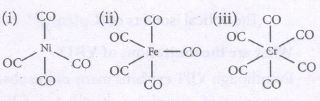
Draw the structure of the following homoleptic metal carbonyl.
(i) [Ni(CO)4]
(ii) [Fe(CO)5]
(iii) [Cr(CO)6]
14.
Assertion: EDTA is used remove lead poisoning.
Reason: EDTA is a chelating ligand.
Codes:
a) Both assertion and reason are true and the reason is the correct explanation of the assertion.
b) Both the assertion and reason are true but the reason is not the correct explanation of the assertion.
c) Assertion is true but reason is false.
d) Both assertion and reason are false.
15.
Assertion: Tetrahedral complexes do not show geometrical isomerism.
Reason: The relative position of the ligands attached to the central metal atom is same with respect to each other.
Codes:
a) Both assertion and reason are true and the reason is the correct explanation of the assertion.
b) Both the assertion and reason are true but the reason is not the correct explanation of the assertion.
c) Assertion is true but reason is false.
d) Both assertion and reason are false.
16.
Which among the following statement is correct?
a) Magnitude of crystal field splitting energy depends only on ligand field.
b) Lower CFSE favour formation of low spin complex.
c) t2g orbitals are three fold degenerate while eg orbitals and two fold degenerate
d) all the above
17.
The crystal field splitting power of various ligands for a given metal ion are in the following order.
a) I- < Br- < Cl- < SCN- < S2- < F < OH-
b) I- < Br- < SCN- < Cl- < S2- < F < OH-
c) Br- < I- < SCN- < S2- < Cl- < F < OH-
d) Br- < I- < SCN- < S2 < Cl- < OH- < F
1.
Sodium tetrafluoridodihydroxychromate (III) Na[CrF4(H2O)2]
2.
(i) Oxidation state of the central metal ion : +2 (i.e) Mn2+
(ii) Co-ordination number : 6
(iii) Nature of ligand: CN- (Negative ligand)
(iv) Magnetic property: Paramagnetic nature
(v) Electronic configuration:
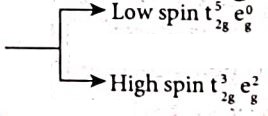
(vi) Oxidation state: +2 (or) Mn2+ of central metal ion
3.
Tetrahedral complexes do not exhibit geometrical isomerism. Because the relative position of donor atoms of ligand the unidentate Iigands (donor atom) attached to the central atom are same with respect to each other.
4.
a) potassiumhexacyanidoferrate(II) - Potassiumhexacyanidoferrate(II) - K4[Fe(CN)6]
b) Pentacarbonyliron(0) - [Fe(CO)5]
c) Pentaamminenitrito −kNcobalt(III)ion - [Co(NH3)5(NO2)]2+
d) Hexaamminecobalt(III) Sulphate - [CO(NH3)6](SO4)3
e) Sodiumtetrafluoridodihydroxidochromate(III) - Na2[CrF4(OH)2]
5.
Metal carbonyls are classified in two different ways as described below Classification based on the number of metal atoms present.
a. Mononuclear carbonyls
These compounds contain only one metal atom. For example, [Ni(CO)4] - nickel tetracarbonyl is tetrahedral, [Fe(CO)5] - Iron pentacarbonyl is trigonal bipyramidal, and [Cr(CO)6] - Chromium hexacarbonyl is octahedral.
b. Polynuclear carbonyls
Metallic carbonyls containing two or more metal atoms are called polynuclear carbonyls. Polynuclear metal carbonyls may be Homonuclear [Co2(CO)8], [Mn2(CO)10], [Fe3 (CO)12] or heteronuclear [MnCo(CO)9], [MnRe(CO)10] etc.
6.
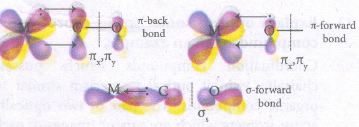
Bonding in metal carbonyls:
(i) In metal carbonyls, the bond between metal atom and the carbonyl ligand consists of two components.
(ii) The first component is an electron pair donation from the carbon atom of carbonyl ligand into a vacant d-orbital of central metal atom.
(iii) This electron pair donation forms \(M\overset { \sigma \ bond }{ \longleftarrow } \text {CO sigma bond}\)
(iv) This sigma bond formation increases the electron density in metal d orbitals and makes the metal electron rich.
(v) In order to compensate for this increased electron density, a filled metal d-orbital interacts with the empty \({ \pi }^{ \bigstar }\) orbital on the carbonyl ligand and transfers the added electron density back to the ligand.
(vi) This second component is called \(\pi\)-back bonding.
(vii) Thus in metal carbonyls, electron density moves from ligand to metal through sigma bonding and from metal to ligand through pi bonding, this synergic effect accounts for strong M⇽CO bond in metal carbonyls.
(viii) This phenomenon is shown diagrammatically as follows.
7.
(b)
Trigonal bipyramidal, dsp3
8.
(d)
Dihydrogenhexaehloro platinate (IV)
9.
(a)
[Cr(H2O)4Cl2]Cl2
10.
(a) coordination isomers
(b) no isomerism ( different molecular formula)
(c)⬅NCS; ⬅SCN coordinating atom differs : linkage isomers
11.
(d)
12.
If we perform a qualitative analysis to identify the constituent ions present in both the compounds, Mohr's salt answers the presence of Fe2+, NH4+, and SO42- ions, whereas the potassium ferrithiocyanate will not answer Fe3+ and SCN ions. We can infer that the double salts loose their identity and dissociate into their constituent simple ions in solutions, whereas the complex ion in coordination compound, does not loose its identity and never dissociate to give simple ions.
13.
14.
a) Both assertion and reason are true and the reason is the correct explanation of the assertion.
15.
a) Both assertion and reason are true and the reason is the correct explanation of the assertion.
16.
()
c) t2g orbitals are three fold degenerate while eg orbitals and two fold degenerate
17.
b) I- < Br- < SCN- < Cl- < S2- < F < OH-

12th Standard Syllabus & Materials
12th Standard
TN 12th Computer Applications களப்பெயர் முறைமை (DNS) Sample Question Papers Study Material - QB365 Set A
NEW12th Standard
TN 12th Computer Applications வலையமைப்பு எடுத்துக்காட்டுகள் மற்றும் நெறிமுறைகள் Sample Question Papers Study Material - QB365 Set A
NEW12th Standard
TN 12th Computer Applications கணினி வலையமைப்பு ஓர் அறிமுகம் Sample Question Papers Study Material - QB365 Set A
NEW12th Standard
TN 12th Computer Applications PHP-உடன் MySQL-ஐ இணைத்தல் Sample Question Papers Study Material - QB365 Set A



Tamilnadu Stateboard 12th Standard Subjects

Maths
Chemistry

Physics

Biology

Computer Science

Business Maths and Statistics

Economics

Commerce

Accountancy

History

Computer Applications
Biology
Computer Technology
Computer Applications
Computer Science
Business Maths and Statistics
Commerce
Economics
Maths
Chemistry
Physics
Computer Technology
History
Accountancy

Tamil

English

French
Tamilnadu Stateboard Standards
