
 100% FREE ACCESS
12th Standard Syllabus & Materials
12th Standard
TN 12th Computer Applications மின்னணு தரவு பரிமாற்றம் Sample Question Papers Study Material - QB365 Set A
NEW12th Standard
TN 12th Computer Applications மின் - வணிக பாதுகாப்பு அமைப்புகள் Sample Question Papers Study Material - QB365 Set A
NEW12th Standard
TN 12th Computer Applications மின்னணு செலுத்தல் முறைகள் Sample Question Papers Study Material - QB365 Set A
NEW12th Standard
TN 12th Computer Applications மின் - வணிகம் Sample Question Papers Study Material - QB365 Set A
NEW12th Standard
TN 12th Computer Applications திறந்த மூல கருத்துருக்கள் Sample Question Papers Study Material - QB365 Set A
NEW12th Standard
TN 12th Computer Applications வலையமைப்பு வடமிடல் Sample Question Papers Study Material - QB365 Set A

Published on: 19/09/2019
Coordination Chemistry
Download Tamil Nadu 12th Standard Chemistry question papers, model tests, one-mark questions, important questions, and public exam papers in PDF format. Free study materials and answer keys for TN State Board students.
Questions + Answers key
Take MCQ Chemistry Test
1.
What is Co-ordination entity?
2.
Name the following :
(i) Ring that is attached to Fe2+ in hemoglobin.
(ii) Vitamin B12 is a co-ordination compound of this element.
(iii) Complex that is used in the hydrogenation of alkenes
3.
Arrange the following complex ions in the increasing order of crystal filed splitting energy (\({ \triangle }_{ 0 }\)) [CrCI6]3-, [Cr(CN)6]3-, [Cr(NH3)6]3+
4.
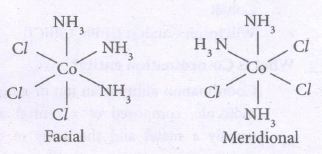
How many geometrical isomers are possible in the following co-ordination entities?
(i) [Cr(C2O4)3]3-
(ii) [CO(NH3)3Cl3]
5.
Calculate the magnetic moment of [Fe(H2O)6]2+, if atomic number of Fe is 26.
6.
Give the chemical formula of potassium trioxalato ferrate(III}
7.
Write the IUPAC name of [Cu(NH3)4]SO4
8.
Define 'Ligand' Give an example of neutral ligand.
9.
Write the IUPAC name of [Ni(H2O)6] (CI)2
10.
What is the coordination number of central metal ion in [Fe(C2O4)3]3-?
11.
Name the following complex using IUPAC names. [Co(en)2(ONO)CI]CI
12.
[Ti(H2O)6]3+ is coloured, while [Sc(H2O)6]3+ is colourless- explain.
13.
Arrange the following in order of increasing molar conductivity
(i) Mg[Cr(NH3)(Cl)5]
(ii) Cr(NH3)5Cl]3[CoF6]2
(iii) [Cr(NH3)3Cl3]
14.
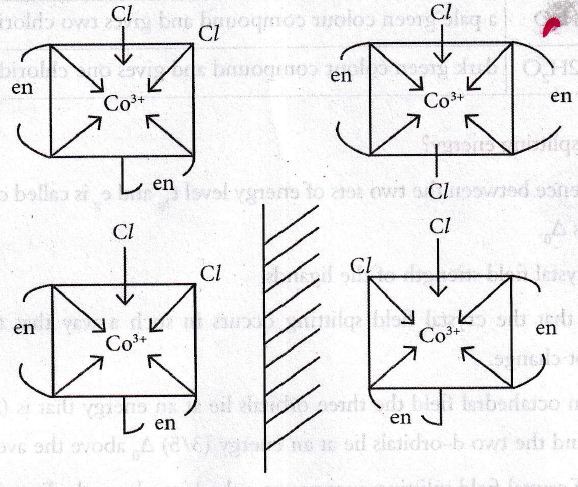
Draw all possible geometrical isomers of the complex [Co(en)2Cl2]+ and identify the optically active isomer.
15.
Based on VB theory explain why [Cr(NH3)6]3+ is paramagnetic, while [Ni(CN)4]2- is diamagnetic.
1.
(i) Coordination entity is an ion or a neutral molecule, composed of a central atom, usually a metal and the array of other atoms or groups of atoms (ligands) that are attached to it. In the formula, the coordination entity is enclosed in square brackets.
(ii) For example, in potassium ferrocyanide, K4[Fe(CN)6], the coordination entity is [Fe(CN)6]4-.
2.
(i) Porphyrin
(ii) Cobalt
(iii) Wilkinson Catalyst [(PPh3)3 RhCl]
3.
(i) CFSE is higher when the complex contains strong field ligand as per spectro chemical series.
(ii) Thus, crystal field splitting energy increases in the order
[CrCI6]3- < [Cr(NH3)6]3+ < [Cr(CN)6]3-, Because the order of field strength is Cl- < NH3 < CN-
4.
(i) [Cr(C2O4)3]3- - It does not possess geometrical isomerism.
(ii) [CO(NH3)3Cl3] - Two geometrical isomers are possible.
5.
Magnetic moment (μ) = \(\sqrt { n(n+2) } \) BM
Fe (z = 26) = 1s2 2s2 2p6 3s2 3p6 4s2 3d6
Fe2+ = 1s2 2s2 2p6 3s2 3p6 3d6 4s0

∴μ = \(\sqrt { n(n+2) } \) = \(\sqrt { 4(4+2) } =\sqrt { 24 } \)
= 4. 89 BM
6.
K3[Fe(C2O4)3]
7.
Tetraammine copper (II) sulphate.
8.
Ligand is an atom or a group of atoms which is either negatively charged or has lone pair of electrons and from co-ordinate bond with the central metal or ion, e.g.H2O.
9.
Hexaqua Nickel Chloride
10.
Six
11.
Monochloro is (ethane-1, 2-diamine) nitrito- K O Cobalt (III) chloride.
12.
\({ }_{22} \mathrm{Ti}-{ }_{18}[\mathrm{Ar}] 4 \mathrm{s}^{2} 3 \mathrm{d}^{2} / {}_{21}\mathrm{Sc}-{ }_{18}[\mathrm{Ar}] 4 \mathrm{~s}^{2} 3 \mathrm{~d} \)
\({ }_{22} \mathrm{Ti}^{3+}-{ }_{18}[\mathrm{Ar}] 3 \mathrm{~d}^{1} /{ }_{18} \mathrm{Sc}^{3+}{ }_{18}[\mathrm{Ar}] 3 \mathrm{~d}^{0}\)
(i) In this complex the central metal ion is Ti3+, which has d1 configuration. This single electron occupies one of the t2g orbitals in the octahedral aqua ligand field. When white light falls on this complex the electron absorbs light and promotes itself to eg level. The spectral data show the absorption maximum is at 20000 cm-1 corresponding to the crystal field splitting energy \(\left(\Delta_{o}\right)\) 239.7 kJmol-1. The transmitted colour associated with this absorption is purple and hence the complex appears purple in colour.
(ii) Thus in \(\left[\mathrm{Ti}\left(\mathrm{H}_{2} \mathrm{O}\right)_{6}\right]^{3+} \mathrm{d}-\mathrm{d}\) transition takes place.
(iii) But in \(\left[\mathrm{Sc}\left(\mathrm{H}_{2} \mathrm{O}\right)_{6}\right]^{3+} \mathrm{Sc}^{3+}\) has the outer electronic configuration of 3d0 where d-d transition is not possible and it is colourless.
13.
(i) \(\mathrm{Mg}\left[\mathrm{Cr}\left(\mathrm{NH}_{3}\right) \mathrm{Cl}_{5}\right]^{2-} \rightleftharpoons \mathrm{Mg}^{2+}+\left[\mathrm{Cr}\left(\mathrm{NH}_{3}\right) \mathrm{Cl}_{5}\right]^{2-} (2 ions)\)
(ii) \(\begin{aligned}
{\left[\mathrm{Cr}\left(\mathrm{NH}_3\right)_5 \mathrm{Cl}_3\left[\mathrm{CoF}_6\right]_2 \rightleftharpoons 3\right.} & {\left[\mathrm{Cr}\left(\mathrm{NH}_3\right)_5 \mathrm{Cl}\right]^{2+} } \\
& (5 \text { ions })
\end{aligned}\)\(+2\left[\mathrm{CoF}_6\right]^{3-}\)
(iii) \(\left[\mathrm{Cr}\left(\mathrm{NH}_{3}\right)_{3} \mathrm{Cl}_{3}\right]= \text{ No ions}\)
If no of ions increases, molar conductivity increases molar conductivity of the complex also INCREASES.
\(\therefore\) The order of the given compound is
[Cr(NH3)3Cl3]<Mg[Cr(NH3)3Cl3] < [Cr(NH3)5Cl3] [CoF6]2
(No ion) (2 ions) (5 ions)
14.
[Co (en)2 Cl2]+ This is an octahedral complex
15.
\(\text {(a) }\left[\mathrm{Cr}\left(\mathrm{NH}_{3}\right)_{6}\right]^{3+}:{ }_{24} \mathrm{Cr} \Rightarrow{ }_{18}[\mathrm{Ar}] 4 \mathrm{~s}^{2} 3 \mathrm{~d}^{4} \)
\({ }_{21} \mathrm{Cr}^{3+} \Rightarrow{ }_{18}[\mathrm{Ar}] 3 \mathrm{~d}^{3}\)
.JPG)
(i) d2sp3 hybridisation (octahedral)
(ii) It has three unpaired electrons (n = 3)
(iii) So it is paramagnetic
(iv) Magnetic moment \(\left(\mu_{\mathrm{s}}\right)=\sqrt{\mathrm{n}(\mathrm{n}+2)} \mathrm{BM}\)
\(=\sqrt{3(3+2)}=\sqrt{15}=3.87 \mathrm{BM}\)
\((b) \ \left[\mathrm{Ni}(\mathrm{CN})_{4}\right]^{2-:}{ }_{28} \mathrm{Ni} \Rightarrow[\mathrm{Ar}] 4 \mathrm{~s}^{2} 3 \mathrm{~d}^{8} ;{ }_{26} \mathrm{Ni}^{2+} \Rightarrow{ }_{18}[\mathrm{Ar}] 3 \mathrm{~d}^{8}\)
.JPG)
(i) dsp2 hybridisation
(ii) Geometry - square planar
(iii) No unpaired electrons- It is Diamagnetic
(iv) Magnetic moment (μs) = 0.

12th Standard Syllabus & Materials
12th Standard
TN 12th Computer Applications களப்பெயர் முறைமை (DNS) Sample Question Papers Study Material - QB365 Set A
NEW12th Standard
TN 12th Computer Applications வலையமைப்பு எடுத்துக்காட்டுகள் மற்றும் நெறிமுறைகள் Sample Question Papers Study Material - QB365 Set A
NEW12th Standard
TN 12th Computer Applications கணினி வலையமைப்பு ஓர் அறிமுகம் Sample Question Papers Study Material - QB365 Set A
NEW12th Standard
TN 12th Computer Applications PHP-உடன் MySQL-ஐ இணைத்தல் Sample Question Papers Study Material - QB365 Set A



Tamilnadu Stateboard 12th Standard Subjects

Maths
Chemistry

Physics

Biology

Computer Science

Business Maths and Statistics

Economics

Commerce

Accountancy

History

Computer Applications
Biology
Computer Technology
Computer Applications
Computer Science
Business Maths and Statistics
Commerce
Economics
Maths
Chemistry
Physics
Computer Technology
History
Accountancy

Tamil

English

French
Tamilnadu Stateboard Standards
