
 100% FREE ACCESS
12th Standard Syllabus & Materials
12th Standard
TN 12th Computer Applications மின்னணு தரவு பரிமாற்றம் Sample Question Papers Study Material - QB365 Set A
NEW12th Standard
TN 12th Computer Applications மின் - வணிக பாதுகாப்பு அமைப்புகள் Sample Question Papers Study Material - QB365 Set A
NEW12th Standard
TN 12th Computer Applications மின்னணு செலுத்தல் முறைகள் Sample Question Papers Study Material - QB365 Set A
NEW12th Standard
TN 12th Computer Applications மின் - வணிகம் Sample Question Papers Study Material - QB365 Set A
NEW12th Standard
TN 12th Computer Applications திறந்த மூல கருத்துருக்கள் Sample Question Papers Study Material - QB365 Set A
NEW12th Standard
TN 12th Computer Applications வலையமைப்பு வடமிடல் Sample Question Papers Study Material - QB365 Set A

Published on: 07/01/2020
Electro Chemistry
Download Tamil Nadu 12th Standard Chemistry question papers, model tests, one-mark questions, important questions, and public exam papers in PDF format. Free study materials and answer keys for TN State Board students.
Questions + Answers key
Take MCQ Chemistry Test
1.
In H2-O2 fuel cell the reaction occur at cathode is _______.
O2(g) + 2H2O(l) + 4e- ⟶ 4OH− (aq)
H+(aq) + OH− (aq) ⟶ H2O (l)
2H2 (g) + O2 (g) ⟶ 2H2O (g)
H+ + e- ⟶ 1/2 H2
2.
Zinc can be coated on iron to produce galvanized iron but the reverse is not possible. It is because _______.
Zinc is lighter than iron
Zinc has lower melting point than iron
Zinc has lower negative electrode potential than iron
Zinc has higher negative electrode potential than iron
3.
A current strength of 3.86 A was passed through molten Calcium oxide for 41 minutes and 40 seconds. The mass of Calcium in grams deposited at the cathode is_______. (atomic mass of Ca is 40g / mol and 1F = 96500C).
4
2
8
6
4.
The molar conductivity of a 0.5 mol dm-3 solution of AgNO3 with electrolytic conductivity of 5.76 ×10⁻³ S cm−1at 298 K is______.
2.88 S cm2mol-1
11.52 S cm2mol-1
0.086 S cm2mol-1
28.8 S cm2mol -1
5.
6.
Account for the following : For a strong electrolyte molar conductivity decreases as concentration increases
7.
Give a mathematical expression that relates I cell constant, specific conductance and specific resistance.
8.
The resistance of a conductivity cell is measured as 190 Ω using 0.1M KCl solution (specific conductance of 0.1M KCl is 1.3 Sm-1). When the same cell is filled with 0.003 M sodium chloride solution, the measured resistance is 6.3KΩ. Both these measurements are made at a particular temperature. Calculate the specific and molar conductance of NaCl solution.
9.
A solution of silver nitrate is electrolysed for 20 minutes with a current of 2 amperes. Calculate the mass of silver deposited at the cathode.
10.
Define anode and cathode
11.
How are electro chemical cells classified? Explain.
12.
From the below graph. Explain the variation of molar conductance of a weak electrolyte with decrease in concentration.
13.
For the cell Mg (s) Mg2+(aq)||Ag+(aq)|Ag(s), calculate the equilibrium constant at 250C and maximum work that can be obtained during operation of cell. Given: \(E^{0}_{Mg^{2+}|Mg}\)=-237V and \(E^{0}_{Ag^{2+}|Ag}\) = 0.80V.
14.
A copper electrode is dipped in 0.1M copper sulphate solution at 25oC. Calculate the electrode potential of copper. [Given: E0Cu2+|Cu = 0.34V].
15.
0.1M NaCl solution is placed in two different cells having cell constant 0.5 and 0.25 cm-1 respectively. Which of the two will have greater value of specific conductance.
16.
Why is AC current used instead of DC in measuring the electrolytic conductance?
17.
State Faraday’s Laws of electrolysis
18.
How will you calculate solubility product of AgCI which is a sparingly soluble salt?
19.
Specific conductance of 1M KNO3 solution is oberved to be 5.55 x 10⁻³ mho cm2. What is the equivalent conductance of KNO3 when one litre of the solution is used?
1.
(a)
O2(g) + 2H2O(l) + 4e- ⟶ 4OH− (aq)
2.
EoZn2+[Zn] = 0.76V and EoFe2+[Fe] = -0.44V
Zinc has higher negative electrode potential than iron, iron cannot be coated on zinc
3.
mg = ZIt
\(= \frac{40 \times 3.86 \times 2500}{2 \times 96500} = 2g\)
(∵ t = 41 min 40 sec = 2500 seconds & \(Z = \frac{m}{n \times 96500} = \frac{40}{x \times 96500})\)
4.
Λ = k/W x 10−3 mol−1 dm3
\(=\frac{ 5.76 \times 10^{−3} S cm^{−1} \times 10^{−3}}{0.5} = mol^{-1} dm^{3}\)
\(=\frac{ 5.76 \times 10^{−3} S cm^{−1} \times 10^{−3}}{0.5}\) S cm-1 mol−1 dm3
= 11.52 S cm2mol-1
5.
(c)
6.
(i) For a strong electrolyte, at high concentration, the number of constituent ions of the electrolyte in a given volume is high and hence the attractive force between the oppositely charged ions is also high.
(ii) Moreover the ions also experience a viscous drag due to greater solvation.
(iii) These factors attribute for the low molar conductivity at high concentration.
7.
k = \(\frac{1}{R}.\frac{1}{a}=\frac{1}{ρ}\)
Where K is specific conductance
R is resistance and \(\frac1a\) is cell constant.
ρ is specific resistance.
8.
Given that
κ = 1.3 Sm-1 (for 0.1M KCl solution)
R = 190 Ω
\(\kappa = \frac{1}{R}(\frac{l}{A})\)
κ . R =\((\frac{l}{A})\) = (1.3 Sm-1) (190Ω)
= 247 m-1
\(\kappa_{(NaCl)} = \frac{1}{R_{(NaCl)}} (\frac{l}{A})\)
\(= \frac{1}{6.3 K\Omega}(247 m^{-1})\) (6.3KΩ = 6.3 x 10³Ω)
= 39.2 x 10⁻³ Sm-1
\(\Lambda_m = \frac{\kappa \times 10^{-3} mol^{-1} m^3}{M}\)
\(=\frac{39.2 \times 10 ^{-3}(Sm^{-1})10^-3 (mol^{-1} m^3)}{0.003}\)
\(\Lambda_m\) = 13.04 \(\times\) 10-3 Sm2 mol-1
9.
Electrochemical reaction at cathode is Ag+ + e- → Ag (reduction)
m = ZIT
Z = \(\frac{\text {molar mass of Ag}}{(96500)}\) = \(\frac{108}{1 \times 96500} \)
I = 2A
t = 20 x 60S = 1200 S
It = 2A x 1200S = 2400C
m = \(\frac{108 gmol^{-1}}{96500 C mol^{-1}} \times\) 2400C
m = 2.68g
10.
(i) Anode: The electrode at which the oxidation occurs is called anode. (loss of electrons)
(ii) Cathode: The electrode at which the reduction occurs is called cathode. (gain of electrons)
11.
Electrochemical cells are mainly classified into the following two types.
(i) Galvanic Cell ( Voltaic cell) : It is a device in which a spontaneous chemical reaction generates an electric current i.e., it converts chemical energy into electrical energy. It is commonly known as a battery.
(ii) Electrolytic cell : It is a device in which an electric current from an external source drives a nonspontaneous reaction i.e., it converts electrical energy into chemical energy.
12.
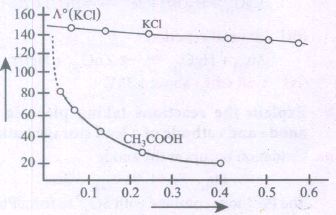
For a weak electrolyte, at high concentration, the plot is almost parallel to concentration axis with slight increase in conductivity as the dilution increases. When the concentration approaches zero, there is a sudden increase in the molar conductance and the curve is almost parallel to \(\Lambda \)m axis. This is due to the fact that the dissociation of the weak electrolyte increases with the increase in dilution (Ostwald dilution law)
13.
a) Oxidation at anode :
\(\mathrm{Mg} \rightarrow \mathrm{Mg}^{2+}+2 \mathrm{e}^{-} ; \mathrm{E}_{\mathrm{Ox}}^{0}=2.37 \mathrm{~V}\) ...(1)
Reduction at cathode:
\(A \mathrm{~g}^{+} +\mathrm{e}^{-} \rightarrow \mathrm{Ag} ; \mathrm{E}_{\text {red }}^{0}=+0.80 \mathrm{~V} \) ...(2)
\(E_{\text {Cell }}^{0} =\left(\mathrm{E}_{\text {ox }}^{0}\right)_{\text {anode }}+\left(\mathrm{E}_{\text {red }}^{0}\right)_{\text {cathode }} \)
= 2.37 + 0.80 = 3.17V
Overall reaction : (1) + 2 x (2)
\(\mathrm{Mg} \rightarrow M g^{2+}+2 e^{-} \)
\(2 \mathrm{Ag}^{+}+2 \mathrm{e}^{-} \rightarrow 2 A g \)
__________________
\(M g+2 A g^{+} \rightarrow M g^{2+}+2 A g\)
b) \( \therefore \Delta G^{0}=-n F E^{0} \)
\(=-2 \times 96500 \times 3.17 \)
\(=-611810=-6.12 \times 10^{5} \mathrm{~J} \)
\(W=6.12 \times 10^{5} \mathrm{~J}\)
c) \(\Delta \mathrm{G}^{0}=-2.303 \mathrm{RT} \log \mathrm{K}_{c} \)
\(\log \mathrm{K}_{\mathrm{c}}=-\frac{\Delta G^{0}}{2.303 R T} \)
\(\log \mathrm{K}_{c}=-\frac{\left(-6.12 \times 10^{5}\right)}{2.303 \times 8.314 \times 298}=107.2 \)
\(K_{c}=A . \log 107.2 \)
\(\mathrm{K}_{c}=\text { Antilog of (107.2) }\)
= 1.58 x 10107
14.
Given: [Cu2+] = 0.1M; E0Cu2+|Cu = +0.34V
Cell reaction is: \(Cu^{2+}_{(aq)}+2e^{-}\rightarrow Cu_{(s)}\)
\(E_{cell}=E^{0}-\frac{0.0591}{n}\log\frac{[Cu]}{[Cu^{2+}]}\)
\(= 0.34\frac{0.0591}{2}\log\frac{1}{0.1}\)
Ecell = 0.34 - 0.0296 = +0.31V
15.
\(\kappa=\mathrm{C}\left(\frac{l}{\mathrm{~A}}\right)\) (or) k = 1/R.l/A
Where, C - Conductance
\(\frac{l}{A} \Rightarrow\) Cell constant (or)
Sp. Conductance \(\propto\) Cell constant
Sp. Conductance \(\propto\) Concentration
1. Sp. Conductance = concentration x cell constant
i) \(\kappa=0.1 \times 0.5=0.05=5 \times 10^{-2} \mathrm{Scm}^{-1}\)
ii) \(\kappa=0.1 \times 0.25=0.025=2.5 \times 10^{-2} \mathrm{Scm}^{-1}\)
2. So the first case will have greater specific conductance with cell constant 0.05.
16.
(a) If we apply DC current through the conductivity cell, it will lead to the electrolysis of the solution taken in the cell.
(b) So, AC current is used for this measurement to prevent electrolysis.
17.
First law:
The mass of the substance (m) liberated at an electrode during electrolysis is directly proportional to the quantity of charge (Q) passed through the cell.
m α Q \(\left[\because \mathrm{I}=\frac{\mathrm{Q}}{\mathrm{t}} \Rightarrow \mathrm{Q}=\mathrm{It}\right]\)
m α It
m = ZIt
Where Z = electro chemical equivalent of the substance
I = current
t = time of passage of current
Second law:
When the same quantity of charge is passed through the solutions of different electrolytes, the amount of substances liberated at the respective electrodes are directly proportional to their electrochemical equivalents.
m α Z
\(\frac{m_{1}}{Z_{1}}=\frac{m_{2}}{Z_{2}}\)
m = mass of the metal deposited
Z = electro chemical equivalent
18.
Substances like AgCl, PbSO4 etc., are sparingly soluble in water. The solubility product of such substances can be determined using conductivity measurements.
Let us consider AgCl as an example
AgCl(s) ⇌ Ag+ + Cl-
Ksp = [Ag+][Cl-]
Let the concentration of [Ag+] be 'C' mol L-1.
As per the stoichiometry, if [Ag+] = C, then [Cl-] also equal to 'C' mol L-1.
Ksp = C.C
⇒ K =C2
We know that the concentration (in mol dm-3) is related to the molar and sepcific conductance by the following expressions
\({ \Lambda }_{ 0 }=\frac { k\times { 10 }^{ -3 } }{ C(in \ mol \ { L }^{ -1 }) } \)
(or)
\(C=\frac { k\times { 10 }^{ -3 } }{ \Lambda } \)
Substitute the concentration value in the relation Ksp =C2
\({ K }_{ sp }={ \left( \frac { k\times { 10 }^{ -3 } }{ \Lambda } \right) }^{ 2 }\)
19.
Given:
Specific conductance = K = 5.55 x 10⁻³ mho cm-1
Concentration C = 1M
Volume = 1 litre.
Formula: Equivalent conductance = K x V
= \(\frac { k\times 1000 }{ C } \)
Solution:
\(\frac { { 5.55\times 10 }^{ -3 }\times 1000 }{ 1 } =5.55\times { 10 }^{ -3 }\times { 10 }^{ -3 }\)

12th Standard Syllabus & Materials
12th Standard
TN 12th Computer Applications களப்பெயர் முறைமை (DNS) Sample Question Papers Study Material - QB365 Set A
NEW12th Standard
TN 12th Computer Applications வலையமைப்பு எடுத்துக்காட்டுகள் மற்றும் நெறிமுறைகள் Sample Question Papers Study Material - QB365 Set A
NEW12th Standard
TN 12th Computer Applications கணினி வலையமைப்பு ஓர் அறிமுகம் Sample Question Papers Study Material - QB365 Set A
NEW12th Standard
TN 12th Computer Applications PHP-உடன் MySQL-ஐ இணைத்தல் Sample Question Papers Study Material - QB365 Set A



Tamilnadu Stateboard 12th Standard Subjects

Maths
Chemistry

Physics

Biology

Computer Science

Business Maths and Statistics

Economics

Commerce

Accountancy

History

Computer Applications
Biology
Computer Technology
Computer Applications
Computer Science
Business Maths and Statistics
Commerce
Economics
Maths
Chemistry
Physics
Computer Technology
History
Accountancy

Tamil

English

French
Tamilnadu Stateboard Standards
