
 100% FREE ACCESS
12th Standard Syllabus & Materials
12th Standard
TN 12th Computer Applications மின்னணு தரவு பரிமாற்றம் Sample Question Papers Study Material - QB365 Set A
NEW12th Standard
TN 12th Computer Applications மின் - வணிக பாதுகாப்பு அமைப்புகள் Sample Question Papers Study Material - QB365 Set A
NEW12th Standard
TN 12th Computer Applications மின்னணு செலுத்தல் முறைகள் Sample Question Papers Study Material - QB365 Set A
NEW12th Standard
TN 12th Computer Applications மின் - வணிகம் Sample Question Papers Study Material - QB365 Set A
NEW12th Standard
TN 12th Computer Applications திறந்த மூல கருத்துருக்கள் Sample Question Papers Study Material - QB365 Set A
NEW12th Standard
TN 12th Computer Applications வலையமைப்பு வடமிடல் Sample Question Papers Study Material - QB365 Set A

Published on: 30/10/2019
Electro Chemistry
Download Tamil Nadu 12th Standard Chemistry question papers, model tests, one-mark questions, important questions, and public exam papers in PDF format. Free study materials and answer keys for TN State Board students.
Questions + Answers key
Take MCQ Chemistry Test
1.
In the electrochemical cell: Zn|ZnSO4 (0.01M)|| CuSO4 (1.0M)|Cu, the emf of this Daniel cell is E1. When the concentration of ZnSO4 is changed to 1.0M and that CuSO4 changed to 0.01M, the emf changes to E2. From the above, which one is the relationship between E1 and E2?
E1 < E2
E1 > E2
E2 ≥ E1
E1 = E2
2.
While charging lead storage battery _______.
PbSO4 on cathode is reduced to Pb
PbSO4 on anode is oxidised to PbO2
PbSO4 on anode is reduced to Pb
PbSO4 on cathode is oxidised to Pb
3.
During electrolysis of molten sodium chloride, the time required to produce 0.1mole of chlorine gas using a current of 3A is _____.
55 minutes
107.2 minutes
220 minutes
330 minutes
4.
The molar conductivity of a 0.5 mol dm-3 solution of AgNO3 with electrolytic conductivity of 5.76 ×10⁻³ S cm−1at 298 K is______.
2.88 S cm2mol-1
11.52 S cm2mol-1
0.086 S cm2mol-1
28.8 S cm2mol -1
5.
6.
Ionic conductance at infinite dilution of Al3+ and SO4 2- are 189 and 160 mho cm2 equiv-1. Calculate the equivalent and molar conductance of the electrolyte Al2(SO4)3 at infinite dilution.
7.
A current of 1.608A is passed through 250 mL of 0.5M solution of copper sulphate for 50 minutes. Calculate the strength of Cu2+ after electrolysis assuming volume to be constant and the current efficiency is 100%.
8.
0.1M NaCl solution is placed in two different cells having cell constant 0.5 and 0.25 cm-1 respectively. Which of the two will have greater value of specific conductance.
9.
Which of 0.1M HCl and 0.1 M KCl do you expect to have greater \(\stackrel{0}{\Lambda}_{\mathrm{m}}\)and why?
10.
State Faraday’s Laws of electrolysis
11.
12.
Describe the construction of Daniel cell. Write the cell reaction.
13.
Write a note on sacrificial protection.
14.
Two metals M1 and M2 have reduction potential values of -xV and +yV respectively. Which will liberate H2 and H2SO4.
1.
Ecell = Eocell - \(\frac{0.0591}{2} \log [\frac{Zn^{2+}}{Cu^{2+}}]\)
El = Eocell - \(\frac{0.0591}{2} \log [\frac{10^{-2}}{1}]\)
El = Eocell + 0.0591 ...(1)
E2 = Eocell - \(\frac{0.0591}{2} \log [\frac{1}{10^{-2}}]\)
E2 = Eocell - 0.0591 ...(2)
E1 > E2
Zn(s)| ⟶ Zn2+(aq) + 2e-
Cu2+(aq) + 2e- ⟶ Cu(s)
Zn(s) + Cu2+(aq) ⟶ Zn2+(aq) + Cu(s)
2.
Charging anode:
PbSO4(s) + 2e- ➝ Pb(s) + SO42-(aq)
Cathode:
PbSO4(s) + 2H2O(I) ➝ PbO2(s) + SO42-(aq) + 2e-
3.
mass of 1 mole of CI2 gas = 71
∴ mass of 0.1 mole of Cl2 gas = 7.1 g mol-1
m = Zlt
t = m/ZI
\(= \frac{7.1}{\frac{71}{2 \times 96500} \times 3}\) (2Cl- ➝ Cl2 + 2e-)
\(= \frac{2 \times 96500 \times 7.1}{71 \times 3}\)
= 6433.33s = 107.2 min
4.
Λ = k/W x 10−3 mol−1 dm3
\(=\frac{ 5.76 \times 10^{−3} S cm^{−1} \times 10^{−3}}{0.5} = mol^{-1} dm^{3}\)
\(=\frac{ 5.76 \times 10^{−3} S cm^{−1} \times 10^{−3}}{0.5}\) S cm-1 mol−1 dm3
= 11.52 S cm2mol-1
5.
(c)
6.
a) Equivalent conductance
\(\lambda_{\infty} \mathrm{Al}_{2}\left(\mathrm{SO}_{4}\right)_{3} =\frac{1}{3} \lambda_{\infty} \mathrm{Al}^{3+}+\frac{1}{2} \lambda_{\infty} \mathrm{SO}_{4}^{2-} \)
\(=\left(\frac{1}{3} \times 189\right)+\frac{1}{2}(160) \)
\(=63+80=143 \mathrm{~S} \mathrm{~cm}^{2} \mathrm{~g} \mathrm{eq}^{-1} \)
b) Molar conduçtance
\(\mu_{\infty} \mathrm{Al}_{2}\left(\mathrm{SO}_{4}\right)_{3} =2 \mu_{\infty} \mathrm{Al}^{3+}+3 \mu_{\infty} \mathrm{SO}_{4}^{2-} \)
=2(189) + 3(160)
=378 + 480
= \(858 \mathrm{~S} \mathrm{~cm}{ }^{2} \mathrm{~mol}^{-1}\)
7.
Given : I = 1.608A;
t = 50 min = 50 \(\times\) 60 = 3000sec ; S = 250 mL;
C = 0.5 M ; \(\eta=100%\)%
i) Q = It (I = Q / t)
= 1.608 x 3000 = 4824 Columb
No. of Faradays of electricity \(=\frac{4824}{96500}=0.04 \mathrm{~F}\)
ii) Electrolysis of CuSO4
\(\mathrm{Cu}_{(\mathrm{aq})}^{2+}+2 \mathrm{e}^{-} \rightarrow \mathrm{Cu}_{(\mathrm{s})}\)
\(\therefore\) 2 F electricity will deposit 1 mole of Cu2+ to Cu
\(\therefore\) 0.05 F electricity will deposit
\(x=\frac{1 \times 0.05}{2}=0.025\) mole
Initial No. of moles of Cu2+ in 250 ml of solution \(=\frac{0.5}{1000} \times 250 \) mole = 0.125 moles
\(\therefore\) No. of moles of Cu2+ after elettrolysis = 0.125 - 0.025 = 0.1 mole
\(\therefore\) concentration of Cu2+
\(=\frac{0.1}{250} \times 1000=0.4 \mathrm{M}\)
8.
\(\kappa=\mathrm{C}\left(\frac{l}{\mathrm{~A}}\right)\) (or) k = 1/R.l/A
Where, C - Conductance
\(\frac{l}{A} \Rightarrow\) Cell constant (or)
Sp. Conductance \(\propto\) Cell constant
Sp. Conductance \(\propto\) Concentration
1. Sp. Conductance = concentration x cell constant
i) \(\kappa=0.1 \times 0.5=0.05=5 \times 10^{-2} \mathrm{Scm}^{-1}\)
ii) \(\kappa=0.1 \times 0.25=0.025=2.5 \times 10^{-2} \mathrm{Scm}^{-1}\)
2. So the first case will have greater specific conductance with cell constant 0.05.
9.
(i) The Conductance of HCl will be more, because H+ ion has the maximum mobility of all the ions due to its smallest size and mass.
(ii) At \(25^{0} \mathrm{C}: \mathrm{H}^{+}=36.23 \mathrm{~m}^{2} \mathrm{~S}^{-1} \mathrm{~V}^{-1}\)
(iii) The conductance depends upon
1) Nature of electrolyte
2) Concentration
3) Mobility of ion
4) Temperature
10.
First law:
The mass of the substance (m) liberated at an electrode during electrolysis is directly proportional to the quantity of charge (Q) passed through the cell.
m α Q \(\left[\because \mathrm{I}=\frac{\mathrm{Q}}{\mathrm{t}} \Rightarrow \mathrm{Q}=\mathrm{It}\right]\)
m α It
m = ZIt
Where Z = electro chemical equivalent of the substance
I = current
t = time of passage of current
Second law:
When the same quantity of charge is passed through the solutions of different electrolytes, the amount of substances liberated at the respective electrodes are directly proportional to their electrochemical equivalents.
m α Z
\(\frac{m_{1}}{Z_{1}}=\frac{m_{2}}{Z_{2}}\)
m = mass of the metal deposited
Z = electro chemical equivalent
11.
12.
1. Daniel cell is a galvanic cell. This is a voltaic cell also.
(a) The separation of half reaction is the basis for the construction of Daniel cell. It consists of two half cells.
(i) Oxidation half cell: A metallic zinc strip that dips into an aqueous solution of zinc sulphate taken in a beaker, as shown in Figure
(ii) Reduction half cell: A copper strip that dips into an aqueous solution of copper sulphate taken in a beaker, as shown in Figure
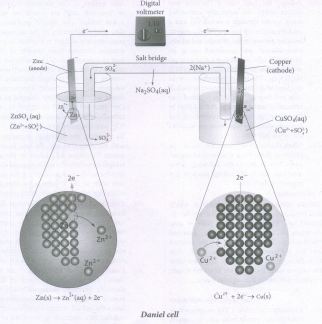
(iii) Joining the half cells:
(a) The zinc and copper strips are externally connected using a wire through a switch (k) and a load (example: volt meter). The electrolytic solution present in the cathodic and anodic compartment are connected using an inverted U tube containing a agar-agar gel mixed with an inert electrolyte such as KCI, Na2SO4 etc.,
(b) The ions of inert electrolyte do not react with other ions present in the half I cells and they are not either oxidised (or) reduced at the electrodes. The solution in the salt bridge cannot get poured out, but through which the ions can move into (or) out of the half cells.
(c) When the switch (k) closes the circuit, the electrons flows from zinc strip to copper strip. This is due to the following redox reactions which are taking place at the respective electrodes.
(iv) Anodic oxidation:
(i) zinc strip acts as the anode.
(ii) Here,oxidation occurs.
The electrode at which the oxidation occur is called the anode. In Daniel cell, the oxidation take place at zinc electrode, i.e., zinc is oxidised to Zn2+ ions and the electrons.
The Zn2+ ions enters the solution and the electrons enter the zinc metal, then flow through the external wire and then enter the copper strip.
Electrons are liberated at zinc electrode and hence it is negative (-ve).
\(Zn_{ (s) }\longrightarrow { { Zn }^{ 2+ }_{ (aq) }+{ 2e }^{ - } } \) (loss of electron-oxidation)
(v) Cathodic reduction:
As discussed earlier. the electrons flow through the circuit from zinc to copper, where the Cu2+ ions in the solution accept the electrons, get reduced to copper and the same get deposited on the electrode Here, the electrons are consumed and hence it is positive (+ve).
\({ Cu }_{ (aq) }^{ 2+ }+{ 2e }^{ - }\longrightarrow { { Cu }_{ (s) } } \)(gain of electron - reduction)
b) When a Zinc metal strip is placed in a copper sulphate solution, the blue colour of the solution fades and the copper is deposited on the zinc strip as red - brown crust due to the following spontaneous chemical reaction.
\(\mathrm{Zn}_{(\mathrm{s})}+\mathrm{CuSO}_{4(\mathrm{aq})} \rightarrow \mathrm{ZnSO}_{4(\mathrm{aq})}+\mathrm{Cu}_{(\mathrm{s})}\)
The energy produced in the above reaction is lost to the surroundings as heat.
In the above redox reaction, Zinc is oxidised to Zn2+ ions and the Cu2+ ions are reduced to metallic copper. The half reactions are represented as below.
\(\mathrm{Zn}_{(\mathrm{s})} \rightarrow \mathrm{Zn}^{2+}{ }_{(\mathrm{aq})}+2 \mathrm{e}^{-} \text {(oxidation) } \)
\(\mathrm{Cu}^{2+}{ }_{(\mathrm{aq})}+2 \mathrm{e}^{-} \rightarrow \mathrm{Cu}_{(\mathrm{s})} \text { (reduction) }\)
If we perform the above two half reactions separately in an apparatus as shown in figure, some of the energy produced in the reaction will be converted into electrical energy.
13.
Cathodic protection:
In this technique, unlike galvanising the entire surface of the metal to be protected need not be covered with a protecting metal. Instead, metals such as Mg or zinc which is corroded more easily than iron can be used as a sacrificial anode and the iron material acts as a cathode. So iron is protected, but Mg or Zn is corroded. This known as sacrificial protection. (or) Cathodic protection.
14.
Metals having higher oxidation potential will liberate H2 from H2SO4. Hence, the metal M1 having +xV, oxidation potential will liberate H2 from H2SO4.

12th Standard Syllabus & Materials
12th Standard
TN 12th Computer Applications களப்பெயர் முறைமை (DNS) Sample Question Papers Study Material - QB365 Set A
NEW12th Standard
TN 12th Computer Applications வலையமைப்பு எடுத்துக்காட்டுகள் மற்றும் நெறிமுறைகள் Sample Question Papers Study Material - QB365 Set A
NEW12th Standard
TN 12th Computer Applications கணினி வலையமைப்பு ஓர் அறிமுகம் Sample Question Papers Study Material - QB365 Set A
NEW12th Standard
TN 12th Computer Applications PHP-உடன் MySQL-ஐ இணைத்தல் Sample Question Papers Study Material - QB365 Set A



Tamilnadu Stateboard 12th Standard Subjects

Maths
Chemistry

Physics

Biology

Computer Science

Business Maths and Statistics

Economics

Commerce

Accountancy

History

Computer Applications
Biology
Computer Technology
Computer Applications
Computer Science
Business Maths and Statistics
Commerce
Economics
Maths
Chemistry
Physics
Computer Technology
History
Accountancy

Tamil

English

French
Tamilnadu Stateboard Standards
