
 100% FREE ACCESS
12th Standard Syllabus & Materials
12th Standard
TN 12th Computer Applications மின்னணு தரவு பரிமாற்றம் Sample Question Papers Study Material - QB365 Set A
NEW12th Standard
TN 12th Computer Applications மின் - வணிக பாதுகாப்பு அமைப்புகள் Sample Question Papers Study Material - QB365 Set A
NEW12th Standard
TN 12th Computer Applications மின்னணு செலுத்தல் முறைகள் Sample Question Papers Study Material - QB365 Set A
NEW12th Standard
TN 12th Computer Applications மின் - வணிகம் Sample Question Papers Study Material - QB365 Set A
NEW12th Standard
TN 12th Computer Applications திறந்த மூல கருத்துருக்கள் Sample Question Papers Study Material - QB365 Set A
NEW12th Standard
TN 12th Computer Applications வலையமைப்பு வடமிடல் Sample Question Papers Study Material - QB365 Set A

Published on: 03/01/2020
Electro Chemistry
Download Tamil Nadu 12th Standard Chemistry question papers, model tests, one-mark questions, important questions, and public exam papers in PDF format. Free study materials and answer keys for TN State Board students.
Questions + Answers key
Take MCQ Chemistry Test
1.
The feasibility of a redox reaction can be predicted with the help of ________.
reduction potential
oxidation potential
electrochemical series
standard emf
2.
The emf of the cell is measured in _______.
ohm
amperes
volts
coulomb
3.
In Daniel cell, the charges developed by Zn/Zn2+ and Cu / Cu2+ are _______.
positive, positive
negative, negative
positive, negative
negative, positive
4.
Calculate the standard emf of the cell, provided the standard reduction potentials of cathode and anode are -0.763 V and 0.80V.
- 1.563V
0.037V
- 0.610V
None of these
5.
The important use of Kohlrausch's law is deducing the ______.
λ∞ value of weak electrolyte.
λ∞ value of strong electrolyte.
λ∞ value of weak electrolyte.
λ∞ value of weak electrolyte
6.
When one coulomb of electricity is passed through an electrolytic solution the mass deposited on the electrode is equal to ______.
equivalent weight
molecular weight
electrochemical equivalent
one gram
7.
Recharging of lead storage battery involves ______.
anode is reduced to pb
cathode is reduced to pb
cathode is oxidised to pb
anode is oxidised to pbO2
8.
Which among the following is the strongest reducing agent?
F2
Cl2
Zn
Li
9.
Cell equation: A + 2B- \(\rightarrow\)A2++ 2B; A2+ + 2e- \(\rightarrow\)A Eo = +0.34V and log10 K = 15.6 at 300K for cell reactions find Eo for B+ + e− \(\rightarrow\) B
0.80
1.26
-0.54
-10.94
10.
A conductivity cell has been calibrated with a 0.01M, 1:1 electrolytic solution (specific conductance (k = 1.25 x 10⁻³cm-1) in the cell and the measured resistance was 800 Ω at 25oC. The cell constant is ______.
10−1 cm−1
101 cm−1
1 cm−1
5.7 x 10⁻¹²
11.
While charging lead storage battery _______.
PbSO4 on cathode is reduced to Pb
PbSO4 on anode is oxidised to PbO2
PbSO4 on anode is reduced to Pb
PbSO4 on cathode is oxidised to Pb
12.
Faraday constant is defined as_______.
charge carried by 1 electron
charge carried by one mole of electrons
charge required to deposit one mole of substance
charge carried by 6.22 ×10¹⁰ electrons
13.
The standard reduction potentials of Fe3+ / Fe and Fe2+ / Fe electrode system are -0.035 V and -0.44 V respectively. Predict which of the two oxidations is easy. Fe3+ / Fe and Fe2+ / Fe
14.
Give the expression that relates molar conductivity and degree of dissociation.
15.
Define conductance. Give its unit
16.
The resistance of a conductivity cell is measured as 190 Ω using 0.1M KCl solution (specific conductance of 0.1M KCl is 1.3 Sm-1). When the same cell is filled with 0.003 M sodium chloride solution, the measured resistance is 6.3KΩ. Both these measurements are made at a particular temperature. Calculate the specific and molar conductance of NaCl solution.
17.
Why does conductivity of a solution decrease on dilution of the solution.
18.
Draw a neat diagram of Leclanche cell and mark the parts.
19.
What is the oxidation and reduction half cell in a Daniel cell?
20.
Ionic conductance at infinite dilution of Al3+ and SO4 2- are 189 and 160 mho cm2 equiv-1. Calculate the equivalent and molar conductance of the electrolyte Al2(SO4)3 at infinite dilution.
21.
Arrange the following solutions in the decreasing order of specific conductance.
i) 0.01M KCl
ii) 0.005M KCl
iii) 0.1M KCl
iv) 0.25M KCl
v) 0.5M KCl
22.
Write an account on cell terminology.
23.
Specific conductance of 1M KNO3 solution is oberved to be 5.55 x 10⁻³ mho cm2. What is the equivalent conductance of KNO3 when one litre of the solution is used?
24.
Assertion: The relationship between ΔG and emf of cell is ΔG = -nFE
Reason: In the Nest equation, 'n' denotes number of protons.
Codes:
a) (A) and (R) are true and (R) is the correct explanation of (A)
b) Both (A) and (R) are true but (R) does not explain (A)
c) (A) is true but (R) is false
d) Both (A) and (R) are false
25.
Assertion: Increase in temperature, decreases conductance
Reason: This is due to the increase in the attractive forces between the oppositely charged ions.
Codes:
a) (A) and (R) are true and (R) is the correct explanation of (A)
b) Both (A) and (R) are true but (R) does not explain (A)
c) (A) is true but (R) is false
d) Both (A) and (R) are false
1.
(c)
electrochemical series
2.
(c)
volts
3.
(d)
negative, positive
4.
(a)
- 1.563V
5.
(a)
λ∞ value of weak electrolyte.
6.
(c)
electrochemical equivalent
7.
(a)
anode is reduced to pb
8.
(d)
Li
9.
(a)
0.80
10.
R = ρ.l/A
Cell constant = R/ρ
\(= k.R (l/ \rho = K)\)
= 1.25 x 10⁻³ Ω-1 cm-1 x 800Ω
= 1 cm-1
11.
Charging anode:
PbSO4(s) + 2e- ➝ Pb(s) + SO42-(aq)
Cathode:
PbSO4(s) + 2H2O(I) ➝ PbO2(s) + SO42-(aq) + 2e-
12.
IF = 96500 C = charge of one mole of e- charge of 6.022 x 10⁻²³ electron
13.
(i) The ion which has lower reduction I potential will be oxidised first at the anode.
(ii) Among (0.035V) and (0.44V), Fe2+ / Fe oxidation is easy because it has the lower reduction potential (-0.44V).
14.
\(\alpha =\frac { { \Lambda }_{ m } }{ { \Lambda }_{ m }^{ o } } \)
15.
The reciprocal of the resistance \((\frac{l}{R})\) gives the conductance of an electrolytic solution. The SI unit of conductance is Siemen (S).
16.
Given that
κ = 1.3 Sm-1 (for 0.1M KCl solution)
R = 190 Ω
\(\kappa = \frac{1}{R}(\frac{l}{A})\)
κ . R =\((\frac{l}{A})\) = (1.3 Sm-1) (190Ω)
= 247 m-1
\(\kappa_{(NaCl)} = \frac{1}{R_{(NaCl)}} (\frac{l}{A})\)
\(= \frac{1}{6.3 K\Omega}(247 m^{-1})\) (6.3KΩ = 6.3 x 10³Ω)
= 39.2 x 10⁻³ Sm-1
\(\Lambda_m = \frac{\kappa \times 10^{-3} mol^{-1} m^3}{M}\)
\(=\frac{39.2 \times 10 ^{-3}(Sm^{-1})10^-3 (mol^{-1} m^3)}{0.003}\)
\(\Lambda_m\) = 13.04 \(\times\) 10-3 Sm2 mol-1
17.
On dilution the concentration decreases. Conductivity decreases with decrease in concentration (or dilution) as the number of ions per unit volume that carry the current in a solution decrease on dilution.
18.
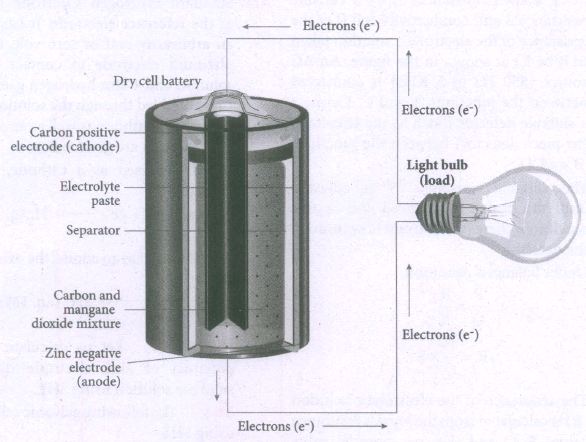
19.
Oxidation half cell : A metallic zinc strip that dips into an aqueous solution of zinc sulphate taken in a beaker.
Reduction half cell : A copper strip that dips into an aqueous solution of copper sulphate taken in a beaker.
20.
a) Equivalent conductance
\(\lambda_{\infty} \mathrm{Al}_{2}\left(\mathrm{SO}_{4}\right)_{3} =\frac{1}{3} \lambda_{\infty} \mathrm{Al}^{3+}+\frac{1}{2} \lambda_{\infty} \mathrm{SO}_{4}^{2-} \)
\(=\left(\frac{1}{3} \times 189\right)+\frac{1}{2}(160) \)
\(=63+80=143 \mathrm{~S} \mathrm{~cm}^{2} \mathrm{~g} \mathrm{eq}^{-1} \)
b) Molar conduçtance
\(\mu_{\infty} \mathrm{Al}_{2}\left(\mathrm{SO}_{4}\right)_{3} =2 \mu_{\infty} \mathrm{Al}^{3+}+3 \mu_{\infty} \mathrm{SO}_{4}^{2-} \)
=2(189) + 3(160)
=378 + 480
= \(858 \mathrm{~S} \mathrm{~cm}{ }^{2} \mathrm{~mol}^{-1}\)
21.
1. \(\kappa=\mathrm{C}\left(\frac{1}{\mathrm{~A}}\right)\)
2. \(\operatorname{let} \frac{l}{A}=x\)
i) \(0.01 \mathrm{M} \mathrm{KCl}: \kappa=0.01 x=10^{-2} x\)
ii) \(0.005 \mathrm{M} \mathrm{KCl}: \kappa=0.005 x=5 \times 10^{-3} x\)
iii) \(0.1 \mathrm{M} \mathrm{KCl} \quad: \kappa=0.1 x=10^{-1} x\)
iv) \(0.25 \mathrm{M} \mathrm{KCl}: \kappa=0.25 x=2.5 \times 10^{-1} x\)
v) \(0.5 \mathrm{M} \mathrm{KCl}: \mathrm{K}=0.5 x=5 \times 10^{-1} x\)
\(\therefore 5 \times 10^{-1} x>2.5 \times 10^{-1} x>10^{-1} x>10^{-2} x>5 \times 10^{-3} x\)
\((ie) 0.5 \mathrm{M} \mathrm{KCl}>0.25 \mathrm{M} \mathrm{KCl}>0.1 \mathrm{M} \mathrm{KCl}>0.01 \mathrm{M} \mathrm{KCl}>0.005 \mathrm{M} \mathrm{KCl}\)
22.
(i) Current: The flow of electrons through a wire or any conductor.
(ii) Electrode: A metallic rod / barf strip which conducts electrons into and out of a solution.
(iii) Anode: The electrode at which oxidation occurs. It sends electrons into the outer circuit. It has negative charge and is shown as (-) in cell diagrams.
(iv) Cathode: The electrode at which lect ons are received from the outer circuit. It has a positive charge and is known as (+) in the cell diagrams.
(v) Electrolyte is the salt solunon in a cell
(vi) Anode compartment: The compartment of cell in which oxidation half-reaction occurs. It contains the anode.
(vii) Cathode compartment: The compartment of the cell in which reduction half-reaction occurs. It contains the cathode.
(vii) Half-cell: Each half of an electrochemical cell, where oxidaton occurs, is called the half cell.
23.
Given:
Specific conductance = K = 5.55 x 10⁻³ mho cm-1
Concentration C = 1M
Volume = 1 litre.
Formula: Equivalent conductance = K x V
= \(\frac { k\times 1000 }{ C } \)
Solution:
\(\frac { { 5.55\times 10 }^{ -3 }\times 1000 }{ 1 } =5.55\times { 10 }^{ -3 }\times { 10 }^{ -3 }\)
24.
c) (A) is true but (R) is false
25.
d) Both (A) and (R) are false

12th Standard Syllabus & Materials
12th Standard
TN 12th Computer Applications களப்பெயர் முறைமை (DNS) Sample Question Papers Study Material - QB365 Set A
NEW12th Standard
TN 12th Computer Applications வலையமைப்பு எடுத்துக்காட்டுகள் மற்றும் நெறிமுறைகள் Sample Question Papers Study Material - QB365 Set A
NEW12th Standard
TN 12th Computer Applications கணினி வலையமைப்பு ஓர் அறிமுகம் Sample Question Papers Study Material - QB365 Set A
NEW12th Standard
TN 12th Computer Applications PHP-உடன் MySQL-ஐ இணைத்தல் Sample Question Papers Study Material - QB365 Set A



Tamilnadu Stateboard 12th Standard Subjects

Maths
Chemistry

Physics

Biology

Computer Science

Business Maths and Statistics

Economics

Commerce

Accountancy

History

Computer Applications
Biology
Computer Technology
Computer Applications
Computer Science
Business Maths and Statistics
Commerce
Economics
Maths
Chemistry
Physics
Computer Technology
History
Accountancy

Tamil

English

French
Tamilnadu Stateboard Standards
