
 100% FREE ACCESS
12th Standard Syllabus & Materials
12th Standard
TN 12th Computer Applications மின்னணு தரவு பரிமாற்றம் Sample Question Papers Study Material - QB365 Set A
NEW12th Standard
TN 12th Computer Applications மின் - வணிக பாதுகாப்பு அமைப்புகள் Sample Question Papers Study Material - QB365 Set A
NEW12th Standard
TN 12th Computer Applications மின்னணு செலுத்தல் முறைகள் Sample Question Papers Study Material - QB365 Set A
NEW12th Standard
TN 12th Computer Applications மின் - வணிகம் Sample Question Papers Study Material - QB365 Set A
NEW12th Standard
TN 12th Computer Applications திறந்த மூல கருத்துருக்கள் Sample Question Papers Study Material - QB365 Set A
NEW12th Standard
TN 12th Computer Applications வலையமைப்பு வடமிடல் Sample Question Papers Study Material - QB365 Set A

Published on: 20/01/2020
Download Tamil Nadu 12th Standard Chemistry question papers, model tests, one-mark questions, important questions, and public exam papers in PDF format. Free study materials and answer keys for TN State Board students.
Questions + Answers key
Take MCQ Chemistry Test
1.
An organic compound (A) of molecular formula C7H6O is called as oil of bitter almonds. (A) on oxidation gives (B) of molecular formula C7H6O2 which gives brisk effervescence with NaHCO3 solution. When (A) is refluxed with aqueous alcoholic (KCN) compound (C) is formed. Identify A, B and C and write the equations.
2.
Compound A with molecular formula C7H6O reduces Tollen's reagent and also gives Cannizaro reaction. A on oxidation gives the compound B with molecular formula C7H6O2 Calcium salt of B on dry distillation gives the compound C with molecular formula CI3H10O. Find A, B and C. Explain the reaction.
3.
Elucidate the structure of glucose.
4.
Explain the prepareation of Bakelite and Give its use.
5.
How do primary, secondary and tertiary amines react with nitrous acid?
6.
How would you distinguish between (i) methyl alcohol and ethyl alcohol (ii) benzyl alcohol and phenol, (iii) ethyl alcohol and benzyl alcohol?
7.
What is the difference between homogenous and hetrogenous catalysis?
8.
A dibromo derivative (A) on treatment with KCN followed by acid hydrolysis and heating gives a monobasic acid (B) along with liberation of CO2 . (B) on heating with liquid ammonia followed by treating with Br2 /KOH gives (c) which on treating with NaNO2 and HCl at low temperature followed by oxidation gives a monobasic acid (D) having molecular mass 74. Identify A to D.
9.
A solution of [Ni(H2O)6]2+ is green, whereas a solution of [Ni(CN)4]2- is colorless -Explain
10.
Explain the principle of electrolytic refining with an example.
11.
Complete the following reactions
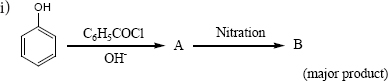
ii) \(C_6H_5-CH_{2}CH(OH)CH(CH_3)_2 \overset{ConH_2SO_4}\longrightarrow\)
12.
Comment on the statement: Colloid is not a substance but it is a state of substance.
13.
14.
Suggest a reason why HF is a weak acid, whereas binary acids of the all other halogens are strong acids.
15.
Write a note on zeolites.
16.
Calculate i) degree of hydrolysis, ii) the constant hydrolysis and iii) pH of 0.1M CH3COONa solution (pKa for CH3COOH is 4.74).
17.
A copper electrode is dipped in 0.1M copper sulphate solution at 25oC. Calculate the electrode potential of copper. [Given: E0Cu2+|Cu = 0.34V].
18.
19.
The rate constant of a reaction at 400 and 200K are 0.04 and 0.02 s-1 respectively. Calculate the value of activation energy.
20.
How will you convert boric acid to boron nitride?
1.
(i) From the molecular formula, (A) is identified as benzaldehyde and it is called as oil of bitter almonds.
(ii) Benzaldehyde is oxidised to benzoic acid by alkaline permanganate which gives brisk effervescence with NaHCO3.
\(\underset { (A) }{ { C }_{ 6 }{ H }_{ 5 }CHO } \overset { (O) }{ \longrightarrow } \underset { (B) }{ { C }_{ 6 }{ H }_{ 5 } } -COOH\)
(iii) When benzaldehyde is refluxed with aqueous alcoholic KCN, benzoin (C) is formed.
\({ C }_{ 6 }{ H }_{ 5 }CH=O+H-\overset { \underset { || }{ O } }{ C } -{ C }_{ 6 }{ H }_{ 5 }\overset { alc }{\underset{KCN} \longrightarrow } { C }_{ 6 }{ H }_{ 5 }-\underset { \overset { | }{ OH\\ (C) } }{ CH } -\overset { \underset { || }{ O } }{ C } -{ C }_{ 6 }{ H }_{ 5 }\)
| Compound | Compound Name | Formula |
| A | Benzaldehyde | C6H5CHO |
| B | Benzoic acid | C6HsCOOH |
| C | Benzoin | \({ C }_{ 6 }{ H }_{ 5 }CHOH-\overset { \underset { || }{ O } }{ C } -{ C }_{ 6 }{ H }_{ 5 }\) |
2.
(i) An organic compound (A) is identified as C6H5CHO benzaldehyde. Benzaldehyde reduces Tollen'sreagent and also undergoes.
Cannizaro reaction:
\(\\ \underset { (A) }{ { C }_{ 6 }{ H }_{ 5 }CHO } +{ Ag }_{ 2 }O\longrightarrow 2Ag+{ C }_{ 6 }{ H }_{ 5 }COOH\)
Cannizaro reaction:
\({ C }_{ 6 }{ H }_{ 5 }CHO+{ C }_{ 6 }{ H }_{ 5 }CHO\overset { NaOH }{ \longrightarrow } { C }_{ 6 }{ H }_{ 5 }{ OH }OH+\underset { (B) }{ { C }_{ 6 }{ H }_{ 5 }COOH } \)
(ii) Benzaldehyde on oxidation gives Benzoic acid C6H5COOH and it is (B).
\({ C }_{ 6 }{ H }_{ 5 }CHO\overset { (O) }{ \longrightarrow } \underset { (B) }{ { C }_{ 6 }{ H }_{ 5 }COOH } \)
(iii) Calcium salt of benzoic acid (calcium benzoate) on dry distillation gives benzophenone C6HsCOC6Hs as (C).
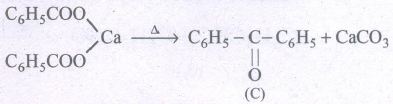
| Compound | Compound Name | Formula |
|---|---|---|
| A | Benzaldehyde | C6H3CHO |
| B | Benzoic acid | C6HsCOOH |
| C | Benzophenone | \(\underset { (C) }{ { C }_{ 6 }{ H }_{ 5 }-\underset { \overset { || }{ O } }{ C } -{ C }_{ 6 }{ H }_{ 5 } } \) |
3.
Structure of glucose: Glucose is an aldohexose. It is optically active with four asymmetric carbons. Its solution is dextrorotatory and hence it is also called as dextrose. The proposed structure of glucose is shown in the figure which was derived based on the following evidences
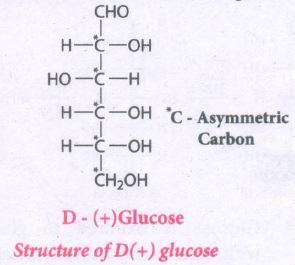
(i) Elemental analysis and molecular weight determination show that the molecular formula of glucose is C6H120 6'
(ii) On reduction with concentrated HI and red phosphorus at 373K, glucose gives a mixture of n hexane and 2, iodohexane indicating that the six carbon atoms are bonded linearly.
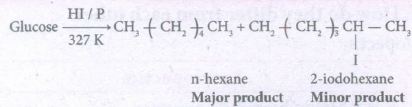
(iii) Glucose reacts with hydroxylamine to form oxime and with HCN to form: cyanohydrin. These reactions indicate the I presence of carbonyl group in glucose
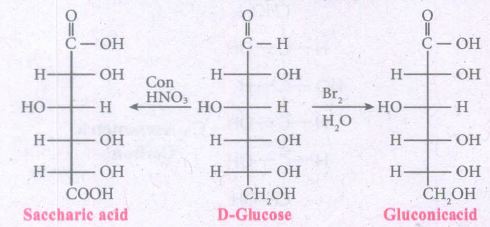
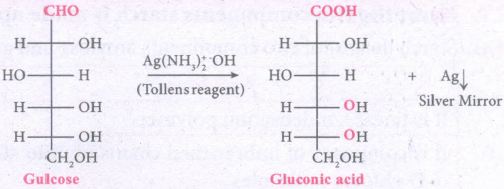
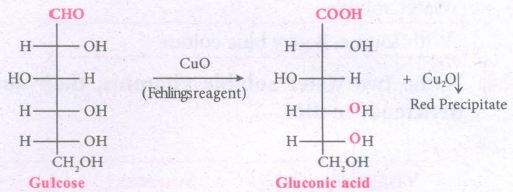
(v) Glucose is oxidised to gluconic acid with ammonical silver nitrate (Tollen's reagent) and alkaline copper sulphate (Fehling's solution). Tollens reagent is I reduced to metallic silver and Fehlings I solution to cuprous oxide which appears as red precipitate. These reactions further: confirm the presence of an aldehyde group
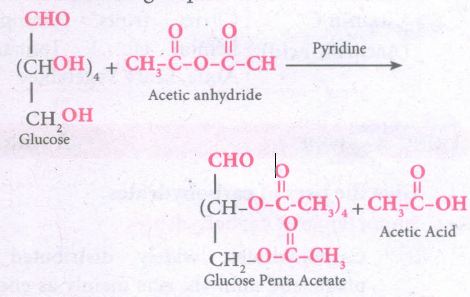
(vi) Glucose forms penta acetate with acetic anhydride suggesting the presence of five alcohol groups.
(vii) Glucoseis a stable compound and does not undergo dehydration easily. It indicates that not more than orie hydroxyl group is bonded to a single carbon atom. Thus the five hydroxyl groups are attached to five different carbon atoms and the sixth carbon is an aldehyde group.
4.
The monomers are phenol and formaldehyde. The polymer is obtained by the condensation polymerization of these monomers in presence of either an acid or a base catalyst.
Phenol reacts with methanal to form ortho or para hydroxyl methylphenols which on further reaction with phenol gives linear polymer called novolac. Novalac on further heating with formaldehyde undergo cross linkages to form Bakelite.
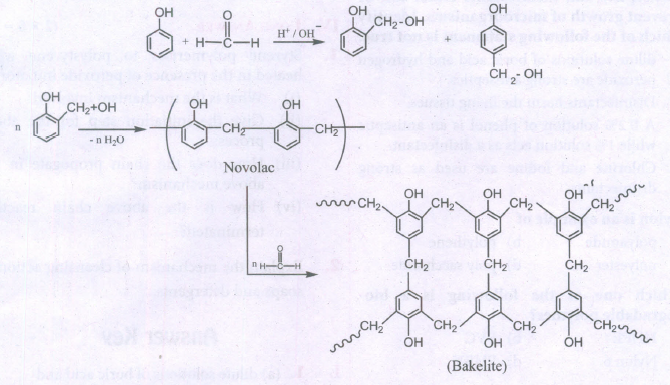
Uses:
Navolac is used in paints. Soft bakelites are used for making glue for binding laminated wooden planks and in varinishes, Hard bakelites are used to prepare combs, pens etc...
5.
(i) Primary amine react with nitrous acid to form alcohols and nitrogen gas
\(\underset { primary \ amine }{ { CH }_{ 3 }NH_{ 2 } } \rightarrow \underset { unstable }{ { [{ CH } }_{ 3 }-N=N-OH] } \rightarrow { CH }_{ 3 }OH+{ N }_{ 2 }\)
Aliphatic diazonium compound is unstable because of absence of resonance stabilisation.
(ii) Secondary amines react with nitrous acid to form N-nitroso amines which are water insoluble yellow oils.
\(\underset { Secondary \ amine }{ { { (CH }_{ 3 } })_{ 2 }NH } +HO-N=O\rightarrow \underset { N-nitroso \ dimethy \ amine-yellow \ oil\\ (insolube \ in \ water) }{ { (CH }_{ 3 })_{ 2 }N-N=O } \)
(iii) Tertiary amine react with nitrous acid to form trialkyl ammonium nitrite salts which are soluble in water
\(\underset { Tertiary \ amine }{ { (CH }_{ 3 })_{ 2 }N } +HONO\rightarrow \underset { trimethyl \ ammonium \ nitrite\\ (salt \ soluble \ in \ water) }{ { { (CH }_{ 3 }) }_{ 3 }{ NH }^{ + }{ NO }_{ 2 }^{ - } } \)
6.
(i) Methyl alcohol and Ethyl alcohol
| S.No | Methyl alcohol | Ethyl alcohol |
| 1. | It does not react with cone. H2SO4 at any temperature. | It reacts with cone. H2SO4 at 410K, to produces diethyl ether and at 440K it produces ethylene products. |
| 2. | It does not react with I2 + NaOH to form iodoform. | It reacts with I2 + NaOH to produce iodoform CHI3. |
(ii) Benzyl alcohol and phenol
| S.No | Benzyl alcohol | Phenol |
| 1. | It does not give violet colour with neutral ferric chloride. |
It gives-violet colour with neutral ferric chloride |
| 2. | It does not decolourise bromin water. | It decolourise bromine water and produce 2,4,6- tribromo phenol. |
(iii) Ethyl alcohol and benzyl alcohol
| S.No | Ethyl alcohol | Benzyl alcohol |
| 1. | It reacts with I2 + NaOH to give iodoform | It does not react with I2 + NaOH |
| 2. | It does not undergo electrophilic substitution | It undergoes electrophilic substitution reactions at ortho and para positions. |
7.
| Homogenous catalysis | Heterogeneous catalysis |
|---|---|
| 1. In a catalysed reaction, the reactants, products and catalyst are present in the same phase. Ex: \( 2\mathrm{SO}_{2(\mathrm{~g})}+\mathrm{O}_{2(\mathrm{~g})}+[\mathrm{NO}]_{(\mathrm{g})} \rightarrow 2 \mathrm{SO}_{3(\mathrm{~g})}+[\mathrm{NO}]_{(\mathrm{g})} \) [NO] - catalyst; gaseous state SO2, O2 & SO3 are gases. |
1. In a catalysed reaction, the catalyst is present in a different phase (ie) it is not present in the same phase as that of the reactants or products. Ex: \(\mathrm{N}_{2(\mathrm{~g})}+3 \mathrm{H}_{2(\mathrm{~g})} \stackrel{\mathrm{Fe}_{(\mathrm{s})}}{\longrightarrow} 2 \mathrm{NH}_{3(\mathrm{~g})}\) Fe - catalyst; solid N2, H2 & NH3 are gases. |
| 2. It is not a contact catalysis. | 2. It is a contact catalysis and the mental catalyst will be in finely divided metal or as gauze. |
| 3. It is explained by intermediate compound formation theory. |
3. It is explained by adsorption theory. |
8.
Compound A,B,C and D
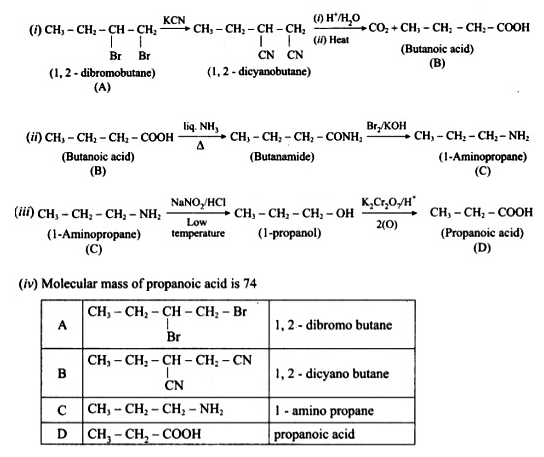
9.
[Ni (H2O)6]2+
.JPG)
It has two unpaired electrons. So there is d-d transition. Hence it is green coloured.
[Ni(CN)4]2-
.JPG)
There is no unpaired electrons. So it is colourless, as there is no d-d transition.
10.
1. The crude metal is refined by electrolysis. It is carried out in an electrolytic cell
Anode : Impure metal to be refined with dilute acid.
Cathode : Thin strips of pure metal
Electrolyte : Aqueous solution of the salts of the metal with dilute acid.
2. The metal dissolves from the anode, pass into the solution.
3. At the same amount of metal ions from the solution will be deposited at the cathode.
4. During electrolysis, the less electropositive impurities in the anode, settle down at the bottom and are removed as anode mud.
Example: Electrolytic refining of silver.
Cathode: Pure silver
Anode: lmpure silver rods
Electrolyte: Acidified aqueous solution of silver nitrate
5. When a current is passed through the electrodes the following reactions will take place
(a) Reaction at anode: \({ Ag }_{ (s) }\longrightarrow { Ag }^{ + }_{ (aq) }+{ 1e }^{ - }\)
(b) Reaction at cathode: \({ Ag }^{ + }_{ (aq) }+{ 1e }^{ - }\longrightarrow { Ag }_{ (s) }\)
6. During electrolysis, at anode silver loses electrons and form silver ions and the silver ions migrate towards the cathode and get discharged and deposited on the cathode.
7. Copper, Zinc etc can also be refined by this process.
11.
(i) .JPG)
n-Nitro benzoate (Major Product)
(ii) .JPG)
12.
(i) A Colloid depends on the size of the particle. A Colloid is formed when the size of the particle lies between 1 nm and 100 nm. For example soap dissolves in water to form colloidal soap solution whereas it dissolves in alcohol to form a true solution. Thus change of state takes place. A colloidal state maybe an intermediate between a true solution and a suspension.
(ii) Also some crystalloids under certain conditions can be colloids. NaCl is a crystalloid in aqueous medium; but when mixed with benzene it acts as a colloid.
13.
14.
HF is a weak acid i.e. 0.1 M solution is only 10% ionised, but in 5M & 15M solution, HF is stronger acid due to chemical equilibrium.
\(\mathrm{HF}+\mathrm{H}_{2} \mathrm{O} \rightleftharpoons \mathrm{H}_{3} \mathrm{O}^{+}+\mathrm{F}^{-} \)
\(\mathrm{HF}+\mathrm{F}^{-} \rightleftharpoons \mathrm{HF}_{2}^{-}\)
15.
(i) Zeolites are three-dimensional crystalline solids containing Al, Si and O in their regular three dimensional framework.
(ii) They are hydrated sodium alumino silicates with general formula Na2O(AI2O3).·x(SiO2)·yH2O
(x = 2 to 10; y = 2 to 6).
(iii) Zeolites have porous structure in which the monovalent sodium ions and water molecules are loosely held.
(iv) The Si and Al atoms are tetrahedrally coordinated with each other through shared oxygen atoms.
(v) Zeolites are similar to clay minerals but they differ in their crystalline structure.
(vi) Zeolites have a three dimensional crystalline structure looks like a honeycomb consisting of a network of interconnected tunnels and cages.
(vii) Water molecules moves freely in and out of these pores but the zeolite framework remains rigid
(viii) Another special aspect of this structure is that the pore/channel sizes are nearly uniform, allowing the crystal to act as a molecular sieve.
16.
(a) CH3COONa is a salt of weak acid
(CH3COOH) and a strong base (NaOH).
Hence, the solutions is alkaline due to hydrolysis.
\(CH_{3}COO^{-}_{(aq)}+H_{2}O_{(aq)}\rightleftharpoons CH_{3}COOH_{(aq)}+OH^{-}_{(aq)}\)
(i)\(h=\sqrt{\frac{K_{w}}{K_{a}\times C}}\)
Given that pKa =4.74
pKa = -log Ka
ie., Ka = antilog of (-pKa)
= antilog of (-4.74)
= antilog of (-5 + 0.26)
= 10-5 \(\times\) 1.8 = 1.8 \(\times\) 10-5
[antilog of 0.26 = 1.82 \( \simeq\) 1.8]
\(\therefore\) h=\(\sqrt{\frac{1\times10^{-14}}{1.8\times10^{-5}\times0.1}}\)
h = 7.5 x 10⁻⁵
(ii) \(K_{h}=\frac{K_{w}}{K_{a}}=\frac{1\times10^{-14}}{1.8\times10^{-5}}\)
\(=5.56\times10^{-10}\)
iii) \(pH=7+\frac{pK_{a}}{2}+\frac{logC}{2}\)
= \(7+\frac{4.74}{2}+\frac{log0.1}{2}\)
= 7 + 2.37 - 0.5
= 8.87
17.
Given: [Cu2+] = 0.1M; E0Cu2+|Cu = +0.34V
Cell reaction is: \(Cu^{2+}_{(aq)}+2e^{-}\rightarrow Cu_{(s)}\)
\(E_{cell}=E^{0}-\frac{0.0591}{n}\log\frac{[Cu]}{[Cu^{2+}]}\)
\(= 0.34\frac{0.0591}{2}\log\frac{1}{0.1}\)
Ecell = 0.34 - 0.0296 = +0.31V
18.
19.
According to Arrhenius equation
\(\log\left( \frac { { k }_{ 2 } }{ { k }_{ 1 } } \right) =\frac { { E }_{ a } }{ 2.303R } \left( \frac { { T }_{ 2 }-{ T }_{ 1 } }{ { T }_{ 1 }{ T }_{ 2 } } \right) \)
T2 = 400K ; k2 = 0.04 s-1
T1 = 200K ; k1 = 0.02 s-1
\(\log\left( \frac { 0.04}{ 0.02} \right) =\frac { { E }_{ a } }{ 2.303\times 8.314} =\left( \frac { 400-200 }{ 200\times 400 } \right) \)
\(\log(2)=\frac { { E }_{ a } }{ 2.303\times 8.314} =\left( \frac { 1 }{ 400 } \right) \)
Ea = log(2) \(\times\) 2.303 \(\times\) 8.314 \(\times\) 400
= 0.3010 \(\times\) 2.303 \(\times\) 8.314 \(\times\) 400
Ea = 2305 J mol-1 = 2.305 kJ mol-1
20.
Fusion of urea with B(OH)3' in an atmosphere of ammonia at 800 - 1200 K gives boron nitride.
B(OH)3 + NH3 \(\overset { \Delta }{ \longrightarrow } \) BN+ 3H2O

12th Standard Syllabus & Materials
12th Standard
TN 12th Computer Applications களப்பெயர் முறைமை (DNS) Sample Question Papers Study Material - QB365 Set A
NEW12th Standard
TN 12th Computer Applications வலையமைப்பு எடுத்துக்காட்டுகள் மற்றும் நெறிமுறைகள் Sample Question Papers Study Material - QB365 Set A
NEW12th Standard
TN 12th Computer Applications கணினி வலையமைப்பு ஓர் அறிமுகம் Sample Question Papers Study Material - QB365 Set A
NEW12th Standard
TN 12th Computer Applications PHP-உடன் MySQL-ஐ இணைத்தல் Sample Question Papers Study Material - QB365 Set A



Tamilnadu Stateboard 12th Standard Subjects

Maths
Chemistry

Physics

Biology

Computer Science

Business Maths and Statistics

Economics

Commerce

Accountancy

History

Computer Applications
Biology
Computer Technology
Computer Applications
Computer Science
Business Maths and Statistics
Commerce
Economics
Maths
Chemistry
Physics
Computer Technology
History
Accountancy

Tamil

English

French
Tamilnadu Stateboard Standards
