
 100% FREE ACCESS
12th Standard Syllabus & Materials
12th Standard
TN 12th Computer Applications மின்னணு தரவு பரிமாற்றம் Sample Question Papers Study Material - QB365 Set A
NEW12th Standard
TN 12th Computer Applications மின் - வணிக பாதுகாப்பு அமைப்புகள் Sample Question Papers Study Material - QB365 Set A
NEW12th Standard
TN 12th Computer Applications மின்னணு செலுத்தல் முறைகள் Sample Question Papers Study Material - QB365 Set A
NEW12th Standard
TN 12th Computer Applications மின் - வணிகம் Sample Question Papers Study Material - QB365 Set A
NEW12th Standard
TN 12th Computer Applications திறந்த மூல கருத்துருக்கள் Sample Question Papers Study Material - QB365 Set A
NEW12th Standard
TN 12th Computer Applications வலையமைப்பு வடமிடல் Sample Question Papers Study Material - QB365 Set A

Published on: 20/01/2020
Download Tamil Nadu 12th Standard Chemistry question papers, model tests, one-mark questions, important questions, and public exam papers in PDF format. Free study materials and answer keys for TN State Board students.
Questions + Answers key
Take MCQ Chemistry Test
1.
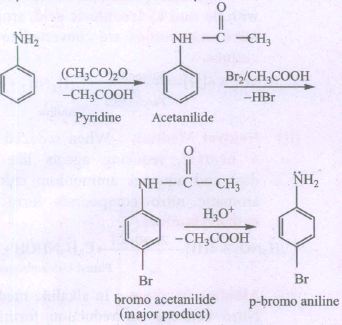
Aniline reacts with Br2/H2O to give a tribromo derivative. How would you convert aniline to get a monobromo derivate?
2.
Organic compound with molecular formula C3H6O has two isomers (A) and (B). (A) on heating with NaOH in I2 forms a yellow precipitate while (B) does not. Identify the isomers A and B and explain the reactions.
3.
Explain Stephen's reaction.
4.
Write the preparation of neoprene and give its use.
5.
Name some important categories of food additives.
6.
Give the sources of vitamin A and E and list the deficiency disease caused by lack of vitamin A and E in diet.
7.
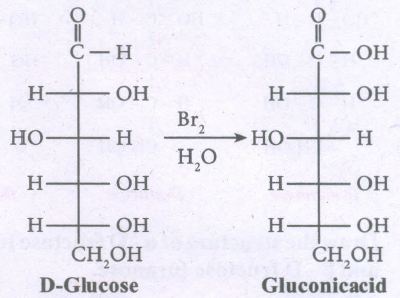
Write a reaction that indicates the presence of an aldehyde group in glucose.
8.
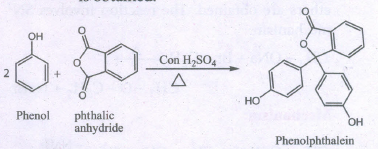
How can the following conversion be effected? (i) Phenol to phenolphthalein.
9.
Before reduction, the ore is first converted into the oxide of metal of interest. Give reason
10.
Explain the variation in E0M3+/M2+ 3d series.
11.
Explain the following terms with suitable examples.
(i) Gangue
(ii) slag
12.
Calculate the number of unpaired electrons in Ti3+ , Mn2+ and calculate the spin only magnetic moment.
13.
Give the uses of argon.
14.
How will you prepare chlorine in the laboratory?
15.
Write a short note on hydroboration.
16.
Explain the mechanism of cleansing action of soaps and detergents.
17.
What are drugs? How are they classified.
18.
Explain briefly the collision theory of bimolecular reactions.
19.
Give the difference between double salts and coordination compounds.
1.
To get mono bromo compounds, -NH2 is first acylated to reduce its activity.
2.
Two possible isomers of C3H6O are
\(\underset { \overset { (A) }{ Acetone } }{ { CH }_{ 3 }CO{ CH }_{ 3 } } \quad \underset { \overset { (B) }{ Propanal } }{ { CH }_{ 3 }{ CH }_{ 2 }CHO } \)
\(\\ \underset { \quad \quad (A)\\ Proponal }{ { CH }_{ 3 }CO{ CH }_{ 3 } } \overset { { I }_{ 2 }/NaOH\Delta }{ \underset { Iodo\ form\ \\ reaction }{ \longrightarrow } } \underset { Sodium\\ acetate }{ { CH }_{ 3 }COONa } +\underset { Iodoform\\ Yellow\ ppt }{ { CHI }_{ 3 } } \)
\(\underset { \quad \quad \quad (B)\\ Propanal }{ { CH }_{ 3 }{ CH }_{ 2 }CHO } \overset { { I }_{ 2 }/NaOH }{ \underset { \Delta }{ \longrightarrow } } No\quad ppt\quad of\quad { CHI }_{ 3 }\)
Acetone answers Iodo form test whereas proponal does not.
3.
When alkylcyanides are reduced using SnCl2 HCl, imines are formed, which on hydrolysis gives corresponding aldehyde.
\({ CH }_{ 3 }-C\equiv N\overset { { SnCl }_{ 2 }/HCl }{ \longrightarrow } { CH }_{ 3 }-CH={ NH }\overset { { H }_{ 3 }{ O }^{ + } }{ \longrightarrow } { CH }_{ 3 }-CHO\)
4.
The free radical polymeristion of the monomer, 2-c Woro buta -1,3-diene( chloroprene) gives neoprene.

It is superior to rubber and resistant to chemical action.
Uses: It is used in the manufacture of chemical containers, conveyer belts
5.
(i) Aroma compounds
(ii) Food colours
(iii) Preservatives
(iv) Stabilizers
(v) Artificial Sweeteners
(vi) Antioxidants
(vii) Buffering substances
(viii) Vitamins and minerals
6.
| Vitamin | Sources | Deficiency Disease |
|---|---|---|
| Vitamin A (Retinol) | Liver oil, Fish, Carrot, Milk spinach and fruits such as Papaya and mango | Night blindness, Xerophthalmia Keratinisation of skin |
| VitaminE (Thiamine) |
Cotton seed oil, Sun flower oil, wheat germ oil, Vegetableoil | muscular dystrophy (muscular weakness) and neurological dysfunction |
7.
Glucose gets oxidized to gluconic acid with mild oxidizing agents like bromine water suggesting that the carbonyl group is an aldehyde group.
8.
On heating phenol with phthalic anhydride in presence of con.H2SO4 phenolphthalein is obtained.
9.
(i) In the concentrated ore, the metal exists in positive oxidation state and hence it is to be reduced to its elemental state.
(ii) From the principles of thermodynamics; that the reduction of oxide is easier when compared to reduction of other compounds of metal and hence, before reduction, the are is first converted into the oxide of metal of interest.
10.
(i) In transition series, as we move down from Ti to Zn, the standard reduction potential E0M2+/M3 value is approaching towards less negative value and copper has a positive reduction potential, i. e. elemental copper is more stable than Cu2+.
(ii) E0M2+/M value for manganese and zinc are more negative than regular trend. It is due to extra stability arises due to the half filled d5 configuration in Mn2+ and completely filled d10 configuration in Zn2+.
(iii) The standard electrode potential for the M3+/M2+ half cell gives the relative stability between M3+ and M2+.
(iv) The high reduction potential of Mn3+/Mn2+ indicates Mn2+ is more stable than Mn3+.
(v) Mn3+ has a 3d4 configuration while that of Mn2+ is 3d5. The extra stability associated with a half filled d sub-shell makes the reduction of Mn3+ very feasible \(\left[\mathrm{E}^{\circ}=+1.51 \mathrm{~V}\right]\).
11.
(i) Gangue: The ores are associated with nonmetallic impurities, rocky materials and siliceous matter which are collectively known as gangue.
Eg: SiO2 is the gangue present in the iron ore (Fe2O3)
(ii) Slag: In the smelting process, a flux combines with Silica gangue forming slag.
CaO(s) + SiO2(s) → CaSiO3(s)
Flux + gangue → Slag
12.
Electronic configuration of Ti = 3d24s2
Electronic configuration of Ti3+ =3d1
Hence number of unpaired electron = 1
Spin only magnetic moment \((\mu)=\sqrt{\mathrm{n}(\mathrm{n}+2)}\)
= \(\sqrt{1(1+2)} \)
= \(\sqrt{3}\)
=1.732 BM
Electronic configuration of \(\mathrm{Mn}=3 \mathrm{~d}^{5} 4 \mathrm{~s}^{2}\)
Electronic configuration of \(\mathrm{Mn}^{2+}=3 \mathrm{~d}^{5}\)
Hence number of unpaired electrons = 5
Spin only magnetic moment
\((\mu) =\sqrt{5(5+2)}\)
= 5.92 BM
13.
Argon prevents the oxidation of hot filament and prolongs the life in filament bulbs.
14.
Chlorine is prepared by the action of conc. sulphuric acid on chlorides in presence of manganese dioxide
4NaCl + MnO2 + 4H2SO4 \(\longrightarrow \)Cl2+ MnCl2 +4NaHSO4 + 2H2O
15.
Diborane adds on to alkenes and alkynes in ether solvent at room temperature. This reaction is called hydroboration.
\({ B }_{ 2 }{ H }_{ 6 }+6RCH=CHR\longrightarrow 2B(RCH_2-{ CH }R)_{ 3 }B\)
16.
(i) To understand how a soap works as a cleansing agent, let us consider sodium palmitate an example of a soap. The cleansing action of soap is directly related to the structure of carboxylate ions (palmitate ion) present in soap. The structure of palmitate exhibit dual polarity. The hydrocarbon portion is non polar and the carboxyl portion is polar.

(ii) The nonpolar portion is hydrophobic while the polar end is hydrophilic. The hydrophobic hydro carbon portion is soluble in oils and greases, but not in water. The hydrophilic carboxylate group is soluble in water.
(iii) The dirt in the cloth is due to the presence of dust particles intact or grease which stick. When the soap is added to an oily or greasy part of the cloth, the hydrocarbon part of the soap dissolve in the grease, leaving the negatively charged carboxylate end exposed on the grease surface.
(iv) At the same time the negatively charged carboxylate groups are strongly attracted by water, thus leading to the formation of small droplets called micelles and grease is floated away from the solid object. When the water is rinsed away, the grease goes with it. As a result, the cloth gets free from dirt and the droplets are washed away with water. The micelles do not combine into large drops because their surfaces are all negatively charged and repel each other. The cleansing ability of a soap depends upon its tendency to act as a emulsifying agent between water and water insoluble greases.
.JPG)
The cleansing action of detergents are similar to cleansing action of soap. Eg: the structure of a cationic detergents is:
.JPG)
17.
A drug is a substance that is used to modify or explore physiological systems or pathological states for the benefit of the recipient. It is used for the purpose of diagnosis, prevention, cure/relief of a disease.
a) Classification of drugs:
Drugs are classified based on their properties such as chemical structure, pharmacological effect, target system, site of action etc.
b) Classification based on the chemical structure:
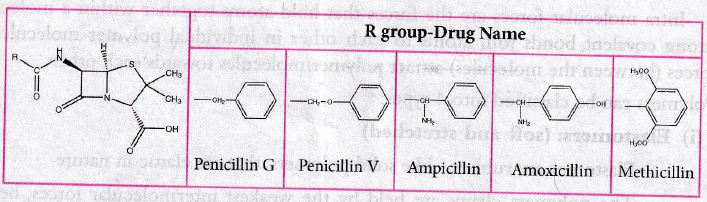
In this classification, drugs with a common chemical skeleton are classified into a single group. For example, ampicillin, amoxicillin, methicillin etc.. all have similar structure and are classified into a single group called penicillin. Similarly, we have other group of drugs such as opiates, steroids, catecholamines etc. Compounds having similar chemical structure are expected to have similar chemical properties. However, their biological actions are not always similar. For example, all drugs belonging to penicillin group have same biological action, while groups such as barbiturates, steroids etc.. have different biological action.
Penicillins
Classification based on Pharmacological effect:
In this classification, the drugs are grouped based on their biological effect that they produce on the recipient. For example, the medicines that have the ability to kill the pathogenic bacteria are grouped as antibiotics. This kind of grouping will provide the full range of drugs that can be used for a particular condition (disease). The physician has to carefully choose a suitable medicine from the available drugs based on the clinical condition of the recipient.
Examples:
Antibiotic drugs: amoxicillin, ampicillin, cefixime, cefpodoxime, erythromycin, tetracycline etc.. Antihypertensive drugs: propranolol, atenolol, metoprolol succinate, amlodipine etc...
Classification based on the target system (drug action):
In this classification, the drugs are grouped based on the biological system/process, that they target in the recipient. This classification is more specific than the pharmacological classification. For example, the antibiotics streptomycin and erythromycin inhibit the protein synthesis (target process) in bacteria and are classified in a same group. However, their mode of action is different. Streptomycin inhibits the initiation of protein synthesis, while erythromycin prevents the incorporation of new amino acids to the protein.
Classification based on the site of action (molecular target):
The drug molecule interacts with biomolecules such as enzymes, receptors etc, which are referred as drug targets. We can classify the drug based on the drug target with which it binds. This classification is highly specific compared to the others. These compounds often have a common mechanism of action, as the target is the same.
18.
(i) Collision theory is based on the kinetic theory of gases. According to this theory, a chemical reaction occurs as a result of collisions between the reacting molecules.
(ii) Let us understand this theory by considering the following reaction.
A2(g) + B2(g) ⟶ 2AB(g)
(iii) If we consider that, the reaction between A2 and B2 molecules proceeds through collisions between them, then the rate would be proportional to the number of collisions per second.
(iv) Rate ∝ number of molecules colliding per litre per second (collision rate).
(v) The number of collisions is directly proportional to the concentration of both A2 and B2.
Collison rate ∝ [A2][B2]
Collision rate = Z [A2][B2]
(vi) Where, Z is a constant
(vii) A fraction of effective collisions (f) is given by the following expression
\(f={ e }^{ \frac { { -E }_{ a } }{ RT } }\)
(xiv) This fraction of collisions is further reduced due to orientation factor i.e., even if the reactant collides with sufficient energy, they will not react unless the orientation of the reactant molecules is suitable for the formation of the transition state.
(viii) The diagram illustrates the importance of proper alignment of molecules which leads to reaction.
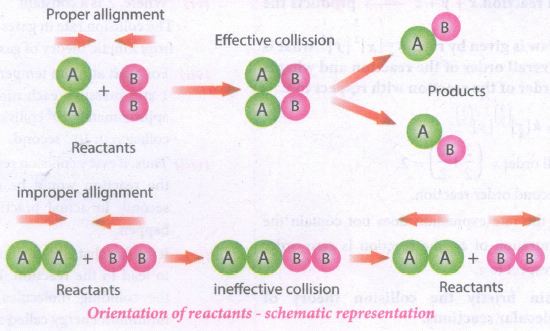
(ix) The fraction of effective collisions (f) having proper orientation is given by the steric factor p.
⇒ Rate = p x f x collision rate
\(\Rightarrow Rate=p\times { e }^{ \frac { -Ea }{ RT } }\times Z\left[ { A }_{ 2 } \right] \left[ { B }_{ 2 } \right] \quad ...(1)\)
As per the rate law,
Rate = \(k=\left[ { A }_{ 2 } \right] \left[ { B }_{ 2 } \right] \quad ...(2)\)
Where k is the rate constant
On comparing equation (1) and (2), the rate constant k is
\(k=pZ{ e }^{ \frac { -Ea }{ RT } }\)
19.
| S. No | Double salts | Co-ordination compound |
|---|---|---|
| 1. | They usually contain two simple salt in equimolar proportions | The simple salts from which they are formed may or may not be in equimolar proportion. |
| 2. | They exists only in the solid state. In aqueous solution they dissociate completely into ions. | They exist in the solid state as well as in aqueous solution. This is because even in solution, the complex ion does not dissociate into ions. |
| 3. | They are ionic compounds and do not contain any co-ordinate bond. | They may or may not be ion but the complex part always contain coordinate bonds |
| 4. | The properties of the double salts are same as those of its constituent compounds. | The properties of the coordination compounds are different for its constituent bonds. |
| 5. | In a double salt, the metal ion show their normal valency. | In a coordinate compound the metal ion satisfies its two types of valence called primary & secondary valenices. |
| 6. | A double salt loses its identity and dissociates into its constitute simple ions in solution. | The complex ion does not lose its identity and never dissociate to give simple ions. |
| Example: FeSO4 (NH4)2 SO4.6H2O | Example: K4[Fe(CN)6), K3[Fe(SCN)6) |

12th Standard Syllabus & Materials
12th Standard
TN 12th Computer Applications களப்பெயர் முறைமை (DNS) Sample Question Papers Study Material - QB365 Set A
NEW12th Standard
TN 12th Computer Applications வலையமைப்பு எடுத்துக்காட்டுகள் மற்றும் நெறிமுறைகள் Sample Question Papers Study Material - QB365 Set A
NEW12th Standard
TN 12th Computer Applications கணினி வலையமைப்பு ஓர் அறிமுகம் Sample Question Papers Study Material - QB365 Set A
NEW12th Standard
TN 12th Computer Applications PHP-உடன் MySQL-ஐ இணைத்தல் Sample Question Papers Study Material - QB365 Set A



Tamilnadu Stateboard 12th Standard Subjects

Maths
Chemistry

Physics

Biology

Computer Science

Business Maths and Statistics

Economics

Commerce

Accountancy

History

Computer Applications
Biology
Computer Technology
Computer Applications
Computer Science
Business Maths and Statistics
Commerce
Economics
Maths
Chemistry
Physics
Computer Technology
History
Accountancy

Tamil

English

French
Tamilnadu Stateboard Standards
