
 100% FREE ACCESS
12th Standard Syllabus & Materials
12th Standard
TN 12th Maths Applications of Matrices and Determinants Sample Question Papers Study Material - QB365 Set A
NEW12th Standard
TN 12th Computer Applications மின்னணு தரவு பரிமாற்றம் Sample Question Papers Study Material - QB365 Set A
NEW12th Standard
TN 12th Computer Applications மின் - வணிக பாதுகாப்பு அமைப்புகள் Sample Question Papers Study Material - QB365 Set A
NEW12th Standard
TN 12th Computer Applications மின்னணு செலுத்தல் முறைகள் Sample Question Papers Study Material - QB365 Set A
NEW12th Standard
TN 12th Computer Applications மின் - வணிகம் Sample Question Papers Study Material - QB365 Set A
NEW12th Standard
TN 12th Computer Applications திறந்த மூல கருத்துருக்கள் Sample Question Papers Study Material - QB365 Set A

Published on: 20/01/2020
Download Tamil Nadu 12th Standard Chemistry question papers, model tests, one-mark questions, important questions, and public exam papers in PDF format. Free study materials and answer keys for TN State Board students.
Questions + Answers key
Take MCQ Chemistry Test
1.
Convertmethylisocyanide ⟶ dimethylamine
2.
\({ C }_{ 2 }{ H }_{ 3 }N\xrightarrow [ Ether ]{ LiAl/{ H }_{ 4 } } B\underrightarrow { HN{ O }_{ 2 } } \) Identify A, B and C.
3.
What is vinegar?
4.
Explain why chloroform is not used as an anaesthetic.
5.
Give the classification of polymers on the basis of their source.
6.
The two strands in DNA are not identical but are complementary explain.
7.
What causes Brownian movement in a colloid?
8.
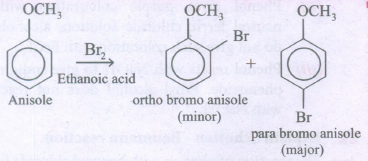
Write short notes on bromination of anisole.
9.
What are the two types of buffer? Give an example for each.
10.
Calculate the molar conductance of 0.025M aqueous solution of calcium chloride at 25°C. The specific conductance of calcium chloride is 12.04 x 10⁻² Sm-1.
11.
The decomposition reaction of ammonia gas on platinum surface has a rate constant R = 2.5 x 10⁻⁴mol L-1. What is the order of the reaction.
12.
What is inert pair effect?
13.
Why Zn2+ salts are white while Ni2+ salts are coloured?
14.
What are structural isomers?
15.
Calculate the magnetic moment of [Fe(H2O)6]2+, if atomic number of Fe is 26.
16.
17.
Explain the oxidation states of 4d series elements.
18.
Ni2+ is identified using alcoholic solution of dimethyl glyoxime. Write the structural formula for the rosy red precipitate of a complex formed in the reaction.
19.
Chalcogens belongs to p-block. Give reason.
20.
Write a note on Fisher tropsch synthesis.
21.
What is the role of quick lime in the extraction of Iron from its oxide Fe2O3?
22.
Explain the rate determining step with an example.
23.
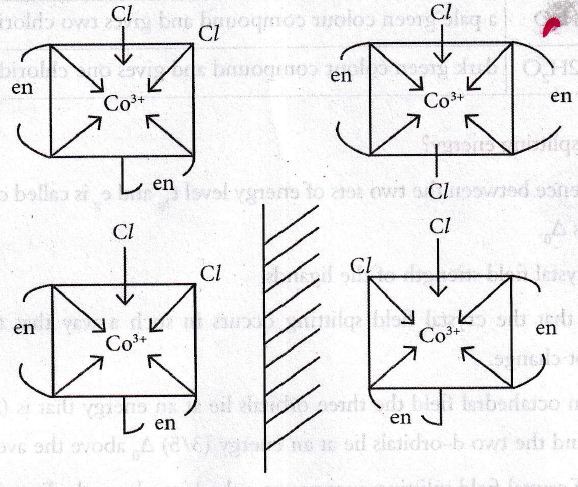
Draw all possible geometrical isomers of the complex [Co(en)2Cl2]+ and identify the optically active isomer.
24.
Identify compounds A, B and C in the following sequence of reactions.
i) \({ C }_{ 6 }{ H }_{ 5 }NO_{ 2 }\overset { Fe/HCL }{ \longrightarrow } A\overset { HN{ O }_{ 2 } }{ \underset { 273K }{ \longrightarrow } } B\overset { { C }_{ 6 }{ H }_{ 5 }OH }{ \longrightarrow } C\)
ii) \({ C }_{ 6 }{ H }_{ 5 }N_{ 2 }cl\overset { CuCN }{ \longrightarrow } A\overset { H_{ 2 }O/H^{ + } }{ \longrightarrow } B\overset { NH_3 }{ \longrightarrow } C\)
iii) \({ C }{ H }_{ 3 }{ C }{ H }_{ 2 }I\overset { NaCN}{ \longrightarrow } A\overset {OH^-}{ \underset {Partial hydrolysis}{ \longrightarrow } } B\overset {NaOH+Br_2 }{ \longrightarrow } C\)
iv) \({ C }{ H }_{ 3 }NH_{ 2 }\overset { CH_3 Br }{ \longrightarrow } A\overset { CH_{ 3 }COCl}{ \longrightarrow } B\overset { B_2H_6 }{ \longrightarrow } C\)
v) \({ C }_{ 6 }{ H }_{ 5 }NH_{ 2 }\overset { (CH_{ 3 }CO)_{ 2 }O }{ \underset { Pyridine }{ \longrightarrow } } A\overset { HNO_{ 3 } }{ \underset { H_{ 2 }SO_{ 4 },288K }{ \longrightarrow } } B\overset { { H }_{ 2 }O/{ H }^{ + } }{ \longrightarrow C } \)
vi)
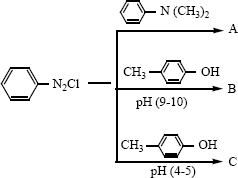
vii) \({ C }{ H }_{ 3 }CN_{ 2 }NC\overset { HgO }{ \longrightarrow } A\overset { H_{ 2 }O }{ \longrightarrow } B\overset { i) NaN{ O }_{ 2 }/HCL }{ \underset { ii){ H }_{ 2 }O }{ \longrightarrow } } \)
25.
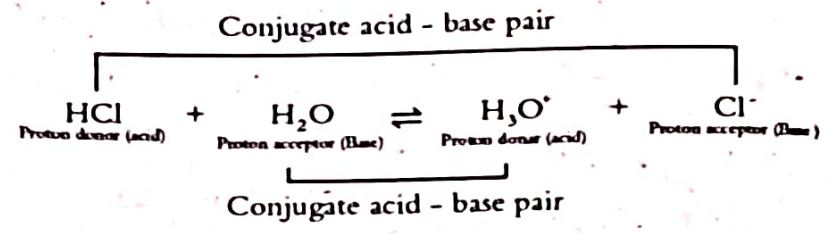
Discuss the Lowry – Bronsted concept of acids and bases.
1.
Reduction: When reduced catalytically (or) by nascent hydrogen, they give secondary amines.
\(\underset { Methyl\quad isocyanide }{ { CH }_{ 3 }-NC+4[H] } \xrightarrow [ (or)Ni/{ H }_{ 2 } ]{ Na/{ C }_{ 2 }{ H }_{ 5 }OH } \underset { Dimethylamine }{ { CH }_{ 3 }-NH-{ CH }_{ 3 } } \)
2.

3.
Vinegar is 6 to 8% solution of acetic acid in water.
4.
With oxygen it forms a toxic carbonyl chloride Hence it is not used an an anaesthetic.
5.
On the basic of their source polymers are classified as
(i) Natural polymers (obtained from plants/ animals). E.g. Cellulose, Silk
(ii) Synthetic polymers (man made from chemicals) E.g. polythene, PVC, etc.,
Semisynthetic polymers (natural polymersmodified by chemical treatment)
E.g. viscose rayon, cellulose diacetate.
6.
In the helical structure of DNA, the two strands are held together by hydrogen bonds between specific pair of bases. Cytosine forms hydrogen bond with guanine while adenine forms hydrogen bonds with thymine. As a result the two strands are complementary to each other.
7.
The colloidal sol particles are continuously bombarded with the molecules of the dispersion medium and hence they follow a zigzag, random, continuous movement.
8.
Anisole undergoes bromination with bromine in acetic acid even in the absence of a catalyst, para isomer is obtained as the major product.
9.
(i) Acidic buffer solution: a solution containing a weak acid and its salt.
Example: Solution containing acetic acid and sodium acetate
(ii) Basic buffer solution: a solution containing a weak base and its salt.
Example: Solution containing NH4OH and NH4Cl.
10.
Molar conductance = Λm = \( \frac{k\ (Sm^{-1})\times10^{-3}}{M} mol^{-1}m^{3} \)
\(= \frac{(12.04 \times 10^{-2} Sm^{-1}) \times 10^{-3} (mol^{-1}m^{3})} {0.025}\)
= 481.6 x 10⁻⁵ Sm2mol-1
11.
The order of the reaction is zero.
12.
(i) In the elements of 4th, 5th and 6th period of the p-block the electrons present in the intervening d and f - orbitals do not shield the s-electrons of the valence shell effectively.
(ii) As a result, ns2-electons remains more tightly held by the nucleus and hence do not participate in bonding. This is called inert pair effect.
13.
(i) Ni2+ (3d8) - has two unpaired electrons, promotion of d orbital by absorption of energy possible - shows colour.
(ii) Zn2+ (3d10) - has no unpaired electron, no promotion of d orbitals possible - shows white colour.
14.
The coordination compounds with same formula, but have different connections among their constituent atoms are called structural isomers or constitutional isomers.
15.
Magnetic moment (μ) = \(\sqrt { n(n+2) } \) BM
Fe (z = 26) = 1s2 2s2 2p6 3s2 3p6 4s2 3d6
Fe2+ = 1s2 2s2 2p6 3s2 3p6 3d6 4s0

∴μ = \(\sqrt { n(n+2) } \) = \(\sqrt { 4(4+2) } =\sqrt { 24 } \)
= 4. 89 BM
16.

.JPG)
17.
The oxidation states of 4d metals vary from +3 for Y to +8 for Ru and Os.
The highest oxidation state of 4d elements are found in their compounds with the higher electronegative elements like O, F & Cl.
Example: In RuO4, OsO4 & WCl6
The oxidation state of Ru and Os is +8.
The oxidation state of W is +6.
Generally in going down a group, a stability of higher oxidation state increases while that of lower oxidation state decreases.
4d series (5th period) - Yttrium to Cadmium (10 elements)
| Elements | Oxidation states |
|---|---|
| Y | +3 |
| Zr | +3, +4 |
| Nb | +2, +3, +4, +5 |
| Mo | +2, +3, +4, +5, +6 |
| Tc | +2, +4, +5, +7 |
| Ru | +2, +3, +4, +5, +6, +7 +8 |
| Rh | +2, +3, +4, +6 |
| Pd | +2, +3, +4 |
| Ag | +1, +2, +3 |
| Cd | +2 |
18.
Addition of an alcoholic solution of dimethylglyoxime to an ammoniacal solution of Ni(II) gives rose - red precipitate Ni[ONCC N OH]2 Nickel Cis (dimethylglyoximate)
19.
(i) The Chalcogens belong to group (16).
(ii) The group consists of elements: Oxygen, Sulphur, Selenium, Tellurium and Polonium.
(iii) These are ore forming elements as most of the ores are oxides and sulphides.
(iv) Chalcos meaning 'ore formers'.
20.
The reaction of CO with hydrogen at a pressure of less than 50 atm using metal catalysts at 500 - 700 K yields saturated and unsaturated hydrocarbons.
\(nCO+(2n+1){ H_2 }\longrightarrow C_{ n }{ H }_{ (2n+2) }+{ nH }_{ 2 }O\)
\(nCO+2n{ H }_{ 2 }\longrightarrow { C }_{ n }{ H }_{ 2n }+{ nH }_{ 2 }O\)
21.
In this extraction, a basic flux, quick lime (CaO) is used, since the silica gangue present in the ore is acidic in nature. The quick lime combines with it to form calcium silicate (slag).
CaO(s) + Sio2(s) ⟶ CaSio3(s)
Flux Gangue Slag
22.
(i) The step which has the lowest rate value among the other steps of the reaction is called as the rate determining step (or) rate limiting step: (or)
(ii) The overall rate of a reaction is controlled by the slowest step in a reaction called the rate determining step.
Example:
\(2 \mathrm{~A}+\mathrm{B} \rightarrow \mathrm{C}+\mathrm{D}\) going by two steps like,
\( \mathrm{A}+\mathrm{B} \stackrel{\mathrm{k}_{1}}{\longrightarrow} \mathrm{C}+\mathrm{Z}-(1) \text { Step }(\text { slow }) \)
\(Z+A \stackrel{k_{2}}{\longrightarrow} D-(2) \text { Step }(\text { fast }) \)
Over all reaction: \(2 \mathrm{~A}+\mathrm{B} \rightarrow \mathrm{C}+\mathrm{D}\)
Here \(A+B \underset{\text { Slow }}{\stackrel{K_{1}}{\longrightarrow}} C+Z\), step is the rate determining step. For the decomposition of hydrogen peroxide catalysed by I-.
2H2O2(aq)\(\rightarrow\) 2H2O(I) + O2(g)
It is experimentally found that the reaction is first order with respect to both H2,O2, and I-, which indicates that I- is also involved in the reaction. The mechanism involves the following steps.
Step: 1
H2O2(aq)+I-1(aq) \(\rightarrow\) H2O(l)+OI-1(aq)
Step: 2
H2O2(aq)+OI-1(aq)\(\rightarrow\) H2O + I-(aq) + O(g)
Overall reaction is
2H2O2(aq) \(\rightarrow\) 2H2O(l) + O2(g)
These two reactions are elementary reactions. Adding equation (1), and (2) gives the overall reaction. Step 1 is the rate determining step, since it involves both H2,O2 and I-, the overall reaction is bimolecular.
23.
[Co (en)2 Cl2]+ This is an octahedral complex
24.
.JPG)
.JPG)
.JPG) +CO2
+CO2
.JPG)
.JPG)
.JPG)
.JPG)
25.
(i) An acid is defined as a substance that has a tendency to donate a proton to another substance and base is a substance that has a tendency to accept a proton form other substance.
(ii) In other words, an acid is a proton donor and a base is a proton acceptor.
(iii) When hydrogen chloride is dissolved in water, it donates a proton to the later. Thus, HCI behaves as an acid and H2O is base. The proton transfer from the acid to base can be represented as
HCI + H2O ⇌ H3O+ + Cl-
(iv) When ammonia is dissolved in water, it accepts a proton from water. In this case, ammonia (NH3) acts as a base and H2O is acid. The reaction is represented as
H2O + NH3 ⇌ NH4+ + OH-
(v) Let us consider the reverse reaction following equilibrium.
\(\underset { proton\ donar\\ \quad \quad \ (acid) }{ HCl } +\underset { Proton\ acceptor\\ \quad \quad \quad \quad (base) }{ { H }_{ 2 }O } \leftrightharpoons \underset { Proton\ donar\\ \quad \quad \quad \quad \ (acid) }{ { H }_{ 2 }{ O }^{ + } } +\underset { Proton\ acceptor\\ \quad \quad \quad \quad \ (base) }{ { Cl }^{ - } } \)
H3O+ donates a proton to Cl- to form HCI i.e., the products also behave as acid and base.
(vi) In general, Lowry - Bronsted (acid - base) reaction is represented as
Acid1 + Base2 ⇌ Acid2 + Base1
(vii) The species that remains after the donation of a proton is a base (Base1) and is called the conjugate base of the Bronsted acid (Acid1). In other words, chemical species that differ only by a proton are called conjugate acid - base pairs.

12th Standard Syllabus & Materials
12th Standard
TN 12th Computer Applications வலையமைப்பு வடமிடல் Sample Question Papers Study Material - QB365 Set A
NEW12th Standard
TN 12th Computer Applications களப்பெயர் முறைமை (DNS) Sample Question Papers Study Material - QB365 Set A
NEW12th Standard
TN 12th Computer Applications வலையமைப்பு எடுத்துக்காட்டுகள் மற்றும் நெறிமுறைகள் Sample Question Papers Study Material - QB365 Set A
NEW12th Standard
TN 12th Computer Applications கணினி வலையமைப்பு ஓர் அறிமுகம் Sample Question Papers Study Material - QB365 Set A



Tamilnadu Stateboard 12th Standard Subjects

Maths
Chemistry

Physics

Biology

Computer Science

Business Maths and Statistics

Economics

Commerce

Accountancy

History

Computer Applications
Biology
Computer Technology
Computer Applications
Computer Science
Business Maths and Statistics
Commerce
Economics
Maths
Chemistry
Physics
Computer Technology
History
Accountancy

Tamil

English

French
Tamilnadu Stateboard Standards
