
 100% FREE ACCESS
12th Standard Syllabus & Materials
12th Standard
TN 12th Computer Applications மின்னணு தரவு பரிமாற்றம் Sample Question Papers Study Material - QB365 Set A
NEW12th Standard
TN 12th Computer Applications மின் - வணிக பாதுகாப்பு அமைப்புகள் Sample Question Papers Study Material - QB365 Set A
NEW12th Standard
TN 12th Computer Applications மின்னணு செலுத்தல் முறைகள் Sample Question Papers Study Material - QB365 Set A
NEW12th Standard
TN 12th Computer Applications மின் - வணிகம் Sample Question Papers Study Material - QB365 Set A
NEW12th Standard
TN 12th Computer Applications திறந்த மூல கருத்துருக்கள் Sample Question Papers Study Material - QB365 Set A
NEW12th Standard
TN 12th Computer Applications வலையமைப்பு வடமிடல் Sample Question Papers Study Material - QB365 Set A

Published on: 12/11/2019
Download Tamil Nadu 12th Standard Chemistry question papers, model tests, one-mark questions, important questions, and public exam papers in PDF format. Free study materials and answer keys for TN State Board students.
Questions + Answers key
Take MCQ Chemistry Test
1.
Which is the monomer of neoprene in the following?
\({ CH }_{ 2 }-\underset { \underset { CL }{ | } }{ C } { -CH=CH }_{ 2 }\)
\({ CH }_{ 2 }=CH-C\equiv CH\)
\({ CH }_{ 2 }=CH-CH={ CH }_{ 2 }\)
\({ CH }_{ 2 }-\underset { \underset { { CH }_{ 3 } }{ | } }{ C } { -CH=CH }_{ 2 }\)
2.
In a protein, various amino acids linked together by ______.
Peptide bond
Dative bond
\(\alpha\) - Glycosidic bond
\(\beta\) - Glycosidic bond
3.
Which one of the following is most basic?
2,4 – dichloroaniline
2,4 – dimethyl aniline
2,4 – dinitroaniline
2,4 – dibromoaniline
4.
Which one of the following reaction is an example of disproportionation reaction.
Aldol condensation
cannizaro reaction
Benzoin condensation
none of these
5.
Which of the following compounds on reaction with methyl magnesium bromide will give tertiary alcohol.
benzaldehyde
propanoic acid
methyl propanoate
acetaldehyde
6.
The most effective electrolyte for the coagulation of As2S3Sol is _______.
NaCl
Ba(NO3)2
K3[Fe(CN)6]
Al2(SO4)3
7.
The button cell used is watches function as follows
Zn (s) + Ag2O (s) + H2O (l) ⇌ 2Ag (s) + Zn2+ (aq) + 2OH-(aq) the half cell potentials are Ag2O (s) + H2O (l) + 2e- → 2Ag (s) + 2OH- (aq) Eo = 34V and Zn (s) → Zn2+ (aq) + 2e− E0 = 0.76V . The cell potential will be_______.
0.84V
1.34V
1.10V
0.42V
8.
What is the pH of the resulting solution when equal volumes of 0.1M NaOH and 0.01M HCl are mixed?
2.0
3
7.0
12.65
9.
The Unit of rate constant and rate of reaction are same for ______.
First order
second order
Third order
zero order
10.
The ionisation energy of Ga is higher than that of Al because of_________
more effective nuclear charge of Ga
smaller atomic size of Ga
larger size of Ga
both (a) and (b)
11.
Which of these statements about [Co(CN)6]3- is true?
[CO(CN)6]3- has four unpaired electrons and will be in a high spin configuration
[Co(CN)6]3- has four unpaired electrons and will be in a low spin configuration
[CO(CN)6]3- has no unpaired electrons and will be in a high spin configuration
[CO(CN)6]3- has no unpaired electrons and will be in low spin configuration
12.
Among the transition metals of 3d series, the one that has highest negative \(\left( \frac { M^{ 2+ } }{ M } \right) \) standard electrode potential is _______.
Ti
Cu
Mn
Zn
13.
AlF3 is soluble in HF only in the presence of KF. It is due to the formation of _________.
K3[AIF3H3]
K3[AiF6]
AIH3
K[AIF3H]
14.
The incorrect statement among the following is______.
Nickel is refined by Mond’s process
Titanium is refined by Van Arkel’s process
Zinc blende is concentrated by froth floatation
In the metallurgy of gold, the metal is leached with dilute sodium chloride solution
15.
9.2\(\times\)1012 litres of water is available in a lake. A power reactor using the electrolysis of water in the lake, produces electricity at the rate of 2\(\times\)106 Cs−1 at an appropriate voltage. How many years would it take to completely electrolyse the water in the lake. Assume that there is no loss of water except due to electrolysis.
16.
Identify the product (s) is / are formed when 1 – methoxy propane is heated with excess HI. Name the mechanism involved in the reaction.
17.
Ksp of Ag2CrO4 is \(1.1\times10^{-12}\). What is solubility of Ag2CrO4 in 0.1M K2CrO4.
18.
What are food preservatives?
19.
What are redox reactions?
20.
Describe the structure of diamond.
21.
How is acid leaching done for the sulphide ores?
22.
Why europium (II) is more stable than Cerium (II)?
23.
Explain optical isomerism in coordination compounds with an example.
24.
What is meant by the term “coordination number”? What is the coordination number of atoms in a bcc structure?
25.
Explain briefly seven types of unit cell.
26.
How are the following conversions effected
i) benzylchloride to benzylalcohol
ii) benzyalalcohol to benzoic acid
27.
Give two difference between Hormones and vitamins.
28.
Account for the acidic nature of HClO4 in terms of Bronsted – Lowry theory, identify its conjugate base.
29.
Define 'Ligand' Give an example of neutral ligand.
30.
Explain why compounds of Cu2+ are coloured but those of Zn2+ are colourless.
31.
Give an example for complex of the type [Ma2b2c2] where a, b, c are monodentate ligands and give the possible isomers.
32.
Arrange the following in order of increasing molar conductivity
(i) Mg[Cr(NH3)(Cl)5]
(ii) Cr(NH3)5Cl]3[CoF6]2
(iii) [Cr(NH3)3Cl3]
33.
Why ionic crystals are hard and brittle?
34.
How will you prepare chlorine in the laboratory?
35.
What is the hybridisation of iodine in IF7? Give its structure.
36.
37.
Give three uses of emulsions.
38.
Account for the following
i. Aniline does not undergo Friedel – Crafts reaction
ii. Diazonium salts of aromatic amines are more stable than those of aliphatic amines
iii. pKb of aniline is more than that of methylamine
iv. Gabriel phthalimide synthesis is preferred for synthesising primary amines.
v. Ethylamine is soluble in water whereas aniline is not
vi. Amines are more basic than amides
vii.Although amino group is o – and p – directing in aromatic electrophilic substitution reactions, aniline on nitration gives a substantial amount of m – nitroaniline.
39.
Write an account of the Arrhenius equation for rates of chemical reactions.
40.
Mention the uses of helium.
41.
Distinguish between diamond and graphite.
42.
Mention the type of hybridisation and magnetic property of the following complexes using VB theory a) [FeF6]4- b) [Fe(CN)6]4-
1.
(a)
\({ CH }_{ 2 }-\underset { \underset { CL }{ | } }{ C } { -CH=CH }_{ 2 }\)
2.
(a)
Peptide bond
3.
(b)
2,4 – dimethyl aniline
4.
(b)
cannizaro reaction
5.
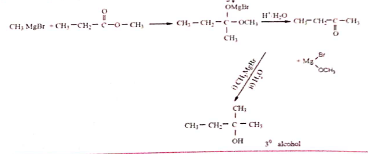
6.
As2S3 is a negatively charged colloid. It will be most effectively coagulated by the cation with greater valency. i.e., Al3+.
7.
Anodic Oxidation: (Reverse the given reaction)
(Eoox ) = 0.76 V Cathodic reduction
Eocell = (Eoox )+ (Eored)
= 0.76 + 0.34 = 1.1 V
8.
x ml of 0.1 M NaOH + x mL of 0.01 M HCI
No. of moles of NaOH = 0.1 x X x 10-3
= 0.1 X x 10-3
No. of moles of HCI = 0.01 x X x 10-3
= 0.01 X x 10-3
No. of moles of NaOH after mixing
= 0.1 X x 10-3 - 0.01 X x 10-3
= 0.09 X x 10-3
Concentration of NaOH\(= (\frac{0.09x \times 10^{-3}}{2x \times 10^{-3}}) = 0 .045\)
[OH-] = 0.045
pOH =-log (4.5 x 10⁻²)
= 2 -log 4.5
= 2 - 0.65 = 1.35
pH = 14 - 1.35 = 12.65
9.
(d)
zero order
10.
(d)
both (a) and (b)
11.
(d)
[CO(CN)6]3- has no unpaired electrons and will be in low spin configuration
12.
(a)
Ti
13.
(b)
K3[AiF6]
14.
(d)
In the metallurgy of gold, the metal is leached with dilute sodium chloride solution
15.
Hydrolysis of water
At anode:
\(2H_{2}O\rightarrow 4H^{+}+O_{2}+4e^{-}\) ..... (1)
At cathode:
\(2H_{2}O+2e^{-}\rightarrow H_{2}+2OH^{-}\) ....(2)
Overall reaction
\(6H_{2}O\rightarrow 4H^{+}+4OH^{-}+2H_{2}+O_{2}\)
(or)
Equation (1) +(2) \(x^2 \Rightarrow 2H_{2}O\rightarrow 2H_{2}+O_{2}\)
\(\therefore\) According to faradays Law of electrolysis, to electrolyse two mole of Water (36g ≃ 36 mL of H2O), 4F charge is required alternatively, when 36 mL of water is electrolysed, the charge generated = \(4\times 96500\)C.
\(\therefore\) When the whole water which is available on the lake is completely electrolysed the amount of charge generated is equal to \(\frac{4\times96500\quad C}{36 \quad mL}\times9\times10^{12}L\)
\(=\frac{4\times96500\times9\times10^{12}}{36\times10^{-3}}C\)
= \(96500\times10^{15}C\)
\(\therefore\) Given that in 1 second, \(2\times10^{6}\) C is generated therefore, the time required to generate \(96500 \times 10^{15}\) C is = \(\frac{1\quad S}{2\times 10^{6}C}\times 96500 \times10^{15}C\)
=\(48250 \times 10^{9} S\)
\(\therefore\) Number of years = \(\frac{48250 \times 10^{9}}{365 \times 24 \times 60 \times 60}\)
=\(1.5299 \times 10^{6}\) years
1 year = 365 days
= 365\(\times\)24 hours
= 365\(\times\)24\(\times\)60 min
= 365\(\times\)24\(\times\)60\(\times\)60 sec.
16.
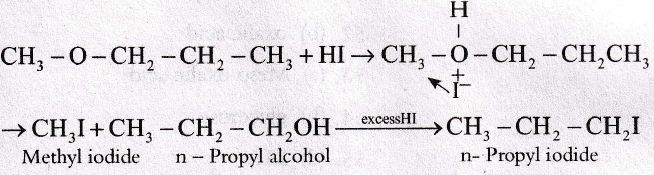
Since 1 - methoxy propane has primary alkyl group, it under goes SN2 reaction.
17.
Ksp =1.1 \(\times\)10-2, [K2, CrO4]= 0.1M
\(\underset {s}{Ag_{2}CrO_{4}}\rightleftharpoons \underset{2s}{2Ag^{+}}+\underset{s}{CrO^{2-}_{4}}\)
\(\underset{0.1M}{K_{2}CrO_{4}}\rightleftharpoons \underset{0.2M}{2K^{+}}+\underset{2 \times 0.1M}{CrO^{2-}_{4}}\)
\({\left[\mathrm{Ag}^{+}\right] } =2 \mathrm{~s} ;\left[\mathrm{CrO}_{4}^{2-}\right]=(\mathrm{S}+0.1) \simeq 0.1 \)
\(\mathrm{~K}_{\mathrm{sp}} =\left[\mathrm{Ag}^{+}\right]^{2}\left[\mathrm{CrO}_{4}^{2-}\right] \)
\(1.1 \times 10^{-12} =(2 \mathrm{~s})^{2}(0.1) \)
\(1.1 \times 10^{-12} =0.4 \mathrm{~s}^{2} \)
\(0.4 \mathrm{~s}^{2} =1.1 \times 10^{-12} \)
\(\mathrm{~s}^{2} =\frac{1.1 \times 10^{-12}}{0.4}=2.75 \times 10^{-12} \)
\(\mathrm{~s} =\sqrt{2.75 \times 10^{-12}} \)
\(\mathrm{~s} =1.658 \times 10^{-6} \mathrm{M}\)
18.
(i) Preservatives are chemicals added to food which are capable of inhibiting, retarding or arresting the process of fermentation, acidification or other decomposition of food by the growth of micro organisms (or)
(ii) Chemical substances which are added to food that prevents the spoilage of food materials by destroying the food - spoiling micro-organisms are called food preservatives.
(iii) Eg: sodium benzoate, NaCl, Acetic acid Sodium metabisulphite, potassium meta bisulphite etc.
19.
(i) Redox reactions involve transfer of electrons from one reactant to another. Such reactions are always coupled, which means that when one substance is oxidised, another must be reduced.
(ii) The substance which is oxidised is a reducing agent and the one which is reduced is an oxidizing agent
20.
(i) Diamond is very hard.
(ii) The carbon atoms in diamond are sp3 hybridised and bonded to four neighbouring carbon atoms by a bonds with a C-C bond length of 1.54 Å.
(iii) This results in a tetrahedral arrangement around each carbon atom that extends to the entire lattice.
(iv) Since all four valance electrons of carbon are involved in bonding there is no free electrons for conductivity.
(v) Being the hardest element, it used for sharpening hard tools, cutting glasses, making bores and rock drilling.
21.
(i) Leaching of sulphide ores such as ZnS, PbS etc., can be done by treating them with hot aqueous sulphuric acid
\(2Zn{ S }_{ (s) }+{ 2H }_{ 2 }{ SO }_{ 4(aq) }+{ O }_{ 2(g) }\longrightarrow { 2ZnSO }_{ 4(aq) }+2{ S }_{ (s) }+{ H }_{ 2 }O\)
(ii) In this process the insoluble sulphide is converted into soluble sulphate and elemental sulphur
22.
\(Eu (63)-[\mathrm{Xe}] 4 \mathrm{f}^{7} 5 \mathrm{~d}^{0} 6 \mathrm{~s}^{2}, \mathrm{Eu}^{2+}-[\mathrm{Xe}] 4 \mathrm{f}^{7} \)
\(\mathrm{Ce}(58)-[\mathrm{Xe}] 4 \mathrm{f}^{1} 5 \mathrm{~d}^{1} 6 \mathrm{~s}^{2}, \mathrm{Ce}^{2+}-[\mathrm{Xe}] 4 \mathrm{f}^{1} 5 \mathrm{~d}^{1} \)
Eu2+ has exactly half filled stable electronic configuration. Hence Europium (II) is more stable than Cerium (II).
23.
(i) Coordination compounds which possess chirality exhibit optical isomerism similar to organic compounds.
(ii) The pair of two optically active isomers which are mirror images of each other are called enantiomers.
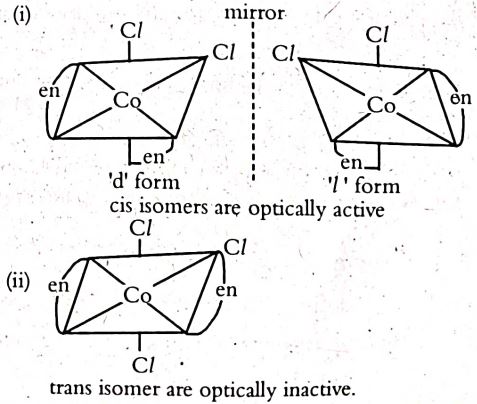
(iii) Their solutions rotate the plane of the plane polarised light either clockwise or anticlockwise and the corresponding isomers are called 'd' (dextrorotatory) and 'I' (levorotatory) forms respectively.
(iv) The octahedral complexes of type \(\left[\mathrm{M}(\mathrm{xx})_{3}\right]^{\mathrm{n} \pm}, \left[\mathrm{M}(\mathrm{xx})_{2} \mathrm{AB}\right]^{\mathrm{n\pm}}\) and \(\left[\mathrm{M}(\mathrm{xx})_{2} \mathrm{~B}_{2}\right]^{\mathrm{n\pm}}\) exhibit optical isomerism.
Examples:
(i) The optical isomers of \(\left[\mathrm{Co}(\mathrm{en})_{3}\right]^{3+}\)
(ii) The coordination complex \(\left[\mathrm{CoCl}_{2}(\mathrm{en})_{2}\right]^{+}\) has three isomers, two optically active cis forms and one optically inactive trans form.
24.
1. The number of nearest neighbours that surrounding a particle in a crystal is called the coordination number of that particle.
2. The coordination number of atoms in a bcc structure is '8'.
25.
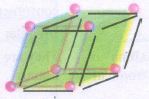
There are seven types of unit cell, Cubic, tetragonal, orthorhombic, hexagonal, monoclinic, triclinic and rhombohedral. They differ in the arrangement of their crystallographic axes and angles.
i) Cubic: a = b = c; α = β = ૪ = 90o.
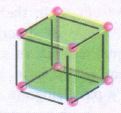
ii) Tetragonal: a = b ≠ c; α = β = ૪ = 90°.
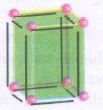
iii) Orthorhombic: a ≠ b ≠ c; α = β = ૪ = 90°.
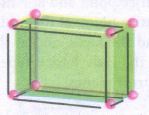
iv) Hexagonal: a = b ≠ c; α = β = 90o, ૪ = 120o.
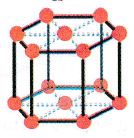
v) Monoclinic: a ≠ b ≠ c; α = ૪ = 90o, β ≠ 90o,
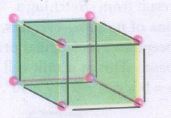
vi) Triclinic: a ≠ b ≠ c; α ≠ β ≠ ૪ ≠ 90o.
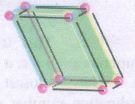
vii) Rhombohedral: a = b = c; α = β = ૪ ≠ 90o.
26.
(i) Benzylchloride to benzylalcohol
\(\underset { Benzyl \ chloride }{ { C }_{ 6 }{ H }_{ 5 }{ CH }_{ 2 }Cl } + NaOH { \longrightarrow } \underset { Benzyl \ alcohol }{ { C }_{ 6 }{ H }_{ 5 }{ CH }_{ 2 }OH } +NaCl\)
(ii) benzyalalcohol to benzoic acid
\(\underset { Benzyl \ alcohol }{\mathrm{C}_{6} \mathrm{H}_{5} \mathrm{CH}_{2} \mathrm{OH} }\stackrel{\mathrm{Na}_{2} \mathrm{Cr}_{2} \mathrm{O}_{7} / \mathrm{H}^{+}}{\longrightarrow}\underset { Benzaldehyde } {\mathrm{C}_{6} \mathrm{H}_{5} \mathrm{CHO}}\stackrel{\mathrm{Na}_{2} \mathrm{CrO}_{7} / \mathrm{H}^{+}}{\longrightarrow} \underset { Benzoic \ acid } {\mathrm{C}_{6} \mathrm{H}_{5} \mathrm{COOH}}\)
27.
| Hormone | Vitamin |
|---|---|
| Synthesized in animal bodies | Synthesised in plants |
| Produced in ductless (endocrine glands) | Have to be supplied in diet except (Vitamin D) |
| These are not stored in body but are continuously produced | These remain stored in the body to keep away diseases |
| Eg: Androgen, Estrogen, thyroxine etc. | Eg: Vitamin A (Retinol) Vitamin C (Ascorbic acid) |
28.
\(\mathrm{HClO}_{4} \rightleftharpoons \mathrm{H}^{+}+\mathrm{ClO}_{4}^{-}\)
Bronsted Acid Proton Conjugate Base
HClO4 can donate a proton. Therefore HClO4 is an acid. Its conjugate base is ClO4-
29.
Ligand is an atom or a group of atoms which is either negatively charged or has lone pair of electrons and from co-ordinate bond with the central metal or ion, e.g.H2O.
30.
(i) The compounds of Cu2+ are coloured as it has one free electron its valence shell which absorb I radiation of visible region and get excited to emit its complementary colour.
(ii) Zn has no free electron it has fully filled shells. Due to extra stable orbitals electron can't be excited by radiations of visible light, hence its compounds are colourless.
31.
[Ma2b2C2]\(\pm\)n where a, b, c are monodentate ligands.
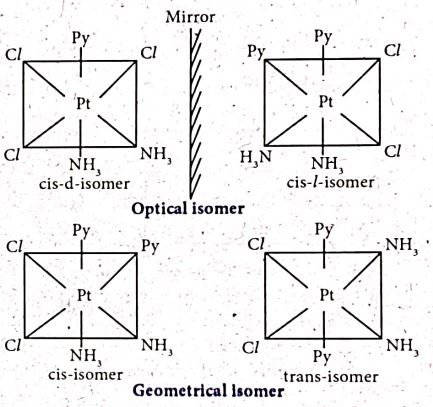
[Pt(py2)(NH3)2Cl2]2+. It exhibits both optical and geometrical isomerism. c is isomer exhibit optical isomerism also. While trans isomer exhibits geometrical isomerism only.
32.
(i) \(\mathrm{Mg}\left[\mathrm{Cr}\left(\mathrm{NH}_{3}\right) \mathrm{Cl}_{5}\right]^{2-} \rightleftharpoons \mathrm{Mg}^{2+}+\left[\mathrm{Cr}\left(\mathrm{NH}_{3}\right) \mathrm{Cl}_{5}\right]^{2-} (2 ions)\)
(ii) \(\begin{aligned}
{\left[\mathrm{Cr}\left(\mathrm{NH}_3\right)_5 \mathrm{Cl}_3\left[\mathrm{CoF}_6\right]_2 \rightleftharpoons 3\right.} & {\left[\mathrm{Cr}\left(\mathrm{NH}_3\right)_5 \mathrm{Cl}\right]^{2+} } \\
& (5 \text { ions })
\end{aligned}\)\(+2\left[\mathrm{CoF}_6\right]^{3-}\)
(iii) \(\left[\mathrm{Cr}\left(\mathrm{NH}_{3}\right)_{3} \mathrm{Cl}_{3}\right]= \text{ No ions}\)
If no of ions increases, molar conductivity increases molar conductivity of the complex also INCREASES.
\(\therefore\) The order of the given compound is
[Cr(NH3)3Cl3]<Mg[Cr(NH3)3Cl3] < [Cr(NH3)5Cl3] [CoF6]2
(No ion) (2 ions) (5 ions)
33.
The structural units of an ionic crystal are cations and anions. They are bound together by strong electrostatic attractive forces. To maximize the attractive force, cations are surrounded by as many anions as possible and vice versa. Hence they are hard and brittle.
34.
Chlorine is prepared by the action of conc. sulphuric acid on chlorides in presence of manganese dioxide
4NaCl + MnO2 + 4H2SO4 \(\longrightarrow \)Cl2+ MnCl2 +4NaHSO4 + 2H2O
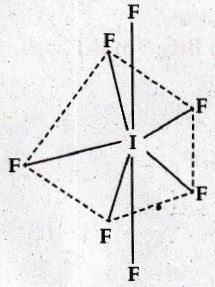
35.
(i) sp3d3 hybridisation
(ii) Pentagonal bipyramidal structure.
36.
(a)
37.
(i) Emulsions are used in food industries. Food stuff like milk, cream, butter, etc., are emulsions.
(ii) Emulsions are very common in pharmaceutical industries. Many medicines are produced in the form of emulsions. Ex: Milk of magnesia is used for stomach troubles. Many lotions and ointments are emulsions.
(iii) Non ionic emulsions are most popular due to their low toxicity.
(iv) Cationic emulsions have anti microbial properties.
(v) In agriculture industry emulsions are used as delivery vehicles for insecticides, fungicides and pesticides.
(vi) In cosmetics, emulsions are the delivery vehicles for many hair and skin conditioning agents.
(v) The blood, protoplasm in plant and animal cells and fats in intestines are emulsions.
38.
Aniline does not undergo Friedel - Craft's reaction:
Aniline does not undergo Friedel - Craft's reaction (alkylation and acetylation). Aniline is basic in nature and it donates its lone pair of electrons to the lewis acid AlCl3 to form an adduct which inhibits further electrophilic substitution reaction.
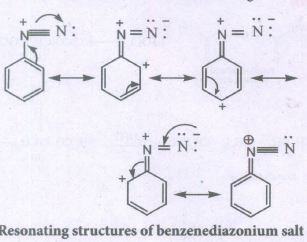
Diazonium salts of aromatic amines are more stable than those of aliphatic amines:
This is due to resonance
Resonance Structure:
The stability of arene diazonium salt is due to the dispersal of the positive charge over the benzene ring.
pKb of aniline is more than that of methylamine:
pKb - methylamine -3.35
pKb - aniline -9.376
In aniline the lone pair of electrons on N - atom is delocalized over the benzene ring. So, the electron density on the N - atom decreases. In methylamine + 1 effect to CH3 group increases the electron density on the nitrogen atom Hence aniline is a weaker base than methylamine. Due to this, the pKb value for aniline is more than that of methylamine.
(iv) Gabriel phthalimide synthesis is preferred for synthesising primary amines:
In this method alkyl halides react with pottassium phthalimide to give pure primary amine by nucleophilic substitution. In contrast, Aniline (Aromatic primary amine) can not be prepared by this method because Aryl halides do not undergo nucleophilic substitution with the anion formed by phthalimide. Therefore, this method used for the Aliphatic primary. amines only. Aryl halides do not undergo SN2 mechanism with the ion formed by the phthalimide.
(v) Ethylamine is soluble in water whereas aniline is not:
(a) Ethylamine is soluble in water, as it can form intermolecular H - bonds with water molecules. In aqueous solution, the substituted ammonium cation get stabilized not only by electron releasing (+I) effect of the alkyl group but also by solvation with water molecules. The greater the size of the ion, the lower will be the solvation.
(b) Amiline doesn't form H - bond with water to a very large extent due to the presence of a large hydrophobic -C6H5 group.
(vi) Amines are more basic than amides:
This is because, in amides, the carbonyl group is highly electro negative It has a greater power to attract the electrons towards it. It makes the lone pair of electrons on amide nitrogen (-CONH2) less available to accept a proton.
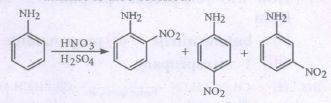
(vii) Although amino group is o - and p - directing in aromatic electrophilic substitution reactions, aniline on nitration gives a substantial amount of m - nitro aniline:
In strong acid medium, aniline is protonated to form anilinium ion which is m - directing and hence m - nitro aniline is formed.
39.
Arrhenius suggested that the rates of most reactions vary with temperature in such a way that the rate constant is directly proportional to \({ e }^{ -\left( \frac { { E }_{ a } }{ RT } \right) }\) and he proposed a relation between the rate constant and temperature.
\(k=A{ e }^{ -\left( \frac { { E }_{ a } }{ RT } \right) }\) ....(1)
Where A the frequency factor,
R the gas constant,
Ea the activation energy of the reaction and,
T the absolute temperature (in K)
(ii) The frequency factor (A) is related to the frequency of collisions (number of collisions per second) between the reactant molecules. The factor A does not vary significantly with temperature and hence it may be taken as a constant.
(iii) Ea is the activation energy of the reaction, which Arrhenius considered as the minimum energy that a molecule must have to posses to react.
(iv) Taking logarithm on both side of the equation (1)
In k = In A + In \({ e }^{ -\left( \frac { { E }_{ a } }{ RT } \right) }\)
In k = In A -\(\left( \frac { { E }_{ a } }{ RT } \right) \) (∴ In e = 1)
In k = In A - \({ \left( \frac { { E }_{ a } }{ R } \right) }\) \(\left( \frac { 1 }{ T } \right) \)....(2)
y = c = m x
The above equation is of the form of a straight line y = mx+c
(v) A plot of In k Vs \(\left( \frac { 1 }{ T } \right) \) gives a straight line with a negative slope -\(\frac { { E }_{ a } }{ R } \) If the rate constant for a reaction at two different temperatures is known, we can calculate the activation energy as follows.
At temperature T = T1; the rate constant k = k1
In k1 = In A - \(^{ \left( \frac { { E }_{ a } }{ { RT }_{ 1 } } \right) }\) ....(3)
At temperature T = T2; the rate constant k = k2
In k2 = In A - \(\left( \frac { { E }_{ a } }{ { RT }_{ 2 } } \right) \) ......(4)
(4) - (3)
In k2 - In k1 = - \(\left( \frac { { E }_{ a } }{ { RT }_{ 2 } } \right) \) + \(^{ \left( \frac { { E }_{ a } }{ { RT }_{ 1 } } \right) }\)
In \(\left( \frac { { k }_{ 2 } }{ { k }_{ 1 } } \right) \) = \(\frac { { E }_{ a } }{ R } \) \(\left( \frac { 1 }{ T_{ 1 } } -\frac { 1 }{ { T }_{ 2 } } \right) \)
2.303 log \(\left( \frac { { k }_{ 2 } }{ { k }_{ 1 } } \right) \)= \(\frac { { E }_{ a } }{ R } \) \(\left( \frac { { T }_{ 2 }-{ T }_{ 1 } }{ { T }_{ 1 }{ T }_{ 2 } } \right) \)
log \(\left( \frac { { k }_{ 2 } }{ { k }_{ 1 } } \right) \) = \(\frac { { E }_{ a } }{ 2.303R } \) \(\left( \frac { { T }_{ 2 }-{ T }_{ 1 } }{ { T }_{ 1 }{ T }_{ 2 } } \right) \)
In k2 - k1 = - \(\left( \frac { { E }_{ a } }{ R{ T }_{ 2 } } \right) \) + \(\left( \frac { { E }_{ a } }{ R{ T }_{ 1 } } \right) \)
This equation can be used to calculate Ea from rate constants k1 and k2 at temperatures T1 and T2.
40.
(i) Because of its lightness and noninflammability helium is used to filling balloons for meteorological observations.
(ii) Because of its lightness it is used in inflating aeroplane tyres.
(iii) Helium oxygen mixture is used by deep sea divers in preference to nitrogen oxygen mixtures. This prevents bends when a diver comes to the surface.
(iv) A mixture of oxygen and helium is used in the treatment of asthma.
(v) Liquid helium (b.pt 4.2K) is used as cryogenic agent for carrying out various experiments at low temperatures.
(vi)It is used to produce and sustain powerful super conducting magnets of modern NMR Spectrometers and Magnetic Resonance Imaging system (MRI) for clinical diagnosis.
41.
| DIAMOND | GRAPHITE |
| C is sp3 hybridised. | C is sp2 hybridised. |
| Three dimensional, tetrahedral structure. | Two dimensional, sheet like structure. |
| Crystalline, transparent with extra brilliance. | Crystalline, opaque and shiny substance. |
| It is hard with high density and high melting point. | It is soft with low density and high melting point. |
| Bad conductor of and electricity. | Good conductor of heat and electricity. |
42.
a) [FeF6]4-: Fe atom - outer electronic configuration 3d6 4s2
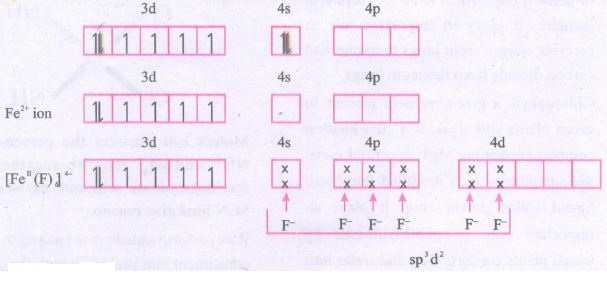
F- is weak field ligand
In [FeF6]4-the hybridisation takes place is sp3d2
The number of unpaired electrons = 4.
\(\therefore \mu =\sqrt { 4(4+2) } =\sqrt { 24 } \)
The molecule is paramagnetic due to the presence of unpaired electrons.
The geometry of the molecule is octahedral.
b) [Fe(CN)6]4-
.JPG)
In [Fe(CN)6]4- complex, the CN- ligand is a powerful ligand, it forces the unpaired electrons in the 3d level to pair up inside.
Hence the species has no unpaired electron after hybridisation So the molecule is diamagnetic.
.JPG)
The geometry of the molecule is octahedral.

12th Standard Syllabus & Materials
12th Standard
TN 12th Computer Applications களப்பெயர் முறைமை (DNS) Sample Question Papers Study Material - QB365 Set A
NEW12th Standard
TN 12th Computer Applications வலையமைப்பு எடுத்துக்காட்டுகள் மற்றும் நெறிமுறைகள் Sample Question Papers Study Material - QB365 Set A
NEW12th Standard
TN 12th Computer Applications கணினி வலையமைப்பு ஓர் அறிமுகம் Sample Question Papers Study Material - QB365 Set A
NEW12th Standard
TN 12th Computer Applications PHP-உடன் MySQL-ஐ இணைத்தல் Sample Question Papers Study Material - QB365 Set A



Tamilnadu Stateboard 12th Standard Subjects

Maths
Chemistry

Physics

Biology

Computer Science

Business Maths and Statistics

Economics

Commerce

Accountancy

History

Computer Applications
Biology
Computer Technology
Computer Applications
Computer Science
Business Maths and Statistics
Commerce
Economics
Maths
Chemistry
Physics
Computer Technology
History
Accountancy

Tamil

English

French
Tamilnadu Stateboard Standards
