
 100% FREE ACCESS
12th Standard Syllabus & Materials
12th Standard
TN 12th Computer Applications மின்னணு தரவு பரிமாற்றம் Sample Question Papers Study Material - QB365 Set A
NEW12th Standard
TN 12th Computer Applications மின் - வணிக பாதுகாப்பு அமைப்புகள் Sample Question Papers Study Material - QB365 Set A
NEW12th Standard
TN 12th Computer Applications மின்னணு செலுத்தல் முறைகள் Sample Question Papers Study Material - QB365 Set A
NEW12th Standard
TN 12th Computer Applications மின் - வணிகம் Sample Question Papers Study Material - QB365 Set A
NEW12th Standard
TN 12th Computer Applications திறந்த மூல கருத்துருக்கள் Sample Question Papers Study Material - QB365 Set A
NEW12th Standard
TN 12th Computer Applications வலையமைப்பு வடமிடல் Sample Question Papers Study Material - QB365 Set A

Published on: 07/01/2020
Hydroxy Compounds and Ethers
Download Tamil Nadu 12th Standard Chemistry question papers, model tests, one-mark questions, important questions, and public exam papers in PDF format. Free study materials and answer keys for TN State Board students.
Questions + Answers key
Take MCQ Chemistry Test
1.
Which one of the following would not react with cone. HCI and anhy. ZnCl2 at room temperature?
(CH3)3COH
(CH3)2CHOH
\({ CH }_{ 3 }-{ CH }_{ 2 }-\underset { \overset { | }{ { CH }_{ 3 } } }{ CH } -OH\)
CH3 - CH2 - CH2 - OH
2.
Which among the following statement are correct with regard to alkyl halides?
Alkyl halides on heating with aq NaOH gives alcohols
10 alkyl halides proceed by SN2 mechanism
20 and 30 alkyl halides undergo substitution by SN1 mechanism
all the above
3.
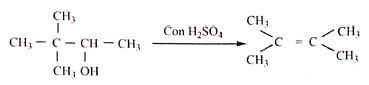
(CH3)3-C-CH(OH) CH3 \(\overset { con{ H }_{ 2 }{ SO }_{ 4 } }{ \longrightarrow } \)X (major product)
(CH3)3 CCH = CH2
(CH3)2C = C (CH3)2
CH2= C(CH3)CH2-CH2- CH3
CH2= C (CH3) - CH2- CH2- CH3
4.
Carbolic acid is _____.
Phenol
Picri cacid
benzoic acid
phenylacetic acid
5.
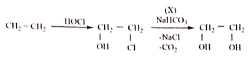
In the reaction sequence, Ethane \(\overset { HOCl }{ \longrightarrow } A\overset { x }{ \longrightarrow } \) ethan -1, 2 - diol. A and X respectively are ________.
Chloroethane and NaOH
ethanol and H2SO4
2 – chloroethan -1-ol and NaHCO3
ethanol and H2O
6.
Account for the following:
(i) Phenol has a smaller dipole moment than methanol,
(ii) Phenols do not give protonation reaction readily.
7.
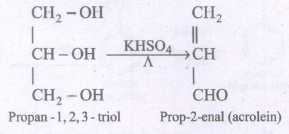
How does glycerol react with KHSO4?
8.
Give chemical tests to distinguish between propan-2-ol and 2-methyl-propan-2-ol.
9.
How will you convert acetylene into n-butyl alcohol.
10.
Is it possible to oxidise t – butyl alcohol using acidified dichromate to form a carbonyl compound.
11.
Can we use nucelophiles such as NH3,CH3O - for the Nucleophilic substitution of alcohols
12.
What is the major product obtained when two moles of ethyl magnesium bromide is treated with methyl benzoate followed by acid hydrolysis.
13.
Draw the major product formed when 1-ethoxyprop-1-ene is heated with one equivalent of HI.
14.
Explain why phenol does not undergo substitution of the -OH group like alcohol.
15.
What is metamerism? Give the structure and IUPAC name of metamers of 2-methoxy propane
16.
What will be the product (X and A) for the following reaction acetylchloride \(\frac{\text { i) } \mathrm{CH}_{3} \mathrm{MgBr}}{\text { ii) } \mathrm{H}_{3} \mathrm{O}^{+}}{\longrightarrow} \mathrm{X} \stackrel{\text { acid } \mathrm{K}_{2} \mathrm{Cr}_{2} \mathrm{O}_{7}}{\longrightarrow}\) A
17.
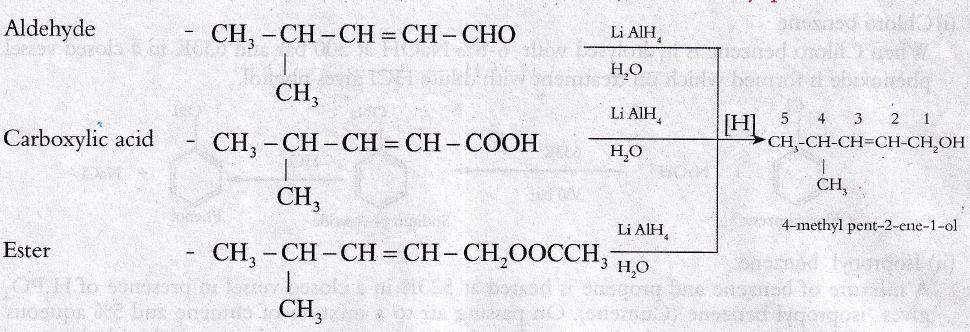
Write the structure of the aldehyde, carboxylic acid and ester that yield 4- methylpent -2-en-1-ol.
18.
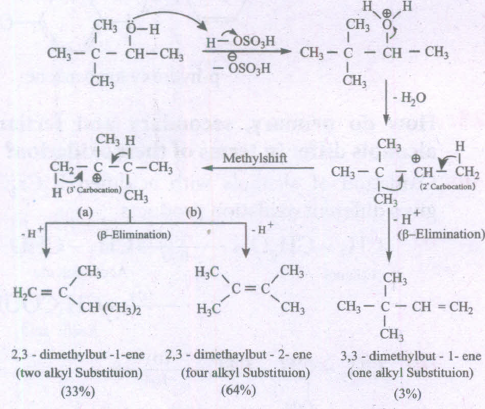
What is major product formed when 3,3-dimethyl-2-butanol is heated in the presence of H2SO4.
19.
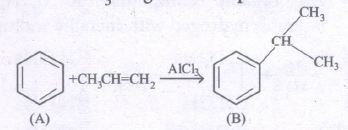
An aromatic hydrocarbon A reacts with propene in the presence of anhydrous AlCl3 to give a compound B with a molecular formula C9H12 Further compound B undergoes oxidation in the, presence of air to give hydrogen peroxide C. Compound C decomposes in HCI acid solution to give compound D and acetone. Identify A, B, C and D. Explain the reactions.
1.
(d)
CH3 - CH2 - CH2 - OH
2.
(d)
all the above
3.
(CH3)2C = C (CH3)2
4.
(a)
Phenol
5.
6.
(i) Phenol are only sparingly soluble in water. Actually they form only negligible hydrogen bonding with water since the size of the phenyl group is large and it almost masks the polar character of -OH group. So, phenol has a smaller dipole moment.
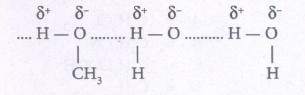
(ii) But methanol is soluble in soluble in water due to the formation of hydrogen bonding with water and it results in higher dipole moment. In henol, there is +ve charge on oxygen, therefore it does not undergo protonation easily.

7.
When glycerol is heated with dehydrating agents such as Con H2SO, KHSO4 etc .... , it undergoes dehydration to form acrolein.
8.
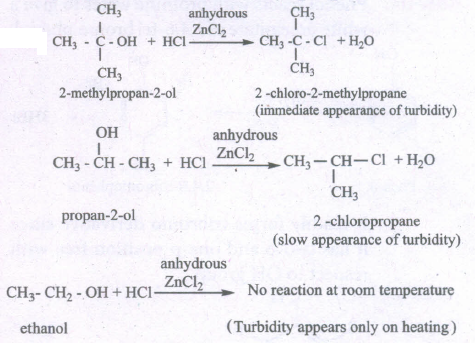
9.
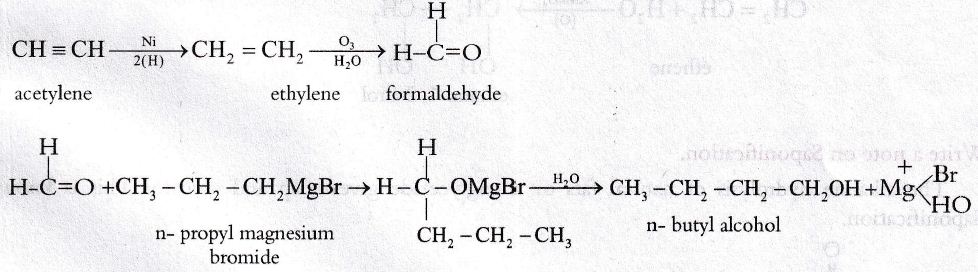
10.
Tertiary alcohols do not undergo oxidation reaction under normal conditions, but at elevated temperature under strong oxidizing, agent cleavage of C-C-bond takes place to give a mixture of carboxylic acid.
11.
Yes, we can use nucleophiles such as NH3, CH3O- for the nucleophilic substitution of alcohol.
Example
\(\mathrm{C}_{2} \mathrm{H}_{5} \mathrm{OH}+\mathrm{NH}_{3} \rightarrow \mathrm{C}_{2} \mathrm{H}_{5} \mathrm{NH}_{2}+\mathrm{H}_{2} \mathrm{O} \)
\(\mathrm{C}_{2} \mathrm{H}_{5} \mathrm{OH}+\mathrm{CH}_{2} \mathrm{~N}_{2} \rightarrow \mathrm{C}_{2} \mathrm{H}_{5} \mathrm{OCH}_{3}+\mathrm{N}_{2}\)
12.
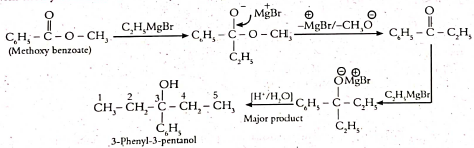
13.

14.
In phenol the electron density is increased in the benzene ring and hence the benzene ring is activated towards electrophilic substitution reaction and -OH group does not undergo substitution reaction like alcohol.
15.
Ethers having same molecular formula, but alkyl groups attached to the oxygen atom are different. This phenomenon is known as metamerism.
Metamers of 2- methoxy propane
\(\mathrm{C}_{2} \mathrm{H}_{5}-\mathrm{O}-\mathrm{C}_{2} \mathrm{H}_{5}-\) diethyl ether
\(\mathrm{CH}_{3}-\mathrm{O}-\mathrm{CH}_{2}-\mathrm{CH}_{2}-\mathrm{CH}_{3}\) methyl n-propyl ether
16.
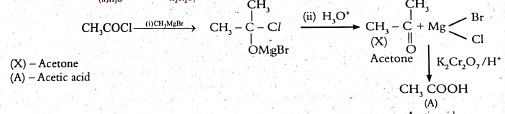
17.
18.
Saytzeff's rule: During intramolecular dehydration, if there is a possibility to form a carbon-carbon double bond at different locations, the preferred location is the one that gives the more (highly) substituted alkene l.e., the stable alkene.
For example, the dehydration of 3,3 - dimethyl - 2- butanol gives a mixture of alkenes. The secondary carbocation formed in this reaction undergoes rearrangement to form a more stable tertiary carbocation.
19.
(i) An aromatic hydrocarbon A reacts with propene in the presence of anhydrous AICl3 to give a compound B.
(ii) Compound B undergoes oxidation in the presence of air and hydrogen peroxide to give C.
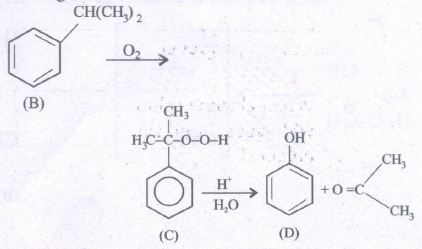
(iii) Compound C decomposes in HCI acid solution to give compound D and acetone. Identify A, B, C and D. Explain the reactions.
| Compound | Compound Name | Formula |
| A | Benzene | C6H6 |
| B | Cumene | 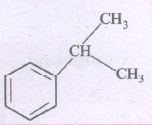 |
| C | Cumene hydroperoxide | 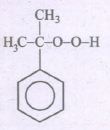 |
| D | Phenol | C6H5OH |

12th Standard Syllabus & Materials
12th Standard
TN 12th Computer Applications களப்பெயர் முறைமை (DNS) Sample Question Papers Study Material - QB365 Set A
NEW12th Standard
TN 12th Computer Applications வலையமைப்பு எடுத்துக்காட்டுகள் மற்றும் நெறிமுறைகள் Sample Question Papers Study Material - QB365 Set A
NEW12th Standard
TN 12th Computer Applications கணினி வலையமைப்பு ஓர் அறிமுகம் Sample Question Papers Study Material - QB365 Set A
NEW12th Standard
TN 12th Computer Applications PHP-உடன் MySQL-ஐ இணைத்தல் Sample Question Papers Study Material - QB365 Set A



Tamilnadu Stateboard 12th Standard Subjects

Maths
Chemistry

Physics

Biology

Computer Science

Business Maths and Statistics

Economics

Commerce

Accountancy

History

Computer Applications
Biology
Computer Technology
Computer Applications
Computer Science
Business Maths and Statistics
Commerce
Economics
Maths
Chemistry
Physics
Computer Technology
History
Accountancy

Tamil

English

French
Tamilnadu Stateboard Standards
