
 100% FREE ACCESS
12th Standard Syllabus & Materials
12th Standard
TN 12th Computer Applications மின்னணு தரவு பரிமாற்றம் Sample Question Papers Study Material - QB365 Set A
NEW12th Standard
TN 12th Computer Applications மின் - வணிக பாதுகாப்பு அமைப்புகள் Sample Question Papers Study Material - QB365 Set A
NEW12th Standard
TN 12th Computer Applications மின்னணு செலுத்தல் முறைகள் Sample Question Papers Study Material - QB365 Set A
NEW12th Standard
TN 12th Computer Applications மின் - வணிகம் Sample Question Papers Study Material - QB365 Set A
NEW12th Standard
TN 12th Computer Applications திறந்த மூல கருத்துருக்கள் Sample Question Papers Study Material - QB365 Set A
NEW12th Standard
TN 12th Computer Applications வலையமைப்பு வடமிடல் Sample Question Papers Study Material - QB365 Set A

Published on: 07/01/2020
Ionic Equilibrium
Download Tamil Nadu 12th Standard Chemistry question papers, model tests, one-mark questions, important questions, and public exam papers in PDF format. Free study materials and answer keys for TN State Board students.
Questions + Answers key
Take MCQ Chemistry Test
1.
Pick the strongest conjugate base among the following
Cl-
\({ NO }_{ 2 }^{ - }\)
\({ SO }_{ 4 }^{ 2- }\)
CH3COO-
2.
MY and NY3, are insoluble salts and have the same Ksp values of 6.2 × 10⁻¹³ at room temperature. Which statement would be true with regard to MY and NY3?
The salts MY and NY3 are more soluble in 0.5M KY than in pure water
The addition of the salt of KY to the suspension of MY and NY3 will have no effect on their solubility’s
The molar solubility of MY and NY3 in water are identical
The molar solubility of MY in water is less than that of NY3
3.
The percentage of pyridine (C5H5N) that forms pyridinium ion (C5H5NH) in a 0.10M aqueous pyridine solution _______.(Kb for C5H5N = 1.7×10⁻⁹) is
0.006%
0.013%
0.77%
1.6%
4.
Which of the following fluro compounds is most likely to behave as a Lewis base?
BF3
PF3
CF4
SiF4
5.
Concentration of the Ag+ ions in a saturated solution of Ag2C2O4 is 2.24 ×10⁻⁴mol L-1 solubility product of Ag2C2O4 is_______.
2.42 × 10⁻⁸mol3L-3
2.66 × 10⁻¹²mol3L-3
4.5 × 10⁻¹¹mol3L-3
5.619 × 10⁻¹²mol3L-3
6.
How is common ion effect related to the solubility of the electrolyte?
7.
The KW of a neutral solution is 10-12 at a particular temperature. What are its pH and pOH values?
8.
Calculate the pH of 0.001M HCl solution
9.
10.
A lab assistant prepared a solution by adding a calculated quantity of HCl gas 250C to get a solution with [H3O+] = 4\(\times\)10-5M. Is the solution neutral (or) acidic (or) basic.
11.
For an aqueous solution of NH4CI, prove that [H+] = \(\sqrt { { K }_{ n }.C } \)
12.
What do you mean by auto ionisation of water?
13.
Calculate i) degree of hydrolysis, ii) the constant hydrolysis and iii) pH of 0.1M CH3COONa solution (pKa for CH3COOH is 4.74).
14.
What is the pH of an aqueous solution obtained by mixing 6 gram of acetic acid and 8.2 gram of sodium acetate and making the volume equal to 500 ml. (Given: Ka for acetic acid is \(1.8\times10^{-5}\))
15.
Find the pH of a buffer solution containing 0.20 mole per litre sodium acetate and 0.18 mole per litre acetic acid. Ka for acetic acid is \(1.8\times10^{-5}\).
16.
Calculate the extent of hydrolysis and the pH of 0.1 M ammonium acetate Given that \(K_{a}=K_{b}=1.8\times10^{-5}\)
17.
The Ka value for HCN is 10-9. What is the pH of 0.4M HCN solution?
18.
pH of a solution is 5.5 at 25°C. Calculate its [OH-].
19.
1.
(d)
CH3COO-
2.
Addition of salt KY (having a common ion Y-) decreases the solubility of MY and NY3 due to common ion effect.
Option (a) and (b) are wrong
For salt MY, MY ⇌ M+ + Y-
Ksp = (s) (s)
6.2 × 10-13 = s2
\(\therefore\) s = \(\sqrt{6.2 \times 10^{-13}} = 10^{-7}\)
For salt NY3,
NY3 ⇌ N3+ + 3Y-
Ksp = (s) (3s)3
Ksp = 27s4
\(s = (\frac{6.2 \times 10^{-13}}{27})^{1/4}\)
s = 10-4
The molar solubility of MY in water is less than of NY3
3.
C5H5N + H-OH ⇌ C5H5 +NH + OH-
\(\frac { { \alpha }^{ 2 }{ C } }{ 1-\alpha } =K_b\)
\(\alpha\)2C \(\approx\) Kb
\(\alpha = \sqrt {\frac{K_b} C} = \sqrt {\frac{1.7 \times 10^{-9}} {0.1}}\)
\(= \sqrt{1.7} \times 10^{-4}\)
Percentage of dissociation =\(= \sqrt{1.7} \times 10^{-4}\) x 100
= 1.3 x 10-2 = 0.013%
4.
BF3 → electron deficient → Lewis acid
PF3 → electron rich → Lewis base
CF4 → neutral → neither Lewis acid nor base
SiF4 → neutral → neither Lewis acid nor base
5.
\(\mathrm{Ag}_{2} \mathrm{C_2O_4} \rightleftharpoons 2 \mathrm{Ag}_{}^{+}+\mathrm{C_2O}_{4{}}^{2-}\)
\(\left[\mathrm{Ag}^{+}\right]=2 .24 \) ×10-4mol L-1
\(\mathrm{C_2O}_{4{}}^{2-} = \frac {2.24 \times 10 ^{-4}}{2}\) mol L-1
= 1.12 ×10⁻⁴mol L-1
Ksp = [Ag]2 [C2O42-]
= (2.24 ×10⁻⁴mol L-1) (1.12 ×10⁻⁴mol L-1)
= 5.619 × 10⁻¹²mol3L-3
6.
Common ion effect decreases the solubility of the electrolyte.
7.
pKw = pH + pOH = 10-12
For a neutral solution, pH = pOH
So pH = pOH = 6.
8.
\(\underset{0.001M}{HCl}\overset{H_{2}O}{\rightleftharpoons }\underset{0.001M}{H_{3}O^{+}}+\underset{0.001M}{Cl^{-}}\)
H3O+ from the auto ionisation of H2O (10-7M) is negligible when compared to the H3O+ from 10-3M HCl.
Hence [H3O+] = 0.001 mol dm-3
pH = -log10 [H3O+]
= -log10(0.001)
= -log10(10-3) = 3
9.
10.
[H3O+] = 4 \(\times\) 10-5M
pH = - log10[H3O+]
pH=-log10[4 \(\times\) 10-5]
pH = -log10[4] - log10[10-5] log10 10 = 1
pH = -log 4 + 5log1010
= 5 - log 4
= 5 - 0.6021
=4.3979
Since pH is less than 7, the solution is acidic.
11.
NH4CI is a salt of a strong acid HCI and weak base NH4OH.
\({ HCl }_{ (aq) }+{ NH }_{ 4 }OH_{(aq)}\rightleftharpoons { { NH }_{ 4 }Cl }_{ (aq) }+{ H }_{ 2 }O(I)\)
\({ NH }_{ 4 }^{ + }\) is a strong conjugate acid of the weak base NH4OH and it has a tendency to react with OH- from water to produce unionised NH4OH shown below.
\({ NH }_{ 4 }^{ + }+{ H }_{ 2 }O(1)\rightleftharpoons { NH }_{ 4 }{ { { OH }_{ (aq) }+ }H }_{ (aq) }^{ + }\)
There is no such tendency shown by Cl- and therefore [H+] > [OH-]; the solution is acidic and the pH is less than 7.
As discussed in the salt hydrolysis of strong base and weak acid. In this case also, we can establish a relationship between the Kh and Kb as
Kh·Kb = Kw
Let us calculate the Kh value in terms of degree of hydrolysis (h) and the concentration of salt
Kb = h2C and \([{ H }^{ + }]=\sqrt { { K }_{ h }.C } \)
= \({ [H }^{ + }]=\sqrt { \frac { { K }_{ w } }{ { K }_{ b } } .C } \)
pH = - log [H+]
\(={ \left( \frac { { K }_{ w }.C }{ { K }_{ b } } \right) }^{ \frac { 1 }{ 2 } }\)
= \(-\frac { 1 }{ 2 } \log { K }_{ w }-\frac { 1 }{ 2 } \log C+\frac { 1 }{ 2 } \log{ K }_{ b }\)
\(pH=7-\frac { 1 }{ 2 } p{ K }_{ b }-\frac { 1 }{ 2 } \log C\)
12.
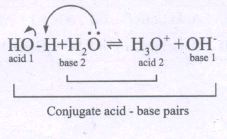
Pure water itself has a little tendency to dissociate. i.e, one water molecule donates a proton to an another water molecule. This is known as auto ionisation of water and it is represented as below.
13.
(a) CH3COONa is a salt of weak acid
(CH3COOH) and a strong base (NaOH).
Hence, the solutions is alkaline due to hydrolysis.
\(CH_{3}COO^{-}_{(aq)}+H_{2}O_{(aq)}\rightleftharpoons CH_{3}COOH_{(aq)}+OH^{-}_{(aq)}\)
(i)\(h=\sqrt{\frac{K_{w}}{K_{a}\times C}}\)
Given that pKa =4.74
pKa = -log Ka
ie., Ka = antilog of (-pKa)
= antilog of (-4.74)
= antilog of (-5 + 0.26)
= 10-5 \(\times\) 1.8 = 1.8 \(\times\) 10-5
[antilog of 0.26 = 1.82 \( \simeq\) 1.8]
\(\therefore\) h=\(\sqrt{\frac{1\times10^{-14}}{1.8\times10^{-5}\times0.1}}\)
h = 7.5 x 10⁻⁵
(ii) \(K_{h}=\frac{K_{w}}{K_{a}}=\frac{1\times10^{-14}}{1.8\times10^{-5}}\)
\(=5.56\times10^{-10}\)
iii) \(pH=7+\frac{pK_{a}}{2}+\frac{logC}{2}\)
= \(7+\frac{4.74}{2}+\frac{log0.1}{2}\)
= 7 + 2.37 - 0.5
= 8.87
14.
According to Henderson – Hasselbalch equation,
\(pH=pK_{a}+\log\frac{[salt]}{[acid]}\)
\(p{K_{a}}=-\log K_{a}=-\log(1.8\times10^{-5})=4.74\)
[Salt]=\(\frac{\text {Number of moles of sodium acetate}}{\text {Volume of the solution (litre)}}\)
Number of moles of sodium acetate =\(\frac{\text {mass of sodium acetate}}{\text {molar mass of sodium acetate}}\)
\(=\frac{8.2}{82}=0.1\)
\(\therefore [Salt]=\frac{0.1\ mole}{1/2 \ Litre}=0.2M\)
\([acid]=\frac{(\frac{mass \ of \ CH_{3}COOH}{molar \ mass \ of \ CH_{3}COOH})}{\text{Volume of solution in litre}}\)
=\(\frac{(\frac{6}{60})}{\frac{1}{2}}\)=0.2 M
\(\therefore pH=4.74+log\frac{(0.2)}{(0.2)}\)
pH = 4.74 + log1
pH = 4.74 + 0 = 4.74
15.
\(pH=pK_{a}+\log[\frac{salt}{acid}]\)
Given that Ka = \(1.8\times10^{-5}\)
\(\therefore pK_{a}=-\log(1.8\times10^{-5})\)
= 5 - log 1.8
= 5 - 0.26
= 4.74
\(\therefore pH=4.74+\log\frac{0.20}{0.18}\)
= 4.74 + log(10/9)
= 4.74 + log10 - log9
= 4.74 + 1 - 0.95
= 5.74 - 0.95
= 4.79
16.
\(h=\sqrt{K_{h}}=\sqrt{\frac{K_{w}}{K_{a}K_{b}}}=\sqrt{\frac{1\times10^{-14}}{1.8\times10^{-5}\times{1.8\times10^{-5}}}}\)
\(= \frac{1 \times10^{-7}}{1.8\times10^{-5}}\)
=\(0.7453\times10^{-2}\)
\(pH=\frac{1}{2}pK_{w}+\frac{1}{2}pK_{a}-\frac{1}{2}pK_{b}\)
Given that \(K_{a}=K_{b}=1.8\times10^{-5}\)
if Ka = Kb, then, pKa = pKb
\(\therefore pH= \frac{1}{2}pK_{w}=\frac{1}{2}(14)=7\)
pH = 7
17.
HCN is a weak acid
\({\left[\mathrm{H}^{+}\right] } =\sqrt{\mathrm{K}_{\mathrm{a}} \cdot \mathrm{C}} \)
\(=\sqrt{10^{-9} \times 0.4} \)
\(=\sqrt{4 \times 10^{-10}} \)
\(=2 \times 10^{-5} \)
\(\mathrm{pH} =-\log _{10}\left[\mathrm{H}^{+}\right] \)
\(=-\log _{10}\left(2 \times 10^{-5}\right) \)
\(=-\left[\log _{10} 2-5 \log 10\right] \)
\(=5-\log 2\)
= 5-0.3010 = 4.6990
18.
pH + pOH = 14.0
∴ pOH = 14.0 - pH
= 14.0 - 5.5 = 8.50
pOH = 8.5 ∴ antilog [-pOH]|
∴ [OH-] = antilog [-8.5] = 3.2 x 10⁻⁹ M.
19.

12th Standard Syllabus & Materials
12th Standard
TN 12th Computer Applications களப்பெயர் முறைமை (DNS) Sample Question Papers Study Material - QB365 Set A
NEW12th Standard
TN 12th Computer Applications வலையமைப்பு எடுத்துக்காட்டுகள் மற்றும் நெறிமுறைகள் Sample Question Papers Study Material - QB365 Set A
NEW12th Standard
TN 12th Computer Applications கணினி வலையமைப்பு ஓர் அறிமுகம் Sample Question Papers Study Material - QB365 Set A
NEW12th Standard
TN 12th Computer Applications PHP-உடன் MySQL-ஐ இணைத்தல் Sample Question Papers Study Material - QB365 Set A



Tamilnadu Stateboard 12th Standard Subjects

Maths
Chemistry

Physics

Biology

Computer Science

Business Maths and Statistics

Economics

Commerce

Accountancy

History

Computer Applications
Biology
Computer Technology
Computer Applications
Computer Science
Business Maths and Statistics
Commerce
Economics
Maths
Chemistry
Physics
Computer Technology
History
Accountancy

Tamil

English

French
Tamilnadu Stateboard Standards
