
 100% FREE ACCESS
12th Standard Syllabus & Materials
12th Standard
TN 12th Computer Applications மின்னணு தரவு பரிமாற்றம் Sample Question Papers Study Material - QB365 Set A
NEW12th Standard
TN 12th Computer Applications மின் - வணிக பாதுகாப்பு அமைப்புகள் Sample Question Papers Study Material - QB365 Set A
NEW12th Standard
TN 12th Computer Applications மின்னணு செலுத்தல் முறைகள் Sample Question Papers Study Material - QB365 Set A
NEW12th Standard
TN 12th Computer Applications மின் - வணிகம் Sample Question Papers Study Material - QB365 Set A
NEW12th Standard
TN 12th Computer Applications திறந்த மூல கருத்துருக்கள் Sample Question Papers Study Material - QB365 Set A
NEW12th Standard
TN 12th Computer Applications வலையமைப்பு வடமிடல் Sample Question Papers Study Material - QB365 Set A

Published on: 07/01/2020
Metallurgy
Download Tamil Nadu 12th Standard Chemistry question papers, model tests, one-mark questions, important questions, and public exam papers in PDF format. Free study materials and answer keys for TN State Board students.
Questions + Answers key
Take MCQ Chemistry Test
1.
Which of the following is incorrect with respect to metallurgy of iron in the blast furnace?
Zone of combustion : \(C+{ O }_{ 2 }\rightarrow { CO }_{ 2 }\)
Zone of heat absorption : \({ CO }_{ 2 }\rightarrow C+{ O }_{ 2 }\)
Zone of slag formation : \(CaO+{ SiO }_{ 2 }\rightarrow CaSiO_{ 3 }\)
Zone of reduction : \({ Fe }_{ 2 }{ O }_{ 3 }3C\rightarrow 3CO+2Fe\)
2.
3.
Wolframite ore is separated from tinstone by the process of________.
Smelting
Calcination
Roasting
Electromagnetic separation
4.
Which of the following statements, about the advantage of roasting of sulphide ore before reduction is not true?
\(\Delta { G }_{ f }^{ 0 }\) of sulphide is greater than those for CS2 and H2S
\(\Delta { G }_{ r }^{ 0 }\) is negative for roasting of sulphide ore to oxide
Roasting of the sulphide to its oxide is thermodynamically feasible
Carbon and hydrogen are suitable reducing agents for metal sulphides
5.
Which of the metal is extracted by Hall-Heroult process?
Al
Ni
Cu
Zn
6.
What is distillation?
7.
Write the two similarities between calcination and roasting.
8.
Name some elements that occur as native elements.
9.
The selection of reducing agent depends on the thermodynamic factor: Explain with an example.
10.
Give the basic requirement for vapour phase refining.
11.
Explain the electrometallurgy of aluminium.
12.
Out of coke and CO, which is better reducing agent for the reduction of ZnO? Why?
13.
What is the role of quick lime in the extraction of Iron from its oxide Fe2O3?
14.
What is zone refining? Describe the principle involved in the purification of the metal by this method.
15.
Explain concentration by magnetic separation with diagram.
16.
Explain zone refining process with an example.
17.
Explain roasting with an example.
18.
What is meant by ammonia leaching?
19.
Write a short note on electrochemical principles of metallurgy.
1.
(b)
Zone of heat absorption : \({ CO }_{ 2 }\rightarrow C+{ O }_{ 2 }\)
2.
(c)
3.
(d)
Electromagnetic separation
4.
(d)
Carbon and hydrogen are suitable reducing agents for metal sulphides
5.
(a)
Al
6.
(i) Distillation is employed for low boiling volatile metals like zinc (boiling point 1180 K) and mercury (630 K).
(ii) In this method, the impure metal is heated to evaporate and the vapours are condensed to get pure metal.
7.
(i) The end product of both the processes is oxide of metal.
(ii) Volatile impurities are removed from the ore and surface area for the further reaction increases.
8.
Copper, Silver, Gold and Platinum
9.
(i) The extraction of metals from their oxides can be carried out by using different reducing agents.
(ii) Consider the following reaction
\(\frac{2}{\mathrm{y}} \mathrm{M}_{\mathrm{x}} \mathrm{O}_{\mathrm{y}(\mathrm{s})} \rightarrow \frac{2 \mathrm{x}}{\mathrm{y}} \mathrm{M}_{(s)}+\mathrm{O}_{ 2(\mathrm{~g})}\) (1)
(iii) The above reduction may be carried out with carbon. In this case the reducing agent carbon may be oxidized to either CO or CO2
\(\mathrm{C}+\mathrm{O}_{2} \rightarrow \mathrm{CO}_{2(\mathrm{~g})} \) (2)
\(2 \mathrm{C}+\mathrm{O}_{2} \rightarrow 2 \mathrm{CO}_{(\mathrm{g})} \) (3)
(iv) If CO is used as a reducing agent
\(2 \mathrm{CO}+\mathrm{O}_{2} \rightarrow 2 \mathrm{CO}_{2(\mathrm{~g})}\) (4)
(v) A suitable reducing agent is selected based on the thermodynamics considerations.
(vi) We know that for a spontaneous reaction, the change in free energy (\(\triangle\)G) should be negative.
(vii) Therefore, thermodynamically, the reduction of metal oxide with a given reducing agent can occur if the free energy change for the coupled reaction is negative.
(viii) Hence, the reducing agent is selected in such a way that it provides a large negative \(\triangle\)G value for the coupled reaction.
10.
In this method, the metal is treated with a suitable reagent which can form a volatile compound with the metal.
Then the volatile compound is decomposed to give the pure metal.
11.
1. This process is called as Hall-Heroult process.
Cathode: In this method, electrolysis is carried out in an iron tank lined with carbon which acts as the cathode.
Anode: The carbon blocks immersed in the electrolyte acts as a anode.
Eletrolyte: A 20% solution of alumina, obtained from the bauxite ore is mixed with molten Cryolite and is taken in the electrolysis chamber.
2. About 10% calcium chloride is also added to the solution.
3. Here Calcium chloride helps to lower the melting point of the mixture.
Temperature: The fused mixture is maintained at a temperature of above 1270 K.
4. The chemical reactions involved in this process as follows
(a) Ionisaiton of alumina: \({ A }l_{ 2 }{ O }_{ 3 }\longrightarrow { 2Al }^{ 3+ }+{ 3O }^{ 2- }\)
(b) Reaction at cathode: \(2{ Al }^{ 3+ }_{(melt)}+{ 6e }^{ - }\longrightarrow { Al }_{ (l) }\)
(c) Reaction at anode: \(6{ O }^{2-}_{(melt)}\longrightarrow { 3O }_{ 2 }+{ 12e }^{ - }\)
5. Since carbon acts as anode the following reaction also takes place
(a) \({ C }_{ (s) }+{ O }^{ 2- }_{(melt)}\longrightarrow CO+{ 2e }^{ - }\)
(b) \({ C }_{ (s) }+{ 2O }^{ 2- }_{(melt)}\longrightarrow { CO }_{ 2 }+{ 4e }^{ - }\)
6. Due to the above two reactions, anodes are slowly consumed during the electrolysis.
7. The pure aluminium is formed at the cathode. The net electrolysis reaction can be written as
\({ 4Al }^{ 3+ }_{(melt)}+{ 6O }^{ 2- }_{(melt)}+{ 3C }_{ (s) }\longrightarrow { 4Al }_{ (l) }+{ 3CO }_{ 2(g) }\)
12.
Ellingham diagram for the formation of ZnO and CO2 intersects around 1200 K. Above this temperature ZnO lies above Carbon which indicates Carbon is the better reducing agent CO is more effective reducing agent only below 983 K.
13.
In this extraction, a basic flux, quick lime (CaO) is used, since the silica gangue present in the ore is acidic in nature. The quick lime combines with it to form calcium silicate (slag).
CaO(s) + Sio2(s) ⟶ CaSio3(s)
Flux Gangue Slag
14.
Zone refining:
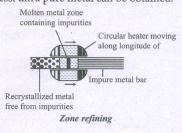
This method is employed for preparing highly pure metal (such as silicon, tellurium, germanium), which are used as semiconductors. It is based on the principle that melting point of a substance is lowered by the presence of impurities. Consequently, when an impure molten metal is cooled, crystals of the pure metal are solidified, and the impurities remain behind the remaining metal.
The process consists In casting the impure metal in the form of a bar. A circular heater fitted around this bar is slowly moved longitudinally from one end to the other. At the heated zone, the bar melts, and as the heater moves on, pure metal crystallizes, while the impurities pass into the adjacent molten part In this way, the impurities are swept from one end of the bar to the other. By repeating the process, ultra pure metal can be obtained.
15.
(i) Magnetic separation is applicable to ferromagnetic ores and it is based on the difference in the magnetic properties of the ore and the impurities.
(ii) For example tin stone can be separated from the wolframite impurities which is magnetic.
(iii) Similarly, ores such as chromite, pyrolusite having magnetic property can be removed from the non magnetic siliceous impurities.
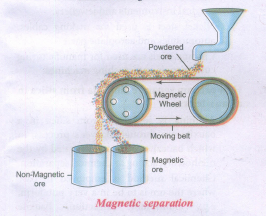
(iv) The crushed ore is poured on to an electromagnetic separator consisting of a belt moving over two rollers of which one is magnetic.
(v) The magnetic part of the ore is attracted towards the magnet and falls as a heap close to the magnetic region while the nonmagnetic part falls away from it as shown in the figure.
16.
Zone refining :
1. Zone refining method is based on the principles of fractional crystallisation.
2. When an impure metal is melted and allowed to solidify, the impurities will prefer to be in the molten region. In this process the impure metal is taken in the form of a rod.
3. One end of the rod is heated using a mobile induction heater which results in melting of the metal on that portion of the rod.
4. When the heater is slowly moved to the other end the pure metal crystallises while the impurities will move on to the adjacent molten zone.
5. As the heater moves further away, the molten zone containing impurities also moves along with it.
6. The process is repeated several times by moving the heater in the same direction again and again to get pure metal.
7. This process is carried out in an inert gas atmosphere to prevent the oxidation of metals.
8. Elements such as germanium (Ge), silicon (Si) and galium (Ga) that are used as semiconductor are refined using this process.
17.
(i) Roasting is the method, usually applied for the conversion of sulphide ores into their oxides.
(ii) In this method, the concentrated ore is oxidised by heating it with excess of oxygen in a suitable furnace below the melting point of the metal.
(iii) \(2PbS+{ 3O }_{ 2 }\overset { \Delta }{ \longrightarrow } 2PbO+{ 2SO }_{ 2 }\uparrow \)
\(2ZnS+{ 3O }_{ 2 }\overset { \Delta }{ \longrightarrow } 2ZnO+2{ SO }_{ 2 }\uparrow \)
\(2Cu_{ 2 }S+{ 3O }_{ 2 }\overset { \Delta }{ \longrightarrow } 2Cu_2O + 2SO_2\uparrow \)
(iii) Roasting also removes impurities such as arsenic, sulphur, phosphorous by converting them into their volatile oxides
(v) Ex.\(4As+{ { 3O }_{ 2 } }\longrightarrow { 2As }_{ 2 }{ O }_{ 3 }\uparrow \)
\( \mathrm{S}_{8}+8 \mathrm{O}_{2} \longrightarrow 8 \mathrm{SO}_{2} \uparrow \)
\(\mathrm{P}_{4}+5 \mathrm{O}_{2} \longrightarrow \mathrm{P}_{4} \mathrm{O}_{10} \uparrow\)
18.
When a crushed ore containing nickel, copper and cobalt is treated with aqueous ammonia under suitable pressure, ammonia selectively leaches these metals by forming their soluble complexes viz. [Ni(NH3)6]2+, [Cu(NH3)4]2+, and [Co(NH3)5H2O]3+ respectively from the ore leaving behind the gangue, iron(III) oxides/ hydroxides and aluminosilicate.
19.
1. Reduction of oxides of active metals such as sodium, potassium etc., by carbon is thermodynamically not feasible.
2. Such metals are extracted from their ores by using electrochemical methods.
3. In this technique, the metal salts are taken in a fused form or in solution form.
4. The metal ion present can be reduced by some suitable reducing agent or by electrolysis.
5. Gibbs free energy for the electrolysis process is given by
Here,
\(\Delta\)Go = -nFEo
\(\Delta\)Go - Standard Gibb's free energy change
n - number of electrons involved,
F - Faraday,
Eo - Standard electrode potential
6. If Eo is positive then the \(\Delta\)Go is negative and the reduction is spontaneous
7. Hence a redox reaction is planned in such a way that the e.m.f of the net redox reaction is positive.
8. When a more reactive metal is added to less reactive metal salt solution, the more reactive metal will go into the solution.
Example:
\({ Cu }_{ (s) }+2{ Ag }^{ + }_{ (aq) }\longrightarrow { Cu }^{ 2+ }_{ (aq) }+2{ Ag }_{ (s) }\)
\({ Cu }^{ 2+ }_{ (aq) }+{ Zn }_{ (s) }\longrightarrow { Cu }_{ \left( s \right) } +{ Zn }^{ 2+ }_{ (aq) }\)

12th Standard Syllabus & Materials
12th Standard
TN 12th Computer Applications களப்பெயர் முறைமை (DNS) Sample Question Papers Study Material - QB365 Set A
NEW12th Standard
TN 12th Computer Applications வலையமைப்பு எடுத்துக்காட்டுகள் மற்றும் நெறிமுறைகள் Sample Question Papers Study Material - QB365 Set A
NEW12th Standard
TN 12th Computer Applications கணினி வலையமைப்பு ஓர் அறிமுகம் Sample Question Papers Study Material - QB365 Set A
NEW12th Standard
TN 12th Computer Applications PHP-உடன் MySQL-ஐ இணைத்தல் Sample Question Papers Study Material - QB365 Set A



Tamilnadu Stateboard 12th Standard Subjects

Maths
Chemistry

Physics

Biology

Computer Science

Business Maths and Statistics

Economics

Commerce

Accountancy

History

Computer Applications
Biology
Computer Technology
Computer Applications
Computer Science
Business Maths and Statistics
Commerce
Economics
Maths
Chemistry
Physics
Computer Technology
History
Accountancy

Tamil

English

French
Tamilnadu Stateboard Standards
