
 100% FREE ACCESS
12th Standard Syllabus & Materials
12th Standard
TN 12th Computer Applications மின்னணு தரவு பரிமாற்றம் Sample Question Papers Study Material - QB365 Set A
NEW12th Standard
TN 12th Computer Applications மின் - வணிக பாதுகாப்பு அமைப்புகள் Sample Question Papers Study Material - QB365 Set A
NEW12th Standard
TN 12th Computer Applications மின்னணு செலுத்தல் முறைகள் Sample Question Papers Study Material - QB365 Set A
NEW12th Standard
TN 12th Computer Applications மின் - வணிகம் Sample Question Papers Study Material - QB365 Set A
NEW12th Standard
TN 12th Computer Applications திறந்த மூல கருத்துருக்கள் Sample Question Papers Study Material - QB365 Set A
NEW12th Standard
TN 12th Computer Applications வலையமைப்பு வடமிடல் Sample Question Papers Study Material - QB365 Set A

Published on: 07/01/2020
Organic Nitrogen Compounds
Download Tamil Nadu 12th Standard Chemistry question papers, model tests, one-mark questions, important questions, and public exam papers in PDF format. Free study materials and answer keys for TN State Board students.
Questions + Answers key
Take MCQ Chemistry Test
1.
Identify the product of the following reaction.
CH3Mg Br + CI - CN ⟶ ?
ethanenitrile
acetamide
propanenitrile
acetaldoxime
2.
Which among the following reactions will give a secondary amine?
\(\mathrm{CH}_{3} \mathrm{CONH}_{2} \stackrel{\mathrm{Br}_{2} / \mathrm{KOH}}{\longrightarrow}\)
\(\mathrm{CH}_{3} \mathrm{CONH}_{2} \stackrel{\mathrm{LiAlH}_{4}}{\longrightarrow}\)
\({ CH }_{ 3 }CN\xrightarrow [ Na/{ C }_{ 2 }{ H }_{ 5 }OH ]{ } \)
\(\mathrm{CH}_{3} \mathrm{NC} \stackrel{\mathrm{LiAlH}_{4}}{\longrightarrow}\)
3.
C5H13N reacts with HNO2 to give an optically active compound – The compound is _______.
pentan – 1- amine
pentan – 2- amine
N,N – dimethylpropan -2-amine
diethyl methyl amine
4.
Which of the following reaction is not correct.
CH3 CH2 NH2 \(\overset { { HNO }_{ 2 } }{ \longrightarrow } \)CH3CH2 OH + N2

CH2 CONH2 \(\overset { { Br }_{ 2 }/NaOH }{ \longrightarrow } \)CH3 NH2
none of these
5.
CH3CH2 Br \(\overset { aqNaOH }{ \underset { \Delta }{ \longrightarrow } } A\overset { { KMnO }_{ 4 }{ /H }^{ + } }{ \underset { \Delta }{ \longrightarrow } } B\overset { { NH }_{ 3 } }{ \underset { \Delta }{ \longrightarrow } } C\overset { { Br }_{ 2 }/NaOH }{ \longrightarrow } D\) D' is________.
bromomethane
α - bromo sodium acetate
methanamine
acetamide
6.
What is chloropicrin?
7.
Two isomers having the molecular formula C2H5NO2 on hydrolysis in acidic medium gives (A) and (B). Identify (A) and (B) and explain the reactions involved.
8.
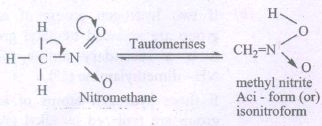
Define tautomerism.
9.
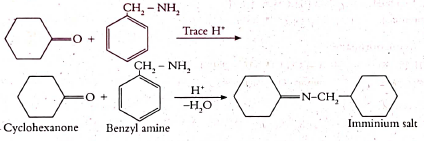
Complete the following reaction
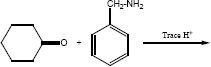
10.
There are two isomers with the formula CH3NO2. How will you distinguish between them?
11.
Write down the possible isomers of the C4H9NO2 give their IUPAC names.
12.
Account for the following:
(i) Nitroethane is soluble NaOH
(ii) Nitroethane reacts with nitrous acid
(iii) 2-methyl-2-nitro propane has neither of the properties.
13.
Account for
i) Reduction of CH3CH gives CH3CH2NH2 while CH3NC gives (CH3)2NH.
ii) (CH3)2NH requires two molar proportion of CH3I to give the same crystalline product formed by (CH3)2N with one mole of CH3l.
iii) Nitration of aniline with conc.HNO3 may end up with same meta nitro product.
iv) p-toluidine is a stronger base than p-nitroaniline.
14.
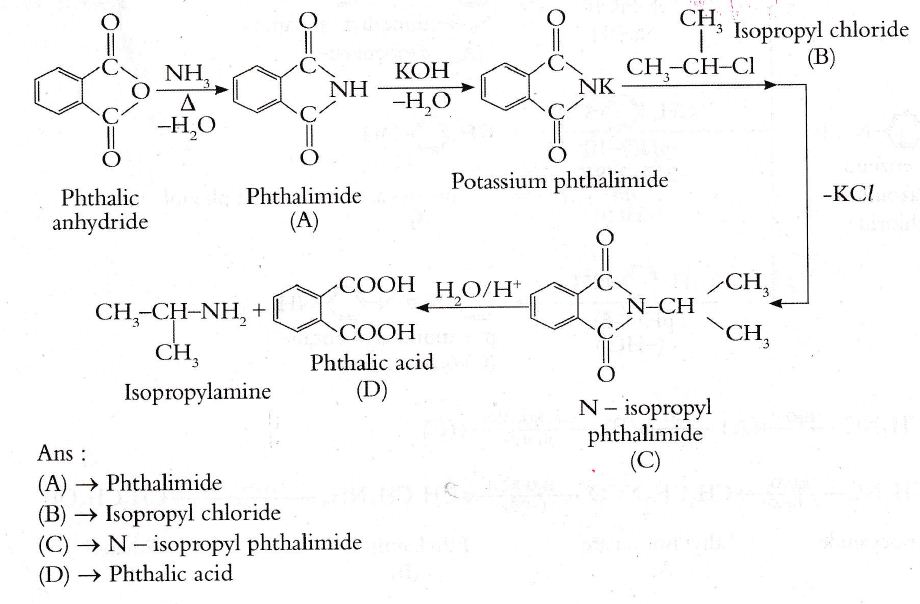
Predict A,B,C and D for the following reaction
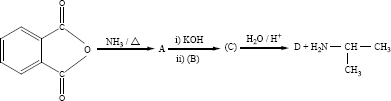
15.
Account for the following
i. Aniline does not undergo Friedel – Crafts reaction
ii. Diazonium salts of aromatic amines are more stable than those of aliphatic amines
iii. pKb of aniline is more than that of methylamine
iv. Gabriel phthalimide synthesis is preferred for synthesising primary amines.
v. Ethylamine is soluble in water whereas aniline is not
vi. Amines are more basic than amides
vii.Although amino group is o – and p – directing in aromatic electrophilic substitution reactions, aniline on nitration gives a substantial amount of m – nitroaniline.
16.
How will you distinguish between primary secondary and tertiary alphatic amines.
17.
An organic compound 'A' on reduction gives compound 'B' which on reaction with trichloromethane and caustic potash forms 'C'. Compound 'C' on catalytic reduction given N-methyl benzenamine. Identify A, B and C and write the reactions involved.
18.
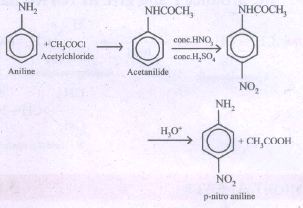
Outline the preparation of (a) para nitroaniline from aniline, (b) tri bromo benzene from tribromo aniline
19.
Explain Levine and hauser acetylation.
1.
(a)
ethanenitrile
2.
(d)
\(\mathrm{CH}_{3} \mathrm{NC} \stackrel{\mathrm{LiAlH}_{4}}{\longrightarrow}\)
3.
(b)
pentan – 2- amine
4.
(b)
5.
(c)
methanamine
6.
CCl3 - NO2 (trichloronitro. methane) is Chloropicrin.
7.
(A) CH3COOH - Acetic acid
(B) CH3CH2OH - Ethanol
CH3CH2 - NO2
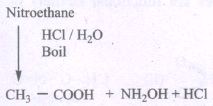
On the other hand, the acid or base hydrolysis of ethyl nitrite gives ethanol.
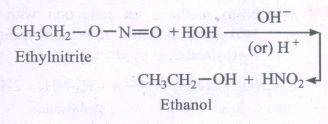
8.
Primary and secondary nitroalkanes, having α-H , also show an equilibrium mixture of two tautomers namely nitro - and aci - form.
9.
10.
a) Primary and secondary nitroalkanes, having α-H, also show an equilibrium mixture of two tautomers namely nitro - and aci - form
.JPG)
b) Difference:
| S.No | Nitro form | Aci - form |
| 1. | Less acidic in nature. | More acidic |
| 2. | Dissolves in NaOH slowly | Dissolves in NaOH instantly |
| 3. | Decolourises FeCl3 solution | With FeCl3 gives reddish brown colour |
| 4. | Electrical conductivity is low | Electrical conductivity is high |
11.
| Isomerism | Structural formula of isomers |
| Chain isomerism: They differ in the length of carbon chain. |
.JPG) |
| Position isomerism: They differ in the position of nitro group. |
.JPG) |
| Functional isomerism: Nitroalkanes exhibit functional isomerism with alkylnitrites |
\( \mathrm{CH}_{3} \mathrm{CH}_{2} \mathrm{CH}_{2} \mathrm{CH}_{2}-\mathrm{NO}_{2} \text { and } \mathrm{CH}_{3} \mathrm{CH}_{2} \mathrm{CH}_{2} \mathrm{CH}_{2}-\mathrm{O}-\mathrm{N}=\mathrm{O}\\ \quad 1 - nitrobutane \quad \quad \quad \quad \quad \quad \quad butyl \ nitrite\) |
12.
(i) Nitroethane exhibits tautomerism of nitro form and aci form. Aciform of nitroethane contains (α - Hydrogen) replaceable hydrogen atom. Hence it dissolves in sodium hydroxide solution forming salt like compounds.
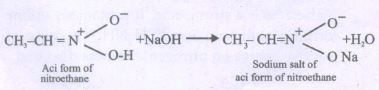
(ii) CH3CH2NO2 has two a-hydrogen and that reacts with HNO2
(iii) 2-methyl - 2 - nitro propane neither soluble in alkali nor reacts with nitrous acid. Because it contains a tertiary nitro group where aciform is not possible and . it does not contain α - H atoms. So it has neither of the properties.
13.
(i) CH3CN (Methyl cyanide) on reduction gives CH3CH2NH2 (ethylamine) because addition of hydrogen takes place at ≡ CN
\({ CH }_{ 2 }-C\equiv N\xrightarrow [ 4H ]{ { LiAH }_{ 4 } } { \underset { Ethylamine\\ (Primary\quad amine) }{ { CH }_{ 3 }-{ CH }_{ 2 }{ NH }_{ 2 } } }\)
Whereas CH3NC (Methyl isocyanide) on reduction with LiAlH4 gives secondary amine
\({ CH }_{ 3 }-\underset { \overset { | }{ H } }{ N } -{ CH }_{ 3 }\)
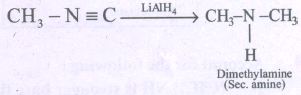
In methyl cyanide, -CN group is attached to alkyl group and by reduction it gives a primary amine wherease in methyl isocyanide -NC group is attached to alkyl group and by reduction it gives a secondary amine.
(ii) (CH3)2 NH (Secondary amine) requires 2 moles of CH3I to give a quaternary salt (crystalline product) whereas (CH3)2N (tertiary amine) require only one mole of CH3I to give the same quaternary salt. It is due to the number of alkyl groups present in amines.
\(\underset { Secondary \ anmine }{ { ( }{ CH }_{ 3 })_{ 2 }-NH+{ 2CH }_{ 3 }I } \rightarrow { { [(CH }_{ 3 })_{ 4 }N] }^{ + }\underset { Tetramethy\\ ammonium \ iodide }{ { I }^{ - } } \)
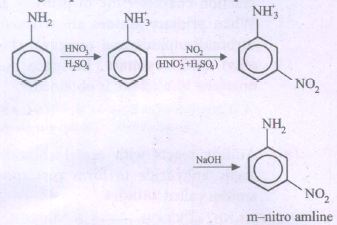
(iii) Nitration of aniline with cone. HNO3 results in the formation of m-nitro aniline because nitric acid is a strong acid. It protonates aniline forming anilinium ion C6H5NH3+ because of positive charge on nitrogen, it is meta directive and -NO2 group is substituted at meta position.
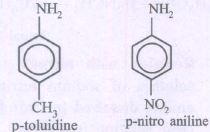
(iv) p-Toluidine contains a methyl group which has +I effect (electron withdrawing group and due to this, p-toluidine is a stronger base than p-nitro aniline in which the nitro group is less reactive and it deactivate the benzene rin make it a less basic
14.
15.
Aniline does not undergo Friedel - Craft's reaction:
Aniline does not undergo Friedel - Craft's reaction (alkylation and acetylation). Aniline is basic in nature and it donates its lone pair of electrons to the lewis acid AlCl3 to form an adduct which inhibits further electrophilic substitution reaction.
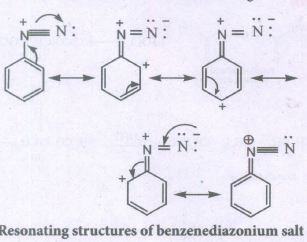
Diazonium salts of aromatic amines are more stable than those of aliphatic amines:
This is due to resonance
Resonance Structure:
The stability of arene diazonium salt is due to the dispersal of the positive charge over the benzene ring.
pKb of aniline is more than that of methylamine:
pKb - methylamine -3.35
pKb - aniline -9.376
In aniline the lone pair of electrons on N - atom is delocalized over the benzene ring. So, the electron density on the N - atom decreases. In methylamine + 1 effect to CH3 group increases the electron density on the nitrogen atom Hence aniline is a weaker base than methylamine. Due to this, the pKb value for aniline is more than that of methylamine.
(iv) Gabriel phthalimide synthesis is preferred for synthesising primary amines:
In this method alkyl halides react with pottassium phthalimide to give pure primary amine by nucleophilic substitution. In contrast, Aniline (Aromatic primary amine) can not be prepared by this method because Aryl halides do not undergo nucleophilic substitution with the anion formed by phthalimide. Therefore, this method used for the Aliphatic primary. amines only. Aryl halides do not undergo SN2 mechanism with the ion formed by the phthalimide.
(v) Ethylamine is soluble in water whereas aniline is not:
(a) Ethylamine is soluble in water, as it can form intermolecular H - bonds with water molecules. In aqueous solution, the substituted ammonium cation get stabilized not only by electron releasing (+I) effect of the alkyl group but also by solvation with water molecules. The greater the size of the ion, the lower will be the solvation.
(b) Amiline doesn't form H - bond with water to a very large extent due to the presence of a large hydrophobic -C6H5 group.
(vi) Amines are more basic than amides:
This is because, in amides, the carbonyl group is highly electro negative It has a greater power to attract the electrons towards it. It makes the lone pair of electrons on amide nitrogen (-CONH2) less available to accept a proton.
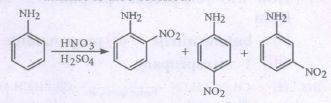
(vii) Although amino group is o - and p - directing in aromatic electrophilic substitution reactions, aniline on nitration gives a substantial amount of m - nitro aniline:
In strong acid medium, aniline is protonated to form anilinium ion which is m - directing and hence m - nitro aniline is formed.
16.
| S.No | Reagents or Reaction | Primary amine RNH2 | Secondary amine R2NH | Tertiary amine R3N |
|---|---|---|---|---|
|
1. |
Carbylamine reaction or with CHCl3/KOH |
Carbylamine is formed (unpleasant smell) |
- | - |
| 2. | Mustard oil reaction or CS2/HgCl2 (Hoffmann's mustard oil test) |
Alkyl isothiocyanate is formed (Mustard oil odour) |
- | - |
| 3. | HNO2 (or) NaNO2 / HCl |
Alcohol is formed +H2 | Yellow oily nitrosoamine is formed, insoluble in water. (Liberman's Test) |
Forms nitrite in cold, soluble in water. |
| 4. | CH3COCl | N-acetyl derivative is formed | N,N- diacetyl derivative is formed |
- |
| 5. | Diethyl oxalate Hoffmann's method |
Solid oxamide is formed | Liquid oxamic ester is formed |
- |
| 6. | Benzene sulphonyl chloride in presence of excess. KOH (Hinsberg's reaction) |
N- alkyl benzene sulphonamide is formed (soluble) |
N, N - dialkyl benzene sulphonamide is formed (Insoluble). |
- |
| 7. | With RX | 1 mol → 2o amine 2 mol → 3o amine 3 mol → Quarternary salt |
1 mol → 3o amine 2 mol → Quarternary salt |
1 mol → Quarternary salt |
17.
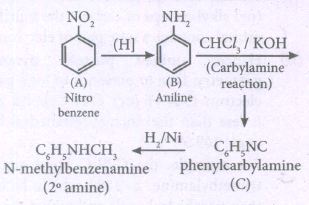
(i) A - C6H5NO2 - Nitro benzene
(ii) B - C6H5NH2 - Aniline
(iii) C - C6H5NC - Phenyl Carbylamine
18.
(i) p-nitroaniline is prepared from aniline in three stages as follows:
(ii) 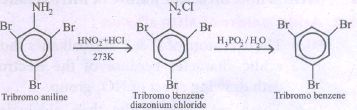
19.
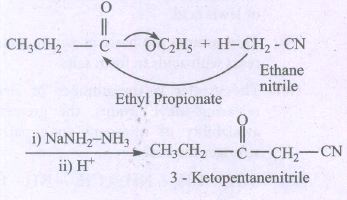
(i) The nitriles containing a-hydrogen also undergo condensation with esters in the presence of sodamide in ether to form ketonitriles.
(ii) This reaction is known as "Levine and hauser" acetylation.
(iii) This reaction involves replacement of ethoxy (OC2H5) group by methylnitrile (-CH2CN) group and is called as cyanomethylation reaction.

12th Standard Syllabus & Materials
12th Standard
TN 12th Computer Applications களப்பெயர் முறைமை (DNS) Sample Question Papers Study Material - QB365 Set A
NEW12th Standard
TN 12th Computer Applications வலையமைப்பு எடுத்துக்காட்டுகள் மற்றும் நெறிமுறைகள் Sample Question Papers Study Material - QB365 Set A
NEW12th Standard
TN 12th Computer Applications கணினி வலையமைப்பு ஓர் அறிமுகம் Sample Question Papers Study Material - QB365 Set A
NEW12th Standard
TN 12th Computer Applications PHP-உடன் MySQL-ஐ இணைத்தல் Sample Question Papers Study Material - QB365 Set A



Tamilnadu Stateboard 12th Standard Subjects

Maths
Chemistry

Physics

Biology

Computer Science

Business Maths and Statistics

Economics

Commerce

Accountancy

History

Computer Applications
Biology
Computer Technology
Computer Applications
Computer Science
Business Maths and Statistics
Commerce
Economics
Maths
Chemistry
Physics
Computer Technology
History
Accountancy

Tamil

English

French
Tamilnadu Stateboard Standards
