
 100% FREE ACCESS
12th Standard Syllabus & Materials
12th Standard
TN 12th Computer Applications மின்னணு தரவு பரிமாற்றம் Sample Question Papers Study Material - QB365 Set A
NEW12th Standard
TN 12th Computer Applications மின் - வணிக பாதுகாப்பு அமைப்புகள் Sample Question Papers Study Material - QB365 Set A
NEW12th Standard
TN 12th Computer Applications மின்னணு செலுத்தல் முறைகள் Sample Question Papers Study Material - QB365 Set A
NEW12th Standard
TN 12th Computer Applications மின் - வணிகம் Sample Question Papers Study Material - QB365 Set A
NEW12th Standard
TN 12th Computer Applications திறந்த மூல கருத்துருக்கள் Sample Question Papers Study Material - QB365 Set A
NEW12th Standard
TN 12th Computer Applications வலையமைப்பு வடமிடல் Sample Question Papers Study Material - QB365 Set A

Published on: 31/10/2019
Organic Nitrogen Compounds
Download Tamil Nadu 12th Standard Chemistry question papers, model tests, one-mark questions, important questions, and public exam papers in PDF format. Free study materials and answer keys for TN State Board students.
Questions + Answers key
Take MCQ Chemistry Test
1.
Secondary nitro alkanes react with nitrous acid to form _______.
red solution
blue solution
green solution
yellow solution
2.
C6H5NO2 \(\overset { Fe/Hel }{ \longrightarrow } A\overset { { NaNO }_{ 2 }/HCl }{ \underset { 273K }{ \longrightarrow } } B\overset { { H }_{ 2 }O }{ \underset { 283 }{ \longrightarrow } } C \) C' is _______.
C6H5 - OH
C6H5 - CH2OH
C6H5 - COH
C6H5NH2
3.
4.
The product formed by the reaction an aldehyde with a primary amine ________.
carboxylic acid
aromatic acid
schiff ’s base
ketone
5.
Aniline + benzoylchloride \(\overset { NaOH }{ \longrightarrow } \)C6H5 - NH - COC6 H5 this reaction is known as ______.
Friedel – crafts reaction
HVZ reaction
Schotten – Baumann reaction
none of these
6.
CH3CH2 Br \(\overset { aqNaOH }{ \underset { \Delta }{ \longrightarrow } } A\overset { { KMnO }_{ 4 }{ /H }^{ + } }{ \underset { \Delta }{ \longrightarrow } } B\overset { { NH }_{ 3 } }{ \underset { \Delta }{ \longrightarrow } } C\overset { { Br }_{ 2 }/NaOH }{ \longrightarrow } D\) D' is________.
bromomethane
α - bromo sodium acetate
methanamine
acetamide
7.
The method by which aniline cannot be prepared is _________.
degradation of benzamide with Br2 / NaOH
potassium salt of phthalimide treated with chlorobenzene followed by hydrolysis with aqueous NaOH solution.
reduction of Nitrobenzene with LiAlH4
reduction of nitrobenzene by Sn / HCl
8.
Which of the following reagent can be used to convert nitrobenzene to aniline.
Sn / HCl
ZnHg / NaOH
Zn/NH4Cl
All of these
9.
Write down the possible isomers of the C4H9NO2 give their IUPAC names.
10.
Identify A to E in the following sequence of reactions

\(\overset { {CH_3} {CL} }{ \underset { {AlCl}_3 }{ \longrightarrow } }\) A \(\overset { {HNO_3}/ {H_2So_4} }{ \underset { {} }{ \longrightarrow } }\) B \(\overset { {Sn} /{HCL} }{ \underset {{} }{ \longrightarrow } }\) (C) \(\overset { {NaNo_2}/ {HCL} }{ \underset { {O^o}C }{ \longrightarrow } }\) D \(\overset { {CuCN} }{ \underset { {}}{ \longrightarrow } }\) E
11.
How will you distinguish between primary secondary and tertiary alphatic amines.
12.
Write short notes on the following
i. Hofmann’s bromide reaction
ii. Ammonolysis
iii. Gabriel phthalimide synthesis
iv. Schotten – Baumann reaction
v. Carbylamine reaction
vi. Mustard oil reaction
vii. Coupling reaction
viii. Diazotisation
ix. Gomberg reaction
13.
Identify compounds A, B and C in the following sequence of reactions.
i) \({ C }_{ 6 }{ H }_{ 5 }NO_{ 2 }\overset { Fe/HCL }{ \longrightarrow } A\overset { HN{ O }_{ 2 } }{ \underset { 273K }{ \longrightarrow } } B\overset { { C }_{ 6 }{ H }_{ 5 }OH }{ \longrightarrow } C\)
ii) \({ C }_{ 6 }{ H }_{ 5 }N_{ 2 }cl\overset { CuCN }{ \longrightarrow } A\overset { H_{ 2 }O/H^{ + } }{ \longrightarrow } B\overset { NH_3 }{ \longrightarrow } C\)
iii) \({ C }{ H }_{ 3 }{ C }{ H }_{ 2 }I\overset { NaCN}{ \longrightarrow } A\overset {OH^-}{ \underset {Partial hydrolysis}{ \longrightarrow } } B\overset {NaOH+Br_2 }{ \longrightarrow } C\)
iv) \({ C }{ H }_{ 3 }NH_{ 2 }\overset { CH_3 Br }{ \longrightarrow } A\overset { CH_{ 3 }COCl}{ \longrightarrow } B\overset { B_2H_6 }{ \longrightarrow } C\)
v) \({ C }_{ 6 }{ H }_{ 5 }NH_{ 2 }\overset { (CH_{ 3 }CO)_{ 2 }O }{ \underset { Pyridine }{ \longrightarrow } } A\overset { HNO_{ 3 } }{ \underset { H_{ 2 }SO_{ 4 },288K }{ \longrightarrow } } B\overset { { H }_{ 2 }O/{ H }^{ + } }{ \longrightarrow C } \)
vi)
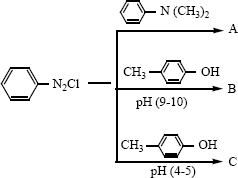
vii) \({ C }{ H }_{ 3 }CN_{ 2 }NC\overset { HgO }{ \longrightarrow } A\overset { H_{ 2 }O }{ \longrightarrow } B\overset { i) NaN{ O }_{ 2 }/HCL }{ \underset { ii){ H }_{ 2 }O }{ \longrightarrow } } \)
14.
Identify A,B,and C
CH3- NO2 \(\overset { { L }_{ 1 }{AlH }_{ 4 } }{ \underset { {} }{ \longrightarrow } }\) A \(\overset { { 2CH_3 }{Ch_2Br } }{ \underset { {} }{ \longrightarrow } }\) B \(\overset { {H}_{ 2 }{SO}_{ 4 } }{ \underset { {} }{ \longrightarrow } } \) C
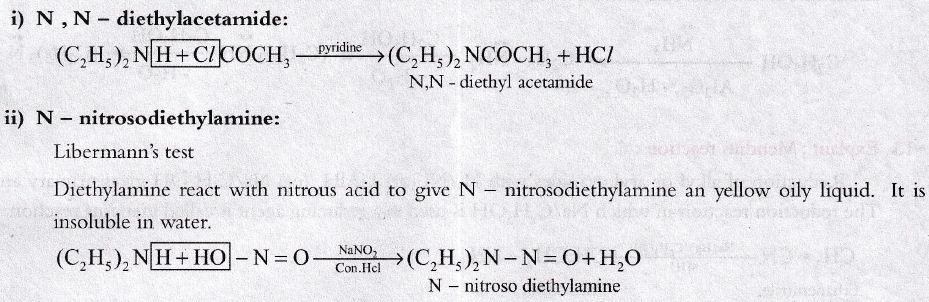
15.
How will you convert diethylamine into
i) N, N – diethylacetamide
ii) N – nitrosodiethylamine
1.
(b)
blue solution
2.
(a)
C6H5 - OH
3.
(d)
4.
(c)
schiff ’s base
5.
(c)
Schotten – Baumann reaction
6.
(c)
methanamine
7.
(b)
potassium salt of phthalimide treated with chlorobenzene followed by hydrolysis with aqueous NaOH solution.
8.
(a)
Sn / HCl
9.
| Isomerism | Structural formula of isomers |
| Chain isomerism: They differ in the length of carbon chain. |
.JPG) |
| Position isomerism: They differ in the position of nitro group. |
.JPG) |
| Functional isomerism: Nitroalkanes exhibit functional isomerism with alkylnitrites |
\( \mathrm{CH}_{3} \mathrm{CH}_{2} \mathrm{CH}_{2} \mathrm{CH}_{2}-\mathrm{NO}_{2} \text { and } \mathrm{CH}_{3} \mathrm{CH}_{2} \mathrm{CH}_{2} \mathrm{CH}_{2}-\mathrm{O}-\mathrm{N}=\mathrm{O}\\ \quad 1 - nitrobutane \quad \quad \quad \quad \quad \quad \quad butyl \ nitrite\) |
10.
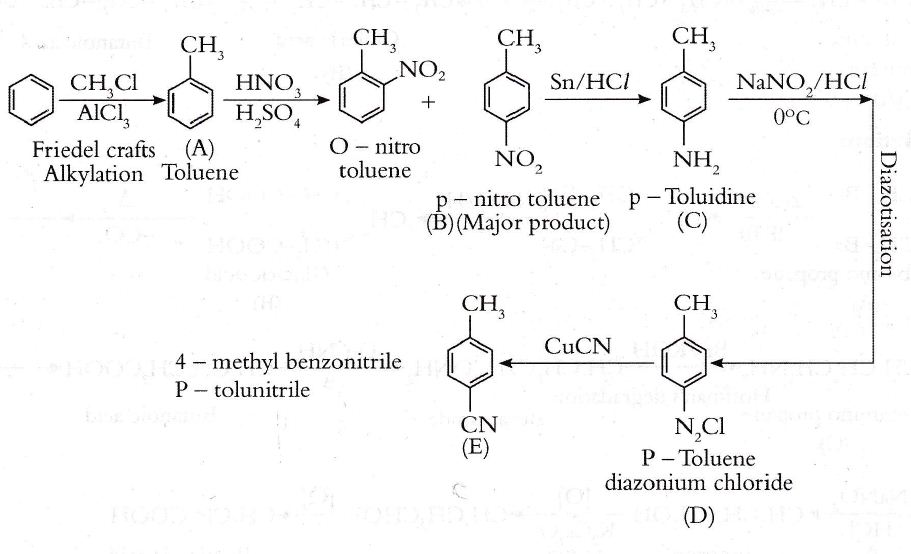
11.
| S.No | Reagents or Reaction | Primary amine RNH2 | Secondary amine R2NH | Tertiary amine R3N |
|---|---|---|---|---|
|
1. |
Carbylamine reaction or with CHCl3/KOH |
Carbylamine is formed (unpleasant smell) |
- | - |
| 2. | Mustard oil reaction or CS2/HgCl2 (Hoffmann's mustard oil test) |
Alkyl isothiocyanate is formed (Mustard oil odour) |
- | - |
| 3. | HNO2 (or) NaNO2 / HCl |
Alcohol is formed +H2 | Yellow oily nitrosoamine is formed, insoluble in water. (Liberman's Test) |
Forms nitrite in cold, soluble in water. |
| 4. | CH3COCl | N-acetyl derivative is formed | N,N- diacetyl derivative is formed |
- |
| 5. | Diethyl oxalate Hoffmann's method |
Solid oxamide is formed | Liquid oxamic ester is formed |
- |
| 6. | Benzene sulphonyl chloride in presence of excess. KOH (Hinsberg's reaction) |
N- alkyl benzene sulphonamide is formed (soluble) |
N, N - dialkyl benzene sulphonamide is formed (Insoluble). |
- |
| 7. | With RX | 1 mol → 2o amine 2 mol → 3o amine 3 mol → Quarternary salt |
1 mol → 3o amine 2 mol → Quarternary salt |
1 mol → Quarternary salt |
12.
Hoffmann's bromide reaction:
When Amides are treated with bromine in the presence of aqueous or ethanolic solution of KOH, primary amines with one carbon atom less than the parent amides are obtained.
\(\underset { \quad \quad \quad amide\\ R=Alkyl(or)Aryl }{ R-\overset { \underset { || }{ O } }{ C } -{ NH }_{ 2 } } \overset { { Br }_{ 2 }/KOH }{ \longrightarrow } \underset { Primary\quad amine }{ R-{ NH }_{ 2 }+{ K }_{ 2 }{ CO }_{ 3 } } +KBr+{ H }_{ 2 }O\)
(ii) Hoffmann's ammonolysis:
When Alkyl halides (or) benzylhalides are heated with alcoholic ammonia in a sealed tube, mixtures of 1°, 2° and 3° amines and quaternary ammonium salts are obtained.
\( { CH }_{ 3 }-Br\overset { \ddot { N } { H }_{ 3 } }{ \underset { \Delta }{ \longrightarrow } } \underset { { 1 }^{ 0 }-amine }{ { CH }_{ 3 }-\ddot { N } { H }_{ 2 } } \overset { { CH }_{ 3 }-Br }{ \longrightarrow } \underset { { 3 }^{ o }-amine }{ \left( { CH }_{ 3 } \right) _{ 2 }\ddot { N } H } \overset { { CH }_{ 3 }Br }{ \longrightarrow } \underset { 3^{ o }-amine }{ \left( { { CH }_{ 3 } } \right) _{ 3 }\ddot { N } } \overset { CH_{ 3 }Br }{ \longrightarrow } \underset { Quartenary \ ammonium\ bromide }{ \left( { CH }_{ 3 } \right) _{ 4 }\overset { + }{ N } { Br }^{ - } } \)
This is a nucleophilic substitution, the halide ion of alkyl halide is substituted by the -NH2 group. The product primary amine so formed can also has a tendency to act as a nucleophile and hence if excess alkyl halide is taken, further nucleophilic substitution takes place leading to the formation of quarternary ammonium salt. However, if the process is carried out with excess ammonia, primary amine is obtained as the major product. The order of reactivity of alkylhalides with amines
RI > RBr > RCl
(iii) Gabriel phthalimide synthesis:
Gabriel synthesis is used for the preparation of Aliphatic primary amines. Phthalimide on treatment with ethanolic KOH forms potassium salt of phthalimide which on heating with alkyl halide followed by alkaline hydrolysis gives primary amine. Aniline cannot be prepared by this method because the arylhalides do not undergo nucleophilic substitution with the anion formed by phthalimide.
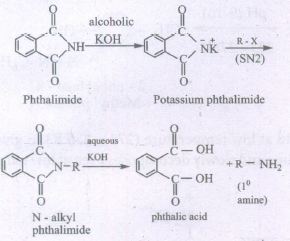
(iv) Schotten - Baumann reaction :
Aniline reacts with benzoylchloride (C6H5COCI) in the presence of NaOH to give N - phenyl benzamide. This reaction is known as Schotten - Baumann reaction. The acylation and benzoylation are nucleophilic substitutions.
\(\underset { Aniline }{ { C }_{ 6 }{ H }_{ 5 }-{ NH }_{ 2 } } +\underset { Benzoyl\quad chloride }{ { C }_{ 6 }{ H }_{ 5 }-\overset { \underset { || }{ O } }{ C } -Cl } \overset { Pyridine }{ \longrightarrow } \underset { N-phenyl\quad benzamide }{ { C }_{ 6 }{ H }_{ 5 }-NH-\overset { \underset { || }{ O } }{ C } -{ C }_{ 6 }{ H }_{ 5 } } +HCl\)
(v) Carbylamine reaction :
Aliphatic (or) aromatic primary amines react with: chloroform and alcoholic KOH to give isocyanides (carbylamines), which has an unpleasant smell. This reaction is known as carbylamines test. This test used to identify the primary amines.
\(\underset { Ethylamine }{ { C }_{ 2 }{ H }_{ 5 }-{ NH }_{ 2 } } +\underset { Chloroform }{ { CHCl }_{ 3 }+3KOH } \longrightarrow \underset { Ethylisocyanide }{ { C }_{ 2 }{ H }_{ 5 }-NC } +3KCl+3{ H }_{ 2 }O\)
(vi) Mustard oil reaction:
(a) When primary amines are treated with carbon disulphide (CS2), N - alkyldithio carbonic acid is formed which on subsequent treatment with HgCI2, gives an alkyl isothiocyanate.
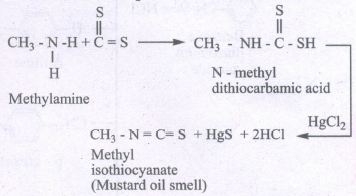
(b) When aniline is treated with carbon disulphide, or heated together, S-diphenylthio urea is formed, which on boiling with strong HCI, phenyl isothiocyanate (phenyl mustard oil), is formed.
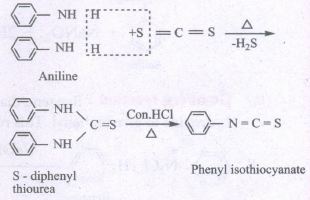
These reactions are known as Hofmann - Mustard oil reaction. This test is used to identify the primary amines.
(vii) Coupling reactions (or) p-hydroxyazobenzene, p-aminoazobenzene, 2-phenyl azo-4-methyl phenol:
Benzene diazonium chloride reacts with electron rich aromatic compounds like phenol, aniline to form brightly coloured azo compounds. Coupling generally occurs at the para position. If para position is occupied then coupling occurs at the ortho position. Coupling tendency is enhanced if an electron donating group is present at the para - position to -N2CI- group. This is an electrophilic substitution.
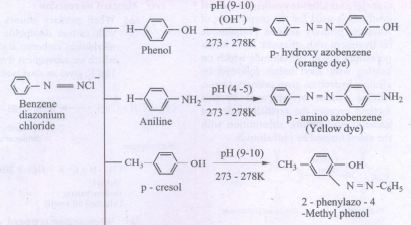
Aryl fluorides and iodides cannot be prepared by direct halogenation and the cyano group cannot be introduced by nucleophilic substitution of chlorine in chlorobenzene. For introducing such a halide group. cyano group -OH, NO2, etc.. benzenediazonium chloride is a very good intermediate Diazo compounds obtained from the coupling reactions of diazonium salts are coloured and are used as dyes.
(viii) Diazotisation :
Aniline reacts with nitrous acid at low temperature (273 - 278 K) to give benzene. Diazonium chloride which is stable for a short time and slowly decomposes even at low temperatures.This reaction is known as diazotization
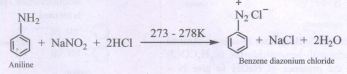
(ix) Gomberg reaction :
Benzene diazonium chloride reacts with benzene in the presence of sodium hydroxide to give biphenyl. This reaction in known as the Gomberg reaction

13.
.JPG)
.JPG)
.JPG) +CO2
+CO2
.JPG)
.JPG)
.JPG)
.JPG)
14.

15.

12th Standard Syllabus & Materials
12th Standard
TN 12th Computer Applications களப்பெயர் முறைமை (DNS) Sample Question Papers Study Material - QB365 Set A
NEW12th Standard
TN 12th Computer Applications வலையமைப்பு எடுத்துக்காட்டுகள் மற்றும் நெறிமுறைகள் Sample Question Papers Study Material - QB365 Set A
NEW12th Standard
TN 12th Computer Applications கணினி வலையமைப்பு ஓர் அறிமுகம் Sample Question Papers Study Material - QB365 Set A
NEW12th Standard
TN 12th Computer Applications PHP-உடன் MySQL-ஐ இணைத்தல் Sample Question Papers Study Material - QB365 Set A



Tamilnadu Stateboard 12th Standard Subjects

Maths
Chemistry

Physics

Biology

Computer Science

Business Maths and Statistics

Economics

Commerce

Accountancy

History

Computer Applications
Biology
Computer Technology
Computer Applications
Computer Science
Business Maths and Statistics
Commerce
Economics
Maths
Chemistry
Physics
Computer Technology
History
Accountancy

Tamil

English

French
Tamilnadu Stateboard Standards
