
 100% FREE ACCESS
12th Standard Syllabus & Materials
12th Standard
TN 12th Computer Applications மின்னணு தரவு பரிமாற்றம் Sample Question Papers Study Material - QB365 Set A
NEW12th Standard
TN 12th Computer Applications மின் - வணிக பாதுகாப்பு அமைப்புகள் Sample Question Papers Study Material - QB365 Set A
NEW12th Standard
TN 12th Computer Applications மின்னணு செலுத்தல் முறைகள் Sample Question Papers Study Material - QB365 Set A
NEW12th Standard
TN 12th Computer Applications மின் - வணிகம் Sample Question Papers Study Material - QB365 Set A
NEW12th Standard
TN 12th Computer Applications திறந்த மூல கருத்துருக்கள் Sample Question Papers Study Material - QB365 Set A
NEW12th Standard
TN 12th Computer Applications வலையமைப்பு வடமிடல் Sample Question Papers Study Material - QB365 Set A

Published on: 30/10/2019
Organic Nitrogen Compounds
Download Tamil Nadu 12th Standard Chemistry question papers, model tests, one-mark questions, important questions, and public exam papers in PDF format. Free study materials and answer keys for TN State Board students.
Questions + Answers key
Take MCQ Chemistry Test
1.
2.
The product formed by the reaction an aldehyde with a primary amine ________.
carboxylic acid
aromatic acid
schiff ’s base
ketone
3.
Which one of the following nitro compounds does not react with nitrous acid.
CH3 -CH2 -CH2 -NO2
(CH3)2 CH - CH2NO2
(CH3)3 C NO2
\({ CH }_{ 3 }-\underset { \overset { || }{ O } }{ C } -\underset { \overset { || }{ { CH }_{ 3 } } }{ CH } -{ NO }_{ 2 }\)
4.
CH3CH2 Br \(\overset { aqNaOH }{ \underset { \Delta }{ \longrightarrow } } A\overset { { KMnO }_{ 4 }{ /H }^{ + } }{ \underset { \Delta }{ \longrightarrow } } B\overset { { NH }_{ 3 } }{ \underset { \Delta }{ \longrightarrow } } C\overset { { Br }_{ 2 }/NaOH }{ \longrightarrow } D\) D' is________.
bromomethane
α - bromo sodium acetate
methanamine
acetamide
5.
The method by which aniline cannot be prepared is _________.
degradation of benzamide with Br2 / NaOH
potassium salt of phthalimide treated with chlorobenzene followed by hydrolysis with aqueous NaOH solution.
reduction of Nitrobenzene with LiAlH4
reduction of nitrobenzene by Sn / HCl
6.
There are two isomers with the formula CH3NO2. How will you distinguish between them?
7.
Identify A to E in the following sequence of reactions

\(\overset { {CH_3} {CL} }{ \underset { {AlCl}_3 }{ \longrightarrow } }\) A \(\overset { {HNO_3}/ {H_2So_4} }{ \underset { {} }{ \longrightarrow } }\) B \(\overset { {Sn} /{HCL} }{ \underset {{} }{ \longrightarrow } }\) (C) \(\overset { {NaNo_2}/ {HCL} }{ \underset { {O^o}C }{ \longrightarrow } }\) D \(\overset { {CuCN} }{ \underset { {}}{ \longrightarrow } }\) E
8.
A dibromo derivative (A) on treatment with KCN followed by acid hydrolysis and heating gives a monobasic acid (B) along with liberation of CO2 . (B) on heating with liquid ammonia followed by treating with Br2 /KOH gives (c) which on treating with NaNO2 and HCl at low temperature followed by oxidation gives a monobasic acid (D) having molecular mass 74. Identify A to D.
9.
Account for the following
i. Aniline does not undergo Friedel – Crafts reaction
ii. Diazonium salts of aromatic amines are more stable than those of aliphatic amines
iii. pKb of aniline is more than that of methylamine
iv. Gabriel phthalimide synthesis is preferred for synthesising primary amines.
v. Ethylamine is soluble in water whereas aniline is not
vi. Amines are more basic than amides
vii.Although amino group is o – and p – directing in aromatic electrophilic substitution reactions, aniline on nitration gives a substantial amount of m – nitroaniline.
10.
How will you distinguish between primary secondary and tertiary alphatic amines.
11.
Identify compounds A, B and C in the following sequence of reactions.
i) \({ C }_{ 6 }{ H }_{ 5 }NO_{ 2 }\overset { Fe/HCL }{ \longrightarrow } A\overset { HN{ O }_{ 2 } }{ \underset { 273K }{ \longrightarrow } } B\overset { { C }_{ 6 }{ H }_{ 5 }OH }{ \longrightarrow } C\)
ii) \({ C }_{ 6 }{ H }_{ 5 }N_{ 2 }cl\overset { CuCN }{ \longrightarrow } A\overset { H_{ 2 }O/H^{ + } }{ \longrightarrow } B\overset { NH_3 }{ \longrightarrow } C\)
iii) \({ C }{ H }_{ 3 }{ C }{ H }_{ 2 }I\overset { NaCN}{ \longrightarrow } A\overset {OH^-}{ \underset {Partial hydrolysis}{ \longrightarrow } } B\overset {NaOH+Br_2 }{ \longrightarrow } C\)
iv) \({ C }{ H }_{ 3 }NH_{ 2 }\overset { CH_3 Br }{ \longrightarrow } A\overset { CH_{ 3 }COCl}{ \longrightarrow } B\overset { B_2H_6 }{ \longrightarrow } C\)
v) \({ C }_{ 6 }{ H }_{ 5 }NH_{ 2 }\overset { (CH_{ 3 }CO)_{ 2 }O }{ \underset { Pyridine }{ \longrightarrow } } A\overset { HNO_{ 3 } }{ \underset { H_{ 2 }SO_{ 4 },288K }{ \longrightarrow } } B\overset { { H }_{ 2 }O/{ H }^{ + } }{ \longrightarrow C } \)
vi)
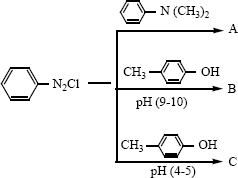
vii) \({ C }{ H }_{ 3 }CN_{ 2 }NC\overset { HgO }{ \longrightarrow } A\overset { H_{ 2 }O }{ \longrightarrow } B\overset { i) NaN{ O }_{ 2 }/HCL }{ \underset { ii){ H }_{ 2 }O }{ \longrightarrow } } \)
12.
How will you convert nitrobenzene into
i. 1,3,5 - trinitrobenzene
ii. o and p- nitrophenol
iii. m – nitro aniline
iv. azoxybenzene
v. hydrozobenzene
vi. N – phenylhydroxylamine
vii. aniline
13.
How will you prepare propan – 1- amine from
i) butane nitrile
ii) propanamide
ii) 1- nitropropane
14.
Identify A,B and C
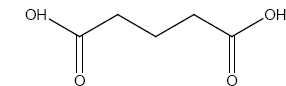 \(\overset{SOCl_2}\longrightarrow A \overset{NH_3}\longrightarrow B\overset{LiAlH_4}\longrightarrow (C)\)
1.
(d)
2.
(c)
schiff ’s base
3.
(c)
(CH3)3 C NO2
4.
(c)
methanamine
5.
(b)
potassium salt of phthalimide treated with chlorobenzene followed by hydrolysis with aqueous NaOH solution.
6.
a) Primary and secondary nitroalkanes, having α-H, also show an equilibrium mixture of two tautomers namely nitro - and aci - form
.JPG)
b) Difference:
| S.No | Nitro form | Aci - form |
| 1. | Less acidic in nature. | More acidic |
| 2. | Dissolves in NaOH slowly | Dissolves in NaOH instantly |
| 3. | Decolourises FeCl3 solution | With FeCl3 gives reddish brown colour |
| 4. | Electrical conductivity is low | Electrical conductivity is high |
7.
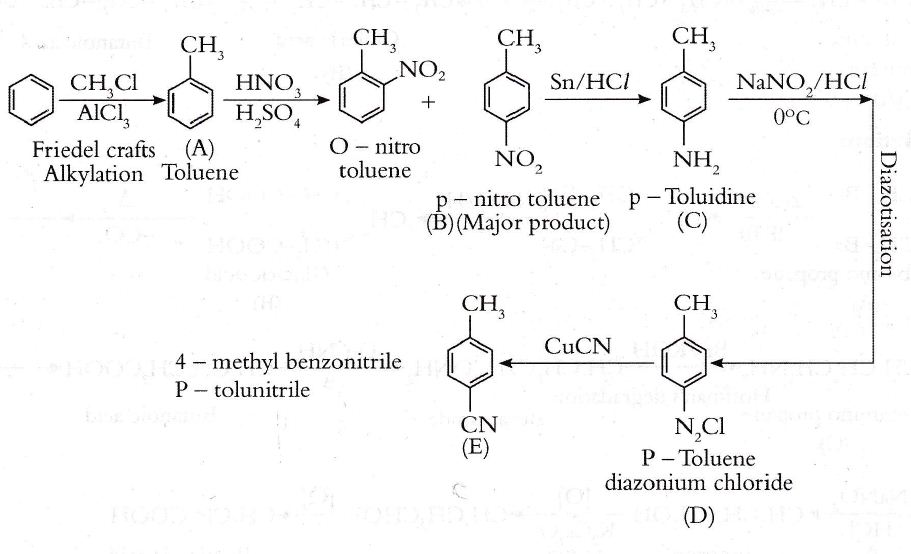
8.
Compound A,B,C and D
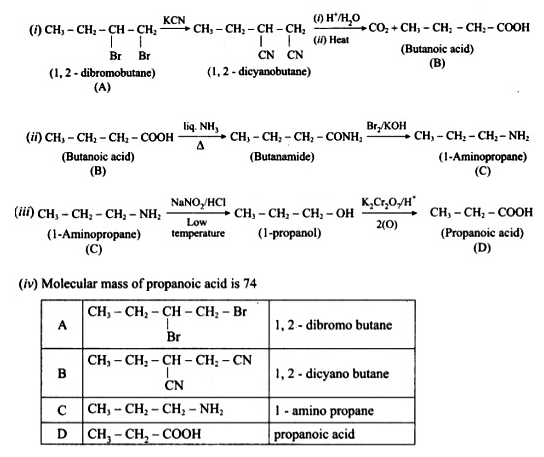
9.
Aniline does not undergo Friedel - Craft's reaction:
Aniline does not undergo Friedel - Craft's reaction (alkylation and acetylation). Aniline is basic in nature and it donates its lone pair of electrons to the lewis acid AlCl3 to form an adduct which inhibits further electrophilic substitution reaction.
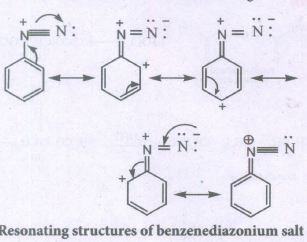
Diazonium salts of aromatic amines are more stable than those of aliphatic amines:
This is due to resonance
Resonance Structure:
The stability of arene diazonium salt is due to the dispersal of the positive charge over the benzene ring.
pKb of aniline is more than that of methylamine:
pKb - methylamine -3.35
pKb - aniline -9.376
In aniline the lone pair of electrons on N - atom is delocalized over the benzene ring. So, the electron density on the N - atom decreases. In methylamine + 1 effect to CH3 group increases the electron density on the nitrogen atom Hence aniline is a weaker base than methylamine. Due to this, the pKb value for aniline is more than that of methylamine.
(iv) Gabriel phthalimide synthesis is preferred for synthesising primary amines:
In this method alkyl halides react with pottassium phthalimide to give pure primary amine by nucleophilic substitution. In contrast, Aniline (Aromatic primary amine) can not be prepared by this method because Aryl halides do not undergo nucleophilic substitution with the anion formed by phthalimide. Therefore, this method used for the Aliphatic primary. amines only. Aryl halides do not undergo SN2 mechanism with the ion formed by the phthalimide.
(v) Ethylamine is soluble in water whereas aniline is not:
(a) Ethylamine is soluble in water, as it can form intermolecular H - bonds with water molecules. In aqueous solution, the substituted ammonium cation get stabilized not only by electron releasing (+I) effect of the alkyl group but also by solvation with water molecules. The greater the size of the ion, the lower will be the solvation.
(b) Amiline doesn't form H - bond with water to a very large extent due to the presence of a large hydrophobic -C6H5 group.
(vi) Amines are more basic than amides:
This is because, in amides, the carbonyl group is highly electro negative It has a greater power to attract the electrons towards it. It makes the lone pair of electrons on amide nitrogen (-CONH2) less available to accept a proton.
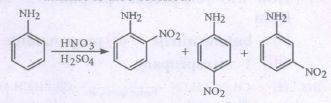
(vii) Although amino group is o - and p - directing in aromatic electrophilic substitution reactions, aniline on nitration gives a substantial amount of m - nitro aniline:
In strong acid medium, aniline is protonated to form anilinium ion which is m - directing and hence m - nitro aniline is formed.
10.
| S.No | Reagents or Reaction | Primary amine RNH2 | Secondary amine R2NH | Tertiary amine R3N |
|---|---|---|---|---|
|
1. |
Carbylamine reaction or with CHCl3/KOH |
Carbylamine is formed (unpleasant smell) |
- | - |
| 2. | Mustard oil reaction or CS2/HgCl2 (Hoffmann's mustard oil test) |
Alkyl isothiocyanate is formed (Mustard oil odour) |
- | - |
| 3. | HNO2 (or) NaNO2 / HCl |
Alcohol is formed +H2 | Yellow oily nitrosoamine is formed, insoluble in water. (Liberman's Test) |
Forms nitrite in cold, soluble in water. |
| 4. | CH3COCl | N-acetyl derivative is formed | N,N- diacetyl derivative is formed |
- |
| 5. | Diethyl oxalate Hoffmann's method |
Solid oxamide is formed | Liquid oxamic ester is formed |
- |
| 6. | Benzene sulphonyl chloride in presence of excess. KOH (Hinsberg's reaction) |
N- alkyl benzene sulphonamide is formed (soluble) |
N, N - dialkyl benzene sulphonamide is formed (Insoluble). |
- |
| 7. | With RX | 1 mol → 2o amine 2 mol → 3o amine 3 mol → Quarternary salt |
1 mol → 3o amine 2 mol → Quarternary salt |
1 mol → Quarternary salt |
11.
.JPG)
.JPG)
.JPG) +CO2
+CO2
.JPG)
.JPG)
.JPG)
.JPG)
12.
Nitrobenzene into 1,3,5 - trinitro benzene
.JPG)
Nitrobenzene 1,3,5 - trinitro benzene
ii. Nitrobenzene into o - and p - nitro phenols
.JPG)
iii. Nitrobenzene into m - nitro aniline
.JPG) + 6NH3 + 2H2O + 3S
+ 6NH3 + 2H2O + 3S
iv. Nitrobenzene into azoxybenzene
.JPG) +3H2O
+3H2O
v. Nitrobenzene into hydrazobenzene
.JPG)
vi. Nitrobenzene into N - phenyl hydrazobenzene
.JPG)
vii. Nitrobenzene into aniline
.JPG)
13.
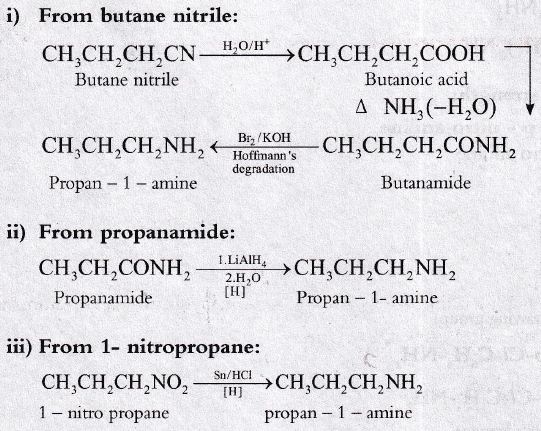 + 2H2O
14.


12th Standard Syllabus & Materials
12th Standard
TN 12th Computer Applications களப்பெயர் முறைமை (DNS) Sample Question Papers Study Material - QB365 Set A
NEW12th Standard
TN 12th Computer Applications வலையமைப்பு எடுத்துக்காட்டுகள் மற்றும் நெறிமுறைகள் Sample Question Papers Study Material - QB365 Set A
NEW12th Standard
TN 12th Computer Applications கணினி வலையமைப்பு ஓர் அறிமுகம் Sample Question Papers Study Material - QB365 Set A
NEW12th Standard
TN 12th Computer Applications PHP-உடன் MySQL-ஐ இணைத்தல் Sample Question Papers Study Material - QB365 Set A



Tamilnadu Stateboard 12th Standard Subjects

Maths
Chemistry

Physics

Biology

Computer Science

Business Maths and Statistics

Economics

Commerce

Accountancy

History

Computer Applications
Biology
Computer Technology
Computer Applications
Computer Science
Business Maths and Statistics
Commerce
Economics
Maths
Chemistry
Physics
Computer Technology
History
Accountancy

Tamil

English

French
Tamilnadu Stateboard Standards
