
 100% FREE ACCESS
12th Standard Syllabus & Materials
12th Standard
TN 12th Computer Applications மின்னணு தரவு பரிமாற்றம் Sample Question Papers Study Material - QB365 Set A
NEW12th Standard
TN 12th Computer Applications மின் - வணிக பாதுகாப்பு அமைப்புகள் Sample Question Papers Study Material - QB365 Set A
NEW12th Standard
TN 12th Computer Applications மின்னணு செலுத்தல் முறைகள் Sample Question Papers Study Material - QB365 Set A
NEW12th Standard
TN 12th Computer Applications மின் - வணிகம் Sample Question Papers Study Material - QB365 Set A
NEW12th Standard
TN 12th Computer Applications திறந்த மூல கருத்துருக்கள் Sample Question Papers Study Material - QB365 Set A
NEW12th Standard
TN 12th Computer Applications வலையமைப்பு வடமிடல் Sample Question Papers Study Material - QB365 Set A

Published on: 03/01/2020
p - Block Elements - I
Download Tamil Nadu 12th Standard Chemistry question papers, model tests, one-mark questions, important questions, and public exam papers in PDF format. Free study materials and answer keys for TN State Board students.
Questions + Answers key
Take MCQ Chemistry Test
1.
Allotropy is due to ______.
difference in chemical properties
difference in the number of atoms in the molecules
difference in the arrangement of atoms in the molecules in the crystal
None of these
2.
Oxidation state exhibited by group 13 elements is ______
+1, +2 and +3
+1 and +3
+1 and +4
+2 +3 and +4
3.
Which of the following statements about H3BO3 is not correct?
It has a layer structure in which planar BO3 units are joined by H-bonds
It is a strong tribasic acid
It is prepared by acidifying an aqueous solution of borax
It does not act as proton donor but acts as lewis acid by accepting hydroxyl ion
4.
Chemical formula of phosgene is_______.
COCl2
CaOCl2
CaCO3
COCI
5.
Thermodynamically the most stable form of carbon is________.
Diamond
graphite
Fullerene
none of these
6.
AlF3 is soluble in HF only in the presence of KF. It is due to the formation of _________.
K3[AIF3H3]
K3[AiF6]
AIH3
K[AIF3H]
7.
The geometry at which carbon atom in diamond are bonded to each other is _______.
Tetrahedral
hexagonal
Octahedral
none of these
8.
Oxidation state of carbon in its hydrides _______.
+4
-4
+3
+2
9.
Starting from SiCl4, prepare the following in steps not exceeding the number given in parentheses.
(i) Silicon
(ii) Linear silicon containing methyl groups only
(iii) Na2SiO3
10.
Name the two important ores of Boron.
11.
What is phosgene? How is it prepared?
12.
Write a note on zeolites.
13.
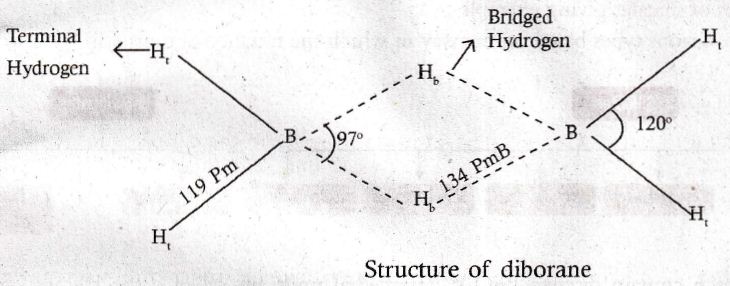
Describe the structure of diborane.
14.
Describe the structure of diamond.
15.
How is boron trifluoride obtained from boron trioxide?
16.
Distinguish between diamond and graphite.
17.
Assertion: Carbon shows an anomalous behaviour in group 14.
Reason: Carbon has maximum covalency of 4.
Codes:
a) Both assertion and reason are true and the reason is the correct explanation of the assertion.
b) Both the assertion and reason are true but the reason is not the correct explanation of the assertion.
c) Assertion is true but reason is false.
d) Both assertion and reason are false.
18.
Assertion: When borax is strongly heated it forms transparent glassy bead.
Reason: Borax is the other name for sodium tetraborate decahydrate.
Codes:
a) Both assertion and reason are true and the reason is the correct explanation of the assertion.
b) Both the assertion and reason are true but the reason is not the correct explanation of the assertion.
c) Assertion is true but reason is false.
d) Both assertion and reason are false.
19.
I. Graphene is an allotropic from of carbon
II. CO is a strong reducing agent
III. CO is a poisonous gas.
IV. CO is used as a propellent
a) I, II & III
b) Only II
c) Only I
d) III & IV
20.
I. Boric acid can be extracted from borax and colemanite.
II. Boric acid is a colourful crystal.
III. It is a very weak monobasic acid.
IV. It accepts hydroxyl ion rather than donating proton.
a) Only I
b) Only II
c) I, III & IV
d) III & IV
21.
a) Carbon is found in the native form as graphite.
b) Coal contains large quantities of carbon
c) Clay is important source for carbon.
d) Carbon exists in many allotropic forms.
22.
a) Alum is potassium aluminium sulphate
b) Alum is extracted from colemanite
c) Anhydrous aluminium chloride a catalyst in Friedel crafts reactions.
d) Its a Lewis acid
1.
(c)
difference in the arrangement of atoms in the molecules in the crystal
2.
(b)
+1 and +3
3.
(b)
It is a strong tribasic acid
4.
(a)
COCl2
5.
(b)
graphite
6.
(b)
K3[AiF6]
7.
(a)
Tetrahedral
8.
(a)
+4
9.
(i) 3SiCl4 + 4 Al ⟶ 4 AICl3 + 3 Si
(ii) n(CH3)2Si(OH)2
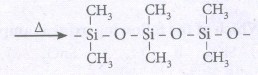
(iii) \(SiC{ l }_{ 4 }+4{ H }_{ 2 }O\longrightarrow \underset { orthosilicic \ acid }{ { H }_{ 4 }Si{ O }_{ 4 } } +4HCl\)
H4SiO4 \(\overset { \triangle }{ \longrightarrow } \) SiO2 + 2H2O
SiO2 + Na2CO3 ⟶ Na2SiO3 + H2O.
10.
(i) Borax - Na2[B4O5.(OH)4].8H2O
(ii) Kernite - Na2[B4O5(OH)4]·2H2O
11.
When carbon monoxide is treated with chlorine in presence of light or charcoal, it forms a poisonous gas carbonyl chloride, which is also known as phosgene.
CO + Cl2 ⟶ COCl2
12.
(i) Zeolites are three-dimensional crystalline solids containing Al, Si and O in their regular three dimensional framework.
(ii) They are hydrated sodium alumino silicates with general formula Na2O(AI2O3).·x(SiO2)·yH2O
(x = 2 to 10; y = 2 to 6).
(iii) Zeolites have porous structure in which the monovalent sodium ions and water molecules are loosely held.
(iv) The Si and Al atoms are tetrahedrally coordinated with each other through shared oxygen atoms.
(v) Zeolites are similar to clay minerals but they differ in their crystalline structure.
(vi) Zeolites have a three dimensional crystalline structure looks like a honeycomb consisting of a network of interconnected tunnels and cages.
(vii) Water molecules moves freely in and out of these pores but the zeolite framework remains rigid
(viii) Another special aspect of this structure is that the pore/channel sizes are nearly uniform, allowing the crystal to act as a molecular sieve.
13.
(i) In diborane two BH2 units are linked by two bridged hydrogens.
(ii) It has eight B-H bonds.
(iii) Diborane has only 12 valance electrons.
(iv) The four terminal B-H- bonds is "2c - 2e" bond (two centre - two electron bond.)
(v) Two three centred B - H - B bonds two electrons each. "(3c - 2e)"
(vi) In diborane, the boron is "sp3" hybridised
(vii) Three of the four "sp3" hydridised orbitals contains single electron and the fourth orbital is empty.
14.
(i) Diamond is very hard.
(ii) The carbon atoms in diamond are sp3 hybridised and bonded to four neighbouring carbon atoms by a bonds with a C-C bond length of 1.54 Å.
(iii) This results in a tetrahedral arrangement around each carbon atom that extends to the entire lattice.
(iv) Since all four valance electrons of carbon are involved in bonding there is no free electrons for conductivity.
(v) Being the hardest element, it used for sharpening hard tools, cutting glasses, making bores and rock drilling.
15.
(i) Boron trifluoride is obtained by the treatment of calcium fluoride with boron trioxide in presence of conc. sulphuric acid.
B2O3 + 3CaF2 + 3H2SO4 \(\overset { \triangle }{ \longrightarrow } \) 2BH3 + 3CaSO4 + 3H2O
(ii) It can also be obtained by treating boron trioxide with carbon and fluorine.
B2O3 + 3C + 3F2 ⟶ 2BF3 + 3CO
(iii) In the laboratory pure BF3 is prepared by the thermal decomposition of benzene diazonium tetrafluoro borate.
PhN2BF4 \(\overset { \triangle }{ \longrightarrow } \) BF3 + PhF + N2
16.
| DIAMOND | GRAPHITE |
| C is sp3 hybridised. | C is sp2 hybridised. |
| Three dimensional, tetrahedral structure. | Two dimensional, sheet like structure. |
| Crystalline, transparent with extra brilliance. | Crystalline, opaque and shiny substance. |
| It is hard with high density and high melting point. | It is soft with low density and high melting point. |
| Bad conductor of and electricity. | Good conductor of heat and electricity. |
17.
b) Both the assertion and reason are true but the reason is not the correct explanation of the assertion
18.
b) Both the assertion and reason are true but the reason is not the correct explanation of the assertion.
19.
()
I, II & III
20.
()
I, III & IV
21.
Clay is important source for carbon
22.
Alum is extracted from colemanite

12th Standard Syllabus & Materials
12th Standard
TN 12th Computer Applications களப்பெயர் முறைமை (DNS) Sample Question Papers Study Material - QB365 Set A
NEW12th Standard
TN 12th Computer Applications வலையமைப்பு எடுத்துக்காட்டுகள் மற்றும் நெறிமுறைகள் Sample Question Papers Study Material - QB365 Set A
NEW12th Standard
TN 12th Computer Applications கணினி வலையமைப்பு ஓர் அறிமுகம் Sample Question Papers Study Material - QB365 Set A
NEW12th Standard
TN 12th Computer Applications PHP-உடன் MySQL-ஐ இணைத்தல் Sample Question Papers Study Material - QB365 Set A



Tamilnadu Stateboard 12th Standard Subjects

Maths
Chemistry

Physics

Biology

Computer Science

Business Maths and Statistics

Economics

Commerce

Accountancy

History

Computer Applications
Biology
Computer Technology
Computer Applications
Computer Science
Business Maths and Statistics
Commerce
Economics
Maths
Chemistry
Physics
Computer Technology
History
Accountancy

Tamil

English

French
Tamilnadu Stateboard Standards
