
 100% FREE ACCESS
12th Standard Syllabus & Materials
12th Standard
TN 12th Computer Applications மின்னணு தரவு பரிமாற்றம் Sample Question Papers Study Material - QB365 Set A
NEW12th Standard
TN 12th Computer Applications மின் - வணிக பாதுகாப்பு அமைப்புகள் Sample Question Papers Study Material - QB365 Set A
NEW12th Standard
TN 12th Computer Applications மின்னணு செலுத்தல் முறைகள் Sample Question Papers Study Material - QB365 Set A
NEW12th Standard
TN 12th Computer Applications மின் - வணிகம் Sample Question Papers Study Material - QB365 Set A
NEW12th Standard
TN 12th Computer Applications திறந்த மூல கருத்துருக்கள் Sample Question Papers Study Material - QB365 Set A
NEW12th Standard
TN 12th Computer Applications வலையமைப்பு வடமிடல் Sample Question Papers Study Material - QB365 Set A

Published on: 01/10/2019
p - Block Elements - I
Download Tamil Nadu 12th Standard Chemistry question papers, model tests, one-mark questions, important questions, and public exam papers in PDF format. Free study materials and answer keys for TN State Board students.
Questions + Answers key
Take MCQ Chemistry Test
1.
Give 3 uses of carbon monoxide.
2.
Describe the structure of graphene.
3.
Describe the structure of carbon nanotubes.
4.
Write a note on metallic nature of p-block elements.
5.
Give the uses of silicones.
6.
Complete the following reactions.
a. \(B(OH)_3 + NH_3\longrightarrow \)
b. \(Na_{ 2 }B_{ 4 }{ O }_{ 7 }+{ { H }_{ 2 }{ SO }_{ 4 }+{ 5H }_{ 2 }O\longrightarrow }\)
c. \({ B }_{ 2 }{ H }_{ 6 }+2NaOH+2{ H }_{ 2 }O\longrightarrow \)
d. \({ B }_{ 2 }{ H }_{ 6 }+6{ CH }_{ 3 }OH\longrightarrow \)
e. \(4{ BF }_{ 3 }+3{ H }_{ 2 }O\longrightarrow \)
f. \(HCOOH+{ H }_{ 2 }{ SO }_{ 4 }\longrightarrow \)
g. \(2SiCl_{ 4 }+NH\)3
h. SiCl4 + 4C2H5OH \(\rightarrow\)
i. 2\(B+6NaOH\longrightarrow \)
j. \({ H }_{ 2 }{ B }_{ 4 }{ O }_{ 7 }\overset { Red\ hot }{ \rightarrow } \)
7.
Give one example for each of the following
(i) icosogens
(ii) Tetragens
(iii) pnictogens
(iv) chalcogens
8.
Write a short note on hydroboration.
9.
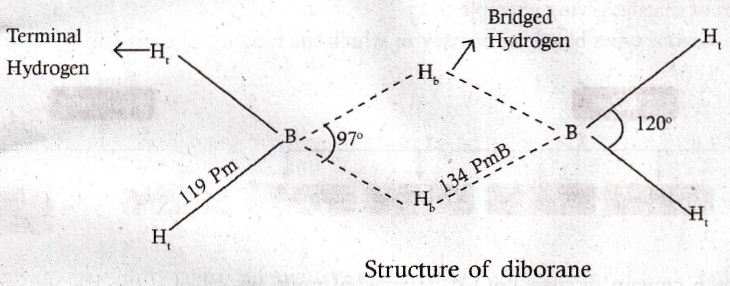
Describe the structure of diborane.
1.
(i) Equimolar mixture of hydrogen and carbon monoxide - water gas and the mixture of carbon monoxide and nitrogen - producer gas are important industrial fuels.
(ii) Carbon monoxide is a good reducing agent and can reduce many metal oxides to metals.
(iii) Carbon monoxide is an important ligand and forms carbonyl compound with transition metals.
2.
(i) Graphene is an allotropic form of carbon.
(ii) It has a single planar sheet of sp2 hybridised carbon atoms that are densely packed in a honeycomb crystal lattice.
3.
(i) Carbon nanotubes, have graphite like tubes with fullerene ends.
(ii) Along the axis, these nanotubes are stronger than steel and conduct electricity.
(iii) These have many applications in nanoscale electronics, catalysis, polymers and medicine.
4.
Generally on descending a group the ionisation energy decreases and hence the metallic character increases.
5.
(i) Silicones are used for low temperature lubrication and in vacuum pumps, high temperature oil baths etc.
(ii) They are used for making water proofing clothes.
(iii) They are used as insulting material in electrical motor and other appliances.
(iv) They are mixed with paints and enamels to make them resistant towards high temperature, sunlight, dampness and chemicals.
6.
(a) B(OH)3 + NH3\(\overset { \Delta }{ \longrightarrow } \) BN + 3H2O
(Boron nitride)
(b) Na2B4O7 + H2SO4 + 5H2O \(\longrightarrow \) 4H3BO3 + Na2SO4
(Boric acid)
(c) B2H6 + 2NaOH + 2H2O \(\longrightarrow \)2NaBO2 + 6H2
(Sodium metaborate)
(d) B2H6 + 6CH3OH \(\longrightarrow \)2B(OCH3)3 + 6H2O
(Trimethyl borate)
(e) 4BF3 + 3H2O \(\longrightarrow \) H3BO3 + 3H+ + 3[BF4]-
(Boric acid)
(f) HCOOH + H2SO4 \(\longrightarrow \)CO + H2SO4. H2O
(Carbon monoxide)
(g) 2SiCl4 + NH3 \(\overset { 330K }{ \underset { ether }{ \longrightarrow } } \)Cl3Si- NH - SiCl3 + 2HCl
(Chlorosilazane)
(h) SiCl4 + 4C2H5OH\(\longrightarrow \)Si(OC2H5)4 + 4HCI
(Tetraethoxysilane)
(i) 2B + 6NaOH\(\longrightarrow \) 2Na3BO3 + 3H2
(j) H2B4O7 \(\xrightarrow[]{Redhot}\) 2B2O3 + H2O
7.
(i) Icosogens → B, Al, Ga, In, Tl
(ii) Tetragens → C, Si, Ge, Sn, Pb
(iii) Pnictogens → N, P, As, Sb, Bi
(iv) Chalcogens → O, S, Se, Te, Po
8.
Diborane adds on to alkenes and alkynes in ether solvent at room temperature. This reaction is called hydroboration.
\({ B }_{ 2 }{ H }_{ 6 }+6RCH=CHR\longrightarrow 2B(RCH_2-{ CH }R)_{ 3 }B\)
9.
(i) In diborane two BH2 units are linked by two bridged hydrogens.
(ii) It has eight B-H bonds.
(iii) Diborane has only 12 valance electrons.
(iv) The four terminal B-H- bonds is "2c - 2e" bond (two centre - two electron bond.)
(v) Two three centred B - H - B bonds two electrons each. "(3c - 2e)"
(vi) In diborane, the boron is "sp3" hybridised
(vii) Three of the four "sp3" hydridised orbitals contains single electron and the fourth orbital is empty.

12th Standard Syllabus & Materials
12th Standard
TN 12th Computer Applications களப்பெயர் முறைமை (DNS) Sample Question Papers Study Material - QB365 Set A
NEW12th Standard
TN 12th Computer Applications வலையமைப்பு எடுத்துக்காட்டுகள் மற்றும் நெறிமுறைகள் Sample Question Papers Study Material - QB365 Set A
NEW12th Standard
TN 12th Computer Applications கணினி வலையமைப்பு ஓர் அறிமுகம் Sample Question Papers Study Material - QB365 Set A
NEW12th Standard
TN 12th Computer Applications PHP-உடன் MySQL-ஐ இணைத்தல் Sample Question Papers Study Material - QB365 Set A



Tamilnadu Stateboard 12th Standard Subjects

Maths
Chemistry

Physics
Biology

Computer Science

Business Maths and Statistics

Economics

Commerce

Accountancy

History

Computer Applications
Biology
Computer Technology
Computer Applications
Computer Science
Business Maths and Statistics
Commerce
Economics
Maths
Chemistry
Physics
Computer Technology
History
Accountancy

Tamil

English

French
Tamilnadu Stateboard Standards
