
 100% FREE ACCESS
12th Standard Syllabus & Materials
12th Standard
TN 12th Maths Applications of Matrices and Determinants Sample Question Papers Study Material - QB365 Set A
NEW12th Standard
TN 12th Computer Applications மின்னணு தரவு பரிமாற்றம் Sample Question Papers Study Material - QB365 Set A
NEW12th Standard
TN 12th Computer Applications மின் - வணிக பாதுகாப்பு அமைப்புகள் Sample Question Papers Study Material - QB365 Set A
NEW12th Standard
TN 12th Computer Applications மின்னணு செலுத்தல் முறைகள் Sample Question Papers Study Material - QB365 Set A
NEW12th Standard
TN 12th Computer Applications மின் - வணிகம் Sample Question Papers Study Material - QB365 Set A
NEW12th Standard
TN 12th Computer Applications திறந்த மூல கருத்துருக்கள் Sample Question Papers Study Material - QB365 Set A

Published on: 07/01/2020
p - Block Elements - II
Download Tamil Nadu 12th Standard Chemistry question papers, model tests, one-mark questions, important questions, and public exam papers in PDF format. Free study materials and answer keys for TN State Board students.
Questions + Answers key
Take MCQ Chemistry Test
1.
Which one of the following orders is not in accordance with the property stated against it?
F2 > CI2 > Br2 > I2: Bond dissociation energy
HI > HBr > HCI > HF: Acidic property in water
F2 > Cl2 > Br2 > l2: Oxidising power
F2 > Cl2 > Br2 > l2: Electronegativity
2.
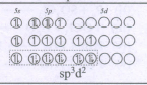
The hybridisation and shape of SF6 is respectively?
sp3d2, square planar
sp3d2, octahedral
sp3d see-saw
sp3d, trigonal bipyramidal
3.
The correct order of the thermal stability of hydrogen halide is_______.
HI > HBr > HCl > HF
HF > HCl > HBr > HI
HCl > HF > HBr > HI
HI > HCl > HF > HBr
4.
The basicity of pyrophosphorous acid ( H4P2O5) is _______.
4
2
3
5
5.
On hydrolysis, PCl3 gives________.
H3PO3
PH3
H3PO4
POCl3
6.
Out of H2O and H2S which one has higher bond angle and why?
7.
Write the order of thermal stability of the hydrides of group 16 elements.
8.
Write the reason for the anomalous behaviour of Nitrogen.
9.
Give the uses of helium.
10.
Why hydrides of oxygen is a liquid whereas hydride of sulphur is a gas?
11.
Elements of group 16 show lower value of first ionization enthalpy compared to group 15, why?
12.
What is phosphorescence?
13.
Deduce the oxidation number of oxygen in hypofluorous acid – HOF.
14.
Suggest a reason why HF is a weak acid, whereas binary acids of the all other halogens are strong acids.
15.
Write the valence shell electronic configuration of group-15 elements.
16.
How will you prepare chlorine in the laboratory?
17.
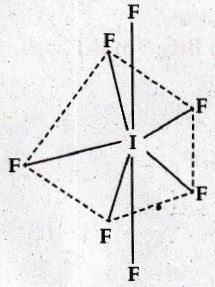
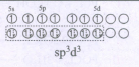
What is the hybridisation of iodine in IF7? Give its structure.
18.
Why is dioxygen a gas but sulphur a solid?
19.
Explain the structure of inter halogen compounds
1.
(a)
F2 > CI2 > Br2 > I2: Bond dissociation energy
2.
(b)
sp3d2, octahedral
3.
(b)
HF > HCl > HBr > HI
4.
(b)
2
5.
(a)
H3PO3
6.
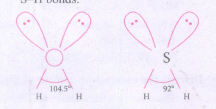
(i) Bond angel of HiX (H-O-H=104.5o) is larger than that of H2S(H-S-H=92o)
(ii) Since oxygen is more electronegative than sulphur, therefore bond pair electrons of O-H bond will be closer to oxygen which will be little away from the sulphur atom.
(iii) As a result bond pair-bond pair repulsions between bond pairs of two O-H bonds would be stronger than in the S-H bonds.
7.
(i) The thermal stability of hydrides of group 16 elements is directly proportional to the bond dissociation enthalpy of H- E bond.
(ii) On moving down the group, bond dissociation energy decreases and hence, E- H bond breaks easily.
(iii) Thus, the thermal stability of hydrides of group 16 elements decreases down the group. Hence the order of thermal stability is,
H2O > H2S > H2Se > H2Te > H2Po
8.
(i) Its small size
(ii) Its high electronegativity
(iii) Its high ionisation energy
(iv) Non-availability of d-orbital in the valence shell.
(v) Rather inert
(vi) High bond energy
9.
(i) Helium is used to provide inert atmosphere in electric-arc welding of metals.
(ii) Helium has lowest boiling point hence used in cryogenics.
(iii) It is much less denser than air and hence used for filling air balloons.
10.
(i) H2O undergoes extensive H-bonding due to high electronegativity of O-atom and hence exist as an associated molecule.
(ii) Therefore H2O is a liquid. On the other hand H2O does not undergo H-bonding and hence exists as a discrete molecules and as a gas.
11.
Element of group 15 have stable half-filled p-orbitals hence large amount of energy is required to remove electrons as compared to group 16, which has an incomplete p subshell.
12.
White Phosphorous glows in the dark due to oxidation which is called as phosphorescence.
13.
Oxidation number of F = -1
Oxidation number of H = +1
Oxidation number of O in HOF =x
(+1) + x + (-1) = 0
x = 0
Oxidation number of O in HOF = 0
14.
HF is a weak acid i.e. 0.1 M solution is only 10% ionised, but in 5M & 15M solution, HF is stronger acid due to chemical equilibrium.
\(\mathrm{HF}+\mathrm{H}_{2} \mathrm{O} \rightleftharpoons \mathrm{H}_{3} \mathrm{O}^{+}+\mathrm{F}^{-} \)
\(\mathrm{HF}+\mathrm{F}^{-} \rightleftharpoons \mathrm{HF}_{2}^{-}\)
15.
(i) The general electronic configuration of 15 group elements is ns2np3.
(ii) Nitrogen \(\Rightarrow 2 \mathrm{~s}^{2} 2 \mathrm{p}^{3}\) (Valence shell)
(iii) Phosphorus \(\Rightarrow 3 \mathrm{~s}^{2} 3 \mathrm{p}^{3}\)
(iv) Arsenic \(\Rightarrow 4 \mathrm{~s}^{2} 4 \mathrm{p}^{3}\)
(v) Antimony \(\Rightarrow 5 s^{2} 5 p^{3}\)
(vi) Bismuth \(\Rightarrow 6 \mathrm{~s}^{2} 6 \mathrm{p}^{3}\)
16.
Chlorine is prepared by the action of conc. sulphuric acid on chlorides in presence of manganese dioxide
4NaCl + MnO2 + 4H2SO4 \(\longrightarrow \)Cl2+ MnCl2 +4NaHSO4 + 2H2O
17.
(i) sp3d3 hybridisation
(ii) Pentagonal bipyramidal structure.
18.
(i) O2 molecules are held together by weak Vander Waal's force because of small size and high electronegativity of oxygen.
(ii) In contrast, sulphur shows catenation and forms stronger S-S bonds.
(iii) Due to catenation, sulphur forms octa-atomic S8 molecules having eight membered puckered ring structure.
(iv) Because of its bigger size the force of attraction holding S8 molecules are much stronger.
(v) Hence sulphur is a solid at room temperature or in other words, that is why there is a large difference between the boiling point (also melting points) of the two elements.
19.
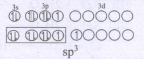
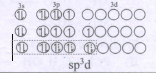
| TYPE | EXAMPLE | SHAPE | DIAGRAM | HYBRIDISATION |
|---|---|---|---|---|
| AX | ClF | Linear |  |
 |
| AX3 | ClF3 | Bipyramidal (without lone pair it is T-shaped) |
 |
 |
| AX5 | IF5 | Octahedral (without lone pair it is square pyramidal) |  |
 |
| AX7 | IF7 | Pentagonal bipyramidal |  |
 |

12th Standard Syllabus & Materials
12th Standard
TN 12th Computer Applications வலையமைப்பு வடமிடல் Sample Question Papers Study Material - QB365 Set A
NEW12th Standard
TN 12th Computer Applications களப்பெயர் முறைமை (DNS) Sample Question Papers Study Material - QB365 Set A
NEW12th Standard
TN 12th Computer Applications வலையமைப்பு எடுத்துக்காட்டுகள் மற்றும் நெறிமுறைகள் Sample Question Papers Study Material - QB365 Set A
NEW12th Standard
TN 12th Computer Applications கணினி வலையமைப்பு ஓர் அறிமுகம் Sample Question Papers Study Material - QB365 Set A



Tamilnadu Stateboard 12th Standard Subjects

Maths
Chemistry

Physics

Biology

Computer Science

Business Maths and Statistics

Economics

Commerce

Accountancy

History

Computer Applications
Biology
Computer Technology
Computer Applications
Computer Science
Business Maths and Statistics
Commerce
Economics
Maths
Chemistry
Physics
Computer Technology
History
Accountancy

Tamil

English

French
Tamilnadu Stateboard Standards
