
 100% FREE ACCESS
12th Standard Syllabus & Materials
12th Standard
TN 12th Maths Applications of Matrices and Determinants Sample Question Papers Study Material - QB365 Set A
NEW12th Standard
TN 12th Computer Applications மின்னணு தரவு பரிமாற்றம் Sample Question Papers Study Material - QB365 Set A
NEW12th Standard
TN 12th Computer Applications மின் - வணிக பாதுகாப்பு அமைப்புகள் Sample Question Papers Study Material - QB365 Set A
NEW12th Standard
TN 12th Computer Applications மின்னணு செலுத்தல் முறைகள் Sample Question Papers Study Material - QB365 Set A
NEW12th Standard
TN 12th Computer Applications மின் - வணிகம் Sample Question Papers Study Material - QB365 Set A
NEW12th Standard
TN 12th Computer Applications திறந்த மூல கருத்துருக்கள் Sample Question Papers Study Material - QB365 Set A

Published on: 27/11/2019
p - Block Elements - II
Download Tamil Nadu 12th Standard Chemistry question papers, model tests, one-mark questions, important questions, and public exam papers in PDF format. Free study materials and answer keys for TN State Board students.
Questions + Answers key
Take MCQ Chemistry Test
1.
S-S bond is present in _______.
H2S2O7
H2SO5
H2S2O6
H2S2O6
2.
Which is dibasic?
Orthophosphoric acid
Pyrophosphoric acid
Orthophosphorus acid
Hypophosphorous acid
3.
Among the following, which is the strongest oxidizing agent?
Cl2
F2
Br2
l2
4.
P4O6 reacts with cold water to give _______.
H3PO3
H4P2O7
HPO3
H3PO4
5.
On hydrolysis, PCl3 gives________.
H3PO3
PH3
H3PO4
POCl3
6.
Although \(\triangle\)H of fluorine is less negative than that of chlorine, but fluorine is a stronger oxidising agent than chlorine, why?
7.
Elements of group 16 show lower value of first ionization enthalpy compared to group 15, why?
8.
What type of hybridisation occur in
a) BrF5
b) BrF3
9.
Suggest a reason why HF is a weak acid, whereas binary acids of the all other halogens are strong acids.
10.
11.
Write the valence shell electronic configuration of group-15 elements.
12.
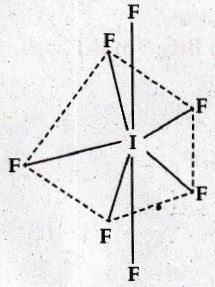
What is the hybridisation of iodine in IF7? Give its structure.
13.
Chalcogens belongs to p-block. Give reason.
14.
Name a reaction for the estimation of Ozone.
15.
Explain the commercial method of preparation of nitric acid.
16.
Write the reason for the anomalous behaviour of Nitrogen.
17.
Give the uses of sulphuric acid.
18.
Give the uses of helium.
19.
An amorphous solid (A) burns in air to form a gas (B) which turns lime water milky. The gas is also produced as a byproduct during roasting of sulphide ore. This gas decolourises acidified aqueous KMnO4 solution and reduces Fe3+ to Fe2+. Identify the solid 'A' and the gas 'B' and write the reactions involved.
1.
(d)
H2S2O6
2.
(c)
Orthophosphorus acid
3.
(b)
F2
4.
(a)
H3PO3
5.
(a)
H3PO3
6.
This is due to,
(i) Lowbond dissociation enthalpy of F-F-bond
(ii) High hydration enthalpy of F-.
7.
Element of group 15 have stable half-filled p-orbitals hence large amount of energy is required to remove electrons as compared to group 16, which has an incomplete p subshell.
8.
a) BrF5
.JPG)
Valence electron of bromine atom 7+ Number of fluorine atom (5) = 12
\(X=\frac{12}{2}=6\)
Hybridization: sp3d2 ;
Geometry: Square Pyramidal
b) BrF3
.JPG)
Valence electron of bromine atom 7+ Number of fluorine atom (3) = 10
X = \(\frac{10}{2}=5\)
Hybridization: sp3d2;
Geometry: Triangular bipyramidal (T - shaped)
9.
HF is a weak acid i.e. 0.1 M solution is only 10% ionised, but in 5M & 15M solution, HF is stronger acid due to chemical equilibrium.
\(\mathrm{HF}+\mathrm{H}_{2} \mathrm{O} \rightleftharpoons \mathrm{H}_{3} \mathrm{O}^{+}+\mathrm{F}^{-} \)
\(\mathrm{HF}+\mathrm{F}^{-} \rightleftharpoons \mathrm{HF}_{2}^{-}\)
10.
11.
(i) The general electronic configuration of 15 group elements is ns2np3.
(ii) Nitrogen \(\Rightarrow 2 \mathrm{~s}^{2} 2 \mathrm{p}^{3}\) (Valence shell)
(iii) Phosphorus \(\Rightarrow 3 \mathrm{~s}^{2} 3 \mathrm{p}^{3}\)
(iv) Arsenic \(\Rightarrow 4 \mathrm{~s}^{2} 4 \mathrm{p}^{3}\)
(v) Antimony \(\Rightarrow 5 s^{2} 5 p^{3}\)
(vi) Bismuth \(\Rightarrow 6 \mathrm{~s}^{2} 6 \mathrm{p}^{3}\)
12.
(i) sp3d3 hybridisation
(ii) Pentagonal bipyramidal structure.
13.
(i) The Chalcogens belong to group (16).
(ii) The group consists of elements: Oxygen, Sulphur, Selenium, Tellurium and Polonium.
(iii) These are ore forming elements as most of the ores are oxides and sulphides.
(iv) Chalcos meaning 'ore formers'.
14.
O3 oxidises potassium iodide to iodine. This reaction is quantitative and can be used for estimation of ozone
\({ O }_{ 3 }+2KI+{ H }_{ 2 }O\longrightarrow 2KOH+{ O }_{ 2 }+{ I }_{ 2 }\)
15.
Commercial method of preparation
(i) Nitric acid prepared in large scales using Ostwald's process. In this method ammonia from Haber's process is mixed about 10 times, of air.
(ii) This mixture is preheated and passed into the catalyst chamber where they come in contact with platinum gauze.
(iii) The temperature rises to about 1275 K and the metallic gauze brings about the rapid catalytic oxidation of ammonia resulting in the formation of NO, which then oxidised to nitrogen dioxide.
\({ 4NH }_{ 3 }+{ 5O }_{ 2 }\longrightarrow 4NO+6{ H }_{ 2 }O+120KJ\)
\(2NO+{ O }_{ 2 }\longrightarrow { 2NO }_{ 2 }\)
(iv) The nitrogen dioxide produced is passed through a series of adsorption towers. It reacts with water to give nitric acid. Nitric acid formed is bleached by blowing air.
\({ 6NO }_{ 2 }+3{ H }_{ 2 }O\longrightarrow { 4HNO }_{ 3 }+2NO+{ H }_{ 2 }O\)
16.
(i) Its small size
(ii) Its high electronegativity
(iii) Its high ionisation energy
(iv) Non-availability of d-orbital in the valence shell.
(v) Rather inert
(vi) High bond energy
17.
(i) Sulphuric acid is used in the manufacture of fertilisers, ammonium sulphate and super phosphates and other chemicals such as HCl, HNO3.
(ii) It is used as a drying agent and also used in the preparation of pigments, explosives etc.
18.
(i) Helium is used to provide inert atmosphere in electric-arc welding of metals.
(ii) Helium has lowest boiling point hence used in cryogenics.
(iii) It is much less denser than air and hence used for filling air balloons.
19.
(I) Since the byproduct of roasting to sulphide ore is SO2 It turns lime water milky.
Therefore, gas 'B' must be SO2
(ii) As the gas 'B' is obtained when amorphous solid 'A' burns in air therefore, amorphous solid 'A' must be sulphur S8
\(\underset { (A) }{ { S }_{ g } } +{ 8O }_{ 2 }\overset { \Delta }{ \longrightarrow } \underset { (B) }{ { 8SO }_{ 2 } } \)
(iii) Gas (B) reduces acidified aqueous KMnO4 solution and reduces Fe3+ to Fe2+ salts as shown below:
\(\underset { (yellow) }{ { 2MnO }_{ 4 } } ^{ - }+\underset { (b) }{ { SO }_{ 2 } } +2{ H }_{ 2 }O\longrightarrow { 2Fe }^{ 2+ }+\underset { (Green) }{ { SO }_{ 4 }^{ 2- } } +{ 4H }^{ + }\)
(iv) Thus, solid 'A' is S8 and gas 'B' is SO2

12th Standard Syllabus & Materials
12th Standard
TN 12th Computer Applications வலையமைப்பு வடமிடல் Sample Question Papers Study Material - QB365 Set A
NEW12th Standard
TN 12th Computer Applications களப்பெயர் முறைமை (DNS) Sample Question Papers Study Material - QB365 Set A
NEW12th Standard
TN 12th Computer Applications வலையமைப்பு எடுத்துக்காட்டுகள் மற்றும் நெறிமுறைகள் Sample Question Papers Study Material - QB365 Set A
NEW12th Standard
TN 12th Computer Applications கணினி வலையமைப்பு ஓர் அறிமுகம் Sample Question Papers Study Material - QB365 Set A



Tamilnadu Stateboard 12th Standard Subjects

Maths
Chemistry

Physics

Biology

Computer Science

Business Maths and Statistics

Economics

Commerce

Accountancy

History

Computer Applications
Biology
Computer Technology
Computer Applications
Computer Science
Business Maths and Statistics
Commerce
Economics
Maths
Chemistry
Physics
Computer Technology
History
Accountancy

Tamil

English

French
Tamilnadu Stateboard Standards
