
 100% FREE ACCESS
12th Standard Syllabus & Materials
12th Standard
TN 12th Computer Applications மின்னணு தரவு பரிமாற்றம் Sample Question Papers Study Material - QB365 Set A
NEW12th Standard
TN 12th Computer Applications மின் - வணிக பாதுகாப்பு அமைப்புகள் Sample Question Papers Study Material - QB365 Set A
NEW12th Standard
TN 12th Computer Applications மின்னணு செலுத்தல் முறைகள் Sample Question Papers Study Material - QB365 Set A
NEW12th Standard
TN 12th Computer Applications மின் - வணிகம் Sample Question Papers Study Material - QB365 Set A
NEW12th Standard
TN 12th Computer Applications திறந்த மூல கருத்துருக்கள் Sample Question Papers Study Material - QB365 Set A
NEW12th Standard
TN 12th Computer Applications வலையமைப்பு வடமிடல் Sample Question Papers Study Material - QB365 Set A

Published on: 22/01/2020
p - Block Elements II
Download Tamil Nadu 12th Standard Chemistry question papers, model tests, one-mark questions, important questions, and public exam papers in PDF format. Free study materials and answer keys for TN State Board students.
Questions + Answers key
Take MCQ Chemistry Test
1.
Why hydrides of oxygen is a liquid whereas hydride of sulphur is a gas?
2.
Explain Why in spite of nearly the same electronegativity, nitrogen forms hydrogen bonding while chlorine does not - Give reason.
3.
Account for the following:
(i) O-O bond lengths in ozone molecule are identical.
(ii) Most of the reactions in fluorine are exothermic.
4.
Arrange the following as indicated below:
(i) F2, Cl2, Br2, I2 - increasing bond dissociation enthalpy.
(ii) HF, HCI, HBr, HI - increasing acidic strength.
5.
Elements of group 16 show lower value of first ionization enthalpy compared to group 15, why?
6.
Give two uses of nitric acid.
7.
How is nitrogen prepared from liquid air?
8.
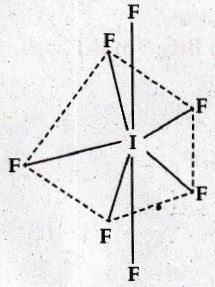
What is the hybridisation of iodine in IF7? Give its structure.
9.
Why fluorine is more reactive than other halogens?
10.
Give the oxidation state of halogen in the following.
a) OF2
b) O2F2
c) Cl2O3
d) I2O4
11.
Explain why fluorine always exhibit an oxidation state of -1?
12.
Chalcogens belongs to p-block. Give reason.
13.
What is inert pair effect?
14.
Give the uses of helium.
15.
What are interhalogen compounds? Give examples.
1.
(i) H2O undergoes extensive H-bonding due to high electronegativity of O-atom and hence exist as an associated molecule.
(ii) Therefore H2O is a liquid. On the other hand H2O does not undergo H-bonding and hence exists as a discrete molecules and as a gas.
2.
Nitrogen has smaller size and can polarise N-H bond d more efficiently than chlorine can do in a CI-H bond. Hence, nitrogen forms H- bond, while chlorine does not.
3.
(i) The two O-O bond lengths are identical due to resonance.
(ii) Due to the strong bond formation with other elements.
4.
(i) l2 < F2 < Br2 < Cl2·
(ii) HF < Hq < HBr < HI.
5.
Element of group 15 have stable half-filled p-orbitals hence large amount of energy is required to remove electrons as compared to group 16, which has an incomplete p subshell.
6.
(i) Nitric acid is used as a oxidising agent and in the preparation of aqua regia.
(ii) Salts of nitric acid are used in photography (AgNO3) and gun powder for fire arms (NaNO3)·
7.
(i) Nitrogen is separated industrially from liquid air by fractional distillation.
(ii) Pure nitrogen gas can be obtained by the thermal decomposition of sodium azide about 575K.
\(2Na{ N }_{ 3 }\longrightarrow 2Na+{ 3N }_{ 2 }\)
8.
(i) sp3d3 hybridisation
(ii) Pentagonal bipyramidal structure.
9.
(i) Fluorine is more electro negative than other halogens.
(ii) Because except fluorine all the other halogens have positive oxidation state.
(iii) It has high electron affinity character
Example:
\(\mathrm{Cl}_{2}\mathrm{O} \Rightarrow+1 \text { oxidation state }(\mathrm{Cl}) \)
\(\mathrm{OF}_{2} \Rightarrow-1 \text { oxidation state }(\mathrm{F})\)
10.
(a) OF2
+ 2 + 2(x) = 0
+2 = -2x
2 x = -2 ⇒ x = -1
(b) O2F2
2(+1) + 2x = 0
2x = -2
x = -1
(c) Cl2O3
2(x) + 3(-2) = 0
2x = +6
x = +3
(d) I2O4
2(x) + 4(-2) = 0
2x = +8
x = +4
11.
(i) Fluorine is most electronegative atom.
(ii) It has only one unpaired electron.
12.
(i) The Chalcogens belong to group (16).
(ii) The group consists of elements: Oxygen, Sulphur, Selenium, Tellurium and Polonium.
(iii) These are ore forming elements as most of the ores are oxides and sulphides.
(iv) Chalcos meaning 'ore formers'.
13.
(i) In heavier post transition metals, the outers electrons (ns) have a tendency to remain inert and show reluctance to take part in the bonding, which is known as inert pair effect.
(ii) This effect is also observed in groups 14, 15 and 16.
14.
(i) Helium is used to provide inert atmosphere in electric-arc welding of metals.
(ii) Helium has lowest boiling point hence used in cryogenics.
(iii) It is much less denser than air and hence used for filling air balloons.
15.
Each halogen combines with other halogens to form a series of compounds are called interhalogen compounds.
Example: AB type: BrF
AB3 type: ICI3

12th Standard Syllabus & Materials
12th Standard
TN 12th Computer Applications களப்பெயர் முறைமை (DNS) Sample Question Papers Study Material - QB365 Set A
NEW12th Standard
TN 12th Computer Applications வலையமைப்பு எடுத்துக்காட்டுகள் மற்றும் நெறிமுறைகள் Sample Question Papers Study Material - QB365 Set A
NEW12th Standard
TN 12th Computer Applications கணினி வலையமைப்பு ஓர் அறிமுகம் Sample Question Papers Study Material - QB365 Set A
NEW12th Standard
TN 12th Computer Applications PHP-உடன் MySQL-ஐ இணைத்தல் Sample Question Papers Study Material - QB365 Set A



Tamilnadu Stateboard 12th Standard Subjects

Maths
Chemistry

Physics

Biology

Computer Science

Business Maths and Statistics

Economics

Commerce

Accountancy

History

Computer Applications
Biology
Computer Technology
Computer Applications
Computer Science
Business Maths and Statistics
Commerce
Economics
Maths
Chemistry
Physics
Computer Technology
History
Accountancy

Tamil

English

French
Tamilnadu Stateboard Standards
