
 100% FREE ACCESS
12th Standard Syllabus & Materials
12th Standard
TN 12th Computer Applications மின்னணு தரவு பரிமாற்றம் Sample Question Papers Study Material - QB365 Set A
NEW12th Standard
TN 12th Computer Applications மின் - வணிக பாதுகாப்பு அமைப்புகள் Sample Question Papers Study Material - QB365 Set A
NEW12th Standard
TN 12th Computer Applications மின்னணு செலுத்தல் முறைகள் Sample Question Papers Study Material - QB365 Set A
NEW12th Standard
TN 12th Computer Applications மின் - வணிகம் Sample Question Papers Study Material - QB365 Set A
NEW12th Standard
TN 12th Computer Applications திறந்த மூல கருத்துருக்கள் Sample Question Papers Study Material - QB365 Set A
NEW12th Standard
TN 12th Computer Applications வலையமைப்பு வடமிடல் Sample Question Papers Study Material - QB365 Set A

Published on: 17/01/2020
Download Tamil Nadu 12th Standard Chemistry question papers, model tests, one-mark questions, important questions, and public exam papers in PDF format. Free study materials and answer keys for TN State Board students.
Questions + Answers key
Take MCQ Chemistry Test
1.
Which among the following exists as zwitter ion?
sulphanilic acid
salicylic acid
acetanilide
all the above
2.
Pick out the odd one.
Wax
Starch
Glucose
Fructose
3.
The process in which chemical change occurs on passing electricity is termed as ______.
neutralisation
hydrolysis
electrolysis
ionisation
4.
The solution whose pH is maintained constant even upon the addition of small amounts of acid or base is called ________.
acidic solution
basic solution
buffer solution
true solution
5.
Which among the following reagent is not used to differentiate ethanol and phenol?
neutral FeCl3
C6H5N2CI
NaOH
anhy ZnCl2
6.
Reaction of acetone with one of the following reagents involves nucleophilic addition followed by elimination of water. The reagent is _______.
Grignard reagent
Sn / HCl
hydrazine in presence of slightly acidic solution
hydrocyanic acid
7.
Fog is colloidal solution of _______.
solid in gas
gas in gas
liquid in gas
gas in liquid
8.
If the solubility product of lead iodide is 3.2 × 10⁻⁸, its solubility will be _______.
2 × 10⁻³M
4 × 10⁻⁴M
1.6 × 10⁻⁵M
1.8 × 10⁻⁵M
9.
The hybridisation and shape of SF6 is respectively?
sp3d2, square planar
sp3d2, octahedral
sp3d see-saw
sp3d, trigonal bipyramidal
10.
In a solid, the cation is missing from the lattice and is found in an interstitial position. The defect is ________.
Metal excess
p type
Schottky
Frenkel
11.
Which metal is used for extraction of Au and Ag and also for galvanisation of iron objects?
Mg
Zn
Cr
Co
12.
For a first order reaction A ⟶ B the rate constant is x min−1. If the initial concentration of A is 0.01M, the concentration of A after one hour is given by the expression.
001. e−x
1 x 10⁻²(1-e-60x)
(1 x 10⁻²)e-60x
none of these
13.
A complex has a molecular formula MSO4Cl.6H2O. The aqueous solution of it gives white precipitate with Barium chloride solution and no precipitate is obtained when it is treated with silver nitrate solution. If the secondary valence of the metal is six, which one of the following correctly represents the complex?
[M(H2O)4Cl]SO4.2H2O
[M(H2O)6]SO4
[M(H2O)5Cl]SO4.H2O
[M(H2O)3Cl]SO4.3H2O
14.
Which of the following oxidation states is most common among the lanthanoids?
+4
+2
+5
+3
15.
The basic structural unit of silicates is _______.
\(\left( SiO_{ 3 } \right) ^{ 2- }\)
\(\left( SiO_{ 4 } \right) ^{ 2- }\)
\(\left( Sio \right) ^{ - }\)
\(\left( SiO_{ 4 } \right) ^{ 4- }\)
16.
Define conductance. Give its unit
17.
Write the expression for the solubility product of Hg2Cl2 .
18.
The concentration of hydroxide ion in a water sample is found to be 2.5 × 10⁻⁶M. Identify the nature of the solution.
19.
Why is instantaneous rate preferred over average rate?
20.
Discuss the oxidising power of fluorine.
21.
Write the two similarities between calcination and roasting.
22.
Give the geometry and magnetic character of [NiCI4]2-
23.
What are point defects?
24.
Write a note on zeolites.
25.
What is catenation ? describe briefly the catenation property of carbon.
26.
How can the following conversion be effected?
i) Nitrobenzene to anisole
ii) Chloro benzene to phenyl hydrazine
iii) Aniline to benzoic acid
iv) Benzene diazonium chloride to ehtyl benzene.
27.
Write a short note on Antioxidants.
28.
Amino acids are amphoteric in nature. Explain.
29.
Write the reactions taking place in anode and cathode of a mercury button cell. Give the over all redox reaction of the cell with the emf generation
30.
Give chemical tests to distinguish between propan-2-ol and 2-methyl-propan-2-ol.
31.
Can we use nucelophiles such as NH3,CH3O - for the Nucleophilic substitution of alcohols
32.
Complete the following reactions?
i) Cr2 + 2e- ⟶
ii) Mn2+ + 2e- ⟶
iii) Fe2+ + 2e- ⟶
iv) CO2+ + 2e- ⟶
33.
Explain alkali leaching in the extraction of aluminum.
34.
The half life of the homogeneous gaseous reaction SO2Cl2 → SO2 + Cl2 which obeys first order kinetics is 8.0 minutes. How long will it take for the concentration of SO2Cl2 to be reduced to 1% of the initial value?
35.
Compound (A) of molecular formula C7H8 when treated with air in presence of V2O5 at 773 K gives a compound (B) of molecular formula C7H6O, which has the smell of bitter almonds. Alkaline KMnO4 oxidised compound (B) to (C) of molecular formula C7H6Or Compound (B) on treatment with N2H4 and KOH gives back compound (A). Identify (A), (B) & (C) and explain the reactions.
36.
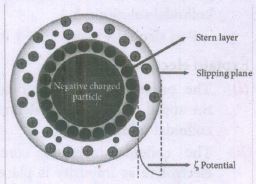
Explain the electrical property of colloids with a neat diagram. (or) Write a note on Helmholta electrical double layer.
37.
Identify A, B, C and D
\(\text { ethanoic acid } \stackrel{\mathrm{SOCl}_{2}}{\longrightarrow} \mathrm{A} \stackrel{\mathrm{Pd} / \mathrm{BaSO}_{4}}{\longrightarrow} \mathrm{B} \stackrel{\mathrm{NaOH}}{\longrightarrow} \mathrm{C} \stackrel {\longrightarrow}{\triangle} \mathrm{D}\)
38.

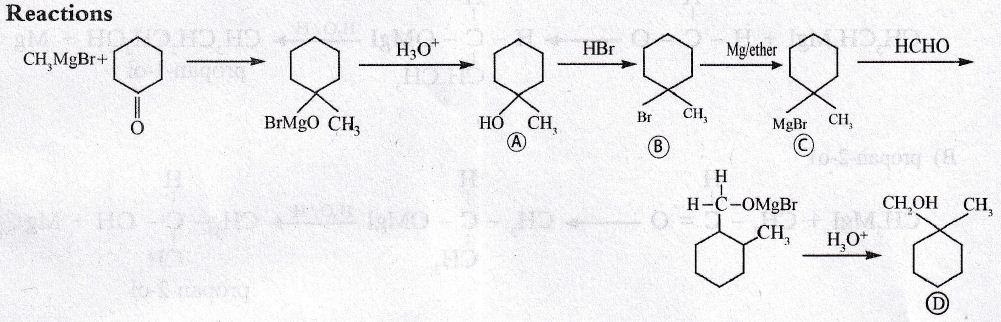
Identify A,B,C,D and write the complete equation
39.
Describe some feature of catalysis by Zeolites.
40.
Justify the following statement.
"Elements of the first transition series possess many properties different from those of heavier transition elements".
41.
Account for the following:
(i) Reducing character decreases from SO2 to TeO2.
(ii) Xenon forms compounds with fluorine and oxygen only.
42.
What are the general characteristics of solids?
43.
Indicate the types of isomerism exhibited by the following complexes and draw the structures for these isomers.
(i) K[Cr(H2O)2 (C2O4)2]
(ii) [Co(en)3]CI3
(iii) [Co(NH3)5(NO2)](NO3)2
(iv) [Pt (NH3)(H2O)CI2]
1.
(a)
sulphanilic acid
2.
(a)
Wax
3.
(c)
electrolysis
4.
(c)
buffer solution
5.
(d)
anhy ZnCl2
6.
(c)
hydrazine in presence of slightly acidic solution
7.
dispersion medium-gas
dispersed phase-liquid
8.
PbI2(s) ⇌ Pb2+(aq) + 2I-(aq)
Ksp = (s) (2s)2
3.2 × 10-8 = 4s3
s = (3.2 × 10⁻⁸/4)1/3
= ( 8 x 10⁻⁹)1/3
= 2 x 10⁻³ M
9.
(b)
sp3d2, octahedral
10.
(d)
Frenkel
11.
(b)
Zn
12.
\(k=\frac { 2.303 }{ t } log\frac { \left[ { A }_{ 0 } \right] }{ \left[ A \right] } \)
\(k=\frac { 1 }{ t } ln \frac { \left[ { A }_{ 0 } \right] }{ \left[ A \right] } \)
\(e^{kt}=\frac { \left[ { A }_{ 0 } \right] }{ \left[ A \right] }\)
[A] = [A0] ekt
In this case
k = x min-1 and [A0] = 0.01 M = 1 x 10⁻²M
t = 1 hour = 60 min
[A] = (1 x 10⁻²)e-60x
13.
Molecular formula: MSO4Cl.6H2O
Formation of white precipitate with Barium chloride indicates that SO2-4 ions are outside the coordination sphere, and no precipitate with AgNO3 solution indicates that the Cl- ions are inside the coordination sphere. Since the coordination number of M is 6.Cl- and 5 H2O are ligands, remaining 1 H2O molecular and SO2-4 are in the outer coordination sphere.
14.
(d)
+3
15.
(d)
\(\left( SiO_{ 4 } \right) ^{ 4- }\)
16.
The reciprocal of the resistance \((\frac{l}{R})\) gives the conductance of an electrolytic solution. The SI unit of conductance is Siemen (S).
17.
\(\mathrm{Hg}_{2} \mathrm{Cl}_{2(\mathrm{~s})} \rightleftharpoons \mathrm{Hg}_{2}^{2+} \text { (aq) }+2 \mathrm{Cl^-}_{(\mathrm{aq})}\\ s \quad \quad \quad \quad \quad \quad s \quad \quad \quad \quad \quad 2s\)
\(\mathrm{K}_{\mathrm{sp}} =\left[\mathrm{Hg}_{2}^{2+}\right]{\left[\mathrm{Cl}^{-}\right]^{2}} \)
\(=(\mathrm{s})(2 \mathrm{~s})^{2} \)
\(\mathrm{~K}_{\mathrm{sp}} =4 \mathrm{~s}^{3}\)
18.
1. If \(\left[\mathrm{OH}^{-}\right]>1 \times 10^{-7} \mathrm{M}\), the solution is basic. \(2.5 \times 10^{-6} \mathrm{M}>1 \times 10^{-7} \mathrm{M}\)
2. \(\therefore\) The solution is basic.
19.
Rate decreases with time as the reaction proceeds and the average rate cannot be used to predict the rate of the reaction at any instant. The rate of the reaction, at a particular instant during the reaction is called the instantaneous rate. So instantaneous rate in prepared over average rate.
20.
(i) All the halogens have strong oxidising property due to their high electron affinity.
(ii) Fluorine is the strongest oxidising agent. It oxidises other halide ions into halogens in solution or when dry.
\({ F }_{ 2 }+{ 2X }^{ - }\longrightarrow { 2F }^{ - }+{ X }_{ 2 }\) (where X- = Cl-, Br-, I-)
21.
(i) The end product of both the processes is oxide of metal.
(ii) Volatile impurities are removed from the ore and surface area for the further reaction increases.
22.
Tetrahedral, paramagnetic.
23.
The imperfection occurs due to missing atoms, displaced atoms or extra atoms, is named as a point defect. Such defects arise due to imperfect packing during the original crystallisation or they may arise from thermal vibrations of atoms at elevated temperatures.
24.
(i) Zeolites are three-dimensional crystalline solids containing Al, Si and O in their regular three dimensional framework.
(ii) They are hydrated sodium alumino silicates with general formula Na2O(AI2O3).·x(SiO2)·yH2O
(x = 2 to 10; y = 2 to 6).
(iii) Zeolites have porous structure in which the monovalent sodium ions and water molecules are loosely held.
(iv) The Si and Al atoms are tetrahedrally coordinated with each other through shared oxygen atoms.
(v) Zeolites are similar to clay minerals but they differ in their crystalline structure.
(vi) Zeolites have a three dimensional crystalline structure looks like a honeycomb consisting of a network of interconnected tunnels and cages.
(vii) Water molecules moves freely in and out of these pores but the zeolite framework remains rigid
(viii) Another special aspect of this structure is that the pore/channel sizes are nearly uniform, allowing the crystal to act as a molecular sieve.
25.
Catenation is an ability of an element to form chain of atoms.
The conditions for catenation.
(a) The valency of element is greater than or equal to two.
(b) Element should have an ability to bond with itself
(c) The self bond must be as strong as Its bond with other elements
(d) Kinetic inertness of catenated compound towards other molecules.
(e) Carbon possesses all the above properties and forms a wide range of compounds with itself and with other elements such as H, O, N, S and halogens.
26.
(i) 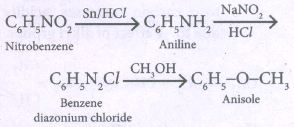
(ii) 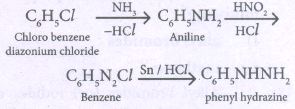
(iii) 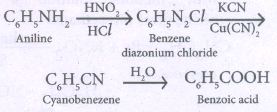
(iv) 
27.
(i) Antioxidants are substances which retard the oxidative deteriorations of food.
(ii) Food containing fats and oils is easily oxidised and turn rancid.
(iii) To prevent the oxidation of the fats and oils, chemical BHT(butylhydroxy toluene), BHA(Butylated hydroxy anisole) are added as food additives.
(iv) They are generally called antioxidants. These materials readily undergo oxidation by reacting with free radicals generated by the oxidation of oils, thereby stop the chain reaction of oxidation of food.
28.
At aqueous solution, the proton from carboxyl group can be transferred to the amino group of an amino acid leaving these groups with opposite charges. Despite having both positive and negative charges, this molecule is neutral and has amphoteric behaviour. These ions are called zwitter ions.
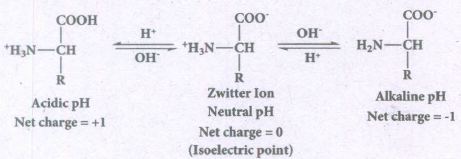
Zwitter ions behave as neutral molecules at pH isoelectric point.
29.
(i) Oxidation occurs at anode:
.JPG)
(ii) Reduction occurs at cathode:
.JPG)
(iii) Overall reaction:
\({ Zn }_{ (s) }+{ HgO }_{ (s) }\rightarrow { ZnO }_{ (s) }+Hg(l)\)
(iv) Cell emf: about 1.35V.
30.
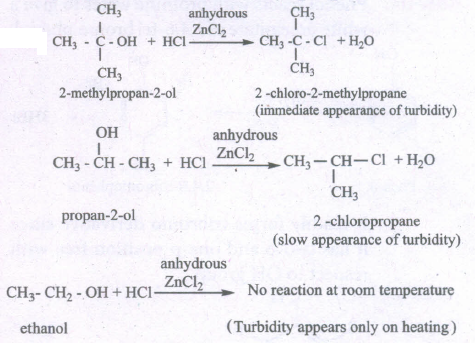
31.
Yes, we can use nucleophiles such as NH3, CH3O- for the nucleophilic substitution of alcohol.
Example
\(\mathrm{C}_{2} \mathrm{H}_{5} \mathrm{OH}+\mathrm{NH}_{3} \rightarrow \mathrm{C}_{2} \mathrm{H}_{5} \mathrm{NH}_{2}+\mathrm{H}_{2} \mathrm{O} \)
\(\mathrm{C}_{2} \mathrm{H}_{5} \mathrm{OH}+\mathrm{CH}_{2} \mathrm{~N}_{2} \rightarrow \mathrm{C}_{2} \mathrm{H}_{5} \mathrm{OCH}_{3}+\mathrm{N}_{2}\)
32.
i) Cr2 + 2e- ⟶ Cr
ii) Mn2+ + 2e- ⟶ Mn
iii) Fe2+ + 2e- ⟶ Fe
iv) CO2+ + 2e- ⟶ Co
33.
(i) In this method, the ore is treated with aqueous alkali to form a soluble complex.
(ii) Bauxite, an important ore of aluminum is heated with a solution of sodium hydroxide or sodium carbonate in the temperature range 470 - 520 K at 35 atm to form soluble sodium meta-aluminate leaving behind the impurities, iron oxide and titanium oxide.
\({ Al }_{ 2 }{ O }_{ 3(s) }+2NaO{ H }_{ (aq) }+3{ H }_{ 2 }{ O }_{ (l) }\longrightarrow 2Na[Al({ OH })_{ 4 }]_{ (aq) }\)
(iii) The hot solution is decanted, cooled, and diluted. This solution is neutralised by passing CO2 gas, to the form hydrated Al2O3 precipitate
\(2Na\left[ Al\left( OH \right) _{ 4 } \right] _{ (aq) }+{ CO }_{ 2(g) }\longrightarrow { Al }_{ 2 }{ { O }_{ 3 }.x{ H }_{ 2 }O_{ (s) }+2NaHCO_{ 3(aq) } }\)
(iii) The precipitate is filtered off and heated around 1670 K to get pure alumina Al2O3
34.
\(\mathrm{k}=0.693 / \mathrm{t}_{1 / 2}\)
\(\mathrm{k}=\frac{0.693}{8.0}=0.08 \mathrm{~min}^{-1}\)
For the first order reaction:
\(t =\frac{2.303}{k} \log \frac{\left[A_{0}\right]}{[A]} \)
\(t =\frac{2.303}{0.087} \log \left(\frac{100}{1}\right)=26.47 \log 10^{2} \)
\(t =2 \times 26.47 \log 10 \)
\(t =52.94 \mathrm{~min}\)
35.
(i) Compound A is Toluene (C6H5CH3).
(ii) When toluene is treated with air in the presence of V2O5 at 773K. It gives compound B benzaldehyde (C6H5CHO).
\({ C }_{ 6 }{ H }_{ 5 }{ CH }_{ 3 }\overset { (O) }{ \underset { air/{ v }_{ 2 }{ O }_{ 5 }\\ \quad 773k }{ \longrightarrow } } { C }_{ 6 }{ H }_{ 5 }CHO+{ H }_{ 2 }O\)
(iii) Alkaline KMnO4 oxidises Benzaldehyde (B) to Benzoic acid (C).
\({ C }_{ 6 }{ H }_{ 5 }CHO\overset { \left( O \right) }{ \longrightarrow } { C }_{ 6 }{ H }_{ 5 }COOH\\
\quad (B) \quad \quad \quad \quad \quad \quad (C)\)
(iv) Benzaldehyde (B) on treatment with N2H4 and KOH gives compound A toluene.
\(\underset {(B)}{{ C }_{ 6 }{ H }_{ 5 }}CHO\underset { { N }_{ 2 }{ H }_{ 4 }/KOH }{ \longrightarrow } \underset{(C)}{{ C }_{ 6 }{ H }_{ 5 }{ CH }_{ 3 }}\)
| Compound | Compound Name | Formula |
|---|---|---|
| A | Toluene | C6H5CH3 |
| B | Benzaldehyde | C6H5CHO |
| C | Benzoic acid | C6H5COOH |
36.
Helmholtz double layer:
(i) The surface of colloidal particle adsorbs one type of ion due to preferential adsorption.
(ii) This layer attracts the oppositely charged < ions in the medium and hence at the boundary separating the two electrical double layers are setup.
(iii) This is called as Helmholtz electrical double layer.
(iv) As the particies nearby are having similar: charges, they cannot come close and condense.
37.
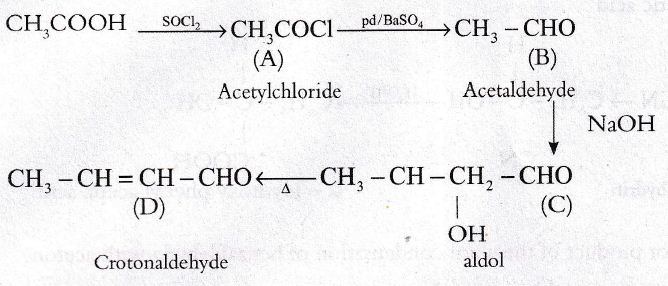
| Compound | Name |
| A | Acetylchloride |
| B | Acetaldehyde |
| C | 3 - Hydroxy butanal |
| D | Crotonaldehyde |
38.
39.
(i) Zeolites are microporous, crystalline, hydrated, alumino silicates, made of silicon and aluminium tetrahedra.
(ii) There are about 50 natural zeolites and 150 synthetic zeolites.
(iii) As silicon is tetravalent and aluminium is trivalent, the zeolite matrix carries extra negative charge.
(iv) To balance the negative charge, there are extra framework cations for example H+or Na+ons. Zeolites carrying protons are used as solid acids, catalysis and they are extensively used in the petrochemical industry for cracking heavy hydrocarbon fractions into gasoline, diesel, etc.,
(v) Zeolites carrying Na+ ions are used as basic catalysis.
(vi) One of the most important applications of zeolites is their shape selectivity.
(vii) In zeolites, the active sites namely protons are lying inside their pores. So, reactions occur only inside the pores of zeolites.
Reactant selectivity:
When bulkier molecules in a reactant mixture are prevented from reaching the active sites within the zeolite crystal, this selectivity is called reactant shape selectivity.
Transition state selectivity:
If the transition state of a reaction is large compared to the pore size of the zeolite, then no product will be formed.
Product selectivity:
It is encountered when certain product molecules one too big to diffuse out of the zeolite pores.
40.
The heavier transition elements belong to fourth (4d), fifth (Sd) and sixth (6d) transition series. Their properties are expected to be different form the elements belonging to the first (3d) series due to the following reasons.
(i) Atomic radii: Size of the transition elements 94d and Sd series are larger than those of the corresponding elements of the first transition series though those of 4d and Sd series are very close to each other.
(ii) Ionisation enthalpy of Sd series are higher than the corresponding elements of 3d and 4d series.
(iii) Atomisation enthalpy of 4d and Sd series are higher than the corresponding elements of the first series.
(iv) Melting and boiling points of heavier transition elements are greater than those of the first transition series due to stronger intermetallic bonding.
(v) The elements of the first transition series generally form low or high spin complexes, depending upon the higher of ligand field. However, the heavier transition elements form low spin complexes irrespective of the strength of the ligand filed.
41.
(i) Stability of higher oxidation state decreases down the group from S to Te because stability of lower oxidation state increases down the group from S to Te.
(ii) Fluorine and oxygen are most electronegative and very reactive. So they can ionised noble gases and form compounds.
42.
(i) Solids have definite volume and shape
(ii) Solids are rigid and incompressible
(iii) Solids have strong cohesive forces.
(iv) Their constituents have fixed positions and can only oscillate about their mean positions.
43.
(i) It exhibits both geometrical and optical isomerism
(a) Geometrical isomers:
.JPG)
(b) Optical isomers:
.JPG)
(ii) It shows two optical isomers
.JPG)
(iii) Ionisation isomers
Linkage isomers
[Co(NH3)5(NO2)(NO3)2], [CO(NH3)5 (ONO)](NO3)2
(iv) Geometrical isomers
.JPG)

12th Standard Syllabus & Materials
12th Standard
TN 12th Computer Applications களப்பெயர் முறைமை (DNS) Sample Question Papers Study Material - QB365 Set A
NEW12th Standard
TN 12th Computer Applications வலையமைப்பு எடுத்துக்காட்டுகள் மற்றும் நெறிமுறைகள் Sample Question Papers Study Material - QB365 Set A
NEW12th Standard
TN 12th Computer Applications கணினி வலையமைப்பு ஓர் அறிமுகம் Sample Question Papers Study Material - QB365 Set A
NEW12th Standard
TN 12th Computer Applications PHP-உடன் MySQL-ஐ இணைத்தல் Sample Question Papers Study Material - QB365 Set A



Tamilnadu Stateboard 12th Standard Subjects

Maths
Chemistry

Physics

Biology

Computer Science

Business Maths and Statistics

Economics

Commerce

Accountancy

History

Computer Applications
Biology
Computer Technology
Computer Applications
Computer Science
Business Maths and Statistics
Commerce
Economics
Maths
Chemistry
Physics
Computer Technology
History
Accountancy

Tamil

English

French
Tamilnadu Stateboard Standards
