
 100% FREE ACCESS
12th Standard Syllabus & Materials
12th Standard
TN 12th Computer Applications மின்னணு தரவு பரிமாற்றம் Sample Question Papers Study Material - QB365 Set A
NEW12th Standard
TN 12th Computer Applications மின் - வணிக பாதுகாப்பு அமைப்புகள் Sample Question Papers Study Material - QB365 Set A
NEW12th Standard
TN 12th Computer Applications மின்னணு செலுத்தல் முறைகள் Sample Question Papers Study Material - QB365 Set A
NEW12th Standard
TN 12th Computer Applications மின் - வணிகம் Sample Question Papers Study Material - QB365 Set A
NEW12th Standard
TN 12th Computer Applications திறந்த மூல கருத்துருக்கள் Sample Question Papers Study Material - QB365 Set A
NEW12th Standard
TN 12th Computer Applications வலையமைப்பு வடமிடல் Sample Question Papers Study Material - QB365 Set A

Published on: 13/09/2019
Download Tamil Nadu 12th Standard Chemistry question papers, model tests, one-mark questions, important questions, and public exam papers in PDF format. Free study materials and answer keys for TN State Board students.
Questions + Answers key
Take MCQ Chemistry Test
1.
Activation energy of a reactant is reduced by ________.
increased temperature
reduced temperature
increased pressure
reduced pressure
2.
For a reaction: aA ⟶ bB, the rate of reaction is doubled when the concentration of A is increased by four times. The rate of reaction is equal to _____.
k[A]a
\(k{ \left[ A \right] }^{ \frac { 1 }{ 2 } }\)
\(k{ \left[ A \right] }^{ \frac { 1 }{ a } }\)
K[A]
3.
The total number of atoms per unit cell in fee lattice is_______.
4
8
12
2
4.
Which type of defect is found in transition metals that have variable valency?
Frenkel defect
Schottky defect
Line defect
Metal deficiency defect
5.
Coinage metals are _______.
normal metals
transition metals
active metals
alkali metals
6.
_______ valencies are directional in nature.
primary
secondary
tertiary
None
7.
The addition of a catalyst during a chemical reaction alters which of the following quantities?
Enthalpy
Activation energy
Entropy
Internal energy
8.
The crystal with a metal deficiency defect is ________.
NaCl
FeO
ZnO
KCl
9.
The composition of a sample of wurtzite is Fe0.93 O1.00 what % of Iron present in the form of Fe3+?
16.05%
15.05%
18.05%
17.05%
10.
An excess of silver nitrate is added to 100ml of a 0.01M solution of Pentaaquachlorochromium (III)chloride. The number of moles of AgCl precipitated would be _______.
0.02
0.002
0.01
0.2
11.
The alloy of copper that contain Zinc is________.
Monel metal
Bronze
bell metal
brass
12.
The molarity of given orthophosphoric acid solution is 2M. Its normality is _______.
6N
4N
2N
none of these
13.
14.
Cupellation is a process used for the refining of________.
Silver
Lead
Copper
iron
15.
Bauxite has the composition ______.
Al2O3
Al2O3.nH2O
Fe2O3.2H2O
None of these
16.
How is nitrogen prepared from liquid air?
17.
Name the various refining process.
18.
Arrange the following complex ions in the increasing order of crystal filed splitting energy (\({ \triangle }_{ 0 }\)) [CrCI6]3-, [Cr(CN)6]3-, [Cr(NH3)6]3+
19.
What are point defects?
20.
Write a note on zeolites.
21.
22.
What is the role of quick lime in the extraction of Iron from its oxide Fe2O3?
23.
What is chromyl chloride test? Give equations.
24.
List the applications of gold.
25.
Distinguish Roasting and Calcination.
26.
Write the reason for the anomalous behaviour of Nitrogen.
27.
Give the uses of silicones.
28.
Explain the following terms with suitable examples.
(i) Gangue
(ii) slag
29.
The specific reaction rates of a chemical reaction are 2.45 x 10⁻⁵ sec-1 at 273 K and 16.2 x 10⁻⁴ sec-1 at 303 K. Calculate the activation energy.
30.
Give the structure for the following compounds.
(i) pentaamminechlorocobalt (III) ion
(ii) Triamminetrinitrito- k N cobalt (III)
(ill) tetraammineaquabromidooobalt(III)nitrate
(iv) Dichloridobisethane-(1,2-diamine) cobalt (lIl) chloride
(v) Tetraamminecopper (lI) sulphate
31.
Mention the type of hybridisation and magnetic property of the following complexes using VB theory a) [FeF6]4- b) [Fe(CN)6]4-
32.
From the following data, show that the decomposition of hydrogen peroxide is a reaction of the first order:
| t(min) | 0 | 10 | 20 |
| V(ml) | 46.1 | 29.8 | 19.3 |
Where t is the time in minutes and V is the volume of standard KMnO4 solution required for titrating the same volume of the reaction mixture.
1.
(a)
increased temperature
2.
(b)
\(k{ \left[ A \right] }^{ \frac { 1 }{ 2 } }\)
3.
(a)
4
4.
(d)
Metal deficiency defect
5.
(b)
transition metals
6.
(d)
None
7.
A catalyst provides a new path to the reaction with low activation energy. i.e., it lowers the activation energy.
8.
(b)
FeO
9.
(b)
15.05%
10.
The complex is [M(H2O)5Cl]Cl2
1000 ml of 1 M solution of the complex gives 2 moles of Cl- ions 1000 ml of 0.01 M solution of the complex will give
\(\frac{100 ml \times 0.01M \times 2Cl^-}{1000 ml \times 1M}\)
= 0.002 moles of Cl- ions
11.
(d)
brass
12.
(a)
6N
13.
(d)
14.
(a)
Silver
15.
(b)
Al2O3.nH2O
16.
(i) Nitrogen is separated industrially from liquid air by fractional distillation.
(ii) Pure nitrogen gas can be obtained by the thermal decomposition of sodium azide about 575K.
\(2Na{ N }_{ 3 }\longrightarrow 2Na+{ 3N }_{ 2 }\)
17.
Distillation, liquation, electrolytic refining, zone refining, vapour phase method, van -Arkel method
18.
(i) CFSE is higher when the complex contains strong field ligand as per spectro chemical series.
(ii) Thus, crystal field splitting energy increases in the order
[CrCI6]3- < [Cr(NH3)6]3+ < [Cr(CN)6]3-, Because the order of field strength is Cl- < NH3 < CN-
19.
The imperfection occurs due to missing atoms, displaced atoms or extra atoms, is named as a point defect. Such defects arise due to imperfect packing during the original crystallisation or they may arise from thermal vibrations of atoms at elevated temperatures.
20.
(i) Zeolites are three-dimensional crystalline solids containing Al, Si and O in their regular three dimensional framework.
(ii) They are hydrated sodium alumino silicates with general formula Na2O(AI2O3).·x(SiO2)·yH2O
(x = 2 to 10; y = 2 to 6).
(iii) Zeolites have porous structure in which the monovalent sodium ions and water molecules are loosely held.
(iv) The Si and Al atoms are tetrahedrally coordinated with each other through shared oxygen atoms.
(v) Zeolites are similar to clay minerals but they differ in their crystalline structure.
(vi) Zeolites have a three dimensional crystalline structure looks like a honeycomb consisting of a network of interconnected tunnels and cages.
(vii) Water molecules moves freely in and out of these pores but the zeolite framework remains rigid
(viii) Another special aspect of this structure is that the pore/channel sizes are nearly uniform, allowing the crystal to act as a molecular sieve.
21.
22.
In this extraction, a basic flux, quick lime (CaO) is used, since the silica gangue present in the ore is acidic in nature. The quick lime combines with it to form calcium silicate (slag).
CaO(s) + Sio2(s) ⟶ CaSio3(s)
Flux Gangue Slag
23.
(i) When potassium dichromate is heated with any chloride salt in the presence of Conc. H2SO4, orange red vapours of chromyl chloride (CrO2CI2) is evolved.
(ii) This reaction is used to confirm the presence of chloride ion in inorganic qualitative analysis
.JPG)
(iii) The chromyl chloride vapours are dissolved in sodium hydroxide solution and then acidified with acetic acid and treated with lead acetate. A yellow precipitate of lead chromate is obtained
.JPG)
24.
(i) Gold, one of the expensive and precious metals. It is used for coinage, and has been used as standard for monetary systems in some countries.
(ii) It is used extensively in jewellery in its alloy form with copper.
(iii) It is also used in electroplating to cover other metals with a thin layer of gold which are used in watches, artificial limb joints, cheap jewellery, dental fillings and electrical connectors.
(iv) Gold nanoparticles are also used for increasing the efficiency of solar cells and also used an catalysts.
25.
| Roasting | Calcination |
|---|---|
| Roasting is a process which ore is heated in the presence of excess of air. | Calcination is a process in which ore is heated in the absence of air. |
| As a result of roasting the sulphide ores are converted into their oxides. | As a result of calcination, the carbonal ore is converted into its oxide. |
| \(2PbS+3O2\overset { \Delta }{ \longrightarrow } PbO+{ 2SO }_{ 2 }\uparrow \) | \(PbCO\overset { \Delta }{ \longrightarrow } PbO+{ CO }_{ 2 }\uparrow \) |
| Roasting removes impurities such as arsenic, sulphur phosphorous by converting them into their volatile oxides \(4As+{ 3O }_{ 2 }\longrightarrow { 2As }_{ 2 }{ O }_{ 3 }\) |
During calcination of hydrated ore, the water of hydration is expelled as vapour. |
26.
(i) Its small size
(ii) Its high electronegativity
(iii) Its high ionisation energy
(iv) Non-availability of d-orbital in the valence shell.
(v) Rather inert
(vi) High bond energy
27.
(i) Silicones are used for low temperature lubrication and in vacuum pumps, high temperature oil baths etc.
(ii) They are used for making water proofing clothes.
(iii) They are used as insulting material in electrical motor and other appliances.
(iv) They are mixed with paints and enamels to make them resistant towards high temperature, sunlight, dampness and chemicals.
28.
(i) Gangue: The ores are associated with nonmetallic impurities, rocky materials and siliceous matter which are collectively known as gangue.
Eg: SiO2 is the gangue present in the iron ore (Fe2O3)
(ii) Slag: In the smelting process, a flux combines with Silica gangue forming slag.
CaO(s) + SiO2(s) → CaSiO3(s)
Flux + gangue → Slag
29.
Given data:
k1 = 2.45 x 10⁻⁵ sec-1; T1 = 273 K
k2 = 16.2 x 10⁻⁴ sec-1; T2 = 303 K
R = 8.314 JK-1 mol-1
Formula: \(\log { \frac { { k }_{ 2 } }{ { k }_{ 1 } } } =\frac { { E }_{ a } }{ 2.303R } \left[ \frac { { T }_{ 2 }-{ T }_{ 1 } }{ { T }_{ 1 }{ T }_{ 2 } } \right] \)
Solution:
\(\log { \frac { 16.2\times { 10 }^{ -4 } }{ 2.45\times { 10 }^{ -5 } } } =\frac { { E }_{ a } }{ 2.303\times 8.314 } \left( \frac { 303-273 }{ 273\times 303 } \right) \)
\(1.8203=\frac { { E }_{ a } }{ 2.303\times 8.314 } \times \left[ \frac { 30 }{ 273\times 303 } \right] \)
∴ Ea = 52802.3 x 1.8203
= 96116 J / mol
Ea = 96.116 kJ mol-1.
30.
(i) [Co(NH3)5 CI]2+
(ii) [CO(NO2)3(NH3)3]
(iii) [Co(NH3)4H2OBr](NO3)2
(iv) [Co(en)2CI2]CI
(v) [Cu(NH3)4]SO4
31.
a) [FeF6]4-: Fe atom - outer electronic configuration 3d6 4s2
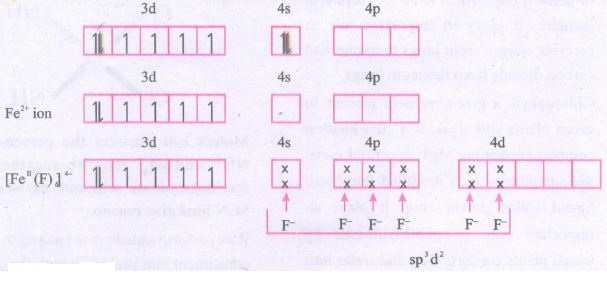
F- is weak field ligand
In [FeF6]4-the hybridisation takes place is sp3d2
The number of unpaired electrons = 4.
\(\therefore \mu =\sqrt { 4(4+2) } =\sqrt { 24 } \)
The molecule is paramagnetic due to the presence of unpaired electrons.
The geometry of the molecule is octahedral.
b) [Fe(CN)6]4-
.JPG)
In [Fe(CN)6]4- complex, the CN- ligand is a powerful ligand, it forces the unpaired electrons in the 3d level to pair up inside.
Hence the species has no unpaired electron after hybridisation So the molecule is diamagnetic.
.JPG)
The geometry of the molecule is octahedral.
32.
Volume of KMnO4 used is proportional to the amount of H2O2 present. If the reaction is of first order, it must obey the equation.
\(k=\frac { 2.303 }{ t } log\frac { \left[ { A } \right] _{ 0 }}{ \left[ A \right] } \)
(or) \(k=\left( \frac { 2.303 }{ t } \right) log\left( \frac { { V }_{ 0 } }{ { V }_{ 1 } } \right) \)
(i) \( \mathrm{V}_{\mathrm{o}}=46.1 \mathrm{~mL} ; \mathrm{t}=10 \mathrm{mins} ; \mathrm{V}_{\mathrm{t}}=29.8 \mathrm{~mL}\)
\(k =\frac{2.303}{10} \log \left(\frac{46.1}{29.8}\right) \)
\(=0.2303 \log 1.5469 \)
\(=0.2303 \times 0.1894=0.0436 \mathrm{~min}^{-1}\)
\(\mathrm{t}=20 \mathrm{mins} ; \mathrm{V}_{\mathrm{t}}=19.3 ; \mathrm{V}_{\mathrm{o}}=46.1 \mathrm{~mL} \)
\(k =\frac{2.303}{20} \log \left(\frac{46.1}{19.3}\right) \)
\(=0.11515 \times \log 2.388 \)
\(=0.11515 \times 0.3780 \)
\(=0.0435 \mathrm{~min}^{-1}\)
Since the value of k comes out to be almost constant for the reaction, it is of first order. The mean value of k = 0.04355 min-1

12th Standard Syllabus & Materials
12th Standard
TN 12th Computer Applications களப்பெயர் முறைமை (DNS) Sample Question Papers Study Material - QB365 Set A
NEW12th Standard
TN 12th Computer Applications வலையமைப்பு எடுத்துக்காட்டுகள் மற்றும் நெறிமுறைகள் Sample Question Papers Study Material - QB365 Set A
NEW12th Standard
TN 12th Computer Applications கணினி வலையமைப்பு ஓர் அறிமுகம் Sample Question Papers Study Material - QB365 Set A
NEW12th Standard
TN 12th Computer Applications PHP-உடன் MySQL-ஐ இணைத்தல் Sample Question Papers Study Material - QB365 Set A



Tamilnadu Stateboard 12th Standard Subjects

Maths
Chemistry

Physics

Biology

Computer Science

Business Maths and Statistics

Economics

Commerce

Accountancy

History

Computer Applications
Biology
Computer Technology
Computer Applications
Computer Science
Business Maths and Statistics
Commerce
Economics
Maths
Chemistry
Physics
Computer Technology
History
Accountancy

Tamil

English

French
Tamilnadu Stateboard Standards
