
 100% FREE ACCESS
12th Standard Syllabus & Materials
12th Standard
TN 12th Computer Applications மின்னணு தரவு பரிமாற்றம் Sample Question Papers Study Material - QB365 Set A
NEW12th Standard
TN 12th Computer Applications மின் - வணிக பாதுகாப்பு அமைப்புகள் Sample Question Papers Study Material - QB365 Set A
NEW12th Standard
TN 12th Computer Applications மின்னணு செலுத்தல் முறைகள் Sample Question Papers Study Material - QB365 Set A
NEW12th Standard
TN 12th Computer Applications மின் - வணிகம் Sample Question Papers Study Material - QB365 Set A
NEW12th Standard
TN 12th Computer Applications திறந்த மூல கருத்துருக்கள் Sample Question Papers Study Material - QB365 Set A
NEW12th Standard
TN 12th Computer Applications வலையமைப்பு வடமிடல் Sample Question Papers Study Material - QB365 Set A

Published on: 07/01/2020
Solid State
Download Tamil Nadu 12th Standard Chemistry question papers, model tests, one-mark questions, important questions, and public exam papers in PDF format. Free study materials and answer keys for TN State Board students.
Questions + Answers key
Take MCQ Chemistry Test
1.
How can you determine the atomic mass of an unknown metal if you know its density and the dimension of its unit cell? Explain.
2.
What are molecular solids? Explain the types of molecular solids.
3.
Differentiate crystalline solids and amorphous solids.
4.
Inspite of long range order in the arrangement of particles, why are the crystals usually not perfect?
5.
What is the formula of a compound in which the element Y forms ccp lattice and atoms of X occupy 2/3rd of tetrahedral voids?
6.
Silver crystallizes in fcc lattice. If edge length of the cell is 4.07 x 10⁻⁸ em and density is 10.5 g cm-3. Calculate the atomic mass of silver
7.
Write a note on Frenkel defect.
8.
Experiment shows that Nickel oxide has the formula Ni0.96.O1.00. What fraction of Nickel exists as of Ni2+ and Ni3+ ions?
9.
10.
Explain briefly seven types of unit cell.
11.
What is coordination number?
12.
Define void.
13.
Sodium metal crystallizes in bcc structure with the edge length of the unit cell 4.3 x 10⁻⁸ cm. Calculate the radius of sodium atom.
14.
Why ionic crystals are hard and brittle?
15.
Which one of the following crystal has 8 : 8 structure?
MgF2
CsCl
KCl
NaCl
16.
An example of metal deficiency defect _______.
NaCl
AgCl
CsCl
FeS
17.
A solid compound XY has NaCl structure if the radius of the cation is 100pm, the radius of the anion will be ________.
\(\left( \frac { 100 }{ 0.414 } \right) \)
\(\left( \frac { 0.732 }{ 100 } \right) \)
100 x 0.414
\(\left( \frac { 0.414 }{ 100 } \right) \)
18.
The number of carbon atoms per unit cell of diamond is _______.
8
6
1
4
19.
1.
(i) By knowing the density of an unknown metal and the dimension of its unit cell, the atomic mass of the metal can be: determined.
(ii) Let 'a' be the edge length of a unit cell of a crystal, 'd' be the density of the metal, 'm' be the atomic mass of the metal and 'z' be the number of atoms in the unit cell.
(iii) Now,
Density of the unit cell
\(=\frac{Mass\ of\ the\ unit\ cell}{Volume\ of\ the\ unit\ cell}\)
\(d=\frac{Z\times m}{a^3}\) ...(1)
[Since, mass of the unit cell = Number of atoms in the unit cell x Atomic mass]
[Volume of the unit cell = (edge length of the cubic unit cell)3]
(iv) From equation (1), We have
\(m=\frac{d\times a^3}{Z}\) ....(2)
(v) Now,
Mass of the metal (M) \(=\frac{Atomic\ mass(M)}{Avogadro's\ number(N_A)}\)
M=\(\frac{d\times a^3 \times N_A}{Z}\)
(vi) From equation (3), we can determine the atomic mass of the unknown metal.
2.
Molecular solids:
In molecular solids, the constituents are neutral molecules. They are held together by weak Vander Waals forces. Generally molecular solids are soft and they do not conduct electricity. These molecular solids are further classified into three types.
(i) Non-polar molecular solids:
(a) In non-polar molecular solids constituent molecules are held together by weak dispersion forces or London forces.
(b) They have low melting points and are usually in liquids or gaseous state at room temperature.
Ex: Naphthalene, anthracene etc.,
(ii) Polar molecular solids:
(a) The constituents are molecules formed by polar covalent bonds.
(b) They are held together by relatively strong dipole-dipole interactions.
(c) They have higher melting points than the nonpolar molecular solids.
Ex: Solid CO2, solid NH3 etc.
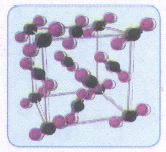
(iii) Hydrogen bonded molecular solids:
(a) The constituents are held together by hydrogen bonds.
(b) They are generally soft solids under room temperature.
(c) Examples: solid ice (H2O), glucose, urea etc.
3.
| S. No | Crystalline Solids | Amorphous Solids |
| 1. | Long range orderly arrangement of constituents. | Short range, random arrangement of constituents. |
| 2. | Definite shape | Irregular shape |
| 3. | Anisotropic in nature | They are "isotropic" like liquids |
| 4. | They are true solids | They are considered as pseudo solids (or) super cooled liquids |
| 5. | Definite Heat of fusion | Heat of fusion is not definite |
| 6. | They have sharp melting points. | Gradually soften over a range of temperature and so can be moulded. |
| 7. | Eg: NaCl, diamond etc. | Eg: Rubber, plastics, glass etc. |
4.
i) Crystals have long range repeated pattern of arrangement of constituent particles but in the process of crystallisation.
ii) Some deviations from the ideal arrangement may be introduced because the constituent particles may not get sufficient time to arrange themselves in a perfect order. Therefore, crystals are usually not perfect.
5.
Number of tetrahedral voids formed = 2 x No. of atoms of element Y
No. of atoms of element Y in the ccp unit cell = 4
No. of tetrahedral voids by atoms of Y = 2 x 4 = 8
∴ No. of tetrahedral voids occupied by atoms of
X = \(\frac{2}{3}\times 8=\frac{16}{3}\)
Ratio of the no. of atoms of X and Y is = \(\frac{16}{3}:4\)
= 16:12
= 4:3
Hence, formula would be X4Y3.
6.
\(M=\frac { d\times { a }^{ 3 }\times NA }{ g } \)
d = Density of the material
a = Length of the edge of the cell.
NA = Avogadro number
Z = No. of atoms
\(M=\frac { 10.5{ gcm }^{ -3 }{ (4.07\times { 10 }^{ -6 }cm) }^{ 3 }\times \left( 6.023\times { 10 }^{ 23 }{ mol }^{ -1 } \right) }{ 4 } \)
Atomic mass of silver M = 107.08 g mol-1.
7.
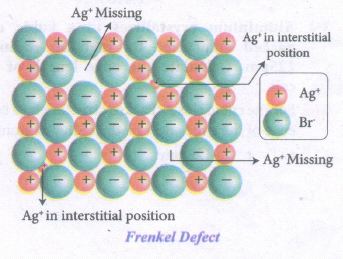
(i) Frenkel defect arises due to the dislocation of ions from its crystal lattice.
(ii) The ion which is missing from the lattice point occupies an interstitial position.
(iii) This defect is shown by ionic solids in which cation and anion differ in size.
(iv) Unlike Schottky defect, this defect does not affect the density of the crystal.
For example AgBr, in this case, small Ag+ ion leaves its normal site and occupies an interstitial position.
8.
Formula is Nio.96 O1.00
So the ration of Ni = O = 96.00
So if there are 100 atom of oxygen, as atoms of Ni
Let the number of atoms of Ni+2 = x
The number of atoms of Ni+2 = 96 - x
Charge on Ni = charge on O
So that oxygen has charge = 2
3 (96 - x) + 2x = 2(100)
288 - 3x + 2x = 200
-x = -88
x = 88
Percentage of Ni + 2 = (atom of Ni+2 / total number of atoms of Ni 100.)
= 100.(94/98) x 100 = 96%
Percentage of Ni+3 = 100 - Ni+2
= 100 - 96 = 4%
9.
10.
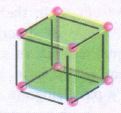
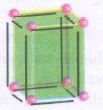
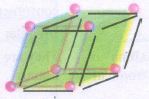
There are seven types of unit cell, Cubic, tetragonal, orthorhombic, hexagonal, monoclinic, triclinic and rhombohedral. They differ in the arrangement of their crystallographic axes and angles.
i) Cubic: a = b = c; α = β = ૪ = 90o.
ii) Tetragonal: a = b ≠ c; α = β = ૪ = 90°.
iii) Orthorhombic: a ≠ b ≠ c; α = β = ૪ = 90°.
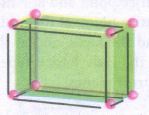
iv) Hexagonal: a = b ≠ c; α = β = 90o, ૪ = 120o.
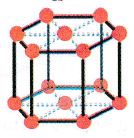
v) Monoclinic: a ≠ b ≠ c; α = ૪ = 90o, β ≠ 90o,
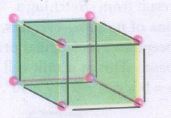
vi) Triclinic: a ≠ b ≠ c; α ≠ β ≠ ૪ ≠ 90o.
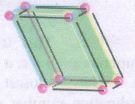
vii) Rhombohedral: a = b = c; α = β = ૪ ≠ 90o.
11.
Coordination number is defined as the number of nearest neighbours that an atom has in a unit cell.
Coordination no. of = 6
Coordination no. of fcc = 12
Coordination no. of bcc = 8
12.
The empty spaces present between the metal atom or the ions when they are packed within the crystal are called voids.
13.
For bcc structure \((r)=\frac{\sqrt{3}}{4} a\)
a = 4.3 \(\times\) 10-8 cm, r = ?
\(=\frac{1.732 \times 4.3 \times 10^{-8}}{4}\)
\(r=1.86 \times 10^{-8} \mathrm{~cm}\)
14.
The structural units of an ionic crystal are cations and anions. They are bound together by strong electrostatic attractive forces. To maximize the attractive force, cations are surrounded by as many anions as possible and vice versa. Hence they are hard and brittle.
15.
(b)
CsCl
16.
(d)
FeS
17.
For a fcc structure = rx+ / ry- = 0.414
Given that rx+ = 100 pm
ry = 100pm/0.414
18.
(a)
8
19.
(c)

12th Standard Syllabus & Materials
12th Standard
TN 12th Computer Applications களப்பெயர் முறைமை (DNS) Sample Question Papers Study Material - QB365 Set A
NEW12th Standard
TN 12th Computer Applications வலையமைப்பு எடுத்துக்காட்டுகள் மற்றும் நெறிமுறைகள் Sample Question Papers Study Material - QB365 Set A
NEW12th Standard
TN 12th Computer Applications கணினி வலையமைப்பு ஓர் அறிமுகம் Sample Question Papers Study Material - QB365 Set A
NEW12th Standard
TN 12th Computer Applications PHP-உடன் MySQL-ஐ இணைத்தல் Sample Question Papers Study Material - QB365 Set A



Tamilnadu Stateboard 12th Standard Subjects

Maths
Chemistry

Physics

Biology

Computer Science

Business Maths and Statistics

Economics

Commerce

Accountancy

History

Computer Applications
Biology
Computer Technology
Computer Applications
Computer Science
Business Maths and Statistics
Commerce
Economics
Maths
Chemistry
Physics
Computer Technology
History
Accountancy

Tamil

English

French
Tamilnadu Stateboard Standards
