
 100% FREE ACCESS
12th Standard Syllabus & Materials
12th Standard
TN 12th Computer Applications மின்னணு தரவு பரிமாற்றம் Sample Question Papers Study Material - QB365 Set A
NEW12th Standard
TN 12th Computer Applications மின் - வணிக பாதுகாப்பு அமைப்புகள் Sample Question Papers Study Material - QB365 Set A
NEW12th Standard
TN 12th Computer Applications மின்னணு செலுத்தல் முறைகள் Sample Question Papers Study Material - QB365 Set A
NEW12th Standard
TN 12th Computer Applications மின் - வணிகம் Sample Question Papers Study Material - QB365 Set A
NEW12th Standard
TN 12th Computer Applications திறந்த மூல கருத்துருக்கள் Sample Question Papers Study Material - QB365 Set A
NEW12th Standard
TN 12th Computer Applications வலையமைப்பு வடமிடல் Sample Question Papers Study Material - QB365 Set A

Published on: 03/01/2020
Solid State
Download Tamil Nadu 12th Standard Chemistry question papers, model tests, one-mark questions, important questions, and public exam papers in PDF format. Free study materials and answer keys for TN State Board students.
Questions + Answers key
Take MCQ Chemistry Test
1.
The energy required to vapourise one mole of copper is smaller than that of energy required to vapourise 1 mole of diamond why?
2.
A compound made up of two atoms X and Y has a face centred cubic arrangement. X is present in the coners and Y at the centre of each face. If one atom is missing from corner. What is the simplest formula of the compound.
3.
What is point defect in crystals?
4.
Ionic solids conduct electricity in molten state but not in solid state. Explain.
5.
What are point defects?
6.
Classify the following solids
a. P4
b. Brass
c. diamond
d. NaCl
e. Iodine
7.
Explain the following: Similarities and differences between metallic and ionic crystals.
8.
Explain AAAA and ABABA and ABCABC type of three dimensional packing with the help of neat diagram.
9.
A metallic element exists as a cubic lattice. Each edge of the unit cell is 2.88\(\mathring { A } \). The density of the metal is 7.20 g cm-3. How many unit cells there will be in 100g of the metal?
10.
Why are solids incompressible?
11.
An element has bcc structure with a cell edge of 288 pm. The density of the element is 7.2 g cm-3. How many atoms are present in 208 g of the element.
12.
For a solid with the following structure. The co-ordination number of the point B is_______.
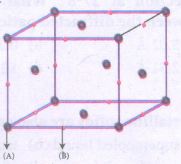
3
4
5
6
13.
The empty space between the shaded balls and hollow balls as shown in the diagram is called, _______.
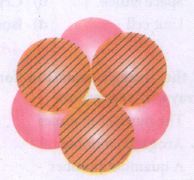
Hexagonal void
Octahedral void
Tetrahedral void
Double triangular void
14.
Which of the following is characteristic of ionic solids?
Very low value of electrical conductivity in the molten state
Brittle nature
Very strong forces of attractions
Anisotropic nature
15.
The crystal with a metal deficiency defect is ________.
NaCl
FeO
ZnO
KCl
16.
If ‘a’ stands for the edge length of the cubic system sc, bcc, and fcc. Then the ratio of radii of spheres in these systems will be respectively ________.
\(\left( \frac { 1 }{ 2 } a;\frac { \sqrt { 3 } }{ 2 } a;\frac { \sqrt { 2 } }{ 2 } a \right) \)
\(\left( \sqrt { 1a } :\sqrt { 3a } :\sqrt { 2a } \right) \)
\(\left( \frac { 1 }{ 2 } a:\frac { \sqrt { 3 } }{ 4 } a:\frac { 1 }{ 2\sqrt { 2 } } a \right) \)
\(\frac { 1 }{ 2 } a:\sqrt { 3 } a:\frac { 1 }{ \sqrt { 2 } } a\)
17.
A solid compound XY has NaCl structure if the radius of the cation is 100pm, the radius of the anion will be ________.
\(\left( \frac { 100 }{ 0.414 } \right) \)
\(\left( \frac { 0.732 }{ 100 } \right) \)
100 x 0.414
\(\left( \frac { 0.414 }{ 100 } \right) \)
18.
The number of unit cells in 8 gm of an element X (atomic mass 40) which crystallizes in bcc pattern is (NA is the Avogadro number)________.
6.023 x 10²³
6.023 x 10²²
60.23 x 10²³
\(\left( \frac { 6.023\times { 10 }^{ 23 } }{ 8\times 40 } \right) \)
19.
Assertion: The packing efficiency of fee structure is maximum
Reason: The coordination number is 12 in fee structure.
Codes:
a) Both assertion and reason are true and the reason is the correct explanation of the assertion.
b) Both the assertion and reason are true but the reason is not the correct explanation of the assertion.
c) Assertion is true but reason is false.
d) Both assertion and reason are false.
20.
Assertion: In Schottky defect, density of crystal decreases.
Reason: Number of cations and anions are missing in Schottky defect are equal.
Codes:
a) Both assertion and reason are true and the reason is the correct explanation of the assertion.
b) Both the assertion and reason are true but the reason is not the correct explanation of the assertion.
c) Assertion is true but reason is false.
d) Both assertion and reason are false
21.
Assertion: Total number of octahedral voids present in unit cell of cubic close packing including the one that is present at the body centre is four.
Reason: Besides the body centre there is one octahedral void present at the centre of each of the six faced of the unit cell and each of which is shared between the adjacent unit cells.
Codes:
a) Both assertion and reason are true and the reason is the correct explanation of the assertion.
b) Both the assertion and reason are true but the reason is not the correct explanation of the assertion.
c) Assertion is true but reason is false.
d) Both assertion and reason are false
22.
I. Gas molecules move randomly without exerting reasonable forces on one another.
II. Covalent solids are held together by weak Vander waals forces.
Ill. Molecules are held together by strong force of attraction.
IV. Covalent solids are good thermal and electrical conductors.
a) Only I
b) Only II
c) I, II & IV
d) I & III
23.
Which one of the following statement is wrong about Frenkel defect?
a) An ion occupies an interstitial position
b) Anion is much larger in size than the cation
c) The crystal remains neutral
d) Non-stoichiometric compound is formed
24.
a) Co-ordination number of each sphere is 12 in hcp arrangements.
b) Co-ordination number of each sphere is 8 in ccp arrangements.
c) The cubic close packing is based on the face centered cubic unit cell.
d) The structure of an ionic compound depends upon the stoichiometry.
1.
Copper is a metallic solid having metal - metal bonds white diamond is a covalent solid having covalent bonds. Metallic bonds are weaker than covalent bonds and thus less amount of energy is required to break metallic bonds than covalent bonds.
2.
No. of atoms of X at the corners = 8 - 1 = 7
(since 1 is missing)
Contribution of X towards unit cell
\(=7\times \frac { 1 }{ 8 } =\frac { 7 }{ 8 } \)
No. of atoms of Y at the face centres = 6
Contribution of Y towards unit cell
= 6 x \(\frac{1}{2}\) = 3
Ratio of X : Y = \(\frac{7}{8}\) : 3 = 7:24
Formula of the compound is X7 Y24.
3.
The defects which are caused by missing or misplaced atoms or ions in the crystal.
4.
(i) In ionic compounds, electricity is conducted by ions.
(ii) In solid state, ions are held together by A strong electrostatic forces and are not free to move about within the solid.
(iii) Hence, ionic solids do not conduct electricity in solid state
(iv) However, in molten state or in solution form, the ions are free to move and can conduct electricity.
5.
The imperfection occurs due to missing atoms, displaced atoms or extra atoms, is named as a point defect. Such defects arise due to imperfect packing during the original crystallisation or they may arise from thermal vibrations of atoms at elevated temperatures.
6.
a. P4 - Covalent solid
b. Brass - Metallic solid
c. Diamond - Covalent solid
d. NaCl - Ionic solid
e. Iodine - Covalent solid
7.
(i) Similarities between ionic and metallic crystals:
(a) Ionic and metallic crystals have electrostatic forces of attraction.
(b) Both the crystals exhibit high melting point.
(c) The bonds in metallic and ionic crystals are non-directional.
(ii) Differences between ionic and metallic crystals:
| Property | Ionic Crystals | Metallic Crystals |
| Electrical conductivity | They conduct electricity in the molten state or in aqueous solution but not in solid state. | They conduct electricity in solid state as well as in molten state. |
| Binding forces | It is strong due to electrostatic forces of attraction. | It may be weak or strong depending upon the number of valence electrons. |
| Physical nature | Ionic crystals are hard but brittle | Metallic crystals are usually hard and malleable. |
8.
AAAA type of three dimensional packing:
.JPG)
1. This is simple cubic arrangement.
2. Three dimensional packing arrangement can be obtained by repeating the AAAA type two dimensional arrangements in three dimensions.
3. Spheres in one layer sitting directly on the top of in the previous layer so that all layers are identical.
4. All spheres of different layers of crystal are perfectly aligned horizontally and also vertically.
5. In simple cubic packing, each sphere is in contact with 6 neighbouring spheres
6. Four in its own layer, one above and one below and hence the coordination number of the sphere in simple cubic arrangement is 6.
ABABA type of three dimensional packing:
.JPG)
(i) This is body centered cubic arrangement.
(ii) The spheres in the first layer are slightly separated and the second layer is formed by arranging the spheres in the depressions between the spheres in layer A.
(iii) The third layer is a repeat of the first.
(iv) This pattern ABABAB is repeated throughout the crystal.
(v) Each sphere has a coordination number of 8, four neighbors in the layer above and four in the layer below.
ABCABC type of three dimensional packing:
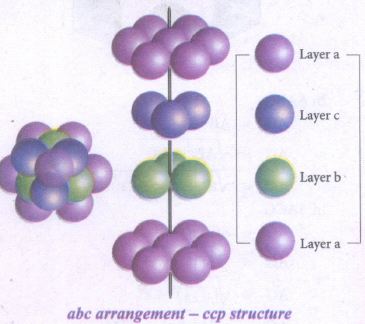
(i) This is face centered cubic arrangement.
(ii) In this arrangement (FCC) second layer spheres are arranged at the dips of first layer. Third layer spheres are arranged in a manner such that it cover the octahedral void.
(iii) Then no longer third layer is similar to first or second layer.
(iv) Third layer gives different arrangement. Fourth layer spheres are similar to first layer.
(v) If the first, second and third layer are represented as A, B, C then this type of packing gives the arrangement of layers as ABCABC.. and the sequence is repeated.
9.
Volume of unit cell = (2.88\(\mathring { A } \))3 = 23.9 x 10⁻²⁴cm3
Volume of 100 g of the metal \(=\frac { m }{ A } =\frac { 100g }{ 7.2{ gcm }^{ -3 } } \) = 13.9 cm3
Number of unit cells in this volume \(=\frac { 13.9{ cm }^{ 3 } }{ 23.9\times { 10 }^{ -24 }{ cm }^{ 3 } } \) = 5.82 x 10²³
10.
(i) Compressibility is the ability of the substance to change its shape by applying external pressure.
(ii) Solids form closed packed structure with negligible intermolecular space and possesses very strong intermolecular forces of attraction.
(iii) Thus, they do not change their shape in the presence of external pressure.
11.
\(\operatorname{Density}(\rho)=\frac{\mathrm{nM}}{\mathrm{a}^{3} \mathrm{~N}_{\mathrm{A}}} \)
\(\mathrm{n}=2, \mathrm{~N}_{\mathrm{A}}=6.023 \times 10^{23} ; \mathrm{a}=288 \mathrm{pm}=2.88 \times 10^{-8} \mathrm{~cm}, \rho=7.2 \mathrm{~g} \mathrm{~cm}^{-3} \)
\(\therefore M=\frac{\rho \times a^{3} \times N_{A}}{n} \)
\(=\frac{7.2 \times\left(2.88 \times 10^{-8}\right)^{3} \times 6.023 \times 10^{23}}{2} \)
\(=517.95 \times 10^{-1} \)
\(=51.795 \mathrm{~g} \mathrm{~mol}^{-1} \)
Number of moles (n) \(=\frac{\text { Mass }}{\text { Molar mass }}=\frac{208}{51.795}\)=4.02 moles
No. of atoms = No. of moles \(\times\) Avogadro number
=n \(\times\) NA
\(=4.01 \times 6.023 \times 10^{23} \)
\(=24.15 \times 10^{23} \text { atoms }\)
12.
(d)
6
13.
(b)
Octahedral void
14.
(c)
Very strong forces of attractions
15.
(b)
FeO
16.
sc ⇒ 2r = a
⇒ r = a/2
bcc ⇒ 4r = \( \sqrt{3a} \) ⇒ r = \(\frac { \sqrt{3a}} {4}\)
fcc ⇒ 4r ⇒ \( \sqrt{2a} \) ⇒ r = \(\frac { \sqrt{2a}} {4} = \frac { a} {2\sqrt{2a}}\)
\(\left( \frac { a }{ 2 } :\frac { \sqrt { 3 } }{ 4 } a:\frac { a }{ 2\sqrt { 2 } } \right) \)
17.
For a fcc structure = rx+ / ry- = 0.414
Given that rx+ = 100 pm
ry = 100pm/0.414
18.
In bcc unit cell,
2 atoms = 1 unit cell
Number of atoms in 8 g of element is, Number of moles = 8g / 40 g mol-1 = 0.2 mol
1 mole contains 6.023 x10²³ atoms
0.2 mole contains 0.2 x 6.023 x 1023 atoms
[1 unit cell / 2 atoms] x 0.2 x 6.023 x 1023
= 6.023 x 10²² unit cells.
19.
b) Both the assertion and reason are true but the reason is not the correct explanation of the assertion.
20.
a) Both assertion and reason are true and the reason is the correct explanation of the assertion.
21.
c) Assertion is true but reason is false.
22.
()
d) I & III
23.
d) Non-stoichiometric compound is formed
24.
b) Co-ordination number of each sphere is 8 in ccp arrangements

12th Standard Syllabus & Materials
12th Standard
TN 12th Computer Applications களப்பெயர் முறைமை (DNS) Sample Question Papers Study Material - QB365 Set A
NEW12th Standard
TN 12th Computer Applications வலையமைப்பு எடுத்துக்காட்டுகள் மற்றும் நெறிமுறைகள் Sample Question Papers Study Material - QB365 Set A
NEW12th Standard
TN 12th Computer Applications கணினி வலையமைப்பு ஓர் அறிமுகம் Sample Question Papers Study Material - QB365 Set A
NEW12th Standard
TN 12th Computer Applications PHP-உடன் MySQL-ஐ இணைத்தல் Sample Question Papers Study Material - QB365 Set A



Tamilnadu Stateboard 12th Standard Subjects

Maths
Chemistry

Physics

Biology

Computer Science

Business Maths and Statistics

Economics

Commerce

Accountancy

History

Computer Applications
Biology
Computer Technology
Computer Applications
Computer Science
Business Maths and Statistics
Commerce
Economics
Maths
Chemistry
Physics
Computer Technology
History
Accountancy

Tamil

English

French
Tamilnadu Stateboard Standards
