
 100% FREE ACCESS
12th Standard Syllabus & Materials
12th Standard
TN 12th Computer Applications மின்னணு தரவு பரிமாற்றம் Sample Question Papers Study Material - QB365 Set A
NEW12th Standard
TN 12th Computer Applications மின் - வணிக பாதுகாப்பு அமைப்புகள் Sample Question Papers Study Material - QB365 Set A
NEW12th Standard
TN 12th Computer Applications மின்னணு செலுத்தல் முறைகள் Sample Question Papers Study Material - QB365 Set A
NEW12th Standard
TN 12th Computer Applications மின் - வணிகம் Sample Question Papers Study Material - QB365 Set A
NEW12th Standard
TN 12th Computer Applications திறந்த மூல கருத்துருக்கள் Sample Question Papers Study Material - QB365 Set A
NEW12th Standard
TN 12th Computer Applications வலையமைப்பு வடமிடல் Sample Question Papers Study Material - QB365 Set A

Published on: 20/08/2019
Solid State
Download Tamil Nadu 12th Standard Chemistry question papers, model tests, one-mark questions, important questions, and public exam papers in PDF format. Free study materials and answer keys for TN State Board students.
Questions + Answers key
Take MCQ Chemistry Test
1.
Distinguish the following. Crystal lattice and unit cell.
2.
Silver crystallizes in fcc lattice. If edge length of the cell is 4.07 x 10⁻⁸ em and density is 10.5 g cm-3. Calculate the atomic mass of silver
3.
Why are solids rigid?
4.
Experiment shows that Nickel oxide has the formula Ni0.96.O1.00. What fraction of Nickel exists as of Ni2+ and Ni3+ ions?
5.
Explain briefly seven types of unit cell.
6.
How many atoms can be present in a simple cubic lattice?
7.
Which point effect in crystal doesn't alter the density of the relevant solid?
8.
An atom crystallizes in fcc crystal lattice and has a density of 10 gcm−3 with unit cell edge length of 100pm. Calculate the number of atoms present in 1 g of crystal.
9.
What are point defects?
10.
The correct order of packing efficiency in different types of unit cells is________.
fcc > bcc > sc
sc < fcc < bcc
fcc < bcc > sc
bcc < fcc < sc
11.
The coordination number of ZnS is _______.
3
4
6
8
12.
Crystals of NaCI has yellow colour due the presence of_________.
cation vacancy
F centres
both (a) and (b)
neither (a) nor (b)
13.
The number of octahedral void(s) per atom present in a cubic close-packed structure is_________.
1
2
3
4
14.
Calculate the number of atoms in a cubic unit cell having one atom on each corner and one atom on each body diagonal _______.
2
3
4
5
15.
Which one of the following crystal has 8 : 8 structure?
MgF2
CsCl
KCl
NaCl
16.
If ‘a’ stands for the edge length of the cubic system sc, bcc, and fcc. Then the ratio of radii of spheres in these systems will be respectively ________.
\(\left( \frac { 1 }{ 2 } a;\frac { \sqrt { 3 } }{ 2 } a;\frac { \sqrt { 2 } }{ 2 } a \right) \)
\(\left( \sqrt { 1a } :\sqrt { 3a } :\sqrt { 2a } \right) \)
\(\left( \frac { 1 }{ 2 } a:\frac { \sqrt { 3 } }{ 4 } a:\frac { 1 }{ 2\sqrt { 2 } } a \right) \)
\(\frac { 1 }{ 2 } a:\sqrt { 3 } a:\frac { 1 }{ \sqrt { 2 } } a\)
17.
The ionic radii of A+ and B− are 0.98 x 10⁻¹⁰ m and 1.81 x 10⁻¹⁰ m. the coordination number of each ion in AB is ________.
8
2
6
4
18.
19.
Graphite and diamond are ________.
Covalent and molecular crystals
ionic and covalent crystals
both covalent crystals
both molecular crystals
20.
Write note on impurity defect?
21.
What are the general characteristics of solids?
22.
Ionic solids, which have anionic vacancies due to metal excess defect, develop colour. Explain with the help of a suitable example.
1.
crystal lattice and unit cell:
| Crystal Lattice | Unit Cell |
| In 3 dimensional space, a regular arrangement and repeating pattern of the constituent particles of a crystal in which each particle is depicted as a point is known as crystal lattice. | The smallest portion of the crystal lattice which, when repeated in different directions generates the entire lattice, is known as unit cell. |
2.
\(M=\frac { d\times { a }^{ 3 }\times NA }{ g } \)
d = Density of the material
a = Length of the edge of the cell.
NA = Avogadro number
Z = No. of atoms
\(M=\frac { 10.5{ gcm }^{ -3 }{ (4.07\times { 10 }^{ -6 }cm) }^{ 3 }\times \left( 6.023\times { 10 }^{ 23 }{ mol }^{ -1 } \right) }{ 4 } \)
Atomic mass of silver M = 107.08 g mol-1.
3.
(i) The intermolecular forces of attraction that are present in solids are very strong.
(ii) The constituent particles of solids cannot: move from their positions. They have fixed positions.
(iii) However, they can oscillate about their mean positions.
(iv) This is the reason solids are rigid.
4.
Formula is Nio.96 O1.00
So the ration of Ni = O = 96.00
So if there are 100 atom of oxygen, as atoms of Ni
Let the number of atoms of Ni+2 = x
The number of atoms of Ni+2 = 96 - x
Charge on Ni = charge on O
So that oxygen has charge = 2
3 (96 - x) + 2x = 2(100)
288 - 3x + 2x = 200
-x = -88
x = 88
Percentage of Ni + 2 = (atom of Ni+2 / total number of atoms of Ni 100.)
= 100.(94/98) x 100 = 96%
Percentage of Ni+3 = 100 - Ni+2
= 100 - 96 = 4%
5.
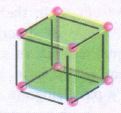
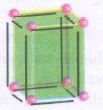
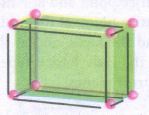
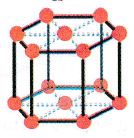
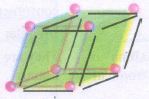
There are seven types of unit cell, Cubic, tetragonal, orthorhombic, hexagonal, monoclinic, triclinic and rhombohedral. They differ in the arrangement of their crystallographic axes and angles.
i) Cubic: a = b = c; α = β = ૪ = 90o.
ii) Tetragonal: a = b ≠ c; α = β = ૪ = 90°.
iii) Orthorhombic: a ≠ b ≠ c; α = β = ૪ = 90°.
iv) Hexagonal: a = b ≠ c; α = β = 90o, ૪ = 120o.
v) Monoclinic: a ≠ b ≠ c; α = ૪ = 90o, β ≠ 90o,
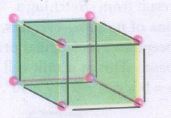
vi) Triclinic: a ≠ b ≠ c; α ≠ β ≠ ૪ ≠ 90o.
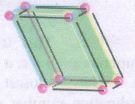
vii) Rhombohedral: a = b = c; α = β = ૪ ≠ 90o.
6.
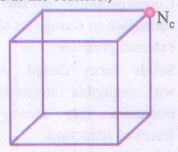
i) In a simple cubic lattice atoms are present at the corners only, each atom at the corner is shared equally by eight other unit cells.
ii) The total number of atoms per unit cell \(\frac { { N }_{ c } }{ 8 } =8\times \frac { 1 }{ 8 } =1\) (Nc is the number of atoms at the corners.)
7.
Frenkel defect
8.
\(\operatorname{Density}(\rho)=\frac{\mathrm{nM}}{\mathrm{a}^{3} \mathrm{~N}_{\mathrm{A}}} \)
\(\rho=10 \mathrm{~g} \mathrm{~cm}^{-3} ; \mathrm{a}=100 \mathrm{pm}=1 \times 10^{-8} \mathrm{~cm} ; \mathrm{N}_{\mathrm{A}}=6.023 \times 10^{23} ; \mathrm{n}=4 ; \mathrm{M}=? \)
\(M=\frac{\rho \mathrm{a}^{3} \mathrm{N_{A}}}{n} \)
\(=\frac{10 \times\left(1 \times 10^{-8}\right)^{3} \times 6.023 \times 10^{23}}{4} \)
\(=\frac{6.023}{4} \)
= 1.505 g /mol
No. of moles \(=\frac{\text { Mass }}{\text { Molar mass }}=\frac{1}{1.505}\)
= 0.664 moles
Hence number of atoms = 0.664 x 6.023 x 1023 = 3.99 x 10²³ atoms
9.
The imperfection occurs due to missing atoms, displaced atoms or extra atoms, is named as a point defect. Such defects arise due to imperfect packing during the original crystallisation or they may arise from thermal vibrations of atoms at elevated temperatures.
10.
(a)
fcc > bcc > sc
11.
(b)
4
12.
(b)
F centres
13.
(a)
1
14.
(d)
5
15.
(b)
CsCl
16.
sc ⇒ 2r = a
⇒ r = a/2
bcc ⇒ 4r = \( \sqrt{3a} \) ⇒ r = \(\frac { \sqrt{3a}} {4}\)
fcc ⇒ 4r ⇒ \( \sqrt{2a} \) ⇒ r = \(\frac { \sqrt{2a}} {4} = \frac { a} {2\sqrt{2a}}\)
\(\left( \frac { a }{ 2 } :\frac { \sqrt { 3 } }{ 4 } a:\frac { a }{ 2\sqrt { 2 } } \right) \)
17.
\(\left( \frac { r_{c^+} }{ r_{A^-} } \right) \) = \(\left( \frac { 0.98 \times 10^{-10 }}{ 1.81 \times 10^{-10} } \right) = 0.54\)
It is in the range of 0.414 to 0.732, hence the coordination number of each ion is 6.
18.
(c)
19.
(c)
both covalent crystals
20.
(i) The defects in ionic solids is by adding impurity ions.
(ii) If the impurity ions are in different valance state from that of host, vacancies are created in the crystal lattice of the host.
(iii) For example, addition of CdCl2 to silver chloride yields solid solutions where the divalent cation Cd2+ occupies the position of Ag+.
(iv) This will disturb the electrical neutrality of the crystal.
(v) In order to maintain the same, proportional number of Ag+ ions leaves the lattice.
(vi) This produces a cation vacancy in the lattice, such kind of crystal defects are called impurity defects.
21.
(i) Solids have definite volume and shape
(ii) Solids are rigid and incompressible
(iii) Solids have strong cohesive forces.
(iv) Their constituents have fixed positions and can only oscillate about their mean positions.
22.
(i) The colour develops because of the presence of electrons in the 8 anionic sites.
(ii) These electron absorb energy from the visible region of radiation and get excited.
(iii) For example when crystals of NaCl are heated in an atmosphere of sodium vapours, the sodium atoms get deposited on the surface of the crystal and the deposited Na atoms.
(iv) During this process, the Na atoms on the surface lose electrons to form Na+ ions
(v) These electrons get excited by absorbing energy from the visible light and impart yellow colour to the crystals.

12th Standard Syllabus & Materials
12th Standard
TN 12th Computer Applications களப்பெயர் முறைமை (DNS) Sample Question Papers Study Material - QB365 Set A
NEW12th Standard
TN 12th Computer Applications வலையமைப்பு எடுத்துக்காட்டுகள் மற்றும் நெறிமுறைகள் Sample Question Papers Study Material - QB365 Set A
NEW12th Standard
TN 12th Computer Applications கணினி வலையமைப்பு ஓர் அறிமுகம் Sample Question Papers Study Material - QB365 Set A
NEW12th Standard
TN 12th Computer Applications PHP-உடன் MySQL-ஐ இணைத்தல் Sample Question Papers Study Material - QB365 Set A



Tamilnadu Stateboard 12th Standard Subjects

Maths
Chemistry

Physics

Biology

Computer Science

Business Maths and Statistics

Economics

Commerce

Accountancy

History

Computer Applications
Biology
Computer Technology
Computer Applications
Computer Science
Business Maths and Statistics
Commerce
Economics
Maths
Chemistry
Physics
Computer Technology
History
Accountancy

Tamil

English

French
Tamilnadu Stateboard Standards
