
 100% FREE ACCESS
12th Standard Syllabus & Materials
12th Standard
TN 12th Computer Applications மின்னணு தரவு பரிமாற்றம் Sample Question Papers Study Material - QB365 Set A
NEW12th Standard
TN 12th Computer Applications மின் - வணிக பாதுகாப்பு அமைப்புகள் Sample Question Papers Study Material - QB365 Set A
NEW12th Standard
TN 12th Computer Applications மின்னணு செலுத்தல் முறைகள் Sample Question Papers Study Material - QB365 Set A
NEW12th Standard
TN 12th Computer Applications மின் - வணிகம் Sample Question Papers Study Material - QB365 Set A
NEW12th Standard
TN 12th Computer Applications திறந்த மூல கருத்துருக்கள் Sample Question Papers Study Material - QB365 Set A
NEW12th Standard
TN 12th Computer Applications வலையமைப்பு வடமிடல் Sample Question Papers Study Material - QB365 Set A

Published on: 22/01/2020
Solid State
Download Tamil Nadu 12th Standard Chemistry question papers, model tests, one-mark questions, important questions, and public exam papers in PDF format. Free study materials and answer keys for TN State Board students.
Questions + Answers key
Take MCQ Chemistry Test
1.
The energy required to vapourise one mole of copper is smaller than that of energy required to vapourise 1 mole of diamond why?
2.
Frenkel defect is not show by alkali metal halides but silver halides do. Give reason.
3.
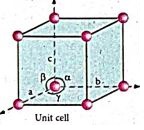
Distinguish between cubic and hexagonal unit cells.
4.
Name the seven primitive crystal systems.
5.
What are primitive unit cells?
6.
Which point effect in crystal doesn't alter the density of the relevant solid?
7.
What type of stoichiometric defect is shown by ZnS.
8.
What are point defects?
9.
Classify the following solids
a. P4
b. Brass
c. diamond
d. NaCl
e. Iodine
10.
Define unit cell.
11.
12.
Distinguish between hexagonal close packing and cubic close packing.
13.
Explain briefly seven types of unit cell.
14.
Give any three characteristics of ionic crystals.
15.
Differentiate crystalline solids and amorphous solids.
1.
Copper is a metallic solid having metal - metal bonds white diamond is a covalent solid having covalent bonds. Metallic bonds are weaker than covalent bonds and thus less amount of energy is required to break metallic bonds than covalent bonds.
2.
Frenkel defect occurs in a Silver halides due to small size of Ag+ ions which occupy interstitial position. Whereas in alkali metal halides, size of the cation and anion are almost similar so alkali metal ions do not fit into the interstitial sites.
3.
| Cubic | Hexagonal |
| a=b=c | a=b≠c |
| ∝=β=૪=90o | ∝=β=90o, ૪=120o |
4.
There are seven primitive crystal systems; cubic, tetragonal, orthorhombic, hexagonal, monoclinic, triclinic and rhombohedral.
5.
A unit cell that contains only one lattice point is called a primitive unit cell, which is made up from the lattice points at each of the corners.
6.
Frenkel defect
7.
ZnS exhibits Frenkel defect.
8.
The imperfection occurs due to missing atoms, displaced atoms or extra atoms, is named as a point defect. Such defects arise due to imperfect packing during the original crystallisation or they may arise from thermal vibrations of atoms at elevated temperatures.
9.
a. P4 - Covalent solid
b. Brass - Metallic solid
c. Diamond - Covalent solid
d. NaCl - Ionic solid
e. Iodine - Covalent solid
10.
(i) A basic repeating structural unit of a crystalline solid is called a unit cell.
(ii) A crystal is consisted of large number of unit cells.
11.
12.
| hcp structure | ccp structure | |
| 1. | This is 'aba' pattern of arrangement. | This is 'abc' pattern of arrangement. |
| 2. | The spheres can be arranged so as to fit into the depression in such a way that the third layer is directly over a first layer. | The third layer may be placed over the second layer in such a way that all the spheres of the third layer fit in octahedral voids. |
| 3. | The tetrahedral voids of the second layer are covered by the spheres of the third layer. | This arrangement of the third layer is different from other two layers and the stacking of layers continued. |
| 4. | 6 spheres are present | 4 spheres are present |
13.
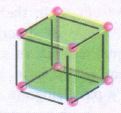
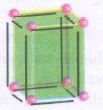
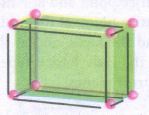
There are seven types of unit cell, Cubic, tetragonal, orthorhombic, hexagonal, monoclinic, triclinic and rhombohedral. They differ in the arrangement of their crystallographic axes and angles.
i) Cubic: a = b = c; α = β = ૪ = 90o.
ii) Tetragonal: a = b ≠ c; α = β = ૪ = 90°.
iii) Orthorhombic: a ≠ b ≠ c; α = β = ૪ = 90°.
iv) Hexagonal: a = b ≠ c; α = β = 90o, ૪ = 120o.
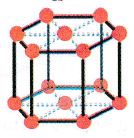
v) Monoclinic: a ≠ b ≠ c; α = ૪ = 90o, β ≠ 90o,
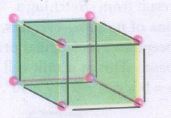
vi) Triclinic: a ≠ b ≠ c; α ≠ β ≠ ૪ ≠ 90o.
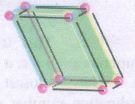
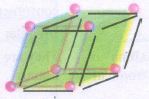
vii) Rhombohedral: a = b = c; α = β = ૪ ≠ 90o.
14.
(i) Ionic solids have high melting points.
(ii) These solids do not conduct electricity, because the ions are fixed in their lattice positions.
(iii) They are hard so strong external force can change the relative positions of ions.
15.
| S. No | Crystalline Solids | Amorphous Solids |
| 1. | Long range orderly arrangement of constituents. | Short range, random arrangement of constituents. |
| 2. | Definite shape | Irregular shape |
| 3. | Anisotropic in nature | They are "isotropic" like liquids |
| 4. | They are true solids | They are considered as pseudo solids (or) super cooled liquids |
| 5. | Definite Heat of fusion | Heat of fusion is not definite |
| 6. | They have sharp melting points. | Gradually soften over a range of temperature and so can be moulded. |
| 7. | Eg: NaCl, diamond etc. | Eg: Rubber, plastics, glass etc. |

12th Standard Syllabus & Materials
12th Standard
TN 12th Computer Applications களப்பெயர் முறைமை (DNS) Sample Question Papers Study Material - QB365 Set A
NEW12th Standard
TN 12th Computer Applications வலையமைப்பு எடுத்துக்காட்டுகள் மற்றும் நெறிமுறைகள் Sample Question Papers Study Material - QB365 Set A
NEW12th Standard
TN 12th Computer Applications கணினி வலையமைப்பு ஓர் அறிமுகம் Sample Question Papers Study Material - QB365 Set A
NEW12th Standard
TN 12th Computer Applications PHP-உடன் MySQL-ஐ இணைத்தல் Sample Question Papers Study Material - QB365 Set A



Tamilnadu Stateboard 12th Standard Subjects

Maths
Chemistry

Physics

Biology

Computer Science

Business Maths and Statistics

Economics

Commerce

Accountancy

History

Computer Applications
Biology
Computer Technology
Computer Applications
Computer Science
Business Maths and Statistics
Commerce
Economics
Maths
Chemistry
Physics
Computer Technology
History
Accountancy

Tamil

English

French
Tamilnadu Stateboard Standards
