
 100% FREE ACCESS
12th Standard Syllabus & Materials
12th Standard
TN 12th Computer Applications மின்னணு தரவு பரிமாற்றம் Sample Question Papers Study Material - QB365 Set A
NEW12th Standard
TN 12th Computer Applications மின் - வணிக பாதுகாப்பு அமைப்புகள் Sample Question Papers Study Material - QB365 Set A
NEW12th Standard
TN 12th Computer Applications மின்னணு செலுத்தல் முறைகள் Sample Question Papers Study Material - QB365 Set A
NEW12th Standard
TN 12th Computer Applications மின் - வணிகம் Sample Question Papers Study Material - QB365 Set A
NEW12th Standard
TN 12th Computer Applications திறந்த மூல கருத்துருக்கள் Sample Question Papers Study Material - QB365 Set A
NEW12th Standard
TN 12th Computer Applications வலையமைப்பு வடமிடல் Sample Question Papers Study Material - QB365 Set A

Published on: 04/12/2019
Surface Chemistry Model Question Paper
Download Tamil Nadu 12th Standard Chemistry question papers, model tests, one-mark questions, important questions, and public exam papers in PDF format. Free study materials and answer keys for TN State Board students.
Questions + Answers key
Take MCQ Chemistry Test
1.
Which of the following interface cannot be obtained?
solid - solid
solid - liquid
gas - gas
liquid -Iiquid
2.
According to Freundlich adsorption isotherm,_______.
\(\frac { x }{ m } =kp\)
\(\frac { m }{ x } ={ (kp) }^{ \frac { 1 }{ n } }\)
\(\frac { x }{ m } ={ kp }^{ \frac { 1 }{ n } }\)
\(\\ \\ \frac { x }{ m } =\frac { k }{ { p }^{ \frac { 1 }{ n } } } \)
3.
Collodion is a 4% solution of which one of the following compounds in alcohol – ether mixture?
Nitroglycerine
Cellulose acetate
Glycoldinitrate
Nitrocellulose
4.
Which one of the following is correctly matched?
Emulsion - Smoke
Gel - butter
foam - Mist
whipped cream - sol
5.
For Freundlich isotherm a graph of log \(\frac{x}{m}\) is plotted against log P. The slope of the line and its y – axis intercept respectively corresponds to________.
\(\frac{1}{n}\), K
log\(\frac{1}{n}\), K
\(\frac{1}{n}\), log K
log \(\frac{1}{n}\), log K
6.
Why are colloids purified?
7.
When are condensation methods used for the preparation of colloids?
8.
The mechanism of Fridel crafts reaction is given below
\({ C }_{ 6 }{ H }_{ 5 }+{ { CH }_{ 3 }Cl\overset { anhydrous\\ \quad { Alcl }_{ 3 } }{ \longrightarrow } }{ C }_{ 6 }{ H }_{ 5 }{ CH }_{ 3 }+HCl\)
9.
Which will be adsorbed more readily on the surface of charcoal and why? NH3 or CO2?
10.
Give two important characteristics of physisorption.
11.
Describe adsorption theory of catalysis
12.
What is the difference between homogenous and hetrogenous catalysis?
13.
Describe some feature of catalysis by Zeolites.
14.
What do you mean by activity and selectivity of catalyst?
15.
What are enzymes? Write a brief note on the mechanism of enzyme catalysis.
16.
What are the advantages of Brownian movement?
17.
Write a note on Ultrafilteration?
1.
(c)
gas - gas
2.
(c)
\(\frac { x }{ m } ={ kp }^{ \frac { 1 }{ n } }\)
3.
Pyroxylin(nitro cellulose)
4.
(b)
Gel - butter
5.
\(\frac{x}{m}\) = K.p1/n
log \((\frac{x}{m})\) = log K + \(\frac{1}{n}\), log p
y = c + mx
m = 1/n and c = log K
6.
The colloidal solutions due to their different methods of preparation may contain impurities. If they are not removed, they may destablise and precipitate the colloidal solution.
7.
When the substance for colloidal particle is present as small sized particle, molecule or ion they are brought to the colloidal dimension by condensation methods.
8.
The action of catalyst is explained as follows
CH3Cl + AlCl3 → [CH3 ]+[AlCl4]-
It is an intermediate.
C6H6 + [CH3+][AlCl4]- → C6H5CH3 + AlCl3 + HCl
9.
The critical temperature of NH3 is 406 K and that of CO2 is 304 K. So, NH3 has higher critical temperature and greater VanderWaal's forces of attraction than CO2. So NH3 will be more adsorbed than CO2.
10.
(i) It is instantaneous.
(ii) It is non-specific.
(iii) No transfer of electrons.
(iv) Multilayer of adsorbate is formula.
11.
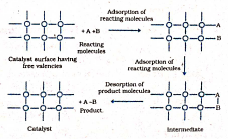
1. Langmuir explained the action of catalyst in heterogeneous catalysed reactions based on adsorption. The reactant molecules are adsorbed on the catalyst surfaces, so this can also be called as contact catalysis.
2. According to this theory, various steps involved in a heterogeneous catalyse reaction are given as follows:
(i) Reactant molecules diffuse from bulk to the catalyst surface.
(ii) The reactant molecules are adsorbed on the surface of the catalyst.
(iii) The adsorbed reactant molecules are activated and form activated complex which is decomposed to form the products.
(iv) The product molecules are desorbed.
(v) The product diffuse away from the surface of the catalyst.
12.
| Homogenous catalysis | Heterogeneous catalysis |
|---|---|
| 1. In a catalysed reaction, the reactants, products and catalyst are present in the same phase. Ex: \( 2\mathrm{SO}_{2(\mathrm{~g})}+\mathrm{O}_{2(\mathrm{~g})}+[\mathrm{NO}]_{(\mathrm{g})} \rightarrow 2 \mathrm{SO}_{3(\mathrm{~g})}+[\mathrm{NO}]_{(\mathrm{g})} \) [NO] - catalyst; gaseous state SO2, O2 & SO3 are gases. |
1. In a catalysed reaction, the catalyst is present in a different phase (ie) it is not present in the same phase as that of the reactants or products. Ex: \(\mathrm{N}_{2(\mathrm{~g})}+3 \mathrm{H}_{2(\mathrm{~g})} \stackrel{\mathrm{Fe}_{(\mathrm{s})}}{\longrightarrow} 2 \mathrm{NH}_{3(\mathrm{~g})}\) Fe - catalyst; solid N2, H2 & NH3 are gases. |
| 2. It is not a contact catalysis. | 2. It is a contact catalysis and the mental catalyst will be in finely divided metal or as gauze. |
| 3. It is explained by intermediate compound formation theory. |
3. It is explained by adsorption theory. |
13.
(i) Zeolites are microporous, crystalline, hydrated, alumino silicates, made of silicon and aluminium tetrahedra.
(ii) There are about 50 natural zeolites and 150 synthetic zeolites.
(iii) As silicon is tetravalent and aluminium is trivalent, the zeolite matrix carries extra negative charge.
(iv) To balance the negative charge, there are extra framework cations for example H+or Na+ons. Zeolites carrying protons are used as solid acids, catalysis and they are extensively used in the petrochemical industry for cracking heavy hydrocarbon fractions into gasoline, diesel, etc.,
(v) Zeolites carrying Na+ ions are used as basic catalysis.
(vi) One of the most important applications of zeolites is their shape selectivity.
(vii) In zeolites, the active sites namely protons are lying inside their pores. So, reactions occur only inside the pores of zeolites.
Reactant selectivity:
When bulkier molecules in a reactant mixture are prevented from reaching the active sites within the zeolite crystal, this selectivity is called reactant shape selectivity.
Transition state selectivity:
If the transition state of a reaction is large compared to the pore size of the zeolite, then no product will be formed.
Product selectivity:
It is encountered when certain product molecules one too big to diffuse out of the zeolite pores.
14.
Active centres:
The surface of a catalyst is not smooth. It bears steps, cracks and corners. Hence the atoms on such locations of the surface are co-ordinatively unsaturated. So, they have much residual force of attraction. Such sites are called active centres. So, the surface carries high surface free energy. The presence of such active centres increases the rate of reaction (activity) by adsorbing and activating the reactants.
The adsorption theory explains the following:
(i) Increase in the activity of a catalyst by increasing the surface area. Increase in the surface area of metals and metal oxides by reducing the particle size increases the rate of the reaction.
(ii) The action of catalytic poison occurs when the poison blocks the active centres of the catalyst.
(iii) A promoter or activator increases the number of active centres on the surfaces
Selectivity:
A Catalyst can catalyse a particular type of reaction. Hence they are said to the specific (selectivity) in nature. Enzyme catalysis is highly specific in nature.
\(\mathrm{NH}_{2} \mathrm{CONH}_{2}+\mathrm{H}_{2} \mathrm{O} \stackrel{\text { Unease }}{\longrightarrow} 2 \mathrm{NH}_{3}+\mathrm{CO}_{2}\)
The enzyme urease which catalyses their reaction of Urea does not catalyse the reaction of methyl Urea.
\(\mathrm{NH}_{2} \mathrm{CONH} \mathrm{CH_3}+\mathrm{H}_{2} \mathrm{O} \stackrel{\text { Urease }}{\longrightarrow} \text { No reaction }\)
Intermediate compound formation theory explains the specificity of a catalyst.
15.
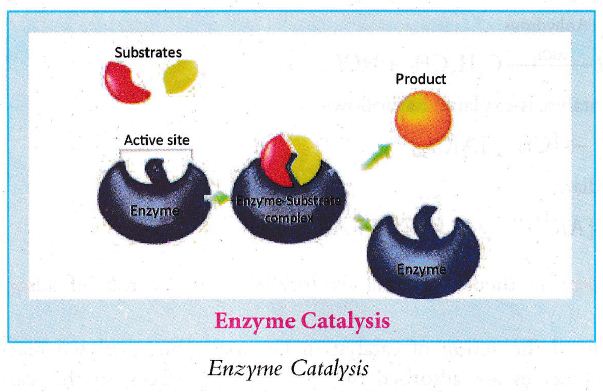
(i) Enzymes are complex protein molecules with three dimensional structures. They catalyse the chemical reaction in living organism. They are often present in colloidal state and extremely specific in catalytic action. Each enzyme produced in a particular living cell can catalyse a particular reaction in the cell.
Some common examples for enzyme catalysis:
(ii) The peptide glycyl L-glutamyl L-tyrosin is hydrolysed by an enzyme called pepsin.
(iii) The enzyme diastase hydrolyses starch into maltose
\(2\left(\mathrm{C}_{6} \mathrm{H}_{10} \mathrm{O}_{5}\right)_{\mathrm{n}}+\mathrm{nH}_{2} \mathrm{O} \rightarrow \mathrm{nC}_{12} \mathrm{H}_{22} \mathrm{O}_{11}\)
(iv) The yeast contains the enzyme zymase which converts glucose into ethanol.
\(\mathrm{C}_{6} \mathrm{H}_{12} \mathrm{O}_{6} \rightarrow 2 \mathrm{C}_{2} \mathrm{H}_{5} \mathrm{OH}+2 \mathrm{CO}_{2}\)
(v) The enzyme micoderma aceti oxidises alcohol into acetic acid.
\(\mathrm{C}_{2} \mathrm{H}_{5} \mathrm{OH}+\mathrm{O}_{2} \rightarrow \mathrm{CH}_{3} \mathrm{COOH}+\mathrm{H}_{2} \mathrm{O}\)
(vi) The enzyme urease present in soya beens hydrolyses the urea.
\(\mathrm{NH}_{2}-\mathrm{CO}-\mathrm{NH}_{2}+\mathrm{H}_{2} \mathrm{O} \rightarrow 2 \mathrm{NH}_{3}+\mathrm{CO}_{2}\)
Mechanism of enzyme catalysed reaction
(vii) The following mechanism is proposed for the enzyme catalysis
\(\mathrm{E}+\mathrm{S} \rightleftharpoons \mathrm{ES} \rightarrow \mathrm{P}+\mathrm{E}\).
(viii) Where E is the enzyme, S the substrate (reactant), ES represents activated complex and P the products.
16.
Brownian movement enables us,
(i) to calculate Avogadro number.
(ii) to confirm kinetic theory which considers the ceaseless rapid movement of molecules that increases with increase in temperature.
(iii) to understand the stability of colloids: As the particles are in continuous rapid movement they do not come close and hence not get condensed.
(iv) That is Brownian movement does not allow the particles to be acted on by force of gravity.
17.
(i) The pores of ordinary filter papers permit the passage of colloidal solutions.
(ii) In ultra filtrations, the membranes are made by using collodion cellophane or visiking.
(iii) When a colloidal solution is filtered using such a filter, colloidal particles are separated on the filter and the impurities are removed as washings.
(iv) This process is quickened by application of pressure.
(v) The separation of sol particles from electrolyte by filteration through an ultrafilter is called ultrafiltration.

12th Standard Syllabus & Materials
12th Standard
TN 12th Computer Applications களப்பெயர் முறைமை (DNS) Sample Question Papers Study Material - QB365 Set A
NEW12th Standard
TN 12th Computer Applications வலையமைப்பு எடுத்துக்காட்டுகள் மற்றும் நெறிமுறைகள் Sample Question Papers Study Material - QB365 Set A
NEW12th Standard
TN 12th Computer Applications கணினி வலையமைப்பு ஓர் அறிமுகம் Sample Question Papers Study Material - QB365 Set A
NEW12th Standard
TN 12th Computer Applications PHP-உடன் MySQL-ஐ இணைத்தல் Sample Question Papers Study Material - QB365 Set A



Tamilnadu Stateboard 12th Standard Subjects

Maths
Chemistry

Physics

Biology

Computer Science

Business Maths and Statistics

Economics

Commerce

Accountancy

History

Computer Applications
Biology
Computer Technology
Computer Applications
Computer Science
Business Maths and Statistics
Commerce
Economics
Maths
Chemistry
Physics
Computer Technology
History
Accountancy

Tamil

English

French
Tamilnadu Stateboard Standards
