
 100% FREE ACCESS
12th Standard Syllabus & Materials
12th Standard
TN 12th Computer Applications மின்னணு தரவு பரிமாற்றம் Sample Question Papers Study Material - QB365 Set A
NEW12th Standard
TN 12th Computer Applications மின் - வணிக பாதுகாப்பு அமைப்புகள் Sample Question Papers Study Material - QB365 Set A
NEW12th Standard
TN 12th Computer Applications மின்னணு செலுத்தல் முறைகள் Sample Question Papers Study Material - QB365 Set A
NEW12th Standard
TN 12th Computer Applications மின் - வணிகம் Sample Question Papers Study Material - QB365 Set A
NEW12th Standard
TN 12th Computer Applications திறந்த மூல கருத்துருக்கள் Sample Question Papers Study Material - QB365 Set A
NEW12th Standard
TN 12th Computer Applications வலையமைப்பு வடமிடல் Sample Question Papers Study Material - QB365 Set A

Published on: 03/01/2020
Surface Chemistry
Download Tamil Nadu 12th Standard Chemistry question papers, model tests, one-mark questions, important questions, and public exam papers in PDF format. Free study materials and answer keys for TN State Board students.
Questions + Answers key
Take MCQ Chemistry Test
1.
Electrophoresis is a_________property of a colloid.
Optical
Kinetic
Electrical
Magnetic
2.
The platinum catalyst used in the oxidation of SO2 by contact process is poisoned by _______.
As2O3
V2O5
Fe2O3
CuCl2
3.
In W/O system, the dispersion medium is_______
water
benzene
alcohol
oil
4.
Tyndall effect is a _____ property of colloidal particles.
optical
kinetic
electrical
electronic
5.
The phenomenon of scattering of light by the sol particles is called _______.
tyndall effect
electrophoresis
cataphoresis
dialysis
6.
Which one of the following is correctly matched?
Emulsion - Mayonnaise
Foam - Cream
Solid aerosol - Fog
Solid sol - Pumice stone
7.
Which among the following does not affect adsorption?
surface area of the adsorbent
catalyst
temperature
pressure
8.
The coagulation values in millimoles per litre of the electrolytes used for the coagulation of As2S3 are given below
(I) (NaCl) = 52
(II) ((BaCl2) = 0.69
(III) (MgSO4) = 0.22
The correct order of their coagulating power is ________.
III > II > I
I > II > III
I > III > II
II > III > I
9.
Hair cream is _____.
gel
emulsion
solid sol
sol.
10.
Why the sun looks red at the time of setting? Explain on the basis of colloidal properties.
11.
What is Tyndall effect?
12.
Write a note on dialysis.
13.
The mechanism of Fridel crafts reaction is given below
\({ C }_{ 6 }{ H }_{ 5 }+{ { CH }_{ 3 }Cl\overset { anhydrous\\ \quad { Alcl }_{ 3 } }{ \longrightarrow } }{ C }_{ 6 }{ H }_{ 5 }{ CH }_{ 3 }+HCl\)
14.
Explain any one method for coagulation.
15.
Assertion: Colloidal solutions show colligative properties.
Reason: Colloidal particles are larger in size.
Codes:
a) (A) and (R) are true and (R) is the correct explanation of (A)
b) Both (A) and (R) are true but (R) does not explain (A)
c) (A) is true but (R) is false
d) Both (A) and (R) are false
16.
Assertion: Gases such as SO2 NH3 HCI are easily adsorbed.
Reason: Adsorption is a surface phenomenon
Codes:
a) (A) and (R) are true and (R) is the correct explanation of (A)
b) Both (A) and (R) are true but (R) does not explain (A)
c) (A) is true but (R) is false
d) Both (A) and (R) are false
17.
Pick out the correct statement with respect of lyophillic sol.
a) They are less stable
b) They will not be precipitated easily
c) There is no definite attractive force existing between the dispersion medium and dispersed phase
d) They are called irreversible sols.
18.
Pick out the wrong statement regarding physical adsorption.
a) It is reversible
b) It depends on the nature of the gas
c) It is due to Vanderwall's force
d) Heat of adsorption is large
19.
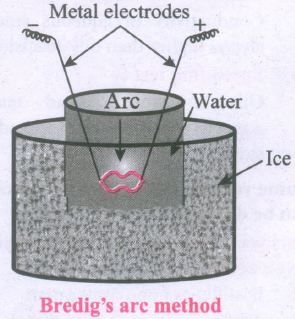
Explain the preparation of colloidal platinum by Bredig arc method.
20.
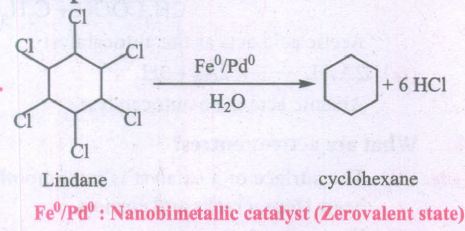
Give an example for a reaction catalysed by nano particles
21.
Write any five applications of colloids in day - to day life.
22.
Give the special characteristics of enzyme catalysed reactions.
1.
(c)
Electrical
2.
(a)
As2O3
3.
(d)
oil
4.
(a)
optical
5.
(a)
tyndall effect
6.
(a)
Emulsion - Mayonnaise
7.
(b)
catalyst
8.
coagulating power ∝ 1/coagulation value
9.
Emulsion-Dispersed phase
Dispersion meduun -liquid
10.
At the time of setting, the sun is at the horizon The light emitted by the sun has to travel a longer distance through the atmosphere. As a result, blue part of the light is scattered away by the dust particles in the atmosphere. Hence, the red part is visible.
11.
(i) When a strong beam of light is passed through a sol, the path of light is illuminated by the scattering of light by colloidal particles.
(ii) The phenomenon of the scattering of light by the sol particles is called Tyn all effect.
12.
(i) In this method, the colloidal solution is taken in a bag made up of semipermeable membrane.
(ii) It is suspended in a trough of flowing water, the electrolytes diffuse out of the membrane and they are carried away by II water.
13.
The action of catalyst is explained as follows
CH3Cl + AlCl3 → [CH3 ]+[AlCl4]-
It is an intermediate.
C6H6 + [CH3+][AlCl4]- → C6H5CH3 + AlCl3 + HCl
14.
Addition of electrolytes:
A negative ion causes the precipitation of positively charged sol and vice versa. When the valency of ion is high, the precipitation power is increased.
For example, the precipitation power of some cations and anions varies in the following order
\(\mathrm{Al}^{3+}>\mathrm{Ba}^{2+}>\mathrm{Na}^{+} \text {, Similarly }\left[\mathrm{Fe}\left(\mathrm{CN}_{6}\right)\right]^{3-}>\mathrm{SO}_{4}{ }^{2-}>\mathrm{Cl}^{-}\)
The precipitation power of electrolyte is determined by finding the minimum concentration (millimoles/lit) required to cause precipitation of a sol in 2 hours. This value is called flocculation value. The smaller the flocculation value greater will be precipitation.
15.
b) Both (A) and (R) are true but (R) does not explain (A)
16.
b) Both (A) and (R) are true but (R) does not explain (A)
17.
()
b) They will not be precipitated easily
18.
d) Heat of adsorption is large
19.
(i) An electrical arc is struck between electrodes dispersed in water surrounded by ice.
(ii) When a current of 1 amp 1100v is passed an arc produced forms vapours of metal which immediately condense to form colloidal solution.
(iii) By this method, colloidal solution of many metals like copper, silver, gold, platinum, etc. can be prepared alkali hydroxide is added as an stabilising agent for the colloidal solution.
20.
21.
Food:
Food stuffs like milk cream, butter, etc are present in colloidal form.
Medicines:
Antibodies such as penicillin and streptomycin are produced in colloidal form for suitable injections. Colloidal gold and colloidal calcium are used as tonics. Milk of magnesia is used for stomach troubles. Silver sol protected by gelatine known as Argyrol is used as eye lotion.
In Industry:
Colloids find many applications in industries
(i) Water purification:
Purification of drinking water is activated by coagulation of suspended impurities in water using alums containing Al3+.
(ii) In washing:
The cleansing action of soap is due to the formation of emulsion of soap molecules with dirt and grease.
(iii) Tanning of leather:
Skin and hides are protein containing positively charged particles which are coagulated by adding tannin to give hardened leather for further application. Chromium salts are used for the purpose. Chrome tanning can produce soft and polishable leather.
(iv) Rubber industry:
Latex is the emulsion of natural rubber with negative particles. By heating rubber with sulphur, vulcanized rubbers are produced for tyres, tubes, etc.
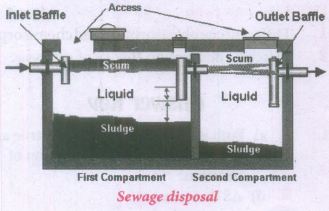
(v) Sewage disposal:
Sewage contains dirt, mud and wastes dispersed in water. The passage of electric current deposits the wastes materials which can be used as a manure.
(vi) Cortrell's precipitator:
Carbon dust in air is solidified by Cottrell's precipitator. In it, a high potential difference of about 50,000V is used. The charge on carbon is neutralized and solidified. Thus the air is free from carbon particles.
(vii) The blue colour of the sky in nature is due to Tyndall effect of air particles.
(viii) Formation of delta:
The electrolyte in sea and river water coagulates the solid particles in river water at their intersection. So, the earth becomes a fertile land.
(ix) Analytical application:
Qualitative and quantitative analysis are based on the various properties of colloids.
22.
(i) Effective and efficient conversion is the special characteristic of enzyme catalysed reactions. An enzyme may transform a million molecules of reactant in a minute
For Eg: \({ 2H }_{ 2 }{ O }_{ 2 }\longrightarrow { 2H }_{ 2 }O+{ O }_{ 2 }\)
For this reaction, the activation energy is 18k cal/mole without a catalyst With colloidal platinum as a, catalyst the activation energy is 11.7kcal /mole. But with the enzyme catalyst the activation energy of this reaction is less than 2kcal/ mole.
(ii) Enzyme catalysis is highly specific in nature.
(iii) Enzyme catalysed reaction has maximum rate at optimum temperature
(iv) The rate of enzyme catalysed reactions varies with the pH of the system. The rate is maximum at a pH called optimum pH.
(v) Enzymes can be inhibited i.e. poisoned activity of an enzyme is decreased and destroyed by a poison. The physiological action of drugs is related to their inhibiting action.
(vi) Catalytic activity of enzymes is increased by coenzymes or activators.

12th Standard Syllabus & Materials
12th Standard
TN 12th Computer Applications களப்பெயர் முறைமை (DNS) Sample Question Papers Study Material - QB365 Set A
NEW12th Standard
TN 12th Computer Applications வலையமைப்பு எடுத்துக்காட்டுகள் மற்றும் நெறிமுறைகள் Sample Question Papers Study Material - QB365 Set A
NEW12th Standard
TN 12th Computer Applications கணினி வலையமைப்பு ஓர் அறிமுகம் Sample Question Papers Study Material - QB365 Set A
NEW12th Standard
TN 12th Computer Applications PHP-உடன் MySQL-ஐ இணைத்தல் Sample Question Papers Study Material - QB365 Set A



Tamilnadu Stateboard 12th Standard Subjects

Maths
Chemistry

Physics

Biology

Computer Science

Business Maths and Statistics

Economics

Commerce

Accountancy

History

Computer Applications
Biology
Computer Technology
Computer Applications
Computer Science
Business Maths and Statistics
Commerce
Economics
Maths
Chemistry
Physics
Computer Technology
History
Accountancy

Tamil

English

French
Tamilnadu Stateboard Standards
