
 100% FREE ACCESS
12th Standard Syllabus & Materials
12th Standard
TN 12th Computer Applications மின்னணு தரவு பரிமாற்றம் Sample Question Papers Study Material - QB365 Set A
NEW12th Standard
TN 12th Computer Applications மின் - வணிக பாதுகாப்பு அமைப்புகள் Sample Question Papers Study Material - QB365 Set A
NEW12th Standard
TN 12th Computer Applications மின்னணு செலுத்தல் முறைகள் Sample Question Papers Study Material - QB365 Set A
NEW12th Standard
TN 12th Computer Applications மின் - வணிகம் Sample Question Papers Study Material - QB365 Set A
NEW12th Standard
TN 12th Computer Applications திறந்த மூல கருத்துருக்கள் Sample Question Papers Study Material - QB365 Set A
NEW12th Standard
TN 12th Computer Applications வலையமைப்பு வடமிடல் Sample Question Papers Study Material - QB365 Set A

Published on: 30/10/2019
Surface Chemistry
Download Tamil Nadu 12th Standard Chemistry question papers, model tests, one-mark questions, important questions, and public exam papers in PDF format. Free study materials and answer keys for TN State Board students.
Questions + Answers key
Take MCQ Chemistry Test
1.
2.
The phenomenon observed when a beam of light is passed through a colloidal solution is_______.
Cataphoresis
Electrophoresis
Coagulation
Tyndall effect
3.
Hair cream is _____.
gel
emulsion
solid sol
sol.
4.
Which one of the following characteristics are associated with adsorption?
\(\Delta\)G and \(\Delta\)H are negative but \(\Delta\)S is positive
\(\Delta\)G and \(\Delta\)S are negative but \(\Delta\)H is positive
\(\Delta\)G is negative but \(\Delta\)H and \(\Delta\)S are positive
\(\Delta\)G, \(\Delta\)H and \(\Delta\)S all are negative.
5.
For Freundlich isotherm a graph of log \(\frac{x}{m}\) is plotted against log P. The slope of the line and its y – axis intercept respectively corresponds to________.
\(\frac{1}{n}\), K
log\(\frac{1}{n}\), K
\(\frac{1}{n}\), log K
log \(\frac{1}{n}\), log K
6.
Explain intermediate compound formation theory of catalysis with an example.
7.
Give three uses of emulsions.
8.
What are the factors which influence the adsorption of a gas on a solid?
9.
Differentiate physisorption and chemisorption.
10.
What is the difference between a sol and a gel?
11.
12.
In a coagulation experiment 10 mL of a colloid (X) is mixed with distilled water and 0.1M solution of an electrolyte AB so that the volume is 20 mL. It was found that all solutions containing more than 6.6 mL of AB coagulate with in 5 minutes. What is the flocculation values of AB for sol (X)?
13.
Which will be adsorbed more readily on the surface of charcoal and why? NH3 or CO2?
14.
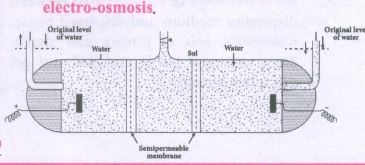
Write a note on electro osmosis.
1.
(b)
2.
Scattering of light
3.
Emulsion-Dispersed phase
Dispersion meduun -liquid
4.
Adsorption leads to decrease in randomnes (entropy).i.e, ΔS < 0 for the adsorption to occur, ΔG slhould be -ve. We know that ΔG = ΔH - TΔS if ΔS is -ve, TΔS is +ve.It means that ΔG will become negative only when ΔH is -ve and ΔH > TΔS.
5.
\(\frac{x}{m}\) = K.p1/n
log \((\frac{x}{m})\) = log K + \(\frac{1}{n}\), log p
y = c + mx
m = 1/n and c = log K
6.
The intermediate compound formation theory :
A catalyst acts by providing a new path with low energy of activation. In homogeneous catalysed reactions a catalyst may combine with one or more reactant to form an intermediate which reacts with other reactant or decompose to give products and the catalyst is regenerated.
Consider the reactions :
A+B➝AB; C is the catalyst .............(1)
A + C ➝ AC (intermediate) ..........(2)
AC + B ⟶ AB + C ...............(3)
Example 1:
The mechanism of Fridel crafts reaction is given below
\({ C }_{ 6 }{ H }_{ 6 }+{ { CH }_{ 3 }Cl\overset { anhydrous\\ { AlCl }_{ 3 } }{ \longrightarrow } }{ C }_{ 6 }{ H }_{ 5 }{ CH }_{ 3 }+HCl\)
The action of catalyst is explained as follows
CH3Cl + AlCl3 ⟶ [CH3]+ [AlCl4]-
It is an intermediate.
\({ C }_{ 6 }{ H }_{ 6 }+\left[ { CH }_{ 3 }^{ + } \right] \left[ { AlCl }_{ 4 } \right] ^{ - }\longrightarrow { C }_{ 6 }{ H }_{ 5 }{ CH }_{ 3 }+{ AlCl }_{ 3 }+Hcl\)
Example 2:
\({ { 2KClO }_{ 3 }\overset {\\ { MnO }_{ 3 } }{ \longrightarrow } }{ 2KCl }+{ 3O }_{ 2 }\)
Thermal decomposition of KCIO3 in the presence of MnO2 proceeds as follows. Steps in the reaction
2KCIO3 ⟶ 2KCI + 3O2 Can be given as
2KClO3 + 6MnO2 → 6MnO3 + 2KCl
It is an intermediate
6MnO3 → 6MnO2 + 3O2
Example 3:
Formation of water due to the reaction of H2 and O2 in the presence of Cu can be given as
H2 + 1/2O2 → H2O
2Cu + \(\frac{1}{2}\)O2 → Cu2O
It is an intermediate.
Cu2O + H2 → H2O + 2Cu
Advantages:
This theory describes
(a) The specificity of a catalyst and
(b) The increase in the rate of the reaction with increasc inthe concentration of a catalyst
Limitations:
(a) The intermediate compound theory fails to explain the action of catalytic poison and activators (promoters).
(b) This theory is unable to explain the mechanism of heterogeneous catalysed reactions.
7.
(i) Emulsions are used in food industries. Food stuff like milk, cream, butter, etc., are emulsions.
(ii) Emulsions are very common in pharmaceutical industries. Many medicines are produced in the form of emulsions. Ex: Milk of magnesia is used for stomach troubles. Many lotions and ointments are emulsions.
(iii) Non ionic emulsions are most popular due to their low toxicity.
(iv) Cationic emulsions have anti microbial properties.
(v) In agriculture industry emulsions are used as delivery vehicles for insecticides, fungicides and pesticides.
(vi) In cosmetics, emulsions are the delivery vehicles for many hair and skin conditioning agents.
(v) The blood, protoplasm in plant and animal cells and fats in intestines are emulsions.
8.
Factors affecting adsorption
Qualitatively, the extent of surface adsorption depends on
(i) Nature of adsorbent
(ii) Nature of adsorbate
(iii) Pressure
(iv) Concentration at a given temperature.
1. Surface area of adsorbent:
As the adsorption is a surface phenomenon it depends on the surface area of adsorbent. i.e., higher the surface area, higher is the amount adsorbed.
2. Nature of adsorbate:
The nature of adsorbate can influence the adsorption. Gases like SO2, NH3, HCl and CO2 are easily liquefiable as have greater vander waal's force of attraction. On the other hand, permanent gases like H2, N2 and O2 cannot be liquefied easily. These permanent gases are having low critical temperature and adsorbed slowly, while gases with high critical temperature are adsorbed readily.
3. Effect of temperature:
When temperature is raised chemisorption first increases and then decreases. whereas physisorption decreases with increases in temperature.
4. Effect of Pressure:
Chemical adsorption is fast with increase in pressure, it cannot alter the amount of adsorption. In physisorption, the extend of adsorption increases with increase in pressure.
9.
| S.No | Physical adsorption or vander waals adsorption or Physisorption | Chemical adsorption or Chemisorption or Activated adsorption |
|---|---|---|
| 1. | It is instantaneous | It is very slow |
| 2. | It is non-specific | It is very specific depends on nature of adsorbent and adsorbate |
| 3. | In Physisorption, when pressure increases the amount of adsorption increases | Chemical adsorption is fast with increase pressure, it can not alter the amount. |
| 4. | Physisorption decreases with increase in temerature | When temperature is raised chemisorption first increases and then decreases |
| 5. | No transfer of electrons | Chemisorption involves transfer of electrons between the adsorbent and adsorbate |
| 6. | Heat of adsorption is low in the order of 40kJ/ mole. | Heat of adsorption is high i.e., from 40- 400kJ/mole. |
| 7. | Multilayer of the adsorbate is formed on the adsorbent. | Monolayer of the adsorbate is formed |
| 8. | It occurs on all sides | Adsorption occurs at fixed sites called active centres. It depends on surface area |
| 9 | Activation energy is insignificant. | Chemisorption involves the formation of activated complex with appreciable activation energy. |
10.
| S.no | Sol | Gel |
| (a) | The liquid state of collidal solution | The solid (or) semi solid stage of a colloidal solution. |
| (b) | Very low viscosity | Very high viscosity |
| (c) | It does not have definite structure. | It possesses definite structure. |
11.
12.
A minimum of 6.6 ml of AB is required to coagulated the sol.
The number of moles of AB in the sol is
= \(\cfrac { 6.6\times 0.1 }{ 20 } \)
= 0.033 moles
This means that minimum of 0.033 moles or 33 millimoles are required to coagulate 1litre of sol.
∴ Flocculating value of AB for sol = 33.
13.
The critical temperature of NH3 is 406 K and that of CO2 is 304 K. So, NH3 has higher critical temperature and greater VanderWaal's forces of attraction than CO2. So NH3 will be more adsorbed than CO2.
14.
A sol is electrically neutral. Hence the medium carries an equal but opposite charge to that of dispersed particles. When sol particles are prevented from moving, under the influence of electric field the medium moves in a direction opposite to that of the sol particles. This movement of dispersion medium under the influence of electric potential is called electro osmosis.

12th Standard Syllabus & Materials
12th Standard
TN 12th Computer Applications களப்பெயர் முறைமை (DNS) Sample Question Papers Study Material - QB365 Set A
NEW12th Standard
TN 12th Computer Applications வலையமைப்பு எடுத்துக்காட்டுகள் மற்றும் நெறிமுறைகள் Sample Question Papers Study Material - QB365 Set A
NEW12th Standard
TN 12th Computer Applications கணினி வலையமைப்பு ஓர் அறிமுகம் Sample Question Papers Study Material - QB365 Set A
NEW12th Standard
TN 12th Computer Applications PHP-உடன் MySQL-ஐ இணைத்தல் Sample Question Papers Study Material - QB365 Set A



Tamilnadu Stateboard 12th Standard Subjects

Maths
Chemistry

Physics

Biology

Computer Science

Business Maths and Statistics

Economics

Commerce

Accountancy

History

Computer Applications
Biology
Computer Technology
Computer Applications
Computer Science
Business Maths and Statistics
Commerce
Economics
Maths
Chemistry
Physics
Computer Technology
History
Accountancy

Tamil

English

French
Tamilnadu Stateboard Standards
