
 100% FREE ACCESS
12th Standard Syllabus & Materials
12th Standard
TN 12th Maths Applications of Matrices and Determinants Sample Question Papers Study Material - QB365 Set A
NEW12th Standard
TN 12th Computer Applications மின்னணு தரவு பரிமாற்றம் Sample Question Papers Study Material - QB365 Set A
NEW12th Standard
TN 12th Computer Applications மின் - வணிக பாதுகாப்பு அமைப்புகள் Sample Question Papers Study Material - QB365 Set A
NEW12th Standard
TN 12th Computer Applications மின்னணு செலுத்தல் முறைகள் Sample Question Papers Study Material - QB365 Set A
NEW12th Standard
TN 12th Computer Applications மின் - வணிகம் Sample Question Papers Study Material - QB365 Set A
NEW12th Standard
TN 12th Computer Applications திறந்த மூல கருத்துருக்கள் Sample Question Papers Study Material - QB365 Set A

Published on: 02/11/2019
Surface Chemistry
Download Tamil Nadu 12th Standard Chemistry question papers, model tests, one-mark questions, important questions, and public exam papers in PDF format. Free study materials and answer keys for TN State Board students.
Questions + Answers key
Take MCQ Chemistry Test
1.
Formation of water due to the reaction of H2 and O2 in the presence of Cu proceeds as follows. Steps in the reaction H2 + 1/2O2 → H2O can be given as
2.
Thermal decomposition of KClO3 in presence of MnO2 proceeds as follows.
Steps in the reaction 2KClO3 → 2KCl + 3O2 can be given as
3.
The mechanism of Fridel crafts reaction is given below
\({ C }_{ 6 }{ H }_{ 5 }+{ { CH }_{ 3 }Cl\overset { anhydrous\\ \quad { Alcl }_{ 3 } }{ \longrightarrow } }{ C }_{ 6 }{ H }_{ 5 }{ CH }_{ 3 }+HCl\)
4.
In a coagulation experiment 10 mL of a colloid (X) is mixed with distilled water and 0.1M solution of an electrolyte AB so that the volume is 20 mL. It was found that all solutions containing more than 6.6 mL of AB coagulate with in 5 minutes. What is the flocculation values of AB for sol (X)?
5.
Heat of adsorption is greater for chemisorptions than physisorption. Why?
6.
Which will be adsorbed more readily on the surface of charcoal and why? NH3 or CO2?
7.
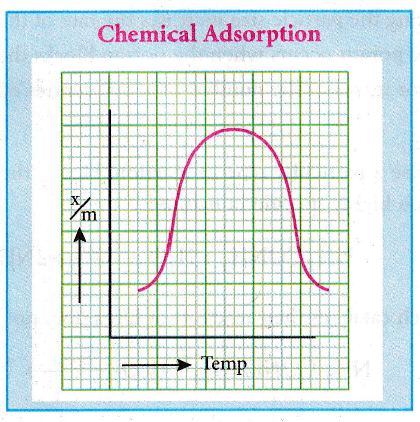
In case of chemisorption, why adsorption first increases and then decreases with temperature?
8.
Give two important characteristics of physisorption.
9.
Differentiate physisorption and chemisorption.
1.
2Cu + \(\frac{1}{2}\)O2 → Cu2O
It is an intermediate.
Cu2O + H2 → H2O + 2Cu
2.
2KClO3 + 6MnO2 → 6MnO3 + 2KCl
It is an intermediate
6MnO3 → 6MnO2 + 3O2
3.
The action of catalyst is explained as follows
CH3Cl + AlCl3 → [CH3 ]+[AlCl4]-
It is an intermediate.
C6H6 + [CH3+][AlCl4]- → C6H5CH3 + AlCl3 + HCl
4.
A minimum of 6.6 ml of AB is required to coagulated the sol.
The number of moles of AB in the sol is
= \(\cfrac { 6.6\times 0.1 }{ 20 } \)
= 0.033 moles
This means that minimum of 0.033 moles or 33 millimoles are required to coagulate 1litre of sol.
∴ Flocculating value of AB for sol = 33.
5.
In Chemisorptions the molecules are held on the surface by attractive forces by formation of chemical bonds. As strong bond is formed nearly 400 kJ / mol is given out as heat of adsorption chemical bonds are much stronger, whereas the Vander Waal's forces in physisorption is weaker.
6.
The critical temperature of NH3 is 406 K and that of CO2 is 304 K. So, NH3 has higher critical temperature and greater VanderWaal's forces of attraction than CO2. So NH3 will be more adsorbed than CO2.
7.
In chemical adsorption, \(\frac { x }{ m } \) increases with rise in temperature and then decreases. The increase illustrates the requirement of activation of the surface for adsorption is due to fact that formation of activated complex requires certain energy. The decrease at high temperature is due to desorption, as the kinetic energy of the adsorbate increases.
8.
(i) It is instantaneous.
(ii) It is non-specific.
(iii) No transfer of electrons.
(iv) Multilayer of adsorbate is formula.
9.
| S.No | Physical adsorption or vander waals adsorption or Physisorption | Chemical adsorption or Chemisorption or Activated adsorption |
|---|---|---|
| 1. | It is instantaneous | It is very slow |
| 2. | It is non-specific | It is very specific depends on nature of adsorbent and adsorbate |
| 3. | In Physisorption, when pressure increases the amount of adsorption increases | Chemical adsorption is fast with increase pressure, it can not alter the amount. |
| 4. | Physisorption decreases with increase in temerature | When temperature is raised chemisorption first increases and then decreases |
| 5. | No transfer of electrons | Chemisorption involves transfer of electrons between the adsorbent and adsorbate |
| 6. | Heat of adsorption is low in the order of 40kJ/ mole. | Heat of adsorption is high i.e., from 40- 400kJ/mole. |
| 7. | Multilayer of the adsorbate is formed on the adsorbent. | Monolayer of the adsorbate is formed |
| 8. | It occurs on all sides | Adsorption occurs at fixed sites called active centres. It depends on surface area |
| 9 | Activation energy is insignificant. | Chemisorption involves the formation of activated complex with appreciable activation energy. |

12th Standard Syllabus & Materials
12th Standard
TN 12th Computer Applications வலையமைப்பு வடமிடல் Sample Question Papers Study Material - QB365 Set A
NEW12th Standard
TN 12th Computer Applications களப்பெயர் முறைமை (DNS) Sample Question Papers Study Material - QB365 Set A
NEW12th Standard
TN 12th Computer Applications வலையமைப்பு எடுத்துக்காட்டுகள் மற்றும் நெறிமுறைகள் Sample Question Papers Study Material - QB365 Set A
NEW12th Standard
TN 12th Computer Applications கணினி வலையமைப்பு ஓர் அறிமுகம் Sample Question Papers Study Material - QB365 Set A



Tamilnadu Stateboard 12th Standard Subjects

Maths
Chemistry

Physics

Biology

Computer Science

Business Maths and Statistics

Economics

Commerce

Accountancy

History

Computer Applications
Biology
Computer Technology
Computer Applications
Computer Science
Business Maths and Statistics
Commerce
Economics
Maths
Chemistry
Physics
Computer Technology
History
Accountancy

Tamil

English

French
Tamilnadu Stateboard Standards
