
 100% FREE ACCESS
12th Standard Syllabus & Materials
12th Standard
TN 12th Computer Applications மின்னணு தரவு பரிமாற்றம் Sample Question Papers Study Material - QB365 Set A
NEW12th Standard
TN 12th Computer Applications மின் - வணிக பாதுகாப்பு அமைப்புகள் Sample Question Papers Study Material - QB365 Set A
NEW12th Standard
TN 12th Computer Applications மின்னணு செலுத்தல் முறைகள் Sample Question Papers Study Material - QB365 Set A
NEW12th Standard
TN 12th Computer Applications மின் - வணிகம் Sample Question Papers Study Material - QB365 Set A
NEW12th Standard
TN 12th Computer Applications திறந்த மூல கருத்துருக்கள் Sample Question Papers Study Material - QB365 Set A
NEW12th Standard
TN 12th Computer Applications வலையமைப்பு வடமிடல் Sample Question Papers Study Material - QB365 Set A

Published on: 07/01/2020
Transition and Inner Transition Elements
Download Tamil Nadu 12th Standard Chemistry question papers, model tests, one-mark questions, important questions, and public exam papers in PDF format. Free study materials and answer keys for TN State Board students.
Questions + Answers key
Take MCQ Chemistry Test
1.
Ce (Z=58) and Yb (Z=70) exhibits stable +4 and +2 oxidation states respectively. This is because_______.
Ce4+ and Yb2+acquire f7 configuration
Ce4+ and Yb2+ acquire f0 configuration
Ce4+ and Yb2+acquire f7 and f14 configuration
Ce4+and Yb2+ acquire f0 and f14 configuration
2.
The highest possible oxidation state shown by osmium in its compound is_______.
+4
+6
+8
+10
3.
Which of the following does not give oxygen on heating?
K2Cr2O7
(NH4)2Cr2O7
KClO3
Zn(ClO3)2
4.
Which of the following compounds is colourless?
Fe3+
Ti4+
Co2+
Ni2+
5.
The magnetic moment of Mn2+ ion is _______.
5.92BM
2.80BM
8.95BM
3.90BM
6.
Explain why oxidation states of transition elements increases first from Sc to Mn and then decrease?
7.
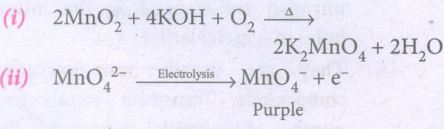
Write chemical equations for the reactions involved in the manufacture of potassium permanganate from pyrolusite ore.
8.
Actinoid contraction is greater from element to element than the lanthanoid contraction, why?
9.
Compare the ionization enthalpies of first series of the transition elements.
10.
Explain the variation in E0M3+/M2+ 3d series.
11.
What are inner transition elements?
12.
What happens when KMnO4 is treated with KI?
13.
Which is the most common oxidation state of lanthanides?
14.
What are coinage metals?
15.
Transition metals show high melting points. Why?
16.
What is lanthanoid contraction and what are the effects of lanthanoid contraction?
17.
How are materials classified based on their magnetic properties?
18.
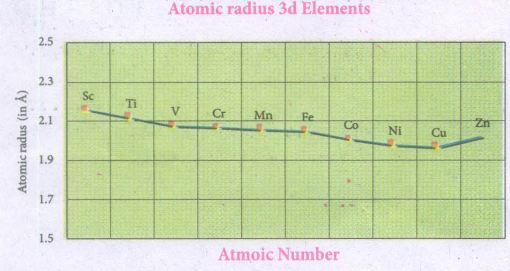
Why is there a variation of atomic and ionic size as we move from Sc to Zn?
19.
Predict which of the following will be coloured in aqueous solution Ti2+, V3+, Sc4+, Cu+, Sc3+, Fe3+, Ni2+ and Co3+
1.
(d)
Ce4+and Yb2+ acquire f0 and f14 configuration
2.
(c)
+8
3.
(b)
(NH4)2Cr2O7
4.
(b)
Ti4+
5.
Mn2+ ⇒ 3d5 contains 5 unpaired electrons
n = 5,
\( \sqrt{n(n+ 2)} \) BM
\(= \sqrt{5(5+ 2)} = \sqrt{35} = 5.92 BM\)
6.
(i) The use of 3d electron for formation of I bond increases from Sc to Mn, causing the increase in oxidation state upto +7.
(ii) The reason for Mn having highest oxidation state of +7 is due to the presence of 7 unpaired electrons in its atom.
(iii) As the number of unpaired electrons decrease from Fe to Cu. So there is the decrease in oxidation state.
7.
8.
(i) In the actinoid series, the elements have poor shielding effect when compared with lanthanide series.
(ii) Hence in the actinoid series, when atomic number increases the effective nuclear charge also increases so actinoid contraction is greater from element to element than the lanthanoid contraction.
9.
As we move from left to right in a transition metal series, the ionization enthalpy increases as expected. This is due to increase in the nuclear charge corresponding to the filling of d electrons. The increase in first ionisation enthalpy with increase in atomic number along a particular series is not regular. The added electron enters (n-1) d orbital and the inner electrons act as a shield and decrease the effect of nuclear charge on valence ns electrons. Therefore, it leads to variation in the ionization energy value.
10.
(i) In transition series, as we move down from Ti to Zn, the standard reduction potential E0M2+/M3 value is approaching towards less negative value and copper has a positive reduction potential, i. e. elemental copper is more stable than Cu2+.
(ii) E0M2+/M value for manganese and zinc are more negative than regular trend. It is due to extra stability arises due to the half filled d5 configuration in Mn2+ and completely filled d10 configuration in Zn2+.
(iii) The standard electrode potential for the M3+/M2+ half cell gives the relative stability between M3+ and M2+.
(iv) The high reduction potential of Mn3+/Mn2+ indicates Mn2+ is more stable than Mn3+.
(v) Mn3+ has a 3d4 configuration while that of Mn2+ is 3d5. The extra stability associated with a half filled d sub-shell makes the reduction of Mn3+ very feasible \(\left[\mathrm{E}^{\circ}=+1.51 \mathrm{~V}\right]\).
11.
(i) The elements in which the extra electron enters (n-2) f orbitals are called f-block elements. These elements are called as inner transition elements because they form a transition. Series within the transition elements.
(ii) The f-block elements are also called as rare earth elements. They are divided into lanthanoid series (4f block elements) and actinoid series (5f block elements).
12.
2KMnO4 + 2KI ⟶ 2MnO2 + I2+ 4KO
2KMnO4 + 2KI + H2O ⟶ KIO3 + 2KOH + MnO2
13.
+3
14.
Cu, Ag and Au which have been used in making of coins in ancient times are called coinage metals
15.
(i) Transition metals have number of unpaired electron. They are involved in metallic bonding. Hence they show high melting point.
(ii) As we move from left to right along the transition metal series melting point first increases reach a maximum value and then decreases as the d-electrons pair up and become less available for bonding.
16.
Lanthanoid contraction:
As we move across 4f series, the atomic and ionic radii of lanthanoids show gradual decrease with increase in atomic number. This decrease in ionic size is called lanthanoid contraction.
Effects (consequence) of lanthanoid contraction:
1. Basicity difference:
As we move from Ce3+ to Lu3+, the basic character of Ln3+ ions decrease. Due to the decrease in the size of Ln3+ ions, the ionic character of Ln -OH bond decreases (covalent character increases) which results in the decrease in the basicity.
2. Similarities among lanthanoid:
In the complete f - series only 10 pm decrease in atomic radii and 20 pm decrease in ionic radii is observed because of this very small change in radii of lanthanoids, their chemical properties are quite similar.
3. The elements of the second and third transition series resemble each other more closely than the elements of the first and second transition series.
17.
On the basis of magnetic properties, materials can be broadly classified as
(a) paramagnetic materials
(b) diamagnetic materials, besides these there are ferromagnetic and antiferromagnetic materials
(i) Materials with no elementary magnetic dipoles are diamagnetic, in other words a species with all paired electrons exhibits diamagnetism.
(ii) This kind of materials are repelled by the magnetic field because the presence of external magnetic field, a magnetic induction is introduced to the material which generates weak magnetic field that oppose the applied field
(iii) Paramagnetic solids having unpaired electrons possess magnetic dipoles which are isolated from one another.
(iv) In the absence of external magnetic field, the dipoles are arranged at random and hence the solid shows no net magnetism.
(v) But in the presence of magnetic field, the dipoles are aligned parallel to the direction of the applied field and therefore, they are attracted by an external magnetic field.
(vi) Ferromagnetic materials have domain structure and in each domain the magnetic dipoles are arranged.
(vii) But the spin dipoles of the adjacent domains are randomly oriented.
(viii) Some transition elements or ions with unpaired d electrons show ferromagnetism.
18.
(i) It is generally expected a steady decrease in atomic radius along a period as the nuclear charge increases and the extra electrons are added to the same sub shell.
(ii) But for the 3d transition elements, the expected decrease in atomic radius is observed from Sc to V, thereafter up to Cu the atomic radius nearly remains the same.
(iii) As we move from Sc to Zn in 3d series the extra electrons are added to the 3d orbitals, the added 3d electrons only partially shield the increased nuclear charge and hence the effective nuclear charge increases slightly.
(iv) However, the extra electrons added to the 3d sub shell strongly repel the 4s electrons and these two forces are operated in opposite direction and as they tend to balance each other, it leads to constancy in atomic radii.
(v) At the end of the series, d - orbitals of Zinc contain 10 electrons in which the repulsive interaction between the electrons is more than the effective nuclear charge and hence, the orbitals slightly expand and atomic radius slightly increases.
19.
(i) Only the ions that have unpaired electrons in d- orbital and in which d - d transition is possible will be coloured.
(ii) The ions in which d - orbitals are empty or completely filled will be colourless as no d -d transition is possible in those configurations.
(iii) From the above ions, it can be easily observed that only Sc3+ has an empty d - orbital and Cu+ has completely filled d-orbitals.
(vi) All other ions, except Sc3+ and Cu+, will be coloured in aqueous solution because of d - d transition.

12th Standard Syllabus & Materials
12th Standard
TN 12th Computer Applications களப்பெயர் முறைமை (DNS) Sample Question Papers Study Material - QB365 Set A
NEW12th Standard
TN 12th Computer Applications வலையமைப்பு எடுத்துக்காட்டுகள் மற்றும் நெறிமுறைகள் Sample Question Papers Study Material - QB365 Set A
NEW12th Standard
TN 12th Computer Applications கணினி வலையமைப்பு ஓர் அறிமுகம் Sample Question Papers Study Material - QB365 Set A
NEW12th Standard
TN 12th Computer Applications PHP-உடன் MySQL-ஐ இணைத்தல் Sample Question Papers Study Material - QB365 Set A



Tamilnadu Stateboard 12th Standard Subjects

Maths
Chemistry

Physics

Biology

Computer Science

Business Maths and Statistics

Economics

Commerce

Accountancy

History

Computer Applications
Biology
Computer Technology
Computer Applications
Computer Science
Business Maths and Statistics
Commerce
Economics
Maths
Chemistry
Physics
Computer Technology
History
Accountancy

Tamil

English

French
Tamilnadu Stateboard Standards
