
 100% FREE ACCESS
12th Standard Syllabus & Materials
12th Standard
TN 12th Computer Applications மின்னணு தரவு பரிமாற்றம் Sample Question Papers Study Material - QB365 Set A
NEW12th Standard
TN 12th Computer Applications மின் - வணிக பாதுகாப்பு அமைப்புகள் Sample Question Papers Study Material - QB365 Set A
NEW12th Standard
TN 12th Computer Applications மின்னணு செலுத்தல் முறைகள் Sample Question Papers Study Material - QB365 Set A
NEW12th Standard
TN 12th Computer Applications மின் - வணிகம் Sample Question Papers Study Material - QB365 Set A
NEW12th Standard
TN 12th Computer Applications திறந்த மூல கருத்துருக்கள் Sample Question Papers Study Material - QB365 Set A
NEW12th Standard
TN 12th Computer Applications வலையமைப்பு வடமிடல் Sample Question Papers Study Material - QB365 Set A

Published on: 18/07/2019
Download Tamil Nadu 12th Standard Chemistry question papers, model tests, one-mark questions, important questions, and public exam papers in PDF format. Free study materials and answer keys for TN State Board students.
Questions + Answers key
Take MCQ Chemistry Test
1.
Which of the following is commonly used to produce foam in froth floatation process?
Pine oil
Cresol
NaCN
Xanthate
2.
Which of the following is not a mineral of aluminium?
Bauxite
Cryolite
China clay
Malachite
3.
Which one of the following reaction represents calcinations?
\(2Zn+{ O }_{ 2 }\rightarrow 2ZnO\)
\(2ZnS+3O_{ 2 }\rightarrow 2ZnO+2SO_{ 2 }\)
\(MgCO_{ 3 }\rightarrow MgO+CO_{ 2 }\)
Both (a) and (c)
4.
Roasting of sulphide ore gives the gas (A).(A) is a colourless gas. Aqueous solution of (A) is acidic. The gas (A) is______.
CO2
SO3
SO2
H2S
5.
Bauxite has the composition ______.
Al2O3
Al2O3.nH2O
Fe2O3.2H2O
None of these
6.
Name some elements that occur as native elements.
7.
Why should we have a ecofriendly metallurgical process?
8.
What is metallurgy?
9.
The selection of reducing agent depends on the thermodynamic factor: Explain with an example.
10.
What is the role of quick lime in the extraction of Iron from its oxide Fe2O3?
11.
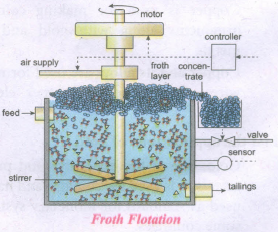
Explain froth flotation, with diagram.
12.
Give the limitations of Ellingham diagram.
13.
Explain zone refining process with an example.
14.
What is cyanide leaching? Give an example
1.
(a)
Pine oil
2.
(d)
Malachite
3.
(c)
\(MgCO_{ 3 }\rightarrow MgO+CO_{ 2 }\)
4.
(c)
SO2
5.
(b)
Al2O3.nH2O
6.
Copper, Silver, Gold and Platinum
7.
It is essential to design an eco friendly metallurgical process that would minimize waste, maximize energy efficiency. Such advances in metallurgy is vital for the economic and technical progress in the current era.
8.
Metallurgy relates to the science and technology of metals. The various steps involved in the extraction of metals form their ores as well as refining of crude metals are collectively know as metallurgy.
9.
(i) The extraction of metals from their oxides can be carried out by using different reducing agents.
(ii) Consider the following reaction
\(\frac{2}{\mathrm{y}} \mathrm{M}_{\mathrm{x}} \mathrm{O}_{\mathrm{y}(\mathrm{s})} \rightarrow \frac{2 \mathrm{x}}{\mathrm{y}} \mathrm{M}_{(s)}+\mathrm{O}_{ 2(\mathrm{~g})}\) (1)
(iii) The above reduction may be carried out with carbon. In this case the reducing agent carbon may be oxidized to either CO or CO2
\(\mathrm{C}+\mathrm{O}_{2} \rightarrow \mathrm{CO}_{2(\mathrm{~g})} \) (2)
\(2 \mathrm{C}+\mathrm{O}_{2} \rightarrow 2 \mathrm{CO}_{(\mathrm{g})} \) (3)
(iv) If CO is used as a reducing agent
\(2 \mathrm{CO}+\mathrm{O}_{2} \rightarrow 2 \mathrm{CO}_{2(\mathrm{~g})}\) (4)
(v) A suitable reducing agent is selected based on the thermodynamics considerations.
(vi) We know that for a spontaneous reaction, the change in free energy (\(\triangle\)G) should be negative.
(vii) Therefore, thermodynamically, the reduction of metal oxide with a given reducing agent can occur if the free energy change for the coupled reaction is negative.
(viii) Hence, the reducing agent is selected in such a way that it provides a large negative \(\triangle\)G value for the coupled reaction.
10.
In this extraction, a basic flux, quick lime (CaO) is used, since the silica gangue present in the ore is acidic in nature. The quick lime combines with it to form calcium silicate (slag).
CaO(s) + Sio2(s) ⟶ CaSio3(s)
Flux Gangue Slag
11.
(i) Froth flotation method is commonly used to concentrate sulphide ores such as galena (PbS), zinc blende (ZnS) etc.
(ii) In this method, the metallic ore particles which are preferentially wetted by oil can be separated from gangue.
(iii) In this method, the crushed ore is suspended in water and mixed with frothing agent such as pine oil, eucalyptus oil etc.
(iv) A small quantity of sodium ethyl xanthate which acts as a collector is also added.
(v) A froth is generated by blowing air through this mixture.
(vi) The collector molecules attach to the ore particle and make them water repellent.
(vii) As a result, ore particles, wetted by the oil, rise to the surface along with the froth.
(viii) The froth is skimmed off and dried to recover the concentrated ore.
(ix) The gangue particles that are preferentially wetted by water settle at the bottom.
12.
(i) Ellingham diagram is constructed based only on thermodynamic considerations. It gives information about the thermodynamic feasibility of a reaction. It does not tell anything about the rate of the reaction. More over, it does not give any idea about the possibility of other reactions that might be taking place.
(ii) The interpretation of \(\triangle\)G is based on the assumption that the reactants are in equilibrium with the product which is not always true.
13.
Zone refining :
1. Zone refining method is based on the principles of fractional crystallisation.
2. When an impure metal is melted and allowed to solidify, the impurities will prefer to be in the molten region. In this process the impure metal is taken in the form of a rod.
3. One end of the rod is heated using a mobile induction heater which results in melting of the metal on that portion of the rod.
4. When the heater is slowly moved to the other end the pure metal crystallises while the impurities will move on to the adjacent molten zone.
5. As the heater moves further away, the molten zone containing impurities also moves along with it.
6. The process is repeated several times by moving the heater in the same direction again and again to get pure metal.
7. This process is carried out in an inert gas atmosphere to prevent the oxidation of metals.
8. Elements such as germanium (Ge), silicon (Si) and galium (Ga) that are used as semiconductor are refined using this process.
14.
(i) The crushed ore of gold is leached with aerated dilute solution of sodium cyanide.
(ii) Gold is converted into a soluble cyanide complex.
(iii) The gangue, aluminosilicate remains insoluble
\({ 4Au }_{ (s) }+{ 8CN }_{ (aq) }^{ - }+{ O }_{ 2(g) }+2{ H }_{ 2 }{ O }_{ (l) }\longrightarrow 4\left[ Au(CN)_{ 2 } \right] +_{ (aq) }^{ - }+{ 4OH }_{ (aq) }^{ - }\)

12th Standard Syllabus & Materials
12th Standard
TN 12th Computer Applications களப்பெயர் முறைமை (DNS) Sample Question Papers Study Material - QB365 Set A
NEW12th Standard
TN 12th Computer Applications வலையமைப்பு எடுத்துக்காட்டுகள் மற்றும் நெறிமுறைகள் Sample Question Papers Study Material - QB365 Set A
NEW12th Standard
TN 12th Computer Applications கணினி வலையமைப்பு ஓர் அறிமுகம் Sample Question Papers Study Material - QB365 Set A
NEW12th Standard
TN 12th Computer Applications PHP-உடன் MySQL-ஐ இணைத்தல் Sample Question Papers Study Material - QB365 Set A



Tamilnadu Stateboard 12th Standard Subjects

Maths
Chemistry

Physics

Biology

Computer Science

Business Maths and Statistics

Economics

Commerce

Accountancy

History

Computer Applications
Biology
Computer Technology
Computer Applications
Computer Science
Business Maths and Statistics
Commerce
Economics
Maths
Chemistry
Physics
Computer Technology
History
Accountancy

Tamil

English

French
Tamilnadu Stateboard Standards
