
 100% FREE ACCESS
12th Standard Syllabus & Materials
12th Standard
TN 12th Computer Applications மின்னணு தரவு பரிமாற்றம் Sample Question Papers Study Material - QB365 Set A
NEW12th Standard
TN 12th Computer Applications மின் - வணிக பாதுகாப்பு அமைப்புகள் Sample Question Papers Study Material - QB365 Set A
NEW12th Standard
TN 12th Computer Applications மின்னணு செலுத்தல் முறைகள் Sample Question Papers Study Material - QB365 Set A
NEW12th Standard
TN 12th Computer Applications மின் - வணிகம் Sample Question Papers Study Material - QB365 Set A
NEW12th Standard
TN 12th Computer Applications திறந்த மூல கருத்துருக்கள் Sample Question Papers Study Material - QB365 Set A
NEW12th Standard
TN 12th Computer Applications வலையமைப்பு வடமிடல் Sample Question Papers Study Material - QB365 Set A

Published on: 01/10/2019
Principles of Management
Download Tamil Nadu 12th Standard Commerce question papers, model tests, one-mark questions, important questions, and public exam papers in PDF format. Free study materials and answer keys for TN State Board students.
Questions + Answers key
Take MCQ Commerce Test1.
What determines the span of management?
2.
What are the principles of Taylor?
3.
Differentiate management from Administration.(any 3)
4.
Is management an Art or Science?
5.
Define the term management.
6.
Discuss the implications of span of management.
7.
8.
Describe the principles of scientific management.
9.
Explain the management process in detail.
10.
Write about the contribution of Drucker to management.
1.
(i) The Span ofManagement has two implications:
1. Influences the complexities of the individual manager's job
2. Determine the shape or configuration of the Organization
(ii) The span of management is related to the horizontal levels of the organization structure, There is a wide and a narrow span of management.
(iii) With the wider span, there will be lesshierarchical levels,and thus, the organizational structure would be flatter.
(iv) Whereas,with the narrow span, the hierarchical levels increases,hence the organizational structure would be tall.
2.
Taylor propounded the principles of scientific management. They are:
(i) Science, Not Rule of Thumb
(ii) Harmony, Not Discord
(iii) Mental Revolution
(iv) Co-operation, Not individualism
(v) Development of each and every person to his or her greatest efficiency and prosperity.
3.
| Basis | Management | Administration | |
|---|---|---|---|
| 1. | Meaning | An organised way of managing people and things of a business is called management | The process of administering an organisation by a group of people is known as administration |
| 2. | Authority | Middle and lower level | Top level |
| 3. | Concerned with | Policy implementation | Policy formulation |
| 4. | Role | Executive | Decisive |
| 5. | Area of operation | It works under administration | It has full control over the activities of the organisation. |
4.
Is Management a Science:
(i) Management is an in exact science, because in pure science, the principles are put into test in a laboratory and they are either proved or disproved exactly and precisely.
(ii) Similarly the management principles can be put to test in an organization where men, machine, money, and materials (4 Ms) are practically integrated towards achieving some chosen organizational goals.
(iii) These principles cannot be exactly proved or disproved either as they tend to be flexible to changing environment, policies and practical difficulties while synchronizing them together.
(iv) Everyone believes that management is an art. No, it is not an art in Toto. Because, the concept of art denotes the learning of skills and practicing them in day to day life.
(v) To conclude, Management is neither a science nor an art, but a combination of both requiring people holding managerial positions.
5.
According to Koontz and Weihrich, "Management is the process of designing and maintaining of an environment in which individuals working together in groups efficiently accomplish selected aims.
6.
The Span of management refers to the number of subordinates who can be managed efficiently by a superior. Simply,the manager having a group of subordinates who report him directly is called as the span of management. The Span of Management has two implications:
(i) Influences the complexities of the individual manager's job
(ii) Determine the shape or configuration of the Organization
The span of management is related to the horizontal levels of the organization structure. There is a wide and a narrow span of management. With the wider span, there will be less hierarchical levels, and thus, the organizational structure would be flatter. Whereas, with the narrow span, the hierarchical levels increases, hence the organizational structure would be tall.
(iii) Both these organizational structures have their advantages and disadvantages. But however the tall organizational structure imposes more challenges.
(iv) Since the span is narrow, which means less number of subordinates under one superior, requires more managers to be employed in the organization. Thus, it would be very expensive in terms of the salaries to be paid to each senior
(v) With more levels in the hierarchy, the communication suffers drastically. It takes a lot of time to reach the appropriate points, and hence the actions get delayed.
(vi) Lack of coordination and control because the operating staff is far away from the top management.
The major advantage of using this structure is that the cross communication gets facilitated, i.e., operative staff communicating with the top management. Also, the chance of promotion increases with the availability of several job positions
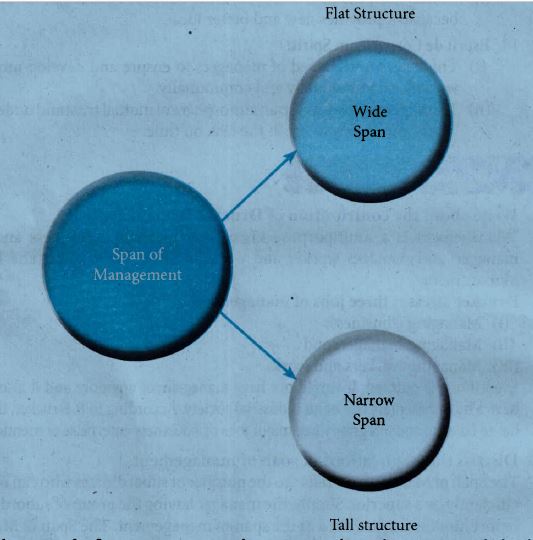
In the case of a flatter organizational structure, where the span is wide leads to a more complex supervisory relationship between the manager and the subordinate. It will be very difficult for a superior to manage a large number of subordinates at a time and also may not listen to all efficiently.
7.
8.
1. Science, Not Rule of Thumb:
(i) Rule of Thumb means decisions taken my manager as per their personal judgements.
(ii) This principle is concerned with selecting the best way of performing a job through the application of scientific analysis and not by intuition or hit and trial methods.
(iii) The work assigned to any employee should be observed and analyzed the time involved, so as to decide the best way of performing that the work to achieve the standard output.
2. Harmony, Not Discord:
(i) Taylor emphasized that there should be complete harmony between the workers and the management.
(ii) Both the management and the workers should realize the importance of each other.
(ii) It becomes possible by
(a) sharing a part of surplus with workers,
(b) training of employees,
(c) division of work,
(d) team spirit,
(e) positive attitude,
(f) sense of discipline,
(g) sincerity etc.
(iv) Management should always be ready to share the gains of the company with the workers and the latter should provide their full co-operation and hard work for achieving organizational goals.
3 Mental Revolution:
(i) The technique of Mental Revolution involves a change in the attitude of workers and management towards each other.
(ii) Both should realize the importance of each other and should work with full co-operation.
(iii) Management as well as the workers should aim to increase the profits of the organisation.
4. Co-operation, Not Individualism:
(i) Co-operation, Mutual confidence, sense of goodwill should prevail among both, managers as well as workers.
(ii) The intention is to replace internal competition with co-operation.
(ii) Workers should be considered as part of management and should be allowed to take part in decision making process of the management.
(iv) Management should always their suggestions and should also reward them if their suggestions prove to be beneficial for the organization for example reduction of costs or increase in production etc.
5. Development of each and every person to his or her greatest efficiency and prosperity:
(i) Efficiency of any organization also depends on the skills and capabilities of its employees to a great extent.
(ii) To attain the efficiency, steps should be taken right from the process of selection of the employees. Employees should be selected.
(iii) The work assigned to each employee should suit his/her physical, mental and intellectual capabilities
(iv) Efficient employees produce more to earn more. This ultimately helps to attain efficiency and prosperity for both organisation and the employees.
9.
There are five parts of management as a process
1. Management is Co-ordination:
(i) The manager of an enterprise must effectively co-ordinate all activities and resources of the organisation.
(ii) Namely, Men, Machines, Materials and Money the Four M's of Management.
2. Management is a Process :
(i) The manager achieves proper co-ordination of resources by means of the managerial functions.
(ii) Planning, Organising, Staffing, Directing (or leading and motivating) and controlling.
3. Management is a Purposive Process:
(i) It is directed toward the achievement of predetermined goals or objectives.
(ii) Without an objective, we have no destination to reach or a path to follow to arrive at our destination
(ii) Example; A goal, both management and organisation must be purposive or goal-oriented.
4. Management is a Social purpose:
It is the art of getting things done through other people.
5. Management is a Cyclical Process:
It represents planning action-control-re-planning cycle. (i.e.,) an ongoing process to attain the planned goals
10.
"Management is a multipurpose organ that manages a business and manages manager, and manages worker and work.- Peter F. Drucker: The Practice of Management.
Drucker stresses three jobs of management:
(i) Managing a business;
(ii) Managing manager; and
(iii) Managing workers and work.
Even if one is omitted, It would not have management anymore and it also would not have a business enterprise or an industrial society. According to P. Drucker, the manager has to balance and integrate the above mentioned three major jobs of a business enterprise.

12th Standard Syllabus & Materials
12th Standard
TN 12th Computer Applications களப்பெயர் முறைமை (DNS) Sample Question Papers Study Material - QB365 Set A
NEW12th Standard
TN 12th Computer Applications வலையமைப்பு எடுத்துக்காட்டுகள் மற்றும் நெறிமுறைகள் Sample Question Papers Study Material - QB365 Set A
NEW12th Standard
TN 12th Computer Applications கணினி வலையமைப்பு ஓர் அறிமுகம் Sample Question Papers Study Material - QB365 Set A
NEW12th Standard
TN 12th Computer Applications PHP-உடன் MySQL-ஐ இணைத்தல் Sample Question Papers Study Material - QB365 Set A



Tamilnadu Stateboard 12th Standard Subjects

Maths

Chemistry

Physics

Biology

Computer Science

Business Maths and Statistics

Economics
Commerce

Accountancy

History

Computer Applications
Biology
Computer Technology
Computer Applications
Computer Science
Business Maths and Statistics
Commerce
Economics
Maths
Chemistry
Physics
Computer Technology
History
Accountancy

Tamil

English

French
Tamilnadu Stateboard Standards

