
 100% FREE ACCESS
12th Standard Syllabus & Materials
12th Standard
TN 12th Computer Applications மின்னணு தரவு பரிமாற்றம் Sample Question Papers Study Material - QB365 Set A
NEW12th Standard
TN 12th Computer Applications மின் - வணிக பாதுகாப்பு அமைப்புகள் Sample Question Papers Study Material - QB365 Set A
NEW12th Standard
TN 12th Computer Applications மின்னணு செலுத்தல் முறைகள் Sample Question Papers Study Material - QB365 Set A
NEW12th Standard
TN 12th Computer Applications மின் - வணிகம் Sample Question Papers Study Material - QB365 Set A
NEW12th Standard
TN 12th Computer Applications திறந்த மூல கருத்துருக்கள் Sample Question Papers Study Material - QB365 Set A
NEW12th Standard
TN 12th Computer Applications வலையமைப்பு வடமிடல் Sample Question Papers Study Material - QB365 Set A

Published on: 06/01/2020
The Negotiable Instruments Act, 1881
Download Tamil Nadu 12th Standard Commerce question papers, model tests, one-mark questions, important questions, and public exam papers in PDF format. Free study materials and answer keys for TN State Board students.
Questions + Answers key
Take MCQ Commerce Test1.
Negotiable instrument means a promissory note, bill of exchange or cheque, payable to
bearer
order
either to bearer or order
neither bearer nor order
2.
An instrument which is not inland instrument is called
Foreign instrument
Bearer instrument
Inland instrument
Ambiguous instrument
3.
Document of title to the goods exclude ______________
Lorry receipt
Railway receipt
Airway bill
Invoice
4.
When crossing restrict further negotiation
Not negotiable crossing
General Crossing
A\c payee crossing
Special crossing
5.
________cannot be a bearer instrument.
Cheque
Promissory Note
Bills of exchange
None of the above
6.
What are the Significance of general crossing?
7.
Define "Negotiable Instrument".
8.
Define Endorsement
9.
List three characteristics of a Promissory Note.
10.
What is meant by Negotiable Instrument?
11.
What is meant by IFSC code?
12.
Write a note on MICR.
13.
Draw the two different types of crossing.
14.
What are the characteristics of a bill of exchange?
15.
Explain the nature of a Negotiable Instrument.
16.
Explain any six kinds of Negotiable Instruments.
17.
Distinguish between cheque and promissory note.
18.
Discuss in detail the features of a cheque. (any 5)
19.
Distinguish a cheque and a bill of exchange.(any 5)
1.
(c)
either to bearer or order
2.
(a)
Foreign instrument
3.
(d)
Invoice
4.
(a)
Not negotiable crossing
5.
(b)
Promissory Note
6.
(i) When a cheque is crossed generally the banker should not pay the amount across the counter.
(ii) The receiver of the amount of the cheque can be easily traced in case the cheque is lost or stolen and collected. Thus the crossing assures safety.
7.
In the words of Justice K.C. Wills, a negotiable instrument is one,the property in which is acquired by anyone who takes it bonafide and for value, and withstanding any defect to title in the person from whom he took it.
8.
When the maker or holder of a negotiable instrument signs the name, otherwise that as such maker for the purpose of negotiation, on the back or face thereof, or on a slip of paper annexed there to or so signs for the same purpose a stamped paper intended to be completed as a negotiable instrument, he is said to endorse the same and is called the endorsee.
9.
Characteristics of a promissory note:
(i) A promissory note must be in writing.
(ii) The promise to pay must be unconditional.
(iii) It must be signed by the maker.
10.
(i) The word "Negotiable" means transferable from one person to another in return for consideration.
(ii) The word 'Instrument' means a written document by which a right is created in favour of certain person.
(iii) A negotiable instrument is a document which entitles a person to a certain sum of money and which is transferable from one person to another by mere delivery or by endorsement and delivery.
11.
(i) IFSC code is an alphanumeric code which facilitates electronic fund transfer in India.
(ii) This code uniquely identifies each bank branch participating in the two main Payment and Settlement systems in India.
(iii) The Real Time Gross Settlement (RTGS) and the National Electronic Fund Transfer (NEFT) systems.
(iv) IFSC is an 11 character code.
(v) The first 4 alphabetic characters represent the bank name and the last 6 characters (usually numeric) represent the branch.
(vi) The fifth character is 0 and reserved for future use. This code routes the messages to the destination banks or branch.
12.
(i) MICR code is a character - recognition technology used mainly by the banking industry to ease processing and clearance of cheques and other documents.
(ii) It is found at the bottom of the cheque. It includes bank code, bank account number, cheque number, cheque amount and a control indicator.
(iii) The MICR code helps the banker to ensure the legitimacy or originality of paper documents.
(iv) The special ink used in the MICR code is sensitive to magnetic fields.
(v) It prevents the crime of printing counterfeit cheques or documents using technology.
(vi) The magnetic ink will help discover fake documents.
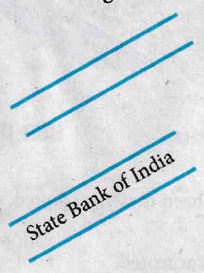
13.
Crossing is of two types: General crossing and special crossing
General Crossing:
1. It is according to section 123 of the Negotiable Instruments Act, 1881.
2. "Where a cheque bears across its face with 'and company" or any abbreviation between two parallel transverse lines with or without the words 'not negotiable, the cheque shall be deemed to be crossed generally':
Special Crossing:
1. It is according to section 124 of the Negotiable Instruments Act, 1881.
2. "Where a cheque bears across its face an addition of the name of a banker with or without the words 'not negotiable, the cheque shall be deemed to be crossed specially and to be crossed to the bankers".
14.
Characteristics of a bill of exchange
(i) A bill of exchange is a document in writing.
(ii) The document must contain an order to pay.
(iii) The order must be unconditional.
(iv) The instrument must be signed by the person who draws it.
(v) The name of the person on whom the bill is drawn must be specified in the bill itself.
(vi) The amount that isrequired to be paid must also be specified in the bill.
15.
(i) The word 'Negotiable' means transferable from one person to another in return for consideration
(ii) The word 'Instrument' means a written document by which a right is created in favour of certain person.
(iii) A negotiable instrument is a document which entitles a person to a certain . sum of money and which is transferable from one person to another by mere delivery or by endorsement and delivery.
(iv) The law relating to negotiable instruments is dealt in the Negotiable Instruments Act 1881.
(v) This Act speaks about promissory note, bills of exchange and cheques.
16.
(i) Bearer Instrument: Promissory Note, Bill of Exchange or cheque is payable to bearer is called bearer instrument subject to fulfilment of either of the two conditions:
(1) It must be expressed to be payable
(2) The only or last endorsement should be a blank endorsement.
(ii) Order Instrument: Promissory Note, Bill of Exchange or cheque is payable to order is called Order instrument.
(iii) Inland Instrument: Promissory Note, Bill of Exchange or cheque is an inland instrument subject to the following conditions:
(a) It must be drawn in India
(b) It must be payable in India
(c) It must be drawn upon any person resident in India
(iv) Foreign Instrument: An instrument which is not the inland instrument is called a foreign instrument.
(1) Bill drawn outside India
(2) Bill payable outside India
(3) Bill drawn upon foreign citizens
(v) Ambiguous Instrument: An ambiguous instrument means an instrument which can be construed either as a promissory note or a bill of exchange.
(vi) Inchoate Instrument: It means an incomplete instrument in some respect.
17.
| SI.No | Basis of Difference | Cheque | Promissory Note |
|---|---|---|---|
| 1. | Nature of order | A cheque contains an order to pay money | A promissory note contains an undertaking to pay money. |
| 2. | Creator of the instrument | The drawer of a cheque is a creditor | The maker of a note is a debtor. |
| 3. | Crossing | A cheque can be crossed | A pronote cannot be crossed. |
| 4. | Stamping | A cheque need not be stamped | A promissory note has to be sufficiently stamped. |
| 5. | Discounting | A cheque cannot be discounted | A promissory note can be discounted with a banker |
| 6. | Bearer | A cheque is payable to order or to bearer | A promissory note cannot be made payable to bearer |
18.
Features of a cheque :
(i) Instrument in writing : A cheque or a bill or a promissory note must be an instrument in writing.Though the law does not prohibit a cheque being written in pencil, bankers never accept it because of risks involved.
(ii) Unconditional order : The instrument must contain an order to pay money.It is not necessary that the word 'order' or its equivalent must be used to make the document a cheque.
(iii) Drawn on a Specified Banker Only: The cheque is always drawn on a specified banker.A cheque vitally differs from a bill in this respect as latter can be drawn on any person including a banker.
(iv) A Certain Sum of Money Only : The order must be for payment of only money. If the banker is asked to deliver securities, the document cannot be called a cheque.Further, the sum ofmoney must be certain.
(v) Payee to be Certain : The cheque must be made payable to a certain person or to the order of a certain person or to the bearer of the instrument.The word, person includes bodies corporate, local authorities, associations, holders of office of an institution etc.
(vi) Signed by the Drawer : The cheque is to be signed by the drawer.Further, it should tally with specimen signature furnished to the bank at the time of opening the account.
19.
| SI.No | Basis of Difference | Cheque | Bill of Exchange |
|---|---|---|---|
| 1. | Drawn | A cheque can be drawn only on a particular banker. | A bill of exchange can be drawn on any person including a banker |
| 2. | Payability | It is payable on demand only. | It is payable on demand or on the expiry of a certain period. |
| 3. | Validity | A cheque drawn payable to bearer on |demand is perfectly valid. | A bill made payable to bearer on demand is void by virtue of section 31 of the RBI Act. |
| 4. | Acceptance | A cheque does not require any acceptance. | In case of time bill, acceptance by the drawee is necessary before he can be made liable on it. |
| 5. | Grace Period | No days of grace are allowed in the case of a cheque for the simple reason that is always payableon demand. | Three days of grace are allowed while calculating the maturity date in the case of time bill. |
| 6. | Notice | Notice is not necessary for a cheque. | When a bill is dishonoured, notice of dishonour is necessary. |

12th Standard Syllabus & Materials
12th Standard
TN 12th Computer Applications களப்பெயர் முறைமை (DNS) Sample Question Papers Study Material - QB365 Set A
NEW12th Standard
TN 12th Computer Applications வலையமைப்பு எடுத்துக்காட்டுகள் மற்றும் நெறிமுறைகள் Sample Question Papers Study Material - QB365 Set A
NEW12th Standard
TN 12th Computer Applications கணினி வலையமைப்பு ஓர் அறிமுகம் Sample Question Papers Study Material - QB365 Set A
NEW12th Standard
TN 12th Computer Applications PHP-உடன் MySQL-ஐ இணைத்தல் Sample Question Papers Study Material - QB365 Set A



Tamilnadu Stateboard 12th Standard Subjects

Maths

Chemistry

Physics

Biology

Computer Science

Business Maths and Statistics

Economics
Commerce

Accountancy

History

Computer Applications
Biology
Computer Technology
Computer Applications
Computer Science
Business Maths and Statistics
Commerce
Economics
Maths
Chemistry
Physics
Computer Technology
History
Accountancy

Tamil

English

French
Tamilnadu Stateboard Standards

