
 100% FREE ACCESS
12th Standard Syllabus & Materials
12th Standard
TN 12th Computer Applications மின்னணு தரவு பரிமாற்றம் Sample Question Papers Study Material - QB365 Set A
NEW12th Standard
TN 12th Computer Applications மின் - வணிக பாதுகாப்பு அமைப்புகள் Sample Question Papers Study Material - QB365 Set A
NEW12th Standard
TN 12th Computer Applications மின்னணு செலுத்தல் முறைகள் Sample Question Papers Study Material - QB365 Set A
NEW12th Standard
TN 12th Computer Applications மின் - வணிகம் Sample Question Papers Study Material - QB365 Set A
NEW12th Standard
TN 12th Computer Applications திறந்த மூல கருத்துருக்கள் Sample Question Papers Study Material - QB365 Set A
NEW12th Standard
TN 12th Computer Applications வலையமைப்பு வடமிடல் Sample Question Papers Study Material - QB365 Set A

Published on: 02/11/2019
The Negotiable Instruments Act, 1881
Download Tamil Nadu 12th Standard Commerce question papers, model tests, one-mark questions, important questions, and public exam papers in PDF format. Free study materials and answer keys for TN State Board students.
Questions + Answers key
Take MCQ Commerce Test1.
The number of parties to a bill of exchange is
2
4
6
3
2.
The cheque is to be signed by the
drawee
banker
drawer
none of these
3.
Document of title to the goods exclude ______________
Lorry receipt
Railway receipt
Airway bill
Invoice
4.
A cheque will become stale after _______ months of its date:
3
4
5
1
5.
When crossing restrict further negotiation
Not negotiable crossing
General Crossing
A\c payee crossing
Special crossing
6.
Section 6 of Negotiable Instruments Act 1881 deals with _______.
Promissory Note
Bills of exchange
Cheque
None of the above
7.
Negotiable Instrument Act was passed in the year _________.
1981
1881
1994
1818
8.
Define Endorsement
9.
List three characteristics of a Promissory Note.
10.
Define Bill of Exchange.
11.
What is meant by Negotiable Instrument?
12.
what do you mean by significance of special crossing?
13.
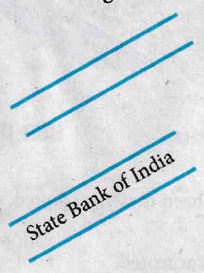
Draw the two different types of crossing.
14.
What are the characteristics of a bill of exchange?
15.
Distinguish between Negotiability and Assignability.
16.
Explain the nature of a Negotiable Instrument.
17.
Explain the different kinds of endorsements.
18.
Distinguish a cheque and a bill of exchange.(any 5)
1.
(d)
3
2.
(c)
drawer
3.
(d)
Invoice
4.
(a)
3
5.
(a)
Not negotiable crossing
6.
(c)
Cheque
7.
(b)
1881
8.
When the maker or holder of a negotiable instrument signs the name, otherwise that as such maker for the purpose of negotiation, on the back or face thereof, or on a slip of paper annexed there to or so signs for the same purpose a stamped paper intended to be completed as a negotiable instrument, he is said to endorse the same and is called the endorsee.
9.
Characteristics of a promissory note:
(i) A promissory note must be in writing.
(ii) The promise to pay must be unconditional.
(iii) It must be signed by the maker.
10.
According to section 5 of the Negotiable Instruments Act, "a bill of exchange is an instrument in writing containing an unconditional order, signed by the maker, directing a certain person to pay a certain sum of money only to, or to the order of a certain person or to the bearer of the instrument''.
11.
(i) The word "Negotiable" means transferable from one person to another in return for consideration.
(ii) The word 'Instrument' means a written document by which a right is created in favour of certain person.
(iii) A negotiable instrument is a document which entitles a person to a certain sum of money and which is transferable from one person to another by mere delivery or by endorsement and delivery.
12.
(i) Here the paying banker should make payment only to the particular banker named as a part of special crossing or to his agent for collection.
(ii) Thus special crossing is safer than general crossing.
13.
Crossing is of two types: General crossing and special crossing
General Crossing:
1. It is according to section 123 of the Negotiable Instruments Act, 1881.
2. "Where a cheque bears across its face with 'and company" or any abbreviation between two parallel transverse lines with or without the words 'not negotiable, the cheque shall be deemed to be crossed generally':
Special Crossing:
1. It is according to section 124 of the Negotiable Instruments Act, 1881.
2. "Where a cheque bears across its face an addition of the name of a banker with or without the words 'not negotiable, the cheque shall be deemed to be crossed specially and to be crossed to the bankers".
14.
Characteristics of a bill of exchange
(i) A bill of exchange is a document in writing.
(ii) The document must contain an order to pay.
(iii) The order must be unconditional.
(iv) The instrument must be signed by the person who draws it.
(v) The name of the person on whom the bill is drawn must be specified in the bill itself.
(vi) The amount that isrequired to be paid must also be specified in the bill.
15.
| SI.No | Basis of Difference | Negotiability | Assignability |
|---|---|---|---|
| 1. | Legal ownership | It passes to the transferee by mere endorsement in the case of a bearer instrument and by endorsement and delivert in the case of an order instrument. | An assignment can be made by observing certain formalities. For instance, an instrument is to be made in writing, duly stamped and igned by the transferor or his agent. |
| 2. | Notice | Notice is not necessary for the holder of negotiable instrument to claim the payment from the debtor. | In case of actionable claim, notice of the assignment by the transferee regarding the transfer of debt to the debtor is necessary. |
| 3. | Nature of title | Holder of negotiable instrument in due course gets a better title than even the transferor. | The transferee's title to the instrument is subject to the defects of the transferor's title. |
| 4. | Consideration | Consideration is presumed | The assignee has to prove the consideration for the transfer. |
16.
(i) The word 'Negotiable' means transferable from one person to another in return for consideration
(ii) The word 'Instrument' means a written document by which a right is created in favour of certain person.
(iii) A negotiable instrument is a document which entitles a person to a certain . sum of money and which is transferable from one person to another by mere delivery or by endorsement and delivery.
(iv) The law relating to negotiable instruments is dealt in the Negotiable Instruments Act 1881.
(v) This Act speaks about promissory note, bills of exchange and cheques.
17.
1. Endorsement in blank or general Endorsement : When the endorser puts his mere signature on the back of an instrument without mentioning the name of the endorse. (Receiver)
2. Endorsement in full or special Endorsement : In addition to his signature, specifies the person to whom or to whose order the instrument is payable.
3. Conditional or qualified Endorsement : Endorser makes his liability dependent upon the happening of an event which may or may not happen.
4. Restrictive Endorsement : When an endorsement restricts or prohibits further Negotiability of the Instrument.
5. Sans recourse Endorsement : Ordinarily the endorser becomes liable to subsequent parties in the event of dishonour of the instrument.
If he makes it clear that the subsequent holders should not look to him for payment in case it is dishonoured.
6. Facultative Endorsement : To make an endorser liable on the instrument, notice of dishonour must be given to him. But if the endorser waives this right by a writing "Notice of dishonour waived" at the time of endorsing
7. Partial Endorsement : Where the endorsement seeks to transfer only a part of the amount payable under the instrument.
18.
| SI.No | Basis of Difference | Cheque | Bill of Exchange |
|---|---|---|---|
| 1. | Drawn | A cheque can be drawn only on a particular banker. | A bill of exchange can be drawn on any person including a banker |
| 2. | Payability | It is payable on demand only. | It is payable on demand or on the expiry of a certain period. |
| 3. | Validity | A cheque drawn payable to bearer on |demand is perfectly valid. | A bill made payable to bearer on demand is void by virtue of section 31 of the RBI Act. |
| 4. | Acceptance | A cheque does not require any acceptance. | In case of time bill, acceptance by the drawee is necessary before he can be made liable on it. |
| 5. | Grace Period | No days of grace are allowed in the case of a cheque for the simple reason that is always payableon demand. | Three days of grace are allowed while calculating the maturity date in the case of time bill. |
| 6. | Notice | Notice is not necessary for a cheque. | When a bill is dishonoured, notice of dishonour is necessary. |

12th Standard Syllabus & Materials
12th Standard
TN 12th Computer Applications களப்பெயர் முறைமை (DNS) Sample Question Papers Study Material - QB365 Set A
NEW12th Standard
TN 12th Computer Applications வலையமைப்பு எடுத்துக்காட்டுகள் மற்றும் நெறிமுறைகள் Sample Question Papers Study Material - QB365 Set A
NEW12th Standard
TN 12th Computer Applications கணினி வலையமைப்பு ஓர் அறிமுகம் Sample Question Papers Study Material - QB365 Set A
NEW12th Standard
TN 12th Computer Applications PHP-உடன் MySQL-ஐ இணைத்தல் Sample Question Papers Study Material - QB365 Set A



Tamilnadu Stateboard 12th Standard Subjects

Maths

Chemistry

Physics

Biology

Computer Science

Business Maths and Statistics

Economics
Commerce

Accountancy

History

Computer Applications
Biology
Computer Technology
Computer Applications
Computer Science
Business Maths and Statistics
Commerce
Economics
Maths
Chemistry
Physics
Computer Technology
History
Accountancy

Tamil

English

French
Tamilnadu Stateboard Standards

