
 100% FREE ACCESS
12th Standard Syllabus & Materials
12th Standard
TN 12th Computer Applications மின்னணு தரவு பரிமாற்றம் Sample Question Papers Study Material - QB365 Set A
NEW12th Standard
TN 12th Computer Applications மின் - வணிக பாதுகாப்பு அமைப்புகள் Sample Question Papers Study Material - QB365 Set A
NEW12th Standard
TN 12th Computer Applications மின்னணு செலுத்தல் முறைகள் Sample Question Papers Study Material - QB365 Set A
NEW12th Standard
TN 12th Computer Applications மின் - வணிகம் Sample Question Papers Study Material - QB365 Set A
NEW12th Standard
TN 12th Computer Applications திறந்த மூல கருத்துருக்கள் Sample Question Papers Study Material - QB365 Set A
NEW12th Standard
TN 12th Computer Applications வலையமைப்பு வடமிடல் Sample Question Papers Study Material - QB365 Set A

Published on: 12/10/2019
Electronic Data Interchange
Download Tamil Nadu 12th Standard Computer Applications question papers, model tests, one-mark questions, important questions, and public exam papers in PDF format. Free study materials and answer keys for TN State Board students.
Questions + Answers key
Take MCQ Computer Applications Test
1.
Write about EDIFACT separators
2.
Write a note on EDIFACT message.
3.
Write a note on UN/EDIFACT.
4.
List the various layers of EDI.
5.
Write a short note on EDI.
6.
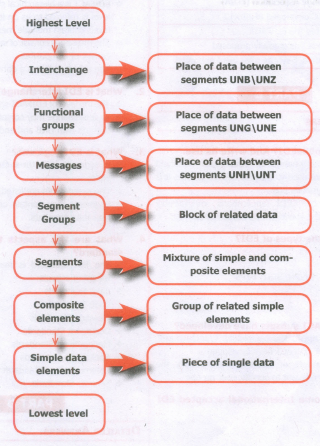
Draw the structure of UN/EDIFACT message
7.
Write about structure of EDIFACT.
8.
9.
Briefly explain various types of EDI.
1.
| Character | Uses |
|---|---|
| Apostrophe (') | segment terminator |
| Plus sign (+) | segment tag and data element separator |
| Colon (:) | component data element separator |
| Question mark (?) | Release character |
| Period (.) | decimal point. |
2.
The basic standardization concept of EDIFACT is that there are uniform message types called United Nations Standard Message. The message types have exactly one nickname consisting of six uppercase English alphabets. The message begins with UNH and with UNT.
3.
(i) United Nations/Electronic Data Interchange for Administration, Commerce and Transport (UN/EDIFACT) is an international EDI - standard developed under the supervision of the United Nations.
(ii) In 1987, the UN / EDIFACT syntax rules were approved as ISO: ISO9735 standard by the International Organization for Standardization.
(iii) EDIFACT includes a set of internationally agreed standards, catalogs and guidelines for electronic exchange of structured data between independent computer systems.
(iv) It is a cross-industry, standard data format of electronic data for commercial transactions.
(v) Maintenance and further development of this standard goes through the United Nations Center for Trade Facilitation and Electronic Business (UN/CEFACT), which is affiliated to the UN Economic Commission for Europe (UNECE).
4.
Electronic data interchange architecture specifies four different layers namely
(i) Semantic layer
(ii) Standards translation layer
(iii) Transport layer
(iv) Physical layer
5.
The Electronic Data Interchange (EDI) is the exchange of business documents between one trade partner and another electronically. It is used to transfer documents such as delivery notes, invoices, purchase orders, advance ship notice, functional acknowledgements etc. These documents are transferred directly from the computer of the issuing company to that of the receiving company, with great time saving and avoiding many errors of traditional on paper communications.
6.
7.
EDIFACT Structure:
EDIFACT is a hierarchical structure where the top level is referred to as an interchange, and lower levels contain multiple messages. The messages consist of segments, which in turn consist of composites. The final iteration is a data element.
8.
9.
The types of EDI were constructed based on how EDI communication connections and the conversion were organized. Thus based on the medium used for transmitting EDI documents the following are the major EDI types:
(i) Direct EDI
(ii) EDI via VAN
(iii) EDI via FTP/VPN, SFTP, FTPS
(iv) Web EDI
(v) Mobile EDI
1. Direct EDI/point-to-point : It is also called as Point-to-Point EDI. It establishes a direct connection between various business stakeholders and partners individually. This type of EDI suits to larger businesses with a lot of day to day business transactions.
2. EDI via VAN : EDI via VAN (Value Added Network) is where EDI documents are transferred with the support of third party network service providers.Many businesses prefer this network model to protect them from the updating ongoing complexities of network technologies.
3. EDI via FTP/VPN, SFTP, FTPS : When protocols like FTP/VPN, SFTP and FTPS are used to exchange of EDI based documents through the Internet or Intranet it is called as EDI via FTP/VPN, SFTP, FTPS.
4. Web EDI : Web based EDI conducts EDI using an web browser via the Internet. Here the businesses are allowed to use any browser to transfer data to their business partners.Web based EDI is easy and convenient for small and medium organizations.
5. Mobile EDI - When smartphones or other such handheld devices are used to transfer EDI documents it is called as mobile EDI.Mobile EDI applications considerably increase the speed of EDI transactions.

12th Standard Syllabus & Materials
12th Standard
TN 12th Computer Applications களப்பெயர் முறைமை (DNS) Sample Question Papers Study Material - QB365 Set A
NEW12th Standard
TN 12th Computer Applications வலையமைப்பு எடுத்துக்காட்டுகள் மற்றும் நெறிமுறைகள் Sample Question Papers Study Material - QB365 Set A
NEW12th Standard
TN 12th Computer Applications கணினி வலையமைப்பு ஓர் அறிமுகம் Sample Question Papers Study Material - QB365 Set A
NEW12th Standard
TN 12th Computer Applications PHP-உடன் MySQL-ஐ இணைத்தல் Sample Question Papers Study Material - QB365 Set A



Tamilnadu Stateboard 12th Standard Subjects

Maths

Chemistry

Physics

Biology

Computer Science

Business Maths and Statistics

Economics

Commerce

Accountancy

History
Computer Applications
Biology
Computer Technology
Computer Applications
Computer Science
Business Maths and Statistics
Commerce
Economics
Maths
Chemistry
Physics
Computer Technology
History
Accountancy

Tamil

English

French
Tamilnadu Stateboard Standards
